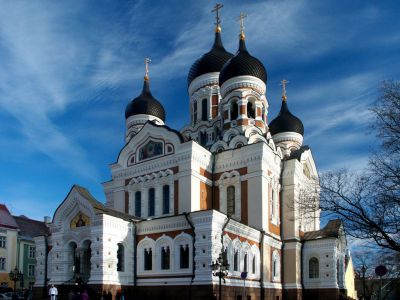


Alexander Nevsky Cathedral, Tallinn (must see)
Built between 1894 and 1900 to a design by Mikhail Preobrazhensky, Alexander Nevsky Cathedral reflects the period when Estonia was part of the Russian Empire. It is dedicated to Saint Alexander Nevsky, the Russian prince who secured victory at the Battle of the Ice in 1242 on nearby Lake Peipus.
Its architecture stands in clear contrast to the surrounding medieval cityscape. Designed in the Russian Revival style, the cathedral features onion-shaped domes, richly ornamented façades, and layered decorative details that distinguish it from the Gothic and Baroque buildings nearby. As Tallinn’s largest Orthodox cathedral, its scale and elevated location make it visible from many points across the city.
Inside, the cathedral presents a richly decorated interior typical of Orthodox tradition. Gilded icons, mosaics, and painted surfaces create a dense visual environment, centered around the iconostasis that separates the altar from the nave. The interplay of light and gold surfaces gives the space a distinct atmosphere, differing markedly from the more restrained interiors of Lutheran churches in Estonia. The cathedral’s bells, among the largest in Tallinn, add another defining feature with their deep, resonant sound.
The cathedral’s history has not been without controversy. Built during a period of Russification, it was at times viewed as a symbol of imperial authority, and plans for its demolition were even considered in the 1920s, though never carried out. During the Soviet era, when religious practice declined, the building fell into disrepair. Since Estonia regained independence in 1991, the cathedral has been carefully restored and continues to function as an active place of worship, while also welcoming visitors interested in this distinct chapter of Tallinn’s past.
Its architecture stands in clear contrast to the surrounding medieval cityscape. Designed in the Russian Revival style, the cathedral features onion-shaped domes, richly ornamented façades, and layered decorative details that distinguish it from the Gothic and Baroque buildings nearby. As Tallinn’s largest Orthodox cathedral, its scale and elevated location make it visible from many points across the city.
Inside, the cathedral presents a richly decorated interior typical of Orthodox tradition. Gilded icons, mosaics, and painted surfaces create a dense visual environment, centered around the iconostasis that separates the altar from the nave. The interplay of light and gold surfaces gives the space a distinct atmosphere, differing markedly from the more restrained interiors of Lutheran churches in Estonia. The cathedral’s bells, among the largest in Tallinn, add another defining feature with their deep, resonant sound.
The cathedral’s history has not been without controversy. Built during a period of Russification, it was at times viewed as a symbol of imperial authority, and plans for its demolition were even considered in the 1920s, though never carried out. During the Soviet era, when religious practice declined, the building fell into disrepair. Since Estonia regained independence in 1991, the cathedral has been carefully restored and continues to function as an active place of worship, while also welcoming visitors interested in this distinct chapter of Tallinn’s past.
Want to visit this sight? Check out these Self-Guided Walking Tours in Tallinn. Alternatively, you can download the mobile app "GPSmyCity: Walks in 1K+ Cities" from Apple App Store or Google Play Store. The app turns your mobile device to a personal tour guide and it works offline, so no data plan is needed when traveling abroad.
Download The GPSmyCity App



Alexander Nevsky Cathedral on Map
Sight Name: Alexander Nevsky Cathedral
Sight Location: Tallinn, Estonia (See walking tours in Tallinn)
Sight Type: Religious
Guide(s) Containing This Sight:
Sight Location: Tallinn, Estonia (See walking tours in Tallinn)
Sight Type: Religious
Guide(s) Containing This Sight:
Nearby Sights
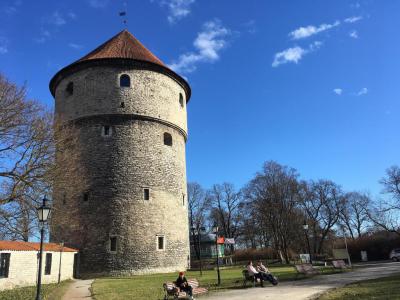
Walking Tours in Tallinn, Estonia

Create Your Own Walk in Tallinn
Creating your own self-guided walk in Tallinn is easy and fun. Choose the city attractions that you want to see and a walk route map will be created just for you. You can even set your hotel as the start point of the walk.
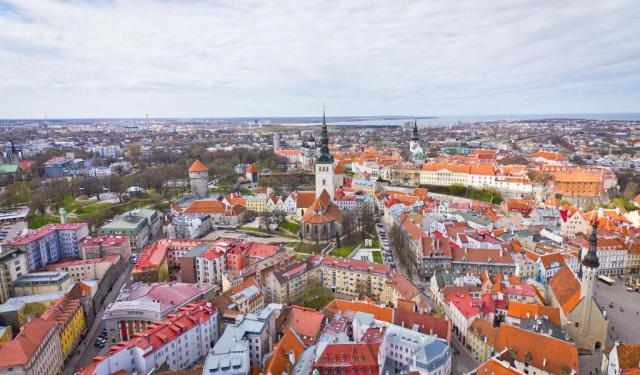
Tallinn Old Town Walking Tour
Tallinn, the capital of Estonia, has a history shaped by trade, conquest, and its strategic position along the Baltic Sea. The area has been inhabited since at least the second millennium BC, but it began to emerge as a significant settlement in the early medieval period. By the 12th century, it was known as a trading hub frequented by Scandinavian and Rus’ merchants, drawn by its sheltered... view more
Tour Duration: 3 Hour(s)
Travel Distance: 4.3 Km or 2.7 Miles
Tour Duration: 3 Hour(s)
Travel Distance: 4.3 Km or 2.7 Miles
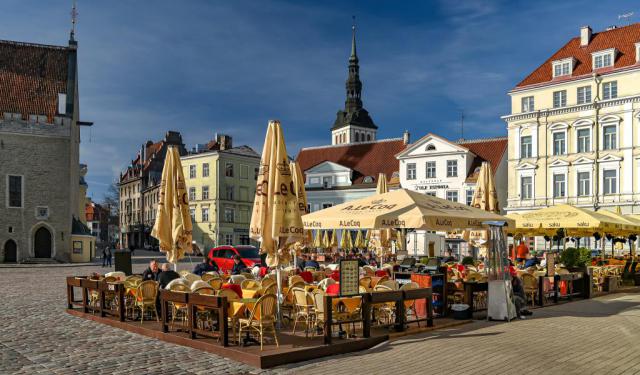
Tallinn Medieval Old Town
In medieval Tallinn, fortunes were not built by kings, but by merchants, men who believed trade could connect worlds separated by sea and distance.
Tallinn’s Medieval Old Town stands as one of the best-preserved urban ensembles in Northern Europe. Its origins trace back to at least the early medieval period, when a settlement grew around a natural harbor that attracted Scandinavian and... view more
Tour Duration: 2 Hour(s)
Travel Distance: 2.1 Km or 1.3 Miles
Tallinn’s Medieval Old Town stands as one of the best-preserved urban ensembles in Northern Europe. Its origins trace back to at least the early medieval period, when a settlement grew around a natural harbor that attracted Scandinavian and... view more
Tour Duration: 2 Hour(s)
Travel Distance: 2.1 Km or 1.3 Miles
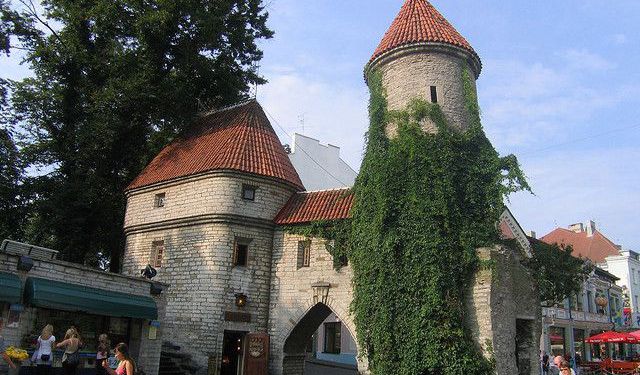
Tallinn Old Towers and Gates
Once Europe's greatest fortified city, Tallinn had 46 defense towers and approximately 4 kilometers of surrounding walls. Today, there are 26 towers and about 2 kilometers of walls still in place, making the Old Town of Tallinn one of the best-preserved systems of medieval fortifications in Europe.
Upon entering the district through the Viru Gate, whose two picturesque, ivy-covered towers... view more
Tour Duration: 2 Hour(s)
Travel Distance: 2.8 Km or 1.7 Miles
Upon entering the district through the Viru Gate, whose two picturesque, ivy-covered towers... view more
Tour Duration: 2 Hour(s)
Travel Distance: 2.8 Km or 1.7 Miles