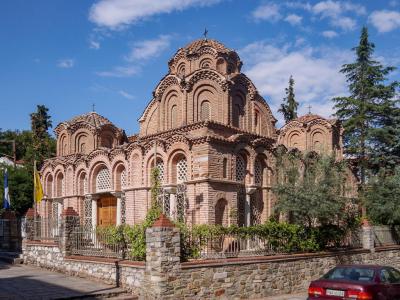


Ayia Katerini (Church of Saint Catherine), Thessaloniki
The Church of Saint Catherine is a significant monument of late Byzantine Thessaloniki, dating to the late 13th or early 14th century during the Palaiologan period. After the Ottoman capture of the city in 1430, it was converted into a mosque, and its Christian imagery was covered with plaster. The building returned to Christian use in 1912, and restoration work between 1947 and 1951 revealed important fragments of its original 14th-century frescoes.
As you enter, stand near the center of the nave and look upward. The church’s decoration was organized vertically, guiding the eye from the earthly to the celestial. Although only fragments survive, this hierarchy is still easy to follow.
Begin at the lower wall zones, where you can see figures of bishops and saints, originally positioned at eye level to establish a direct visual relationship with worshipers. As your gaze rises toward the upper walls and arches, look for fragments of apostles, prophets, and angels, arranged in orderly bands that lead the eye toward the dome.
Near the eastern end, close to the sanctuary, watch for traces of narrative scenes from Christ’s life and miracles. Though incomplete, details such as expressive faces, flowing garments, and balanced compositions reflect the refined style of late Palaiologan painting.
As you move around the interior, notice how the frescoes are adapted to arches and curved surfaces, creating a close dialogue between architecture and image. Despite their fragmentary state, these paintings offer a rare and rewarding glimpse into the artistic and devotional world of late Byzantine Thessaloniki.
As you enter, stand near the center of the nave and look upward. The church’s decoration was organized vertically, guiding the eye from the earthly to the celestial. Although only fragments survive, this hierarchy is still easy to follow.
Begin at the lower wall zones, where you can see figures of bishops and saints, originally positioned at eye level to establish a direct visual relationship with worshipers. As your gaze rises toward the upper walls and arches, look for fragments of apostles, prophets, and angels, arranged in orderly bands that lead the eye toward the dome.
Near the eastern end, close to the sanctuary, watch for traces of narrative scenes from Christ’s life and miracles. Though incomplete, details such as expressive faces, flowing garments, and balanced compositions reflect the refined style of late Palaiologan painting.
As you move around the interior, notice how the frescoes are adapted to arches and curved surfaces, creating a close dialogue between architecture and image. Despite their fragmentary state, these paintings offer a rare and rewarding glimpse into the artistic and devotional world of late Byzantine Thessaloniki.
Want to visit this sight? Check out these Self-Guided Walking Tours in Thessaloniki. Alternatively, you can download the mobile app "GPSmyCity: Walks in 1K+ Cities" from Apple App Store or Google Play Store. The app turns your mobile device to a personal tour guide and it works offline, so no data plan is needed when traveling abroad.
Download The GPSmyCity App



Ayia Katerini (Church of Saint Catherine) on Map
Sight Name: Ayia Katerini (Church of Saint Catherine)
Sight Location: Thessaloniki, Greece (See walking tours in Thessaloniki)
Sight Type: Religious
Guide(s) Containing This Sight:
Sight Location: Thessaloniki, Greece (See walking tours in Thessaloniki)
Sight Type: Religious
Guide(s) Containing This Sight:
Nearby Sights

Walking Tours in Thessaloniki, Greece

Create Your Own Walk in Thessaloniki
Creating your own self-guided walk in Thessaloniki is easy and fun. Choose the city attractions that you want to see and a walk route map will be created just for you. You can even set your hotel as the start point of the walk.
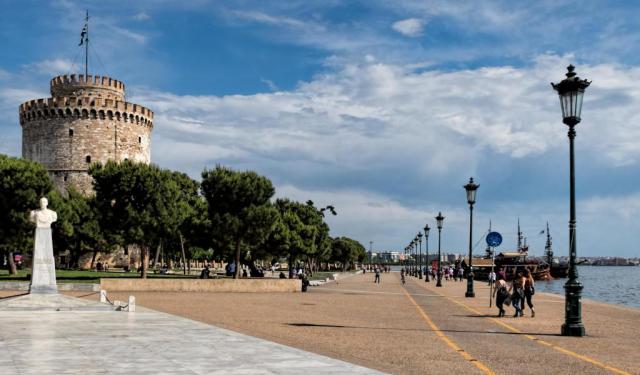
Thessaloniki Waterfront Tour
The Mediterranean has always been an integral part of Thessaloniki’s appeal. The city's orientation toward the sea is largely due to the vision of Ernest Hébrard, the French urban planner and architect, who redesigned the downtown area after the devastating fire of 1917.
To really get the taste of Thessaloniki you need to visit not just its historical landmarks, but also those spots... view more
Tour Duration: 1 Hour(s)
Travel Distance: 2.6 Km or 1.6 Miles
To really get the taste of Thessaloniki you need to visit not just its historical landmarks, but also those spots... view more
Tour Duration: 1 Hour(s)
Travel Distance: 2.6 Km or 1.6 Miles
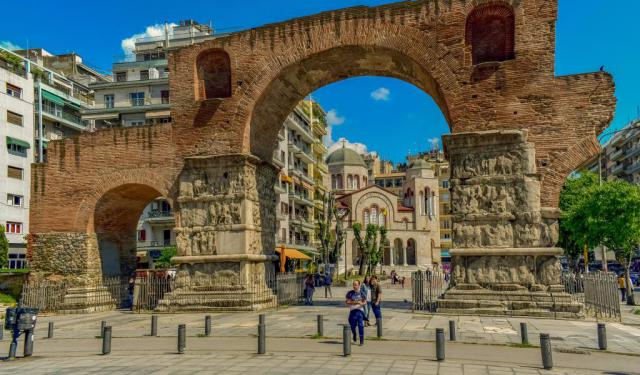
Thessaloniki Downtown Walking Tour
Thessaloniki has been shaped by layers of empire, trade, and migration for more than two millennia. It was founded in 315 BCE by Cassander, king of Macedon, who merged several smaller settlements around the Thermaic Gulf into a single city. He named it after his wife, Thessalonike, the half-sister of Alexander the Great. The name Thessalonikē combines Thessaloi and nikē, meaning victory,... view more
Tour Duration: 2 Hour(s)
Travel Distance: 3.7 Km or 2.3 Miles
Tour Duration: 2 Hour(s)
Travel Distance: 3.7 Km or 2.3 Miles
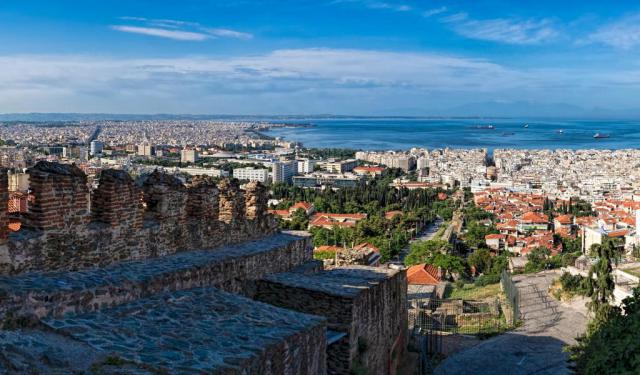
Thessaloniki Upper Town Walking Tour
Thessaloniki’s Upper Town, known locally as Ano Poli, which literally translates as “Upper City” is the city’s oldest continuously inhabited district and the only area to survive the Great Fire of 1917 largely intact. While the lower city was rebuilt along modern, planned lines in the early 20th century, Ano Poli retained its Byzantine street layout, Ottoman-era houses, and defensive... view more
Tour Duration: 2 Hour(s)
Travel Distance: 4.0 Km or 2.5 Miles
Tour Duration: 2 Hour(s)
Travel Distance: 4.0 Km or 2.5 Miles