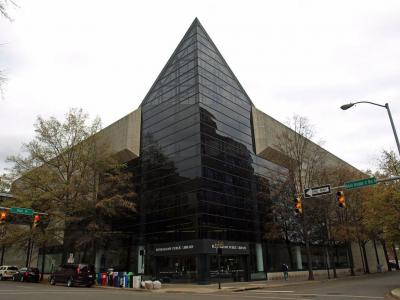


Birmingham Public Library, Birmingham
The Birmingham Public Library (BPL) is a cornerstone of cultural and educational life in Birmingham, and one of the largest public library systems in the southeastern United States. With 19 branches spread throughout the city and a substantial Central Library in downtown Birmingham, BPL serves as a vital hub for information, learning, and local history.
Founded in 1886 in a small schoolroom by Superintendent John H. Phillips, the Birmingham Public Library began as part of the city’s school system. By 1913, it gained public funding, and in 1918, the Booker T. Washington branch opened for African-American residents, led by Alabama’s first Black librarian, Mattie Herd Roland.
A fire in 1925 destroyed the library’s holdings at City Hall, but the loss was soon answered with the construction of a Neo-classical limestone building in 1927, which served as the central library for decades. Following desegregation in 1963-prompted by civil rights litigation-BPL grew both in collection and inclusivity.
To meet growing demand, a modern East Building was added in 1984, creating a two-building campus. The original 1927 structure was renovated and renamed the Linn-Henley Research Library in 1985, now home to special collections such as the Tutwiler Collection of Southern History and Literature, the Rucker Agee Map Collection, and a Rare Book Collection focusing on early Americana.
BPL is known for its rich historical archives, which include resources on Southern culture, Caribbean literature, and regional newspaper clippings. In 2006, the Digital Collections project began, digitizing Birmingham’s local history to make it more accessible online.
Each year, the library hosts Alabama Bound, a well-known book and author fair that highlights the work of Alabama-based writers and publishers. Visitors can attend readings, discussions, and book signings, making it a significant cultural event in the city.
Today, the Birmingham Public Library remains a resilient and evolving institution-committed to preserving Southern heritage, embracing new technologies, and serving as a community anchor for readers, researchers, and learners of all ages.
Founded in 1886 in a small schoolroom by Superintendent John H. Phillips, the Birmingham Public Library began as part of the city’s school system. By 1913, it gained public funding, and in 1918, the Booker T. Washington branch opened for African-American residents, led by Alabama’s first Black librarian, Mattie Herd Roland.
A fire in 1925 destroyed the library’s holdings at City Hall, but the loss was soon answered with the construction of a Neo-classical limestone building in 1927, which served as the central library for decades. Following desegregation in 1963-prompted by civil rights litigation-BPL grew both in collection and inclusivity.
To meet growing demand, a modern East Building was added in 1984, creating a two-building campus. The original 1927 structure was renovated and renamed the Linn-Henley Research Library in 1985, now home to special collections such as the Tutwiler Collection of Southern History and Literature, the Rucker Agee Map Collection, and a Rare Book Collection focusing on early Americana.
BPL is known for its rich historical archives, which include resources on Southern culture, Caribbean literature, and regional newspaper clippings. In 2006, the Digital Collections project began, digitizing Birmingham’s local history to make it more accessible online.
Each year, the library hosts Alabama Bound, a well-known book and author fair that highlights the work of Alabama-based writers and publishers. Visitors can attend readings, discussions, and book signings, making it a significant cultural event in the city.
Today, the Birmingham Public Library remains a resilient and evolving institution-committed to preserving Southern heritage, embracing new technologies, and serving as a community anchor for readers, researchers, and learners of all ages.
Want to visit this sight? Check out these Self-Guided Walking Tours in Birmingham. Alternatively, you can download the mobile app "GPSmyCity: Walks in 1K+ Cities" from Apple App Store or Google Play Store. The app turns your mobile device to a personal tour guide and it works offline, so no data plan is needed when traveling abroad.
Download The GPSmyCity App



Birmingham Public Library on Map
Sight Name: Birmingham Public Library
Sight Location: Birmingham, USA (See walking tours in Birmingham)
Sight Type: Attraction/Landmark
Sight Location: Birmingham, USA (See walking tours in Birmingham)
Sight Type: Attraction/Landmark
Nearby Sights

Walking Tours in Birmingham, Alabama

Create Your Own Walk in Birmingham
Creating your own self-guided walk in Birmingham is easy and fun. Choose the city attractions that you want to see and a walk route map will be created just for you. You can even set your hotel as the start point of the walk.
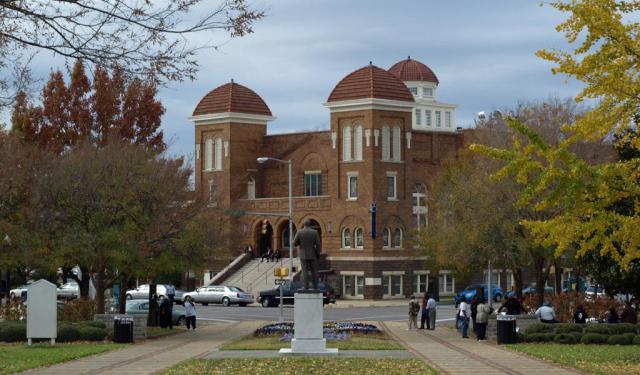
Explore Birmingham's Civil Rights Historical Sites on Foot
Birmingham, Alabama is the very first destination that comes to mind at the mention of the Civil Rights Movement in the United States. Back in the 1950s and 1960s, this city saw a great deal of bloodshed and strife between civil rights leaders, seeking to shed the stigma of centuries-long injustice, and their opponents.
The area of downtown Birmingham, where several significant events in the... view more
Tour Duration: 1 Hour
Travel Distance: 0.9 Km or 0.6 Miles
The area of downtown Birmingham, where several significant events in the... view more
Tour Duration: 1 Hour
Travel Distance: 0.9 Km or 0.6 Miles
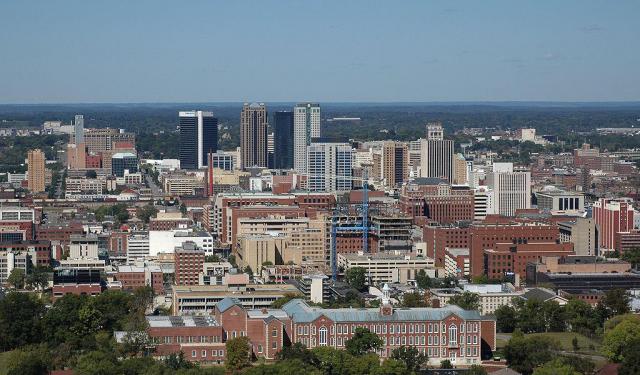
A Walking Guide to Birmingham's Revitalized Downtown
Birmingham is Alabama's biggest city and dates back to 1871, making it a Reconstruction-era city. Although initially formed from agricultural communities, the city quickly became a central railroad and industrial hub, with the iron and steel industries accounting for much of the local workforce.
Irish and Italian immigrants, as well as African Americans, made up most of this early... view more
Tour Duration: 2 Hours
Travel Distance: 3.8 Km or 2.4 Miles
Irish and Italian immigrants, as well as African Americans, made up most of this early... view more
Tour Duration: 2 Hours
Travel Distance: 3.8 Km or 2.4 Miles