

Calumet Building, Buffalo
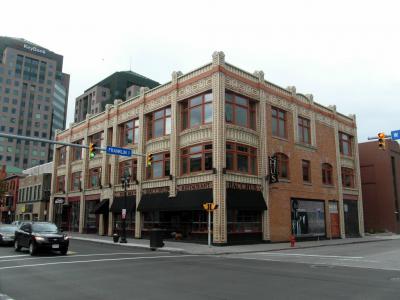
The Calumet Building, located on Chippewa Street in Buffalo is a striking example of early 20th-century commercial architecture and one of the city’s most distinctive terra cotta-clad landmarks. Designed in 1906 by the architectural firm Esenwein & Johnson, the three-story structure features a steel frame wrapped in gleaming white and burnt sienna glazed terra cotta, richly decorated with botanical motifs. The building’s name, Calumet, comes from the Canadian French word for reed, reflected in the stylized calamus plant motifs that adorn its façade and sides.
The building was commissioned by Robert Keating Root, a Buffalo businessman who sought to stimulate commercial development on Chippewa Street which was then largely residential. Root came from a prominent family and pursued careers in banking and real estate. His vision proved successful: the Calumet’s first floor was home to upscale jewelers and tailors, while professionals like dentists and artists occupied the upper floors.
However, the building's history also includes a darker chapter. In the early 1920s, the local Ku Klux Klan used a third-floor business-Kay-Bee Adsign Company-as a front for its operations during a period of political tension in the city. A 1924 police raid exposed the group’s activities, leading to the public release of its membership list.
Like many downtown properties, the Calumet declined in the postwar years, becoming fully vacant by 1980. It remained empty until 1990 when local historian Mark Goldman purchased and revitalized it by opening a restaurant. This move helped spur the broader revival of Chippewa Street.
Now home to a law firm and a restaurant on the ground floor, the Calumet Building was listed on the National Register of Historic Places in 2010. It remains a cherished piece of Buffalo’s architectural legacy, celebrated for its ornate design and role in the city’s evolving urban story.
The building was commissioned by Robert Keating Root, a Buffalo businessman who sought to stimulate commercial development on Chippewa Street which was then largely residential. Root came from a prominent family and pursued careers in banking and real estate. His vision proved successful: the Calumet’s first floor was home to upscale jewelers and tailors, while professionals like dentists and artists occupied the upper floors.
However, the building's history also includes a darker chapter. In the early 1920s, the local Ku Klux Klan used a third-floor business-Kay-Bee Adsign Company-as a front for its operations during a period of political tension in the city. A 1924 police raid exposed the group’s activities, leading to the public release of its membership list.
Like many downtown properties, the Calumet declined in the postwar years, becoming fully vacant by 1980. It remained empty until 1990 when local historian Mark Goldman purchased and revitalized it by opening a restaurant. This move helped spur the broader revival of Chippewa Street.
Now home to a law firm and a restaurant on the ground floor, the Calumet Building was listed on the National Register of Historic Places in 2010. It remains a cherished piece of Buffalo’s architectural legacy, celebrated for its ornate design and role in the city’s evolving urban story.
Want to visit this sight? Check out these Self-Guided Walking Tours in Buffalo. Alternatively, you can download the mobile app "GPSmyCity: Walks in 1K+ Cities" from Apple App Store or Google Play Store. The app turns your mobile device to a personal tour guide and it works offline, so no data plan is needed when traveling abroad.
Download The GPSmyCity App



Calumet Building on Map
Sight Name: Calumet Building
Sight Location: Buffalo, USA (See walking tours in Buffalo)
Sight Type: Attraction/Landmark
Sight Location: Buffalo, USA (See walking tours in Buffalo)
Sight Type: Attraction/Landmark
Nearby Sights




Walking Tours in Buffalo, New York

Create Your Own Walk in Buffalo
Creating your own self-guided walk in Buffalo is easy and fun. Choose the city attractions that you want to see and a walk route map will be created just for you. You can even set your hotel as the start point of the walk.

Buffalo Downtown Walking Tour
Buffalo is the largest city in Western New York and the state's second-largest city. Because of its location on the Niagaras River and the western end of Lake Erie, it has been a center of commerce for generations. The earliest settlers were members of the Iroquois nation and French settlers in the 17th and 18th centuries.
In the 19th century, the Erie Canal's construction brought in... view more
Tour Duration: 2 Hour(s)
Travel Distance: 3.3 Km or 2.1 Miles
In the 19th century, the Erie Canal's construction brought in... view more
Tour Duration: 2 Hour(s)
Travel Distance: 3.3 Km or 2.1 Miles
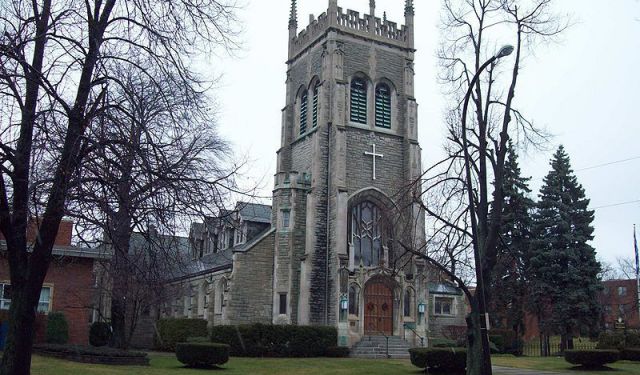
Discover Buffalo's Historical Churches on Foot
Be it for the British and French colonialism or the result of missionary work, today Christianity remains the prevalent religion in Buffalo, New York. The city itself, home to some of the most famous Gothic churches in the US, is long considered a great destination to admire religious architecture and its magical spiritual beauty.
Among the notable landmarks here is Saint Paul's Episcopal... view more
Tour Duration: 2 Hour(s)
Travel Distance: 3.4 Km or 2.1 Miles
Among the notable landmarks here is Saint Paul's Episcopal... view more
Tour Duration: 2 Hour(s)
Travel Distance: 3.4 Km or 2.1 Miles