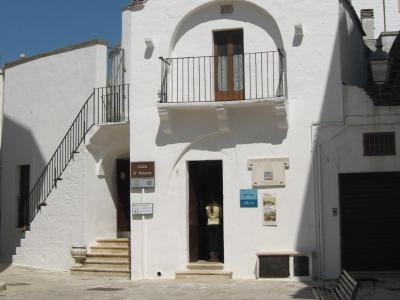


Casa D'Amore (D'Amore's House), Alberobello
D'Amore's House, built in 1797 by Francesco D'Amore, stands out as the first house in Alberobello constructed with terracotta and mortar, marking a significant shift in building practices. This development was possible thanks to a royal decree that allowed locals to build homes without restrictions from the Count of Conversano. A small epigraph under the balcony arch reads "EX AUCTORITATE REGIA - HOC PRIMUM ERECTUM - AD 1797," commemorating this milestone.
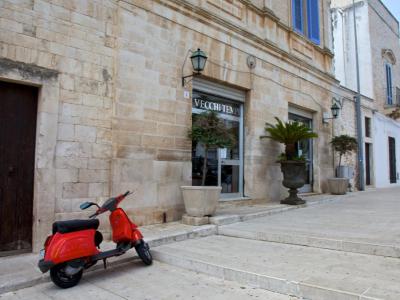
Situated in today's Piazza Ferdinando IV di Borbone, D'Amore's House strategic location made it visible from the residence of the Counts. The house represents a bridge between the traditional trullo houses and more modern nineteenth-century structures. Its facade hints at a more complex interior, but most rooms remain similar to those of the surrounding trullo houses, with the notable exception of the entrance room, which features a star vault instead of the typical stone cone.
A unique aspect of D'Amore's House is its raised floor, accessible via an external staircase, comprising three narrow conical rooms on different levels. The design suggests that D'Amore likely consulted a local bricklayer, known as a caseddaro, familiar with building and repairing trulli. Interestingly, even by 1843, no local architect was available to oversee new constructions, often leaving bricklayers to fulfill this role. Declared a National Monument in 1930, D'Amore's House stands as a testament to a pivotal moment in Alberobello's architectural evolution.
Situated in today's Piazza Ferdinando IV di Borbone, D'Amore's House strategic location made it visible from the residence of the Counts. The house represents a bridge between the traditional trullo houses and more modern nineteenth-century structures. Its facade hints at a more complex interior, but most rooms remain similar to those of the surrounding trullo houses, with the notable exception of the entrance room, which features a star vault instead of the typical stone cone.
A unique aspect of D'Amore's House is its raised floor, accessible via an external staircase, comprising three narrow conical rooms on different levels. The design suggests that D'Amore likely consulted a local bricklayer, known as a caseddaro, familiar with building and repairing trulli. Interestingly, even by 1843, no local architect was available to oversee new constructions, often leaving bricklayers to fulfill this role. Declared a National Monument in 1930, D'Amore's House stands as a testament to a pivotal moment in Alberobello's architectural evolution.
Want to visit this sight? Check out these Self-Guided Walking Tours in Alberobello. Alternatively, you can download the mobile app "GPSmyCity: Walks in 1K+ Cities" from Apple App Store or Google Play Store. The app turns your mobile device to a personal tour guide and it works offline, so no data plan is needed when traveling abroad.
Download The GPSmyCity App



Casa D'Amore (D'Amore's House) on Map
Sight Name: Casa D'Amore (D'Amore's House)
Sight Location: Alberobello, Italy (See walking tours in Alberobello)
Sight Type: Attraction/Landmark
Sight Location: Alberobello, Italy (See walking tours in Alberobello)
Sight Type: Attraction/Landmark
Nearby Sights
Walking Tours in Alberobello, Italy

Create Your Own Walk in Alberobello
Creating your own self-guided walk in Alberobello is easy and fun. Choose the city attractions that you want to see and a walk route map will be created just for you. You can even set your hotel as the start point of the walk.
Alberobello Introduction Walking Tour
Thinking of Apulia, the picturesque region in southern Italy, also known by its Italian name Puglia, the first place that may spring to mind is Alberobello.
The name Alberobello, derived from the Latin words "alber" and "bellum," meaning "beautiful tree," hints at the lush surroundings and natural beauty. Indeed, the insanely beautiful authentic heritage of this... view more
Tour Duration: 1 Hour
Travel Distance: 1.4 Km or 0.9 Miles
The name Alberobello, derived from the Latin words "alber" and "bellum," meaning "beautiful tree," hints at the lush surroundings and natural beauty. Indeed, the insanely beautiful authentic heritage of this... view more
Tour Duration: 1 Hour
Travel Distance: 1.4 Km or 0.9 Miles
City Walks Overview
