

Chiesa di San Costanzo (Church of San Costanzo), Perugia
The Church of San Costanzo in Perugia stands as a testament to the city's rich religious and architectural history. Dedicated to one of Perugia's co-patrons and its first bishop, Saint Costanzo, this parish church holds significant historical and spiritual value. In 2008, it was elevated to the status of a minor basilica by Pope Benedict XVI, marking its importance within the Umbrian capital.
Just outside San Costanzo Gate, at the end of Borgo XX Giugno, stands the church built on the burial site of San Costanzo, Perugia's first bishop, martyred under Marcus Aurelius. Initially interred near Porta San Pietro in 178 CE, the site evolved from a mausoleum into a place of worship, possibly named San Martino in Ajole.
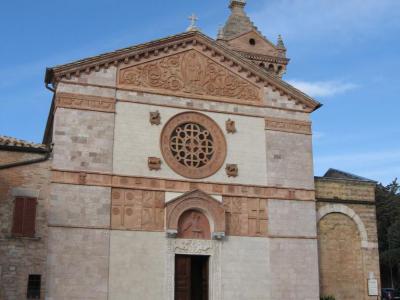
The church saw major changes, first expanded in 1205 by Presbyter Alessio under Pope Innocent III. In 1889, architect Guglielmo Calderini redesigned it in a neo-Romanesque style using pink Assisi limestone, preserving the 12th-century apse and east wall while adding a bell tower and portico. The travertine-columned portico, with its detailed capitals, hosted both sacred activities and local markets.
The façade showcases a blend of medieval and 19th-century artistry. The original portal, adorned with Romanesque sculptures of Christ and the Evangelist symbols, is complemented by 19th-century terracotta decorations by Francesco Biscarini and Raffaele Angeletti. These include a rose window with high-relief Evangelist symbols and a tympanum featuring Christ enthroned.
The church's single nave leads to a 12th-century apse with frescoes by Ludovico Caselli and Matteo Tassi, featuring Christ enthroned, angels, and floral motifs. Painted wooden trusses with stars and crosses enhance the celestial feel. The apse contains a neo-Gothic polyptych of Saint Costanzo and other saints, while neo-Gothic triptychs by Caselli adorn the side walls. Modern pink tiles, added in a 2008 restoration, blend history with modernity.
The Church of San Costanzo remains a cornerstone of Perugia's religious heritage, blending layers of historical significance with architectural and artistic beauty.
Just outside San Costanzo Gate, at the end of Borgo XX Giugno, stands the church built on the burial site of San Costanzo, Perugia's first bishop, martyred under Marcus Aurelius. Initially interred near Porta San Pietro in 178 CE, the site evolved from a mausoleum into a place of worship, possibly named San Martino in Ajole.
The church saw major changes, first expanded in 1205 by Presbyter Alessio under Pope Innocent III. In 1889, architect Guglielmo Calderini redesigned it in a neo-Romanesque style using pink Assisi limestone, preserving the 12th-century apse and east wall while adding a bell tower and portico. The travertine-columned portico, with its detailed capitals, hosted both sacred activities and local markets.
The façade showcases a blend of medieval and 19th-century artistry. The original portal, adorned with Romanesque sculptures of Christ and the Evangelist symbols, is complemented by 19th-century terracotta decorations by Francesco Biscarini and Raffaele Angeletti. These include a rose window with high-relief Evangelist symbols and a tympanum featuring Christ enthroned.
The church's single nave leads to a 12th-century apse with frescoes by Ludovico Caselli and Matteo Tassi, featuring Christ enthroned, angels, and floral motifs. Painted wooden trusses with stars and crosses enhance the celestial feel. The apse contains a neo-Gothic polyptych of Saint Costanzo and other saints, while neo-Gothic triptychs by Caselli adorn the side walls. Modern pink tiles, added in a 2008 restoration, blend history with modernity.
The Church of San Costanzo remains a cornerstone of Perugia's religious heritage, blending layers of historical significance with architectural and artistic beauty.
Want to visit this sight? Check out these Self-Guided Walking Tours in Perugia. Alternatively, you can download the mobile app "GPSmyCity: Walks in 1K+ Cities" from Apple App Store or Google Play Store. The app turns your mobile device to a personal tour guide and it works offline, so no data plan is needed when traveling abroad.
Download The GPSmyCity App



Chiesa di San Costanzo (Church of San Costanzo) on Map
Sight Name: Chiesa di San Costanzo (Church of San Costanzo)
Sight Location: Perugia, Italy (See walking tours in Perugia)
Sight Type: Religious
Sight Location: Perugia, Italy (See walking tours in Perugia)
Sight Type: Religious
Nearby Sights
Walking Tours in Perugia, Italy

Create Your Own Walk in Perugia
Creating your own self-guided walk in Perugia is easy and fun. Choose the city attractions that you want to see and a walk route map will be created just for you. You can even set your hotel as the start point of the walk.
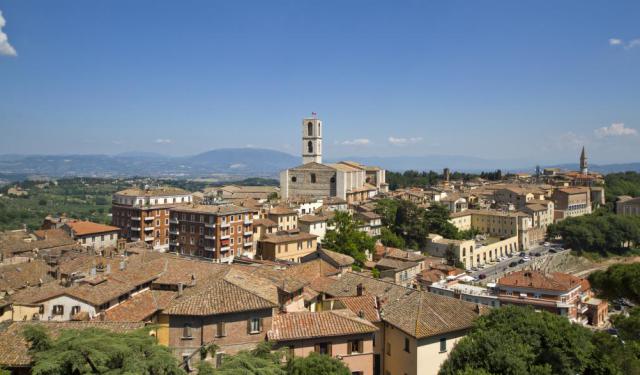
A Walk Through Perugia's Medieval Old Town
Perugia was one of the twelve foremost cities of the Etruscan Federation. It was mentioned by Quintus Fabius Pictor, a Roman historian. He tells of a military expedition of Fabius Maximus Rullianus against the Etruscan League and Perugia in 309 BC.
By 216 BC, Perugia had seen the light and allied itself with Rome in the Second Punic War against Carthage. Things went swimmingly until 41 BC.... view more
Tour Duration: 2 Hours
Travel Distance: 2.1 Km or 1.3 Miles
By 216 BC, Perugia had seen the light and allied itself with Rome in the Second Punic War against Carthage. Things went swimmingly until 41 BC.... view more
Tour Duration: 2 Hours
Travel Distance: 2.1 Km or 1.3 Miles
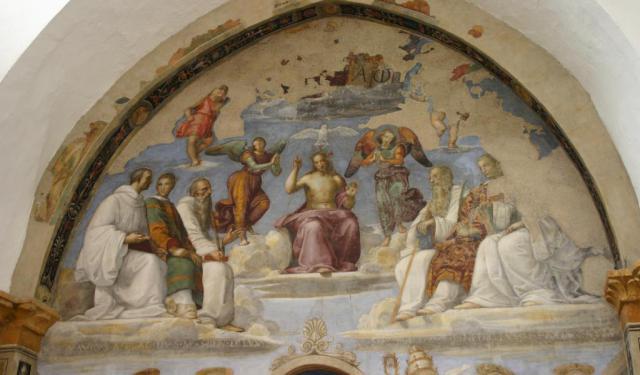
Perugino and Renaissance Art Walk
Perugia today is a well-known cultural and artistic center in Italy that regularly plays host to a multitude of annual festivals and events. The most glorious period in the history of the city, from an artistic standpoint, lasted from the 13th to the 16th centuries.
Perugia’s most celebrated artist, Pietro Vannucci (1450-1523), better known as “il Perugino”, nicknamed so after his... view more
Tour Duration: 1 Hour
Travel Distance: 2.3 Km or 1.4 Miles
Perugia’s most celebrated artist, Pietro Vannucci (1450-1523), better known as “il Perugino”, nicknamed so after his... view more
Tour Duration: 1 Hour
Travel Distance: 2.3 Km or 1.4 Miles
City Walks Overview
