


Church of Hagia Sophia, Thessaloniki (must see)
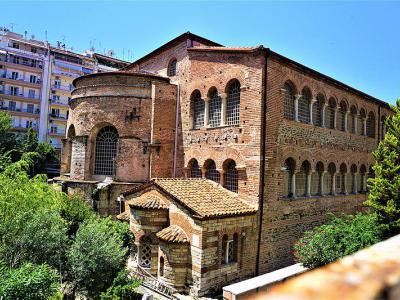
The church takes its name from the Greek Hagia Sophia, meaning “Holy Wisdom”. It is one of Thessaloniki’s most important Byzantine monuments and is included in the UNESCO World Heritage List as part of the Paleochristian and Byzantine Monuments of Thessaloniki.
A church has existed on this site since Late Antiquity, with earlier structures dating to the 5th century, likely replacing a Roman civic building. The present church was constructed in the late 7th century, following damage to its predecessor, and was clearly inspired by Hagia Sophia in Constantinople.
Architecturally, the church follows a domed Greek-cross basilica plan. As you step into the nave, the space immediately draws your eye upward, with strong vertical lines guiding attention toward the dome. A highlight of the church is the 9th-century mosaic of the Ascension, showing Christ rising within a mandorla, surrounded by angels, the Virgin Mary, and the Twelve Apostles. To see it clearly, stand directly beneath the dome and look straight up from the center of the nave.
After taking in the dome, move toward the eastern end of the church, near the sanctuary. Here, along the arches and upper wall surfaces, you can spot fragmentary mosaics dating to the 8th and 9th centuries. These are more subtle than the dome mosaic and require closer attention. Look for isolated tesserae patterns and partial figures, often set against gold backgrounds and embedded among later fresco layers. As you continue around the interior, notice how these mosaic remnants coexist with frescoes largely dating to the 11th century, revealing multiple phases of decoration within the same space.
During the Fourth Crusade, Thessaloniki fell to Western rule, and in 1205 the church was converted into a Catholic cathedral, remaining so until 1224. After the Ottoman capture of the city in 1430, Hagia Sophia continued to function as a church for several decades before being converted into a mosque in 1524. Architectural additions at that time included a minaret and a portico.
When Thessaloniki was incorporated into the modern Greek state in 1912, the building was returned to Christian worship. The minaret and portico were removed, though the base of the minaret remains visible outside, at the northwest corner of the building.
A church has existed on this site since Late Antiquity, with earlier structures dating to the 5th century, likely replacing a Roman civic building. The present church was constructed in the late 7th century, following damage to its predecessor, and was clearly inspired by Hagia Sophia in Constantinople.
Architecturally, the church follows a domed Greek-cross basilica plan. As you step into the nave, the space immediately draws your eye upward, with strong vertical lines guiding attention toward the dome. A highlight of the church is the 9th-century mosaic of the Ascension, showing Christ rising within a mandorla, surrounded by angels, the Virgin Mary, and the Twelve Apostles. To see it clearly, stand directly beneath the dome and look straight up from the center of the nave.
After taking in the dome, move toward the eastern end of the church, near the sanctuary. Here, along the arches and upper wall surfaces, you can spot fragmentary mosaics dating to the 8th and 9th centuries. These are more subtle than the dome mosaic and require closer attention. Look for isolated tesserae patterns and partial figures, often set against gold backgrounds and embedded among later fresco layers. As you continue around the interior, notice how these mosaic remnants coexist with frescoes largely dating to the 11th century, revealing multiple phases of decoration within the same space.
During the Fourth Crusade, Thessaloniki fell to Western rule, and in 1205 the church was converted into a Catholic cathedral, remaining so until 1224. After the Ottoman capture of the city in 1430, Hagia Sophia continued to function as a church for several decades before being converted into a mosque in 1524. Architectural additions at that time included a minaret and a portico.
When Thessaloniki was incorporated into the modern Greek state in 1912, the building was returned to Christian worship. The minaret and portico were removed, though the base of the minaret remains visible outside, at the northwest corner of the building.
Want to visit this sight? Check out these Self-Guided Walking Tours in Thessaloniki. Alternatively, you can download the mobile app "GPSmyCity: Walks in 1K+ Cities" from Apple App Store or Google Play Store. The app turns your mobile device to a personal tour guide and it works offline, so no data plan is needed when traveling abroad.
Download The GPSmyCity App



Church of Hagia Sophia on Map
Sight Name: Church of Hagia Sophia
Sight Location: Thessaloniki, Greece (See walking tours in Thessaloniki)
Sight Type: Religious
Guide(s) Containing This Sight:
Sight Location: Thessaloniki, Greece (See walking tours in Thessaloniki)
Sight Type: Religious
Guide(s) Containing This Sight:
Nearby Sights

Walking Tours in Thessaloniki, Greece

Create Your Own Walk in Thessaloniki
Creating your own self-guided walk in Thessaloniki is easy and fun. Choose the city attractions that you want to see and a walk route map will be created just for you. You can even set your hotel as the start point of the walk.
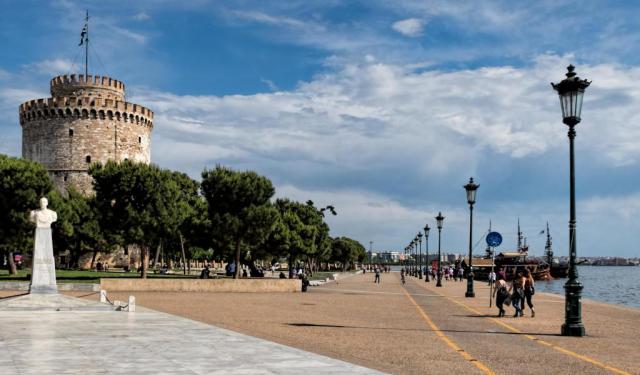
Thessaloniki Waterfront Tour
The Mediterranean has always been an integral part of Thessaloniki’s appeal. The city's orientation toward the sea is largely due to the vision of Ernest Hébrard, the French urban planner and architect, who redesigned the downtown area after the devastating fire of 1917.
To really get the taste of Thessaloniki you need to visit not just its historical landmarks, but also those spots... view more
Tour Duration: 1 Hour(s)
Travel Distance: 2.6 Km or 1.6 Miles
To really get the taste of Thessaloniki you need to visit not just its historical landmarks, but also those spots... view more
Tour Duration: 1 Hour(s)
Travel Distance: 2.6 Km or 1.6 Miles
Thessaloniki Upper Town Walking Tour
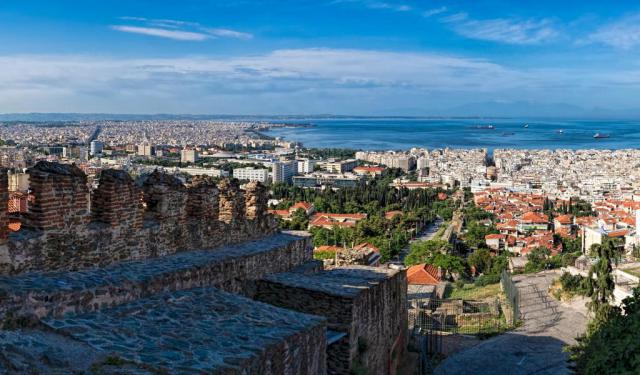
Thessaloniki’s Upper Town, known locally as Ano Poli, which literally translates as “Upper City” is the city’s oldest continuously inhabited district and the only area to survive the Great Fire of 1917 largely intact. While the lower city was rebuilt along modern, planned lines in the early 20th century, Ano Poli retained its Byzantine street layout, Ottoman-era houses, and defensive... view more
Tour Duration: 2 Hour(s)
Travel Distance: 4.0 Km or 2.5 Miles
Tour Duration: 2 Hour(s)
Travel Distance: 4.0 Km or 2.5 Miles
Thessaloniki Downtown Walking Tour
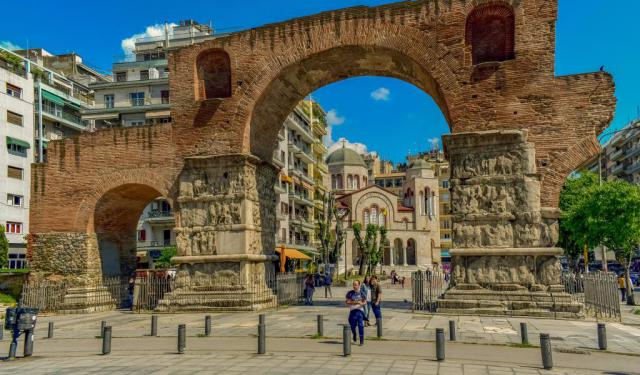
Thessaloniki has been shaped by layers of empire, trade, and migration for more than two millennia. It was founded in 315 BCE by Cassander, king of Macedon, who merged several smaller settlements around the Thermaic Gulf into a single city. He named it after his wife, Thessalonike, the half-sister of Alexander the Great. The name Thessalonikē combines Thessaloi and nikē, meaning victory,... view more
Tour Duration: 2 Hour(s)
Travel Distance: 3.7 Km or 2.3 Miles
Tour Duration: 2 Hour(s)
Travel Distance: 3.7 Km or 2.3 Miles