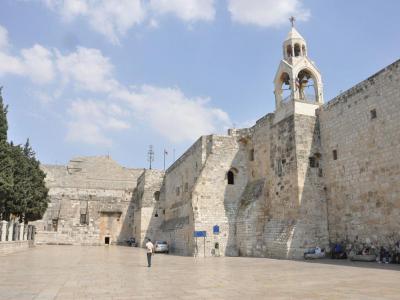


Church of the Nativity (Bethlehem), Jerusalem (must see)
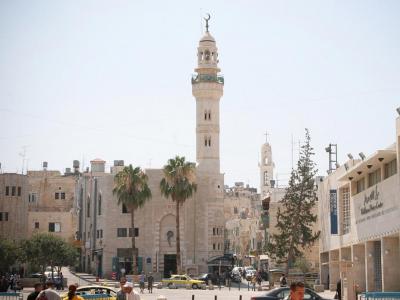
Standing solid and almost fortress-like at the edge of Manger Square, the Church of the Nativity practically anchors Bethlehem’s historic center. For nearly 17 centuries, this has been the place traditionally identified as the birthplace of Jesus. But the story here is anything but simple.
Before church bells rang, this hill saw Roman pagan worship. Emperor Hadrian is said to have installed a shrine to Adonis above the cave now venerated as the Nativity Grotto - a bold move that, ironically, may have helped preserve the location.
Then, in the 4th century, enter Helena, mother of the Roman Emperor Constantine, on a fact-finding mission with imperial backing. She unearthed the hallowed grotto, Constantine ordered a church, and by 339 AD, a basilica rose above the cave. It didn’t stay untouched for long, though. Byzantine emperors rebuilt it, Crusaders decorated it, and centuries layered their mark in stone, mosaic, and legend.
Approaching the entrance, you’ll notice something unexpected: you have to bend. The famously low “Door of Humility” wasn’t designed for dramatic effect; it was narrowed over time, likely to prevent mounted riders from charging in.
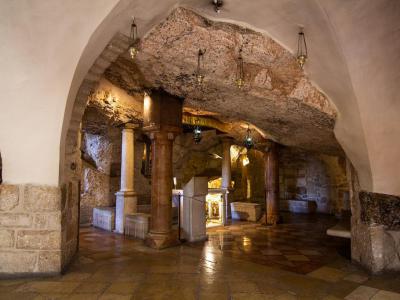
Inside, the mood quietly turns. Tall columns glow softly, fragments of ancient mosaics cling to the walls, and lamps flicker in a steady rhythm. Beneath the wooden ceiling lies the heart of it all - the Grotto of the Nativity, where a silver star set into the floor marks the traditional birthplace of Christ.
Control of this holy space is shared - carefully and sometimes tensely - between the Greek Orthodox, Armenian Orthodox, and Roman Catholic communities. Their coexistence follows a strict arrangement known as the Status Quo, a system born from centuries of rivalry that once escalated far beyond theology. This church has witnessed not only Crusader processions and Ottoman decrees but even modern conflict, including the 2002 siege when it sheltered hundreds seeking refuge.
Descend a few steps further to the Chapel of the Manger, traditionally identified as the spot where the feeding trough once stood - the very detail that gave Manger Square its name. Marble, candles, whispered prayers - the setting is simple, yet charged with meaning. In this quiet underground space, centuries-old legacy, sacred tradition, and politics converge - and the story of the birth said to change the world continues to echo.
Before church bells rang, this hill saw Roman pagan worship. Emperor Hadrian is said to have installed a shrine to Adonis above the cave now venerated as the Nativity Grotto - a bold move that, ironically, may have helped preserve the location.
Then, in the 4th century, enter Helena, mother of the Roman Emperor Constantine, on a fact-finding mission with imperial backing. She unearthed the hallowed grotto, Constantine ordered a church, and by 339 AD, a basilica rose above the cave. It didn’t stay untouched for long, though. Byzantine emperors rebuilt it, Crusaders decorated it, and centuries layered their mark in stone, mosaic, and legend.
Approaching the entrance, you’ll notice something unexpected: you have to bend. The famously low “Door of Humility” wasn’t designed for dramatic effect; it was narrowed over time, likely to prevent mounted riders from charging in.
Inside, the mood quietly turns. Tall columns glow softly, fragments of ancient mosaics cling to the walls, and lamps flicker in a steady rhythm. Beneath the wooden ceiling lies the heart of it all - the Grotto of the Nativity, where a silver star set into the floor marks the traditional birthplace of Christ.
Control of this holy space is shared - carefully and sometimes tensely - between the Greek Orthodox, Armenian Orthodox, and Roman Catholic communities. Their coexistence follows a strict arrangement known as the Status Quo, a system born from centuries of rivalry that once escalated far beyond theology. This church has witnessed not only Crusader processions and Ottoman decrees but even modern conflict, including the 2002 siege when it sheltered hundreds seeking refuge.
Descend a few steps further to the Chapel of the Manger, traditionally identified as the spot where the feeding trough once stood - the very detail that gave Manger Square its name. Marble, candles, whispered prayers - the setting is simple, yet charged with meaning. In this quiet underground space, centuries-old legacy, sacred tradition, and politics converge - and the story of the birth said to change the world continues to echo.
Want to visit this sight? Check out these Self-Guided Walking Tours in Jerusalem. Alternatively, you can download the mobile app "GPSmyCity: Walks in 1K+ Cities" from Apple App Store or Google Play Store. The app turns your mobile device to a personal tour guide and it works offline, so no data plan is needed when traveling abroad.
Download The GPSmyCity App



Church of the Nativity (Bethlehem) on Map
Sight Name: Church of the Nativity (Bethlehem)
Sight Location: Jerusalem, Israel (See walking tours in Jerusalem)
Sight Type: Religious
Guide(s) Containing This Sight:
Sight Location: Jerusalem, Israel (See walking tours in Jerusalem)
Sight Type: Religious
Guide(s) Containing This Sight:
Nearby Sights

Walking Tours in Jerusalem, Israel

Create Your Own Walk in Jerusalem
Creating your own self-guided walk in Jerusalem is easy and fun. Choose the city attractions that you want to see and a walk route map will be created just for you. You can even set your hotel as the start point of the walk.
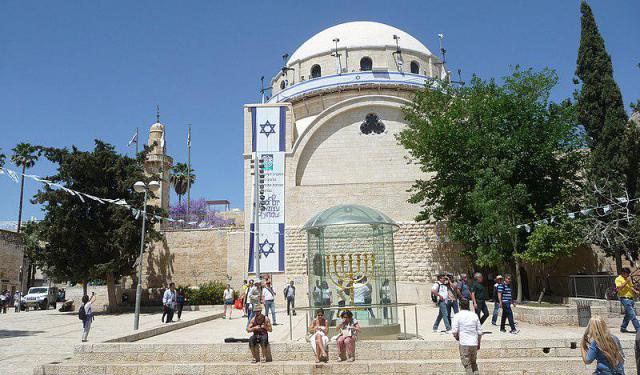
Jewish Quarter Walking Tour
Entirely rebuilt in the 1980s after having been largely destroyed during the 1948 War, the Jewish Quarter is quite distinct from the rest of the Old City. Good signposting, spacious passageways, art galleries and a somewhat less buzzing atmosphere make the area a relaxing place to spend some time.
With its rebuilt residential buildings, some almost consider this area the "New... view more
Tour Duration: 1 Hour(s)
Travel Distance: 1.3 Km or 0.8 Miles
With its rebuilt residential buildings, some almost consider this area the "New... view more
Tour Duration: 1 Hour(s)
Travel Distance: 1.3 Km or 0.8 Miles
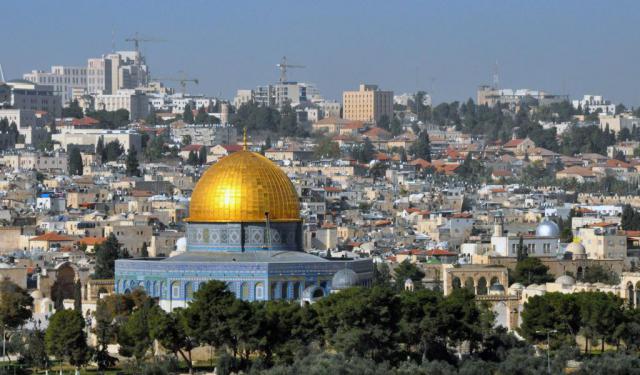
Muslim Quarter & Temple Mount Tour
The largest, most populous and perhaps most chaotic of all Jerusalem’s quarters, the Muslim Quarter is worth exploring for its unique atmosphere. Spending a day here may take you back to a simpler time, but be prepared for many sights and sounds as you pass many vendors, stores and restaurants on your way from site to site.
Some of the city’s most interesting city gates (Damascus and... view more
Tour Duration: 2 Hour(s)
Travel Distance: 2.1 Km or 1.3 Miles
Some of the city’s most interesting city gates (Damascus and... view more
Tour Duration: 2 Hour(s)
Travel Distance: 2.1 Km or 1.3 Miles
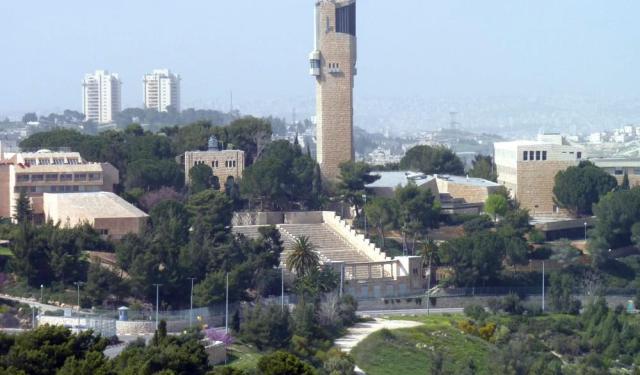
Mount Scopus Walking Tour
Dotted with many sightseeing places, Mount Scopus – translating as the “Observation Mount” from Greek – is a great place to get views over the whole Old City of Jerusalem on a nice day. The mount has been of major strategic importance since Roman times, with forces setting up camp here prior to laying the siege that culminated in the final Roman victory over Jerusalem around 70 AD.... view more
Tour Duration: 1 Hour(s)
Travel Distance: 2.3 Km or 1.4 Miles
Tour Duration: 1 Hour(s)
Travel Distance: 2.3 Km or 1.4 Miles
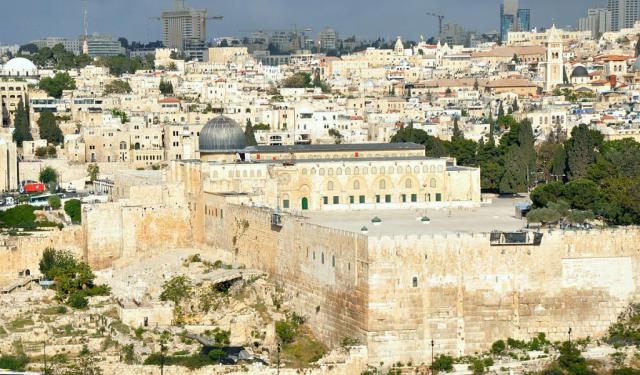
Jerusalem Old City Walking Tour
Jerusalem has been around long enough to see empires rise, fall, and try again. This is one of the world’s oldest continuously inhabited cities, shaped by faith, power, and a long rhythm of destruction followed by rebuilding. Archaeology traces settlement on the site of today's Jerusalem back to the Bronze Age, when it was just a modest Canaanite stronghold.
The city’s name tells a... view more
Tour Duration: 3 Hour(s)
Travel Distance: 5.0 Km or 3.1 Miles
The city’s name tells a... view more
Tour Duration: 3 Hour(s)
Travel Distance: 5.0 Km or 3.1 Miles
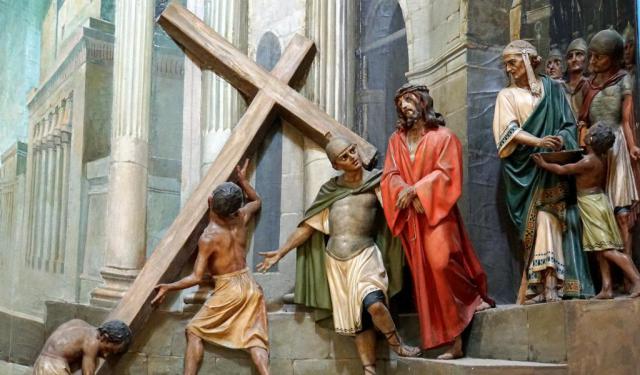
Following Steps of Jesus Walking Tour
The story of Jerusalem is inseparable from the final chapter of Jesus’s earthly life. Here, places linked to his teaching, arrest, trial, crucifixion, burial, and resurrection are woven into a dense urban landscape shaped by centuries of faith, conquest, and rebuilding. Many of these landmarks are only minutes apart from one another, yet they point to the scenes that span the Gospels-from public... view more
Tour Duration: 2 Hour(s)
Travel Distance: 3.7 Km or 2.3 Miles
Tour Duration: 2 Hour(s)
Travel Distance: 3.7 Km or 2.3 Miles
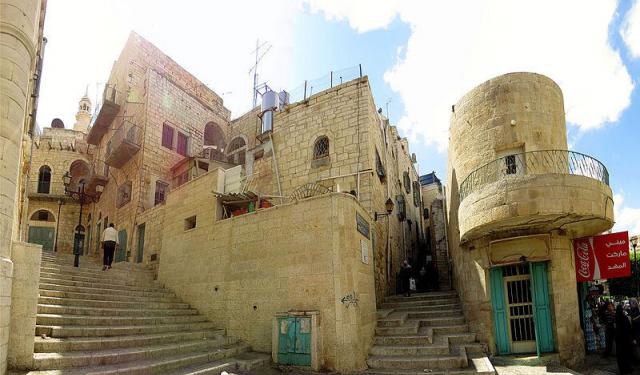
Bethlehem Walking Tour
Just a few kilometers south of Jerusalem, Bethlehem carries a name that echoes across continents. For more than two millennia, it has been known as the birthplace of Jesus Christ - complete with a guiding star, candlelit carols, and a December soundtrack that practically plays on its own. Yet when you arrive, you quickly realize this is not a frozen nativity scene. It’s a living, breathing... view more
Tour Duration: 1 Hour(s)
Travel Distance: 1.5 Km or 0.9 Miles
Tour Duration: 1 Hour(s)
Travel Distance: 1.5 Km or 0.9 Miles
Useful Travel Guides for Planning Your Trip
16 Uniquely Israel Things to Buy in Jerusalem
Modern day Jerusalem is a mosaic of neighborhoods, reflecting different historical periods, cultures, and religions. The influx of repatriates in recent years has made the cultural and artisanal scene of the city even more colourful and diverse. To find your way through Jerusalem's intricate...