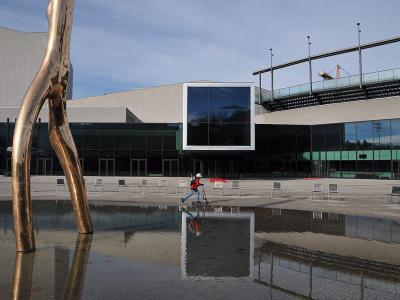


Festspielhaus Bregenz (Festival Theater), Bregenz (must see)
The Festspielhaus Bregenz stands at the centre of the Bregenzer Festspiele, a summer event founded in 1946. The festival began shortly after the Second World War, when performances were staged on two gravel barges floating on Lake Constance. One barge served as the stage and the other held the orchestra. The first production was Mozart’s Bastien und Bastienne, marking the start of what would become a long-standing musical tradition.
As the festival grew, temporary structures were replaced by a permanent theatre building completed in 1980. In 2006, the complex underwent a major renovation and expansion. This project improved acoustics, updated technical facilities, and added the Werkstattbühne, a smaller stage dedicated to contemporary and experimental productions. These changes strengthened the venue’s ability to host both traditional opera and new theatrical forms.
The Großer Saal seats between 1,650 and 1,750 people, depending on layout. Its interior uses wood surfaces and simple architectural lines to support clear, balanced acoustics suited to orchestral and operatic works. Since the festival’s founding, the Wiener Symphoniker has served as orchestra-in-residence. This long collaboration gives the festival a stable musical foundation and links present performances to its origins in 1946.
Just outside the theatre building lies the Seebühne, the large open-air lake stage with around 7,000 seats. It is designed for visually ambitious opera productions performed on vast sets built directly over the water. These stage constructions remain in place for two seasons and are engineered to withstand changing weather conditions on the lake.
Because the Seebühne operates in the open air, it uses a specialised spatial sound system known as the Bregenz Sound Sphere. This directional audio technology distributes sound evenly across the audience, compensating for wind and distance. The result is a listening experience that approaches the clarity of an indoor hall while preserving the atmosphere of an outdoor performance.
As the festival grew, temporary structures were replaced by a permanent theatre building completed in 1980. In 2006, the complex underwent a major renovation and expansion. This project improved acoustics, updated technical facilities, and added the Werkstattbühne, a smaller stage dedicated to contemporary and experimental productions. These changes strengthened the venue’s ability to host both traditional opera and new theatrical forms.
The Großer Saal seats between 1,650 and 1,750 people, depending on layout. Its interior uses wood surfaces and simple architectural lines to support clear, balanced acoustics suited to orchestral and operatic works. Since the festival’s founding, the Wiener Symphoniker has served as orchestra-in-residence. This long collaboration gives the festival a stable musical foundation and links present performances to its origins in 1946.
Just outside the theatre building lies the Seebühne, the large open-air lake stage with around 7,000 seats. It is designed for visually ambitious opera productions performed on vast sets built directly over the water. These stage constructions remain in place for two seasons and are engineered to withstand changing weather conditions on the lake.
Because the Seebühne operates in the open air, it uses a specialised spatial sound system known as the Bregenz Sound Sphere. This directional audio technology distributes sound evenly across the audience, compensating for wind and distance. The result is a listening experience that approaches the clarity of an indoor hall while preserving the atmosphere of an outdoor performance.
Want to visit this sight? Check out these Self-Guided Walking Tours in Bregenz. Alternatively, you can download the mobile app "GPSmyCity: Walks in 1K+ Cities" from Apple App Store or Google Play Store. The app turns your mobile device to a personal tour guide and it works offline, so no data plan is needed when traveling abroad.
Download The GPSmyCity App



Festspielhaus Bregenz (Festival Theater) on Map
Sight Name: Festspielhaus Bregenz (Festival Theater)
Sight Location: Bregenz, Austria (See walking tours in Bregenz)
Sight Type: Attraction/Landmark
Sight Location: Bregenz, Austria (See walking tours in Bregenz)
Sight Type: Attraction/Landmark
Nearby Sights
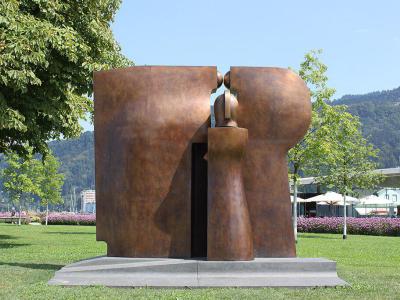
Walking Tours in Bregenz, Austria

Create Your Own Walk in Bregenz
Creating your own self-guided walk in Bregenz is easy and fun. Choose the city attractions that you want to see and a walk route map will be created just for you. You can even set your hotel as the start point of the walk.
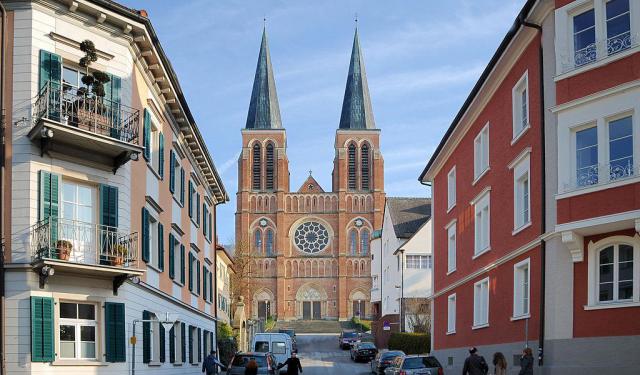
A Walking Map of Historical Buildings in Bregenz
Bregenz is home to many historic buildings, several of which were built between the 13th and 16th centuries. Federal High School, the Vorarlberg Land Theater and City Hall, located near the harbor, are landmarks of the Lower Town. Take the following tour to discover Bregenz’s best historic architecture.
Tour Duration: 3 Hour(s)
Travel Distance: 5.5 Km or 3.4 Miles
Tour Duration: 3 Hour(s)
Travel Distance: 5.5 Km or 3.4 Miles
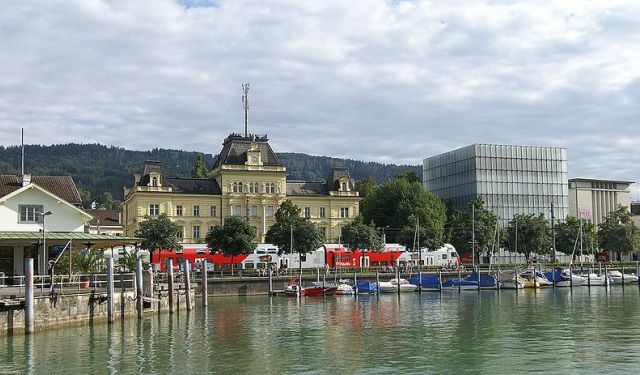
Bregenz Old Town and City Center Walking Tour
Bregenz, located where Austria meets Germany and Switzerland, contains many beautiful landmarks in both the historic and modern parts of the city. Discover Bregenz’s most popular attractions and learn about its history in the following orientation walk.
Tour Duration: 2 Hour(s)
Travel Distance: 2.5 Km or 1.6 Miles
Tour Duration: 2 Hour(s)
Travel Distance: 2.5 Km or 1.6 Miles