

Historical Buildings in Bregenz, Bregenz

Historical Buildings in Bregenz (Self Guided), Bregenz

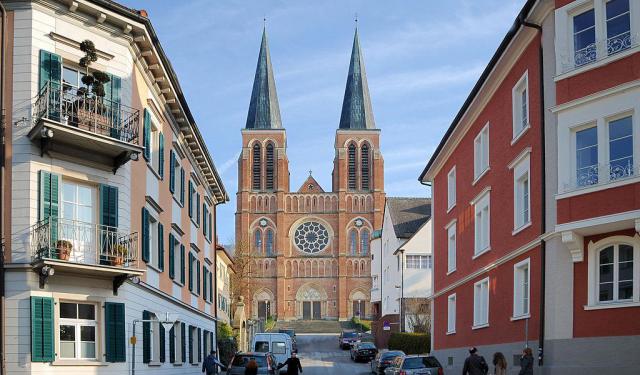
Bregenz is home to many historic buildings, several of which were built between the 13th and 16th centuries. Federal High School, the Vorarlberg Land Theater and City Hall, located near the harbor, are landmarks of the Lower Town. Take the following tour to discover Bregenz’s best historic architecture.
How it works: Download the app "GPSmyCity: Walks in 1K+ Cities" from Apple App Store or Google Play Store to your mobile phone or tablet. The app turns your mobile device into a personal tour guide and its built-in GPS navigation functions guide you from one tour stop to next. The app works offline, so no data plan is needed when traveling abroad.

Download The GPSmyCity App

Historical Buildings in Bregenz Map

Guide Name: Historical Buildings in Bregenz
Guide Location: Austria » Bregenz (See other walking tours in Bregenz)
Guide Type: Self-guided Walking Tour (Sightseeing)
# of Attractions: 9
Tour Duration: 3 Hour(s)
Travel Distance: 5.5 Km or 3.4 Miles
Author: Sandra
Sight(s) Featured in This Guide:
  • Vorarlberg Land Theater
  • Rathaus Bregenz (City Hall)
  • Deuringschloessle (Deuring Castle)
  • Altes Rathaus (Old Town Hall)
  • Thalbach Convent
  • Bundesgymnasium (Federal High School)
  • The Vorarlberg State Library
  • Kreuzkirche am Oelrain (Evangelist Church)
  • Kloster Mehrerau (Mehrerau Monastery)
1
Vorarlberg Land Theater

1) Vorarlberg Land Theater

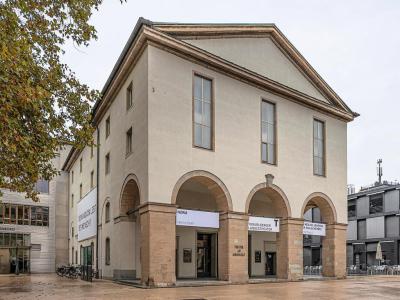
The Vorarlberg Landestheater was founded in November 1945, marking the shift from a municipal stage to a regional theatre with a permanent ensemble. Its building is much older: originally a granary built in 1838, it was already hosting performances by 1840, linking the site to theatre for nearly two centuries.

The theatre’s present look comes from a renovation in the 1990s, when architect Helmut Kuess reshaped the structure. His concept emphasized transparency, placing modern glass elements alongside the historic granary walls. The glass foyer, open and light-filled, creates a visual connection between the interior and the square outside. Stone and glass are combined to balance tradition and contemporary design.

Inside, the “Großes Haus” seats about 500 people. Its compact layout keeps the audience close to the stage, so even from the back rows facial expressions and dialogue remain clear. Locally, the building is often called the Theater am Kornmarkt. Together with the nearby Vorarlberg Museum and Kunsthaus Bregenz, it forms part of a cultural cluster that shapes the artistic life of the area.
2
Rathaus Bregenz (City Hall)

2) Rathaus Bregenz (City Hall)

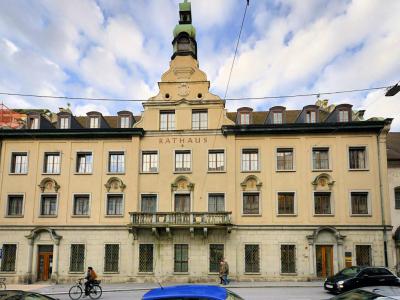
Rathaus Bregenz (City Hall) was built in 1686 as a grain store. Its thick walls and strong structure were needed to hold large amounts of grain, showing how important trade near the lake had become. Around 1720, parts of the city administration moved in. By 1810/11, it officially replaced the old town hall in the Upper Town and became the main centre of local government.

In 1898, the building was redesigned for Emperor Franz Joseph I’s 50th jubilee. The façade was given a Neo-Renaissance look, with a stepped gable, Tuscan half-columns at the entrance, and mosaic details. The council chamber was updated in 1908–1909 by Otto Mallaun. A statue of St. Gebhard, born in Bregenz and later Bishop of Constance, stands in a front niche.

Inside are the mayor’s office, meeting rooms, and city departments. From April 6, 1861, the building hosted sessions of the Vorarlberg Landtag, giving it regional political importance. Some visitors mistake it for the medieval Martinsturm in the Upper Town, but the Rathaus stands in the Lower Town, close to the lakefront and harbour area.
3
Deuringschloessle (Deuring Castle)

3) Deuringschloessle (Deuring Castle) (must see)

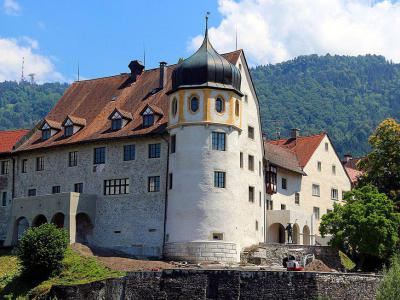
Deuringschlössle rises in the historic Oberstadt and reflects the ambitions of the Deuring family in the decades after the Thirty Years’ War. Around 1660, Hans Karl von Deuring expanded the residence into the stately form seen today. Although the site had medieval origins, the family chose not to rebuild it as a fortress. Instead, the design expressed recovery, learning, and social standing in a post-war society that valued civic authority over military defence.

The four-storey structure is marked by a corner tower and a steep gabled roof. Its compact proportions and balanced façade show the transition from fortified medieval building to early modern residential architecture. Evenly arranged windows and clear symmetry replace battlements and defensive walls. The name “Schlössle,” a southern German diminutive meaning “little castle,” reflects this character: dignified, yet intended as a refined home rather than a stronghold.

Inside, the residence became known for Renaissance and Baroque details that emphasised comfort and cultivated taste. Coffered ceilings, tiled stoves, and finely worked interiors placed it within wider artistic currents of the 17th century. Among its most notable features were the so-called Knights’ Hall and a private chapel with rich Baroque stuccowork, reinforcing the image of education, faith, and status within aristocratic life.

In the late 20th and early 21st centuries, the building entered a new phase as a gourmet hotel led by chef Heino Huber. It earned international recognition and was regularly listed in the Gault Millau guide. Around 2014–2015, this period came to an end when the property was sold. Today it functions once again as a private residence, with only its exterior accessible to visitors.
4
Altes Rathaus (Old Town Hall)

4) Altes Rathaus (Old Town Hall) (must see)

The Altes Rathaus in the upper town dates to 1662 and was built by Michael Kuen. Despite its name, it was not originally the main town hall. It housed the city archives and served as a residence for the Stadtschreiber, or town clerk, and other council servants. The official town hall stood nearby and was demolished in the early 19th century. Over time, the building became linked with local administration and civic affairs.

In 1810, municipal administration moved to the present town hall in the lower part of the town. That structure had been constructed in 1686 as a grain warehouse and was later redesigned in 1898 with a late Renaissance façade and green copper domes to mark the fiftieth anniversary of Emperor Franz Joseph’s reign. After this relocation, the Altes Rathaus gradually lost its administrative function and entered private ownership.

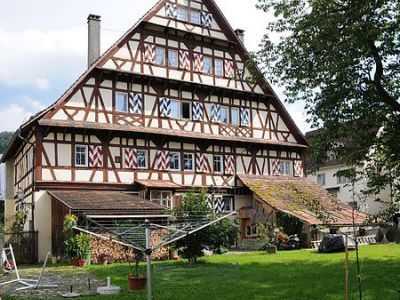
Architecturally, it is recognised as the largest half-timbered (Fachwerk) building in the city, a notable feature in a region where this construction method is relatively uncommon. A solid lower level supports upper storeys of exposed timber framing. The high pointed gable and the yellow façade with red-and-white shutters make the building easy to recognise in the historic quarter.

A painted figure on the façade represents Abundantia, the Roman allegory of prosperity, holding a cornucopia. Although sometimes linked in local legend to Celtic roots, art historians identify her clearly within Roman iconography. Today, the building is a private residence and is not open to the public, yet it remains a key landmark of the upper town.
5
Thalbach Convent

5) Thalbach Convent (must see)
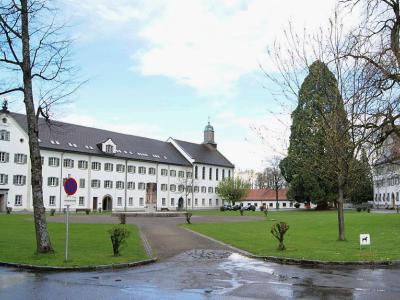
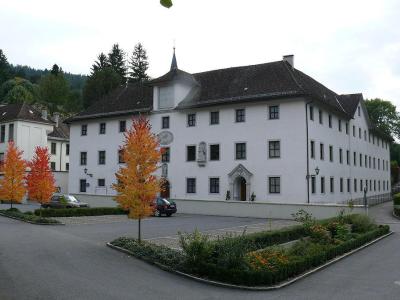
Thalbach Convent traces its beginnings to 1436, when a small chapel was established here. The first community consisted of pious women, known as Beguines, who later adopted the Rule of St. Clare and became a Poor Clare convent within the Franciscan tradition. For centuries, the site served as a place of prayer and enclosed religious life.

In 1782, Emperor Joseph II ordered the dissolution of many contemplative monasteries, and the convent was closed. The buildings were then used for secular purposes, including as a military hospital. In 1854, Dominican Sisters from Hirschberg in Prussia moved into the complex, restoring religious life and opening a new chapter.

Between 1674 and 1677, the convent had already undergone major rebuilding under architects Michael Kuen and Michael Thumb, leading figures of the Vorarlberg Baroque school. They created a symmetrical four-wing complex arranged around a central courtyard. This clear rectangular layout shaped daily monastic life, linking church, living quarters, and workspaces within one enclosed structure.

Inside the church, the space is simple and focused on the main altar. Its most important artwork is the 14th-century Madonna and Child known as the “Sedes Sapientiae” (Seat of Wisdom). The statue was brought here from Mehrerau in 1592, long before the Dominican period, showing that the convent had already become a place of pilgrimage and devotion.

Since 1983, the complex has been in the care of the spiritual family “Das Werk,” founded by Julia Verhaeghe. It remains a centre for spiritual formation and also houses the Catholic Women’s Movement of the diocese, continuing its long link between faith and community life.
6
Bundesgymnasium (Federal High School)

6) Bundesgymnasium (Federal High School)

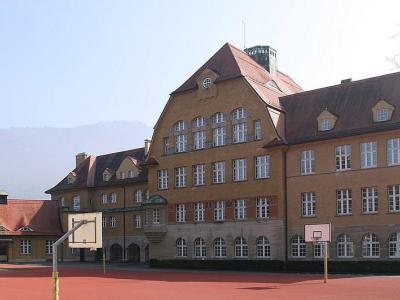
The Bundesgymnasium on Gallusstraße traces its origins to a private convent school founded by the Dominican monastery in 1878. In 1924, it officially became a girls’ gymnasium and later developed into today’s co-educational federal high school. As part of Austria’s Gymnasium system, it prepares students for the Matura, the final examination required for university admission. Over time, it has become a steady presence in the region’s academic and cultural life.

The main building, completed around 1913, reflects late historicism with elements of Heimatstil and regional Jugendstil influences. Its balanced façade, symmetrical windows, and steep red-tiled roof reflect late Austro-Hungarian public architecture. The building has protected monument status and houses a rooftop weather station that collects data for the Vorarlberg region. A recent passive-house extension, linked by an underground passage, adds modern space to the historic structure.

Bregenz has two main federal gymnasiums. Alongside the Bundesgymnasium on Gallusstraße, there is also the Bundesgymnasium on Blumenstraße, another well-regarded academic institution within the city. Together, they represent the local framework of higher secondary education, each with its own history and architectural character.
7
The Vorarlberg State Library

7) The Vorarlberg State Library

The Vorarlberg State Library was founded in 1904 as part of the Vorarlberg State Archives. In September 1977, it became an independent institution. Since that same year, it has held the legal right to receive a deposit copy of every publication printed in the province. This ensures that books, brochures, newspapers, and other printed works connected to Vorarlberg are preserved. Today, the library functions as the region’s central research and documentation centre.

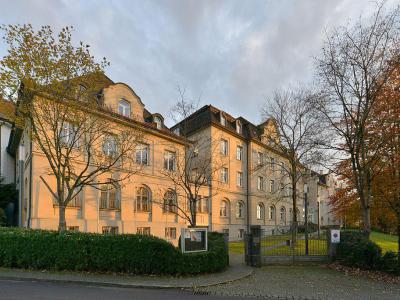
It is housed in the Gallusstift, a former Benedictine convent at the foot of the Gebhardsberg. Over time, the building also served as a barracks and later as a school before becoming a library. One of its most distinctive spaces is the Kuppelsaal, a domed hall created from a redesigned Baroque church. The physical collection includes more than 500,000 volumes, along with photographs, maps, postcards, and audiovisual recordings. Among its notable works is the Emser Chronik from 1616, the first book printed in Vorarlberg.

In addition to its printed holdings, the library operates volare, one of Austria’s most advanced regional digital repositories. Since 2015, it has provided access to over 300,000 digital items, including photographs and other cultural heritage materials. Visitors will find quiet reading rooms for study and small exhibitions that highlight selected items from the archives, linking the region’s past with modern research tools.
8
Kreuzkirche am Oelrain (Evangelist Church)

8) Kreuzkirche am Oelrain (Evangelist Church)

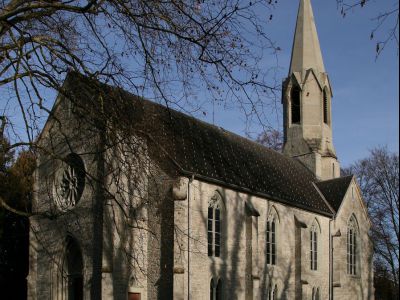
Kreuzkirche am Ölrain was founded in 1862 and completed in 1864 for the growing Protestant community. It stands in an area that once formed the residential quarter of Roman Brigantium. During the foundation works, important Roman remains were uncovered. These discoveries did more than fill museum cases; they helped spark systematic Roman archaeology in the region and shaped the early collection of the Vorarlberg Museum.

Designed by Stuttgart architect Christian Friedrich von Leins, who also created Villa Berg, the church follows the Neo-Gothic style and features exposed brick, typical of his work at the time. Its pointed windows and tall tower echo medieval forms, while the brickwork reflects the 19th century. In 1904, it became the first church in the Austro-Hungarian Monarchy to be electrically lit and heated, a widely reported innovation that highlighted the Protestant community’s progressive outlook.

Inside, the ceiling shows an open wooden roof truss rather than stone vaults, with exposed beams visible above the nave. The layout keeps the focus on the pulpit and altar. The current organ, built by Rieger Orgelbau in 1981, is regularly used for concerts thanks to the strong acoustics. A memorial for soldiers who died in the First World War features a stone crucifix created in 1923 by Albert Bechtold, one of Vorarlberg’s leading 20th-century artists, adding a modern regional layer to the Neo-Gothic setting.
9
Kloster Mehrerau (Mehrerau Monastery)

9) Kloster Mehrerau (Mehrerau Monastery)

Kloster Mehrerau stands by Lake Constance and has more than a thousand years of history. Tradition says Saint Columbanus stayed here around 610–612. The first clearly recorded monastery was founded in the late 11th century by the Counts of Bregenz. The Benedictine monks moved to the lakeshore around 1090–1094, laid the foundation stone of a stone church in 1097, and remained until the abbey was dissolved in 1806 under Bavarian rule.

A new phase began in 1854, when Cistercian monks forced to leave Wettingen Abbey in Switzerland bought the site. They reopened the monastery on 18 October 1854 as Wettingen-Mehrerau. The church interior was redesigned between 1961 and 1964 by Hans Burtscher in a simple modern style inspired by Cistercian simplicity. In the crypt, older Romanesque and Baroque remains, including the tomb of Cardinal Hergenröther, are still visible.

Mehrerau has a special status as a Territorial Abbey, which means it answers directly to the Holy See. The abbot is not automatically a bishop, but he has similar authority here and is a member of the Austrian Bishops’ Conference. He also leads the Mehrerau Congregation. The monks run the Collegium Bernardi secondary school and the Sanatorium Mehrerau, and the complex was renovated between 2020 and 2024.

Walking Tours in Bregenz, Austria

Create Your Own Walk in Bregenz

Create Your Own Walk in Bregenz

Creating your own self-guided walk in Bregenz is easy and fun. Choose the city attractions that you want to see and a walk route map will be created just for you. You can even set your hotel as the start point of the walk.
Bregenz Introduction Walking Tour

Bregenz Introduction Walking Tour

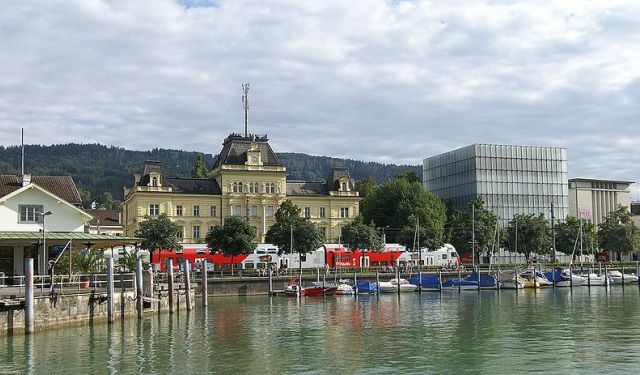
Bregenz, located where Austria meets Germany and Switzerland, contains many beautiful landmarks in both the historic and modern parts of the city. Discover Bregenz’s most popular attractions and learn about its history in the following orientation walk.

Tour Duration: 2 Hour(s)
Travel Distance: 2.5 Km or 1.6 Miles