

Bregenz Introduction Walking Tour (Self Guided), Bregenz
Bregenz, located where Austria meets Germany and Switzerland, contains many beautiful landmarks in both the historic and modern parts of the city. Discover Bregenz’s most popular attractions and learn about its history in the following orientation walk.
How it works: Download the app "GPSmyCity: Walks in 1K+ Cities" from Apple App Store or Google Play Store to your mobile phone or tablet. The app turns your mobile device into a personal tour guide and its built-in GPS navigation functions guide you from one tour stop to next. The app works offline, so no data plan is needed when traveling abroad.
Bregenz Introduction Walking Tour Map
Guide Name: Bregenz Introduction Walking Tour
Guide Location: Austria » Bregenz (See other walking tours in Bregenz)
Guide Type: Self-guided Walking Tour (Sightseeing)
# of Attractions: 17
Tour Duration: 2 Hour(s)
Travel Distance: 2.5 Km or 1.6 Miles
Author: Sandra
Sight(s) Featured in This Guide:
Guide Location: Austria » Bregenz (See other walking tours in Bregenz)
Guide Type: Self-guided Walking Tour (Sightseeing)
# of Attractions: 17
Tour Duration: 2 Hour(s)
Travel Distance: 2.5 Km or 1.6 Miles
Author: Sandra
Sight(s) Featured in This Guide:
- Martinsturm (St. Martin’s Tower)
- Altes Rathaus (Old Town Hall)
- Ehregutaplatz (Ehreguta Square)
- Fountain of the Minnesinger of Montfort
- Deuringschloessle (Deuring Castle)
- Kirche St. Gallus (Church of St. Gallus)
- Kapuzinerkloster (Capuchin Monastery)
- Palais Thurn and Taxis Art House
- Thurn-und-Taxis Park
- Gruenes Haus (Green House)
- Altes Landhaus (Old Country House)
- Vorarlberg Provincial Museum
- Kunsthaus Bregenz (Art House)
- Nepomukkapelle (St. Nepomuk Chapel)
- Kornmarktstrasse No. 7
- Port Bregenz
- Bregenz Promenad (Lake Promenade)
1) Martinsturm (St. Martin’s Tower) (must see)
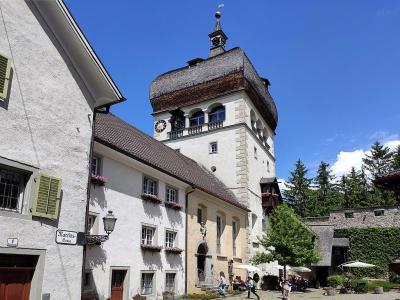
Martinsturm rises above the upper quarter as one of the oldest preserved buildings in the area. Its lower sections date to around 1250, when it functioned as a keep and granary within the medieval town walls. The thick stone walls and small openings reflect this defensive purpose. In the 14th century, a chapel dedicated to Saint Martin was integrated into the tower, giving it both military and religious roles.
Inside the chapel, late Gothic frescoes from about 1360 remain among the most important medieval wall paintings in the Vorarlberg region. The scenes present biblical figures in clear compositions typical of the period. Their survival offers rare insight into the artistic and devotional life of the late Middle Ages in this part of the Alps.
Another unusual object displayed here is the so-called “giant’s rib.” Long believed to be the bone of a mythical giant, it is in fact a prehistoric whale bone. The legend attached to it shows how earlier generations interpreted unusual natural discoveries and integrated them into local storytelling traditions.
In 1601, the tower received its distinctive wooden onion dome, designed by Benedetto Prato. This addition marked the first major Baroque building at Lake Constance and influenced later architecture around the Bodensee. It is widely regarded as the largest historic timber-framed Baroque onion dome in Central Europe among comparable structures, and it continues to define the tower’s silhouette.
Today, the building houses the redesigned Martinsturm Museum. The exhibition focuses strongly on urban history, tracing how the town developed from its medieval fortified core into a modern provincial capital. Visitors who climb the upper levels are rewarded with wide views over the old quarter, Lake Constance, and the surrounding landscape.
Inside the chapel, late Gothic frescoes from about 1360 remain among the most important medieval wall paintings in the Vorarlberg region. The scenes present biblical figures in clear compositions typical of the period. Their survival offers rare insight into the artistic and devotional life of the late Middle Ages in this part of the Alps.
Another unusual object displayed here is the so-called “giant’s rib.” Long believed to be the bone of a mythical giant, it is in fact a prehistoric whale bone. The legend attached to it shows how earlier generations interpreted unusual natural discoveries and integrated them into local storytelling traditions.
In 1601, the tower received its distinctive wooden onion dome, designed by Benedetto Prato. This addition marked the first major Baroque building at Lake Constance and influenced later architecture around the Bodensee. It is widely regarded as the largest historic timber-framed Baroque onion dome in Central Europe among comparable structures, and it continues to define the tower’s silhouette.
Today, the building houses the redesigned Martinsturm Museum. The exhibition focuses strongly on urban history, tracing how the town developed from its medieval fortified core into a modern provincial capital. Visitors who climb the upper levels are rewarded with wide views over the old quarter, Lake Constance, and the surrounding landscape.
2) Altes Rathaus (Old Town Hall) (must see)
The Altes Rathaus in the upper town dates to 1662 and was built by Michael Kuen. Despite its name, it was not originally the main town hall. It housed the city archives and served as a residence for the Stadtschreiber, or town clerk, and other council servants. The official town hall stood nearby and was demolished in the early 19th century. Over time, the building became linked with local administration and civic affairs.
In 1810, municipal administration moved to the present town hall in the lower part of the town. That structure had been constructed in 1686 as a grain warehouse and was later redesigned in 1898 with a late Renaissance façade and green copper domes to mark the fiftieth anniversary of Emperor Franz Joseph’s reign. After this relocation, the Altes Rathaus gradually lost its administrative function and entered private ownership.
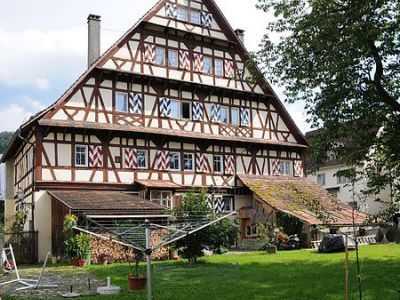
Architecturally, it is recognised as the largest half-timbered (Fachwerk) building in the city, a notable feature in a region where this construction method is relatively uncommon. A solid lower level supports upper storeys of exposed timber framing. The high pointed gable and the yellow façade with red-and-white shutters make the building easy to recognise in the historic quarter.
A painted figure on the façade represents Abundantia, the Roman allegory of prosperity, holding a cornucopia. Although sometimes linked in local legend to Celtic roots, art historians identify her clearly within Roman iconography. Today, the building is a private residence and is not open to the public, yet it remains a key landmark of the upper town.
In 1810, municipal administration moved to the present town hall in the lower part of the town. That structure had been constructed in 1686 as a grain warehouse and was later redesigned in 1898 with a late Renaissance façade and green copper domes to mark the fiftieth anniversary of Emperor Franz Joseph’s reign. After this relocation, the Altes Rathaus gradually lost its administrative function and entered private ownership.
Architecturally, it is recognised as the largest half-timbered (Fachwerk) building in the city, a notable feature in a region where this construction method is relatively uncommon. A solid lower level supports upper storeys of exposed timber framing. The high pointed gable and the yellow façade with red-and-white shutters make the building easy to recognise in the historic quarter.
A painted figure on the façade represents Abundantia, the Roman allegory of prosperity, holding a cornucopia. Although sometimes linked in local legend to Celtic roots, art historians identify her clearly within Roman iconography. Today, the building is a private residence and is not open to the public, yet it remains a key landmark of the upper town.
3) Ehregutaplatz (Ehreguta Square)
Ehregutaplatz lies within the Upper Town, an area shaped by medieval fortifications and narrow lanes. The square takes its name from a legend connected to the Appenzell Wars of 1406–1407. Tradition says that Guta overheard plans to attack the town while hiding in a tavern and rode through the night to warn its inhabitants. In her honour, night guards later called out “Ehre-Guta” during winter evenings, and the square was named after her.
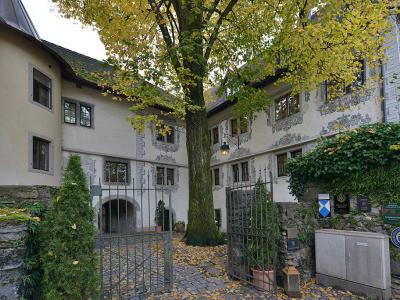
The space preserves one of the remaining late medieval building groups in the Upper Town. At number 1 stands a former city gate and residence from the 14th or 15th century, with a painted sundial on its façade. Nearby, the 17th-century Deuring Schlössle now serves as a hotel, showing the area’s shift from fortified site to residential quarter.
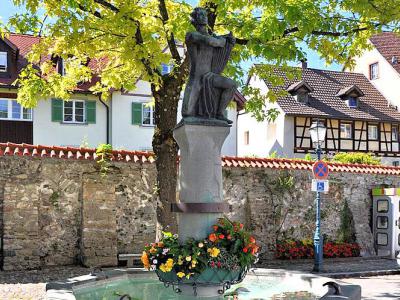
At the centre rises the Montfortbrunnen, also known as the Hugo-von-Montfort Fountain. The sculpture represents Count Hugo von Montfort, a medieval nobleman and Minnesinger associated with the region. Today the square remains calm and enclosed, offering a clear sense of the town’s early layout and the blend of legend, architecture, and daily life that continues to define this historic quarter.
The space preserves one of the remaining late medieval building groups in the Upper Town. At number 1 stands a former city gate and residence from the 14th or 15th century, with a painted sundial on its façade. Nearby, the 17th-century Deuring Schlössle now serves as a hotel, showing the area’s shift from fortified site to residential quarter.
At the centre rises the Montfortbrunnen, also known as the Hugo-von-Montfort Fountain. The sculpture represents Count Hugo von Montfort, a medieval nobleman and Minnesinger associated with the region. Today the square remains calm and enclosed, offering a clear sense of the town’s early layout and the blend of legend, architecture, and daily life that continues to define this historic quarter.
4) Fountain of the Minnesinger of Montfort
The Fountain of the Minnesinger of Montfort, also known as the Montfortbrunnen, honours Hugo von Montfort, a nobleman and poet of the Montfort family. The Counts of Montfort shaped the medieval history of the Lake Constance region, and their name remains part of local heritage. Hugo, who lived from 1357 to 1423, was a late Minnesinger whose autobiographical and moral poems survive in the Codex Palatinus Germanicus 329, with melodies attributed to his companion Burk Mangolt.
The fountain was created by sculptor Hans Tröger and inaugurated in 1955. The figure is slender and elongated, recalling the Gothic style of the 14th century. Hugo is shown with a sword, referring to his role as a knight, and with a scroll or musical reference that points to his literary work. The design evokes the Middle Ages while reflecting the post-war period in which the monument was made.
Water surrounds the base of the sculpture, adding movement and drawing attention to its details. Located between the historic upper quarter and the modern city area, the fountain connects medieval literary culture with present-day public space and keeps the Montfort name visible in regional identity.
The fountain was created by sculptor Hans Tröger and inaugurated in 1955. The figure is slender and elongated, recalling the Gothic style of the 14th century. Hugo is shown with a sword, referring to his role as a knight, and with a scroll or musical reference that points to his literary work. The design evokes the Middle Ages while reflecting the post-war period in which the monument was made.
Water surrounds the base of the sculpture, adding movement and drawing attention to its details. Located between the historic upper quarter and the modern city area, the fountain connects medieval literary culture with present-day public space and keeps the Montfort name visible in regional identity.
5) Deuringschloessle (Deuring Castle) (must see)
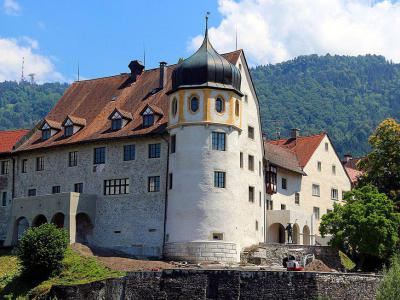
Deuringschlössle rises in the historic Oberstadt and reflects the ambitions of the Deuring family in the decades after the Thirty Years’ War. Around 1660, Hans Karl von Deuring expanded the residence into the stately form seen today. Although the site had medieval origins, the family chose not to rebuild it as a fortress. Instead, the design expressed recovery, learning, and social standing in a post-war society that valued civic authority over military defence.
The four-storey structure is marked by a corner tower and a steep gabled roof. Its compact proportions and balanced façade show the transition from fortified medieval building to early modern residential architecture. Evenly arranged windows and clear symmetry replace battlements and defensive walls. The name “Schlössle,” a southern German diminutive meaning “little castle,” reflects this character: dignified, yet intended as a refined home rather than a stronghold.
Inside, the residence became known for Renaissance and Baroque details that emphasised comfort and cultivated taste. Coffered ceilings, tiled stoves, and finely worked interiors placed it within wider artistic currents of the 17th century. Among its most notable features were the so-called Knights’ Hall and a private chapel with rich Baroque stuccowork, reinforcing the image of education, faith, and status within aristocratic life.
In the late 20th and early 21st centuries, the building entered a new phase as a gourmet hotel led by chef Heino Huber. It earned international recognition and was regularly listed in the Gault Millau guide. Around 2014–2015, this period came to an end when the property was sold. Today it functions once again as a private residence, with only its exterior accessible to visitors.
The four-storey structure is marked by a corner tower and a steep gabled roof. Its compact proportions and balanced façade show the transition from fortified medieval building to early modern residential architecture. Evenly arranged windows and clear symmetry replace battlements and defensive walls. The name “Schlössle,” a southern German diminutive meaning “little castle,” reflects this character: dignified, yet intended as a refined home rather than a stronghold.
Inside, the residence became known for Renaissance and Baroque details that emphasised comfort and cultivated taste. Coffered ceilings, tiled stoves, and finely worked interiors placed it within wider artistic currents of the 17th century. Among its most notable features were the so-called Knights’ Hall and a private chapel with rich Baroque stuccowork, reinforcing the image of education, faith, and status within aristocratic life.
In the late 20th and early 21st centuries, the building entered a new phase as a gourmet hotel led by chef Heino Huber. It earned international recognition and was regularly listed in the Gault Millau guide. Around 2014–2015, this period came to an end when the property was sold. Today it functions once again as a private residence, with only its exterior accessible to visitors.
6) Kirche St. Gallus (Church of St. Gallus) (must see)
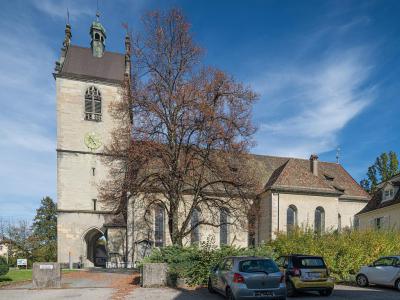
Kirche St. Gallus stands on one of the oldest documented Christian sites in the Lake Constance region. Archaeological excavations in 1973 uncovered remains of a late Roman or early medieval church, confirming that worship has taken place here since at least the 5th century. In 610 AD, the Irish missionaries Saint Gall and Columban are said to have restored a ruined church on this site, strengthening early Christian life in the area and linking the place to wider missionary networks of the time.
The central nave of the present building dates to around 1380 and reflects Gothic construction methods. Pointed arches and thick masonry walls still define its core structure. In 1737–1738, master builder Franz Anton Beer led a Baroque redesign that transformed the interior while keeping the medieval structure. The tower also shows different phases: Gothic lower walls from 1480 and an onion dome added in the late 17th century.
Standing on slightly raised ground, the church has a clear presence within the historic quarter. The sandstone porch-belfry and solid exterior walls underline its medieval origins, while later Baroque additions introduce movement and contrast. These visible phases allow visitors to read the building’s long architectural development directly from its façade.
Inside, Late Baroque and Rococo decoration shape the atmosphere. The marble chancel and finely carved choir stalls, originally from Mehrerau Abbey, demonstrate high craftsmanship. A notable highlight is the Silver Altar from the late 16th century, composed of around forty individual silver elements. Together, these features present a church formed by centuries of religious continuity and artistic adaptation.
The central nave of the present building dates to around 1380 and reflects Gothic construction methods. Pointed arches and thick masonry walls still define its core structure. In 1737–1738, master builder Franz Anton Beer led a Baroque redesign that transformed the interior while keeping the medieval structure. The tower also shows different phases: Gothic lower walls from 1480 and an onion dome added in the late 17th century.
Standing on slightly raised ground, the church has a clear presence within the historic quarter. The sandstone porch-belfry and solid exterior walls underline its medieval origins, while later Baroque additions introduce movement and contrast. These visible phases allow visitors to read the building’s long architectural development directly from its façade.
Inside, Late Baroque and Rococo decoration shape the atmosphere. The marble chancel and finely carved choir stalls, originally from Mehrerau Abbey, demonstrate high craftsmanship. A notable highlight is the Silver Altar from the late 16th century, composed of around forty individual silver elements. Together, these features present a church formed by centuries of religious continuity and artistic adaptation.
7) Kapuzinerkloster (Capuchin Monastery) (must see)
Founded in 1636 and consecrated in 1639, the Kapuzinerkloster was established during the Counter-Reformation to strengthen Catholic life near Protestant territories around Lake Constance. The friars lived simply and served local communities. Although Emperor Joseph II dissolved many monasteries in the late 18th century, this house survived and continues its religious tradition today.
The complex reflects the principles of Kapuzinerstil, a style shaped by restraint and clarity. The church has no large bell tower, only a small ridge turret, and the façade avoids heavy decoration. Inside, the single-nave layout directs attention toward the altar without architectural distraction. While simplicity defines the structure, subtle Baroque features appear in side altars and devotional images, showing how regional artistic traditions influenced even an order committed to austerity.
The monastery buildings are arranged around a quiet inner courtyard that once structured the daily rhythm of prayer, manual work, and study. Covered walkways link the church to the living quarters, creating a sheltered space for reflection. The friars’ cells were simple, and small gardens provided food and quiet space for meditation. Storerooms and workshops supported daily life. From its terrace above the lower town, the monastery looks toward Lake Constance and the surrounding hills, combining seclusion with a strong link to the landscape.
Today, the monastery remains active but also serves a broader social role. With fewer friars in residence, it functions as a spiritual and community centre, cooperating with charitable organisations such as Caritas. Religious services continue alongside social outreach, reflecting the Capuchin tradition of practical service.
The complex reflects the principles of Kapuzinerstil, a style shaped by restraint and clarity. The church has no large bell tower, only a small ridge turret, and the façade avoids heavy decoration. Inside, the single-nave layout directs attention toward the altar without architectural distraction. While simplicity defines the structure, subtle Baroque features appear in side altars and devotional images, showing how regional artistic traditions influenced even an order committed to austerity.
The monastery buildings are arranged around a quiet inner courtyard that once structured the daily rhythm of prayer, manual work, and study. Covered walkways link the church to the living quarters, creating a sheltered space for reflection. The friars’ cells were simple, and small gardens provided food and quiet space for meditation. Storerooms and workshops supported daily life. From its terrace above the lower town, the monastery looks toward Lake Constance and the surrounding hills, combining seclusion with a strong link to the landscape.
Today, the monastery remains active but also serves a broader social role. With fewer friars in residence, it functions as a spiritual and community centre, cooperating with charitable organisations such as Caritas. Religious services continue alongside social outreach, reflecting the Capuchin tradition of practical service.
8) Palais Thurn and Taxis Art House
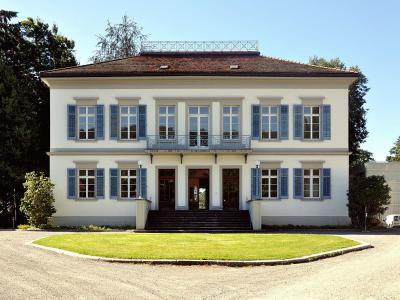
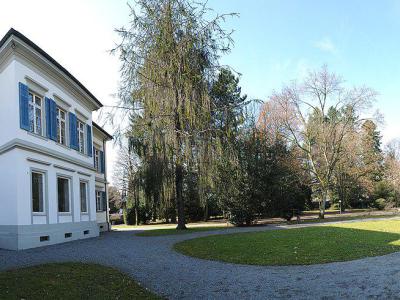
Palais Thurn and Taxis Art House is housed in a villa built in 1848 for Karl Güllich, a manufacturer of imitation jewelry from Pforzheim. The two-story building was designed in a Neoclassical style, with a hipped roof and symmetrical layout. In March 1887, Prince Gustav of Thurn and Taxis bought the property, giving it its present name. The city has owned the villa since 1915. Before becoming an art space, it was used for various municipal purposes.
Since 1953, the villa has been the seat of the Berufsvereinigung der bildenden Künstlerinnen und Künstler Vorarlbergs (Professional Association of Visual Artists of Vorarlberg). After renovations in 1983–84 by Hans Purin and Heinz Wagner, it reopened as a contemporary art centre with exhibitions that change monthly. The former gardener’s house was also restored and now contains offices, a library, an archive, and a lithography workshop.
The villa stands in a heritage-protected park of about 16,000 square meters. In the late 19th century, the grounds were turned into a landscape park and arboretum with exotic and native trees gathered by Prince Gustav and his gardener, Wenzel Smetana. Today it is considered one of the region’s important historic gardens. Inside, the 19th-century proportions and stucco remain, creating an intimate space for contemporary art.
Since 1953, the villa has been the seat of the Berufsvereinigung der bildenden Künstlerinnen und Künstler Vorarlbergs (Professional Association of Visual Artists of Vorarlberg). After renovations in 1983–84 by Hans Purin and Heinz Wagner, it reopened as a contemporary art centre with exhibitions that change monthly. The former gardener’s house was also restored and now contains offices, a library, an archive, and a lithography workshop.
The villa stands in a heritage-protected park of about 16,000 square meters. In the late 19th century, the grounds were turned into a landscape park and arboretum with exotic and native trees gathered by Prince Gustav and his gardener, Wenzel Smetana. Today it is considered one of the region’s important historic gardens. Inside, the 19th-century proportions and stucco remain, creating an intimate space for contemporary art.
9) Thurn-und-Taxis Park
Thurn-und-Taxis Park began as the garden of a villa built in 1848 for a local jewelry manufacturer. In 1884, Prince Gustav von und zu Thurn und Taxis purchased the property and, in 1887, expanded it to about 1.6 hectares. The Thurn und Taxis family is known for establishing a public postal service in the 16th century and operating European postal networks until 1867.
The property has belonged to the city since 1915. Under monument protection since 1929, the park has kept its 19th-century landscape style, with curved paths, open lawns, and mature trees. It is one of the larger public gardens on Lake Constance. Since 1953, the palace has housed Künstlerhaus Bregenz, a centre for contemporary art and the seat of the Professional Association of Fine Artists of Vorarlberg.
One of the park’s special features is its arboretum. Around 78 types of conifers and 33 types of deciduous trees grow here, including rare species such as the handkerchief tree from China. Many of the trees are over 100 years old. In 2016, panels were added to show their origin and age. The park is open all day and is mostly wheelchair accessible, though the historic palace is not barrier-free.
The property has belonged to the city since 1915. Under monument protection since 1929, the park has kept its 19th-century landscape style, with curved paths, open lawns, and mature trees. It is one of the larger public gardens on Lake Constance. Since 1953, the palace has housed Künstlerhaus Bregenz, a centre for contemporary art and the seat of the Professional Association of Fine Artists of Vorarlberg.
One of the park’s special features is its arboretum. Around 78 types of conifers and 33 types of deciduous trees grow here, including rare species such as the handkerchief tree from China. Many of the trees are over 100 years old. In 2016, panels were added to show their origin and age. The park is open all day and is mostly wheelchair accessible, though the historic palace is not barrier-free.
10) Gruenes Haus (Green House)
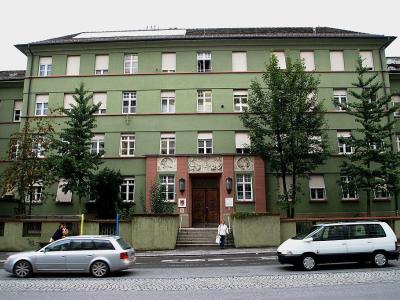
The Grünes Haus is a protected government building designed by Vorarlberg architect Willibald Braun and completed in 1926. It has served public administration from the beginning and continues to house departments of the Vorarlberg State Government. The building is officially listed as a historic monument (ObjektID 17675). Its name comes from the green colour of its façade, which makes it easy to recognize among nearby institutional buildings.
Architecturally, the structure reflects a transition in early twentieth-century public design. In official records, it is described as Neoclassical, yet it is also closely linked to the regional Heimatschutzstil, a traditionalist style common in the interwar period. The four-storey façade is symmetrical, with Ionic semi-columns, a balcony on the main floor, and a triangular gable. A 1923 mosaic by Joseph Huber-Feldkirch decorates the gable, while the overall design keeps clear classical elements without heavy ornament.
Today, the Green House remains part of the provincial government complex, with offices connected to agriculture, forestry, and environmental protection. The interior is not generally open to visitors, but the exterior offers a clear example of how public architecture in the 1920s balanced classical form, regional identity, and modern administrative needs.
Architecturally, the structure reflects a transition in early twentieth-century public design. In official records, it is described as Neoclassical, yet it is also closely linked to the regional Heimatschutzstil, a traditionalist style common in the interwar period. The four-storey façade is symmetrical, with Ionic semi-columns, a balcony on the main floor, and a triangular gable. A 1923 mosaic by Joseph Huber-Feldkirch decorates the gable, while the overall design keeps clear classical elements without heavy ornament.
Today, the Green House remains part of the provincial government complex, with offices connected to agriculture, forestry, and environmental protection. The interior is not generally open to visitors, but the exterior offers a clear example of how public architecture in the 1920s balanced classical form, regional identity, and modern administrative needs.
11) Altes Landhaus (Old Country House)
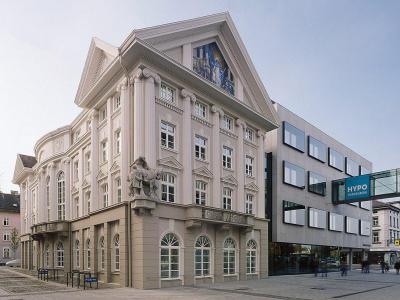
The Altes Landhaus, or Old Country House, was completed in 1921 as a government and convention building. It was designed by Austrian architect Willibald Braun in a Neoclassical style, with a symmetrical four-storey façade. Built shortly after the First World War, it reflected a desire for stability and continuity in Vorarlberg’s public life.
The front elevation is marked by Ionic columns that rise across the upper levels, giving the building a formal rhythm. A gabled roof crowns the structure, and triangular frontons reinforce its classical appearance. In 1923, additional artistic elements were introduced. The gable mosaic was created by Joseph Huber-Feldkirch, adding colour and symbolic detail to the upper façade. At the corners, sculptural works by Josef Piffrader contribute a three-dimensional presence that contrasts with the flat wall surfaces.
A distinctive feature appears in the central section of the façade, where a rounded lobe above the ground floor is framed by a projecting balcony. This subtle curve softens the otherwise strict geometry of the design. Today, the building continues to serve administrative and representative functions, and its exterior remains accessible to visitors interested in early twentieth-century civic architecture.
The front elevation is marked by Ionic columns that rise across the upper levels, giving the building a formal rhythm. A gabled roof crowns the structure, and triangular frontons reinforce its classical appearance. In 1923, additional artistic elements were introduced. The gable mosaic was created by Joseph Huber-Feldkirch, adding colour and symbolic detail to the upper façade. At the corners, sculptural works by Josef Piffrader contribute a three-dimensional presence that contrasts with the flat wall surfaces.
A distinctive feature appears in the central section of the façade, where a rounded lobe above the ground floor is framed by a projecting balcony. This subtle curve softens the otherwise strict geometry of the design. Today, the building continues to serve administrative and representative functions, and its exterior remains accessible to visitors interested in early twentieth-century civic architecture.
12) Vorarlberg Provincial Museum (must see)
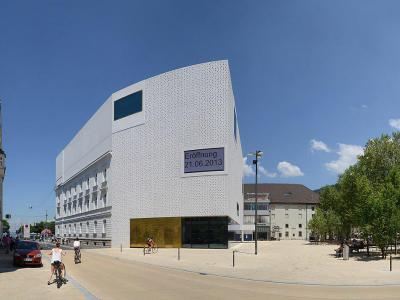
The Vorarlberg Museum presents the history of the region from early settlement to the present day. The current building opened in 2013. Its exhibitions begin with prehistoric finds and the Roman town of Brigantium, the ancient name for Bregenz. They continue through the Middle Ages, the Habsburg period, and into the 19th and 20th centuries. Special attention is given to the industrial development of the Rhine Valley and the social changes that shaped everyday life.
The exterior is one of the museum’s best-known features. The façade carries 16,656 concrete casts made from the bottoms of PET bottles. This idea was developed by architect Andreas Cukrowicz together with artist Manfred Alois Mayr. The modern concrete tower stands beside the historic Landhaus, combining old and new architecture. On the fourth floor, a large panorama window frames a view of the port and Lake Constance.
Inside, the permanent collection includes archaeological objects, church art, traditional clothing, and items from rural and urban life. Medieval wooden sculptures and painted panels show the work of local workshops. The museum also holds important works by Angelika Kauffmann, an 18th century painter with strong ties to the region. Temporary exhibitions focus on photography, modern art, and social themes, linking history with the present.
Clear texts, short films, and interactive stations make the exhibitions easy to follow, even for visitors without a strong background in history. Touchscreens show documents, maps, and photographs, while audio and video explain key events in clear language. Seating areas allow visitors to pause. On the upper floors, large windows, including the panorama window on the fourth level, face the port and Lake Constance, connecting the exhibitions with the region’s landscape and trade history.
The exterior is one of the museum’s best-known features. The façade carries 16,656 concrete casts made from the bottoms of PET bottles. This idea was developed by architect Andreas Cukrowicz together with artist Manfred Alois Mayr. The modern concrete tower stands beside the historic Landhaus, combining old and new architecture. On the fourth floor, a large panorama window frames a view of the port and Lake Constance.
Inside, the permanent collection includes archaeological objects, church art, traditional clothing, and items from rural and urban life. Medieval wooden sculptures and painted panels show the work of local workshops. The museum also holds important works by Angelika Kauffmann, an 18th century painter with strong ties to the region. Temporary exhibitions focus on photography, modern art, and social themes, linking history with the present.
Clear texts, short films, and interactive stations make the exhibitions easy to follow, even for visitors without a strong background in history. Touchscreens show documents, maps, and photographs, while audio and video explain key events in clear language. Seating areas allow visitors to pause. On the upper floors, large windows, including the panorama window on the fourth level, face the port and Lake Constance, connecting the exhibitions with the region’s landscape and trade history.
13) Kunsthaus Bregenz (Art House)
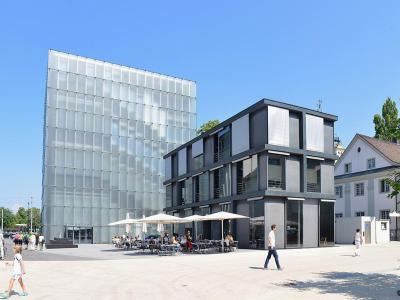
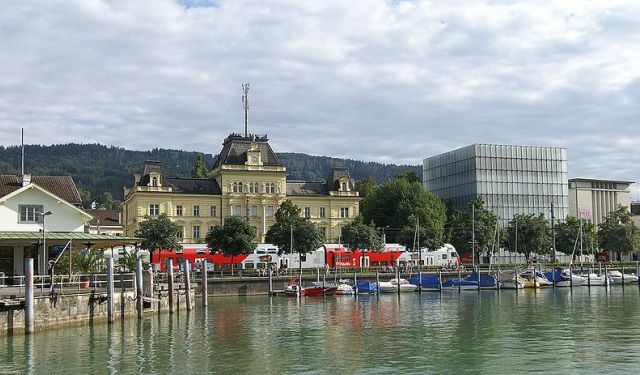
Kunsthaus Bregenz, often called KUB, opened in 1997 as a centre for international contemporary art. The building was designed by Swiss architect Peter Zumthor, who received the Pritzker Prize in 2009. From the outside, the structure appears as a simple glass cube placed near the lake. Its translucent façade is made of etched glass panels that filter daylight into the interior, giving the building a calm and measured presence.
The architecture plays a key role in the visitor experience. Behind the outer glass skin stands a solid concrete core, forming large, open exhibition floors. Natural light enters through a ceiling system that distributes it evenly across each gallery. This allows artists to adapt the space for installations, sound works, or site-specific projects. There is no permanent collection, and exhibitions change several times a year.
Over the years, Kunsthaus Bregenz has presented exhibitions by artists such as Antony Gormley, Rachel Whiteread, Ai Weiwei, and Anish Kapoor. Many projects are created specifically for the building, responding to its scale, light, and materials. The institution also publishes catalogues and hosts talks and educational programmes, functioning as a platform for contemporary art rather than a museum centred on historical collections.
The architecture plays a key role in the visitor experience. Behind the outer glass skin stands a solid concrete core, forming large, open exhibition floors. Natural light enters through a ceiling system that distributes it evenly across each gallery. This allows artists to adapt the space for installations, sound works, or site-specific projects. There is no permanent collection, and exhibitions change several times a year.
Over the years, Kunsthaus Bregenz has presented exhibitions by artists such as Antony Gormley, Rachel Whiteread, Ai Weiwei, and Anish Kapoor. Many projects are created specifically for the building, responding to its scale, light, and materials. The institution also publishes catalogues and hosts talks and educational programmes, functioning as a platform for contemporary art rather than a museum centred on historical collections.
14) Nepomukkapelle (St. Nepomuk Chapel) (must see)
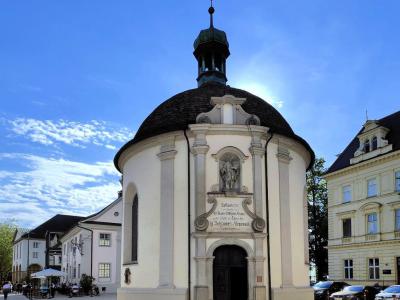
Nepomukkapelle was built in 1757 as a votive chapel. It was commissioned by Dr. Franz Wilhelm Haas after he narrowly escaped drowning in Lake Constance. In the 18th century, such gratitude buildings were common among wealthy citizens who survived illness, accidents, or other dangers. The dedication to Saint John of Nepomuk reflects this personal story, linking the chapel directly to the theme of protection from water.
Saint John of Nepomuk, a 14th-century priest from Bohemia, was thrown into the Vltava River in 1393 after refusing to reveal the queen’s confession. Because of this legend, he became a symbol of loyalty to the seal of confession and a protector against floods and drowning. Devotion to him spread widely across the Habsburg territories during the 18th century, which explains the construction of chapels like this one.
Architecturally, the building is a Rococo rotunda crowned with a dome cupola. Its circular form sets it apart from surrounding rectangular houses. Above the arched portal stands a sandstone statue of the saint. He is typically shown holding a crucifix or with his finger placed to his lips, a gesture symbolizing silence and confession. This statue clearly marks the chapel’s dedication.
Inside, the chapel is small, with space for about 30 people. The altar is richly decorated, and Rococo frescoes depict Saint Nepomuk together with the Virgin Mary, John the Evangelist, and Saint Francis of Assisi. Light from the windows beneath the dome highlights the painted surfaces and carved details.
The chapel stands at the transition between the modern centre and the lakefront, near the harbour area. In this position, it acts almost like a symbolic gatekeeper for those arriving from the water. Restored between 1995 and 1997, it now serves the local Hungarian Catholic community while preserving its 18th-century character.
Saint John of Nepomuk, a 14th-century priest from Bohemia, was thrown into the Vltava River in 1393 after refusing to reveal the queen’s confession. Because of this legend, he became a symbol of loyalty to the seal of confession and a protector against floods and drowning. Devotion to him spread widely across the Habsburg territories during the 18th century, which explains the construction of chapels like this one.
Architecturally, the building is a Rococo rotunda crowned with a dome cupola. Its circular form sets it apart from surrounding rectangular houses. Above the arched portal stands a sandstone statue of the saint. He is typically shown holding a crucifix or with his finger placed to his lips, a gesture symbolizing silence and confession. This statue clearly marks the chapel’s dedication.
Inside, the chapel is small, with space for about 30 people. The altar is richly decorated, and Rococo frescoes depict Saint Nepomuk together with the Virgin Mary, John the Evangelist, and Saint Francis of Assisi. Light from the windows beneath the dome highlights the painted surfaces and carved details.
The chapel stands at the transition between the modern centre and the lakefront, near the harbour area. In this position, it acts almost like a symbolic gatekeeper for those arriving from the water. Restored between 1995 and 1997, it now serves the local Hungarian Catholic community while preserving its 18th-century character.
15) Kornmarktstrasse No. 7
Kornmarktstrasse No. 7 stands in the historic Kornmarkt quarter, which took shape as a grain market in the 16th century. Farmers and merchants once met here to trade cereals, and many of the surrounding buildings combined storage, small shops, and living spaces on narrow plots. Number 7 grew out of this commercial setting and still reflects that long history.
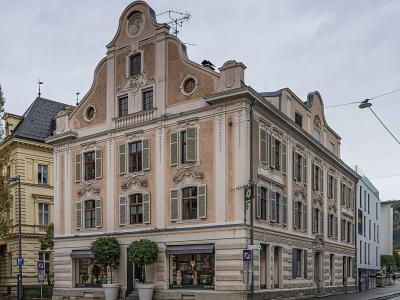
The building is known for its Late Baroque, or Neo-Baroque, style. Its current look comes mainly from a major renovation completed in 1896. The façade is easy to recognise thanks to its mix of circular and rectangular windows. A Madonna sculpture placed in a round niche is the most noticeable detail, showing how religious symbols were often included on homes at that time.
Right across the square are the Vorarlberg Museum and the Landestheater Bregenz. The museum’s modern concrete exterior stands in clear contrast to the older Neo-Baroque design of Number 7. Today, the ground floor is home to the 4D OUTFITTERS Concept Store, which sells design objects and niche perfumes, while the upper floors remain residential.
The building is known for its Late Baroque, or Neo-Baroque, style. Its current look comes mainly from a major renovation completed in 1896. The façade is easy to recognise thanks to its mix of circular and rectangular windows. A Madonna sculpture placed in a round niche is the most noticeable detail, showing how religious symbols were often included on homes at that time.
Right across the square are the Vorarlberg Museum and the Landestheater Bregenz. The museum’s modern concrete exterior stands in clear contrast to the older Neo-Baroque design of Number 7. Today, the ground floor is home to the 4D OUTFITTERS Concept Store, which sells design objects and niche perfumes, while the upper floors remain residential.
16) Port Bregenz
Port Bregenz has long been shaped by Lake Constance, also called the Bodensee. The lake linked Austria, Germany, and Switzerland and made trade easier than crossing mountain passes like the Arlberg. In 1824, the first successful steamship service began with the Wilhelm, connecting Friedrichshafen and Romanshorn and helping goods such as salt, grain, and timber move faster and more reliably.
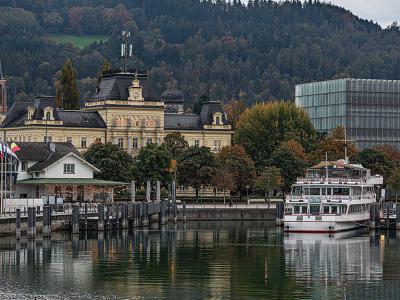
Today, the harbour remains active. The “White Fleet” brings together Austrian, German, and Swiss passenger ships that run regular summer routes. Lindau and Friedrichshafen are among the main destinations from the pier. The marina is also a key sailing centre. Winds such as the Föhn, a warm, dry wind from the south, can create sudden strong waves, making sailing here challenging.
Next to the pier stands the Seebühne, the lake stage of the Bregenzer Festspiele. It holds about 7,000 spectators and is known as the largest floating stage in the world. Although it appears to float, it is built on a fixed concrete foundation anchored deep into the lake bed, while the seating area stands on land. Each opera runs for two summers, shaping the waterfront. The Molo, redesigned around 2009–2010, is a popular evening meeting place.
Today, the harbour remains active. The “White Fleet” brings together Austrian, German, and Swiss passenger ships that run regular summer routes. Lindau and Friedrichshafen are among the main destinations from the pier. The marina is also a key sailing centre. Winds such as the Föhn, a warm, dry wind from the south, can create sudden strong waves, making sailing here challenging.
Next to the pier stands the Seebühne, the lake stage of the Bregenzer Festspiele. It holds about 7,000 spectators and is known as the largest floating stage in the world. Although it appears to float, it is built on a fixed concrete foundation anchored deep into the lake bed, while the seating area stands on land. Each opera runs for two summers, shaping the waterfront. The Molo, redesigned around 2009–2010, is a popular evening meeting place.
17) Bregenz Promenad (Lake Promenade) (must see)
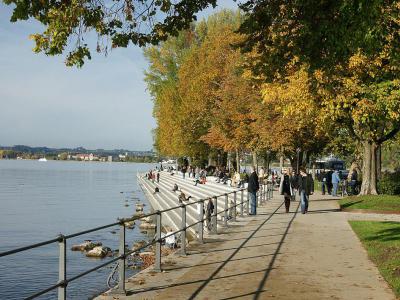
The Bregenz Promenad, also known as the Lake Promenade, follows the eastern shore of Lake Constance (Bodensee), where Austria meets Germany and Switzerland. It developed in the late nineteenth century, when the lakeside shifted from trade to leisure. With improved rail connections and growing tourism, the waterfront became a public space for walking and social life, and it remains closely tied to the town’s cultural identity.
The path runs beside calm water, with views across the wide surface of the lake toward distant Alpine peaks. Boats move in and out of the harbour, connecting nearby countries and towns around the shoreline. The promenade is lined with trees that provide shade in summer, along with benches and open lawns where people gather. The change of light over the lake, especially in the early evening, gives the area a steady rhythm that shifts with the weather and the seasons.
One of the main landmarks along the promenade is the floating stage of the Bregenzer Festspiele. Built directly on the water, it hosts large-scale opera productions each summer. The stage design changes every two years and often includes bold architectural elements that rise above the lake. Even outside festival season, the structure remains visible from the promenade and draws attention to the town’s long-standing connection to music and theatre.
Visitors often combine a walk here with time in nearby parks, cafés, or boat excursions across the lake. The area is easy to explore on foot, offering open views, fresh air, and a clear sense of how nature and cultural life meet along the shoreline.
The path runs beside calm water, with views across the wide surface of the lake toward distant Alpine peaks. Boats move in and out of the harbour, connecting nearby countries and towns around the shoreline. The promenade is lined with trees that provide shade in summer, along with benches and open lawns where people gather. The change of light over the lake, especially in the early evening, gives the area a steady rhythm that shifts with the weather and the seasons.
One of the main landmarks along the promenade is the floating stage of the Bregenzer Festspiele. Built directly on the water, it hosts large-scale opera productions each summer. The stage design changes every two years and often includes bold architectural elements that rise above the lake. Even outside festival season, the structure remains visible from the promenade and draws attention to the town’s long-standing connection to music and theatre.
Visitors often combine a walk here with time in nearby parks, cafés, or boat excursions across the lake. The area is easy to explore on foot, offering open views, fresh air, and a clear sense of how nature and cultural life meet along the shoreline.
Walking Tours in Bregenz, Austria

Create Your Own Walk in Bregenz
Creating your own self-guided walk in Bregenz is easy and fun. Choose the city attractions that you want to see and a walk route map will be created just for you. You can even set your hotel as the start point of the walk.
Historical Buildings in Bregenz
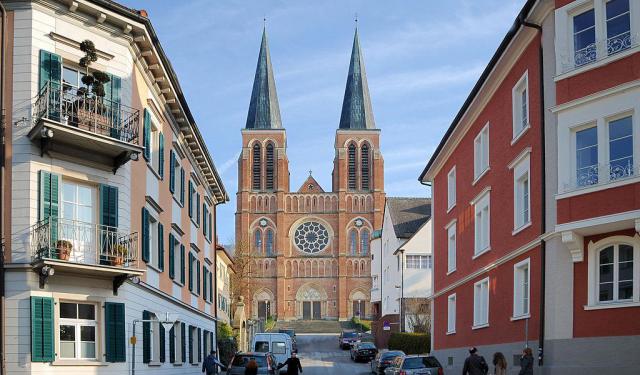
Bregenz is home to many historic buildings, several of which were built between the 13th and 16th centuries. Federal High School, the Vorarlberg Land Theater and City Hall, located near the harbor, are landmarks of the Lower Town. Take the following tour to discover Bregenz’s best historic architecture.
Tour Duration: 3 Hour(s)
Travel Distance: 5.5 Km or 3.4 Miles
Tour Duration: 3 Hour(s)
Travel Distance: 5.5 Km or 3.4 Miles
The Most Popular Cities
/ view all