


Fontana di Orione (Orion Fountain), Messina
The Fountain of Orion, created by Giovanni Angelo Montorsoli in 1553, is a masterpiece of Renaissance sculpture and one of the most remarkable fountains of the 16th century. Located in Cathedral Square, it was commissioned by the city’s Senate to commemorate the completion of Messina’s first aqueduct, a major achievement in the city’s infrastructure.
Montorsoli, a disciple of Michelangelo, designed the fountain in collaboration with sculptor Domenico Vanello, combining artistic beauty with elaborate symbolism. Renowned art historian Bernard Berenson praised it as “the most beautiful fountain of the sixteenth century.”
Located directly opposite the cathedral’s bell tower, the fountain’s pyramidal composition is rich in Neoplatonic and mythological symbolism, with Orion-the mythical founder of Messina-standing at the top, accompanied by his dog, Sirius. Below him, four cherubs ride dolphins, sending streams of water into the tiers beneath them. Farther down, naiads and tritons symbolize the close relationship between humanity and the sea.
The large dodecagonal basin features four statues personifying the Nile, Tiber, Ebro and Camaro rivers. The last of these represents the local stream whose waters were brought to Messina through the new aqueduct. The Camaro can be distinguished from the other three rivers by the bas-relief beneath its statue, which depicts a young crowned woman personifying the city of Messina as she welcomes the stream through the city gates. Surrounding the four statues are eight bas-reliefs inspired by Ovid’s Metamorphoses, depicting mythological stories associated with water.
The entire composition celebrates Messina’s connection to water, both as a practical necessity and as an important element of its mythology. Dark-stone marine creatures, smaller basins and aquatic figures add movement and variety to the elaborate design. The scholar Francesco Maurolico is believed to have contributed to the fountain’s complex iconography and composed the Latin inscriptions beneath the river statues. Take a slow walk around the base of the fountain to examine these inscriptions and appreciate the intricate marine figures from every angle.
Want to visit this sight? Check out these Self-Guided Walking Tours in Messina. Alternatively, you can download the mobile app "GPSmyCity: Walks in 1K+ Cities" from Apple App Store or Google Play Store. The app turns your mobile device to a personal tour guide and it works offline, so no data plan is needed when traveling abroad.
Download The GPSmyCity App



Fontana di Orione (Orion Fountain) on Map
Sight Name: Fontana di Orione (Orion Fountain)
Sight Location: Messina, Italy (See walking tours in Messina)
Sight Type: Statue/Public Art
Guide(s) Containing This Sight:
Sight Location: Messina, Italy (See walking tours in Messina)
Sight Type: Statue/Public Art
Guide(s) Containing This Sight:
Nearby Sights





Walking Tours in Messina, Italy
Create Your Own Walk in Messina
Creating your own self-guided walk in Messina is easy and fun. Choose the city attractions that you want to see and a walk route map will be created just for you. You can even set your hotel as the start point of the walk.
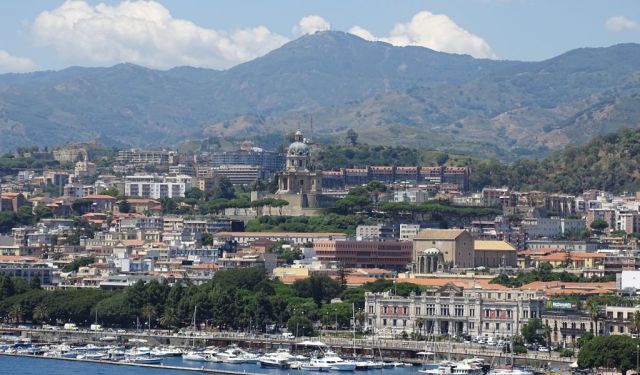
Messina Introduction Walking Tour
When German writer Johann Wolfgang von Goethe arrived in Messina in 1787, he traveled past “ruin after ruin” before reaching his inn. He encountered a city still scarred by a devastating earthquake four years earlier.
Messina, standing at the northeastern tip of Sicily beside the narrow strait separating the island from mainland Italy, has been shaped by the sea for nearly three thousand... view more
Tour Duration: 2 Hours
Travel Distance: 3.4 Km or 2.1 Miles
Messina, standing at the northeastern tip of Sicily beside the narrow strait separating the island from mainland Italy, has been shaped by the sea for nearly three thousand... view more
Tour Duration: 2 Hours
Travel Distance: 3.4 Km or 2.1 Miles
City Walks Overview
