

Fontanna della Vergogna (Fountain of Shame), Palermo (must see)
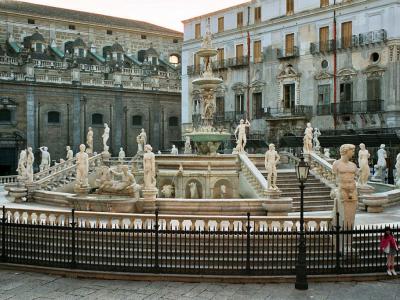
The monumental fountain, crowded with nude figures, gods, animals, and mythological creatures, was originally designed as a garden fountain in Florence. It was commissioned around 1554 by Luigi de Toledo, a Florentine nobleman. When Luigi later ran into serious financial trouble, he was forced to sell the fountain.
The work was designed by the Florentine sculptor Francesco Camilliani and originally consisted of dozens of statues arranged around concentric basins, connected by an elaborate hydraulic system. Because of its size and complexity, the fountain had to be dismantled, shipped by sea, and reassembled. Despite the challenges, the Senate of Palermo purchased the fountain in 1573, convinced it would lend prestige to the city.
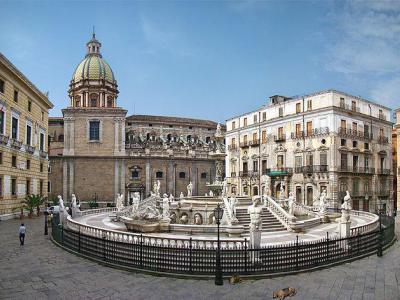
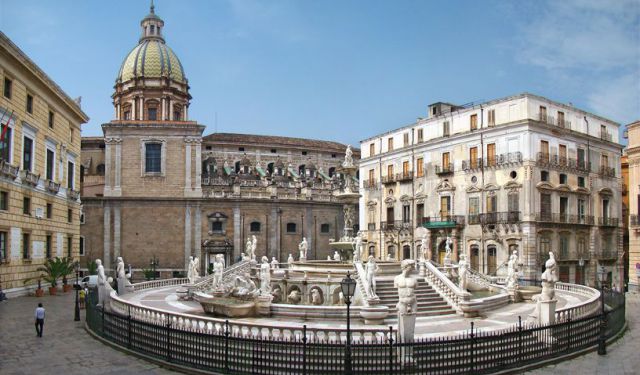
An outer stone ring encloses a water-filled basin, separated from the central area by a shallow moat. Stone steps bridge the water, allowing visitors to enter the inner circle. Here, classical deities preside over the scene, while animals and fantastical figures populate the lower levels, many of them designed as water spouts, with open mouths spraying jets of water.
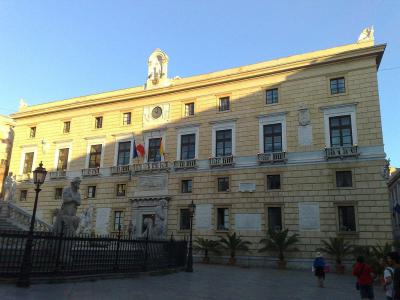
In Palermo, however, the fountain’s reception was mixed. During the 18th and 19th centuries, its abundance of nude figures clashed with local sensibilities. Popular tradition claims that nearby nuns damaged some statues by breaking off anatomically explicit details. A more convincing explanation links the nickname to the Praetorian Palace itself, which by that time had become a symbol of municipal corruption and misrule. The naked statues were seen as a satirical mirror of shameless civic life.
In the end, both interpretations stuck. The square became known as Pretoria Square, while the fountain earned its enduring nickname: the Fountain of Shame.
The work was designed by the Florentine sculptor Francesco Camilliani and originally consisted of dozens of statues arranged around concentric basins, connected by an elaborate hydraulic system. Because of its size and complexity, the fountain had to be dismantled, shipped by sea, and reassembled. Despite the challenges, the Senate of Palermo purchased the fountain in 1573, convinced it would lend prestige to the city.
An outer stone ring encloses a water-filled basin, separated from the central area by a shallow moat. Stone steps bridge the water, allowing visitors to enter the inner circle. Here, classical deities preside over the scene, while animals and fantastical figures populate the lower levels, many of them designed as water spouts, with open mouths spraying jets of water.
In Palermo, however, the fountain’s reception was mixed. During the 18th and 19th centuries, its abundance of nude figures clashed with local sensibilities. Popular tradition claims that nearby nuns damaged some statues by breaking off anatomically explicit details. A more convincing explanation links the nickname to the Praetorian Palace itself, which by that time had become a symbol of municipal corruption and misrule. The naked statues were seen as a satirical mirror of shameless civic life.
In the end, both interpretations stuck. The square became known as Pretoria Square, while the fountain earned its enduring nickname: the Fountain of Shame.
Want to visit this sight? Check out these Self-Guided Walking Tours in Palermo. Alternatively, you can download the mobile app "GPSmyCity: Walks in 1K+ Cities" from Apple App Store or Google Play Store. The app turns your mobile device to a personal tour guide and it works offline, so no data plan is needed when traveling abroad.
Download The GPSmyCity App



Fontanna della Vergogna (Fountain of Shame) on Map
Sight Name: Fontanna della Vergogna (Fountain of Shame)
Sight Location: Palermo, Italy (See walking tours in Palermo)
Sight Type: Attraction/Landmark
Guide(s) Containing This Sight:
Sight Location: Palermo, Italy (See walking tours in Palermo)
Sight Type: Attraction/Landmark
Guide(s) Containing This Sight:
Nearby Sights
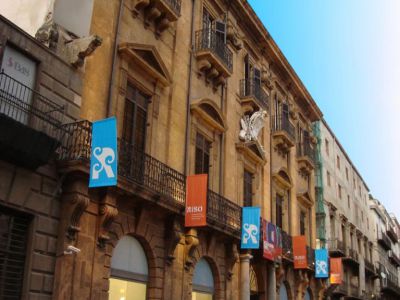
Walking Tours in Palermo, Italy

Create Your Own Walk in Palermo
Creating your own self-guided walk in Palermo is easy and fun. Choose the city attractions that you want to see and a walk route map will be created just for you. You can even set your hotel as the start point of the walk.
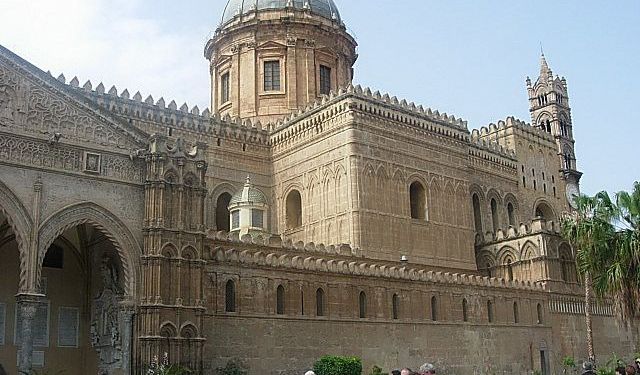
Historical Religious Buildings
Religion has always played an important role in the lives of the Italians – and the Sicilians are no exception. Thus, it is little wonder that the main city of the island, Palermo, boasts a plethora of religious buildings. The collection of historical churches found here ranges from the Arab-Norman-Byzantine to the Medieval, Gothic, Baroque and the Renaissance.
In the course of history, many... view more
Tour Duration: 2 Hour(s)
Travel Distance: 3.2 Km or 2 Miles
In the course of history, many... view more
Tour Duration: 2 Hour(s)
Travel Distance: 3.2 Km or 2 Miles
A Walk In Palermo's Historic Yet Lively City Center
The German polymath Johann Wolfgang von Goethe, who visited Sicily in 1787, wrote: “To have seen Italy without having seen Sicily is not to have seen Italy at all, for Sicily is the key to everything.”, Palermo being his main reference point.
Palermo’s story begins with a trading post established by the ancient Phoenician civilization around the 8th century BCE. The Phoenicians called it... view more
Tour Duration: 2 Hour(s)
Travel Distance: 3.1 Km or 1.9 Miles
Palermo’s story begins with a trading post established by the ancient Phoenician civilization around the 8th century BCE. The Phoenicians called it... view more
Tour Duration: 2 Hour(s)
Travel Distance: 3.1 Km or 1.9 Miles
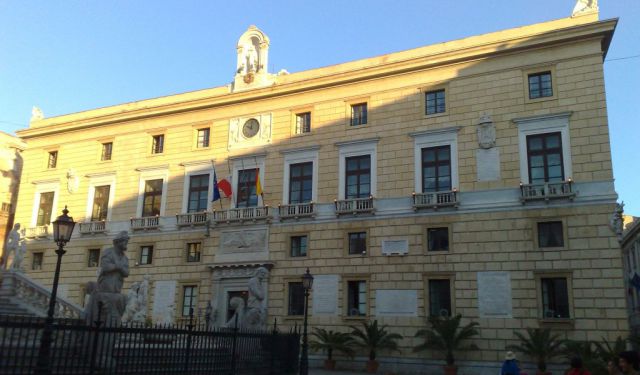
Palaces of Palermo
For centuries, Sicilian capital Palermo has been a focal point for the construction of noble dwellings and palaces. The latter were and still are a fine manifestation of the historical life in the region. They are a few hundred of them still in place, ranging chronologically from the medieval period to the first decades of the 20th century, and comprising an impressive collection of architectural... view more
Tour Duration: 1 Hour(s)
Travel Distance: 2.6 Km or 1.6 Miles
Tour Duration: 1 Hour(s)
Travel Distance: 2.6 Km or 1.6 Miles