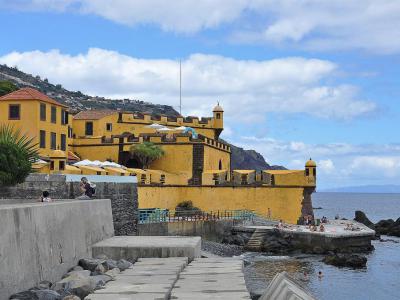


Forte de São Tiago (Saint James Fort), Funchal
There was a time when Portugal dominated the commercial routes of the North Atlantic, and the safety of Funchal seemed assured. Who would want to attack an isolated island in the mid-ocean? Someone did. In 1566, French corsairs under aristocrate Bertrand de Montluc ravaged the undefended port for several days, looting churches, burning homes, and killing many residents. The danger was real and recurring, yet Funchal was not fortified until 1614, decades after the attack.
Construction of the fortress began under the direction of master builder Jerónimo Jorge, the royal engineer responsible for several military projects in Madeira. The work was continued later by his son, Bartolomeu João, and by the Italian-born engineer Tossi Columbano, who also contributed to the development of the Port of Funchal. By the mid-18th century, the fort’s main defensive structures were considered complete, including the thick walls, battlements, and sea-facing gun platforms.
As pirate and privateer activity diminished, the fort took on new roles. It served as a base for British troops during the Peninsular War in the early 19th century, when Portugal and Britain were allied against Napoleonic France. Later, the military police and the Funchal Lancers were quartered within its walls. In 1803, after catastrophic floods swept through Funchal, the fort provided emergency shelter for hundreds of displaced families. Its role shifted again in 1901, when King Carlos I and Queen Amélie visited Madeira and were formally received here, taking lunch under a tent in the courtyard.
Today, Saint James Fort is open to visitors and remains one of Funchal’s most recognizable historical landmarks. Travelers can walk freely into the courtyard, explore the ramparts overlooking the Atlantic, and view small military displays inside the former barracks. Parts of the interior host rotating cultural exhibitions, and the seaside terrace-now occupied by a restaurant-offers some of the best panoramic views along Madeira’s coast.
Construction of the fortress began under the direction of master builder Jerónimo Jorge, the royal engineer responsible for several military projects in Madeira. The work was continued later by his son, Bartolomeu João, and by the Italian-born engineer Tossi Columbano, who also contributed to the development of the Port of Funchal. By the mid-18th century, the fort’s main defensive structures were considered complete, including the thick walls, battlements, and sea-facing gun platforms.
As pirate and privateer activity diminished, the fort took on new roles. It served as a base for British troops during the Peninsular War in the early 19th century, when Portugal and Britain were allied against Napoleonic France. Later, the military police and the Funchal Lancers were quartered within its walls. In 1803, after catastrophic floods swept through Funchal, the fort provided emergency shelter for hundreds of displaced families. Its role shifted again in 1901, when King Carlos I and Queen Amélie visited Madeira and were formally received here, taking lunch under a tent in the courtyard.
Today, Saint James Fort is open to visitors and remains one of Funchal’s most recognizable historical landmarks. Travelers can walk freely into the courtyard, explore the ramparts overlooking the Atlantic, and view small military displays inside the former barracks. Parts of the interior host rotating cultural exhibitions, and the seaside terrace-now occupied by a restaurant-offers some of the best panoramic views along Madeira’s coast.
Want to visit this sight? Check out these Self-Guided Walking Tours in Funchal. Alternatively, you can download the mobile app "GPSmyCity: Walks in 1K+ Cities" from Apple App Store or Google Play Store. The app turns your mobile device to a personal tour guide and it works offline, so no data plan is needed when traveling abroad.
Download The GPSmyCity App



Forte de São Tiago (Saint James Fort) on Map
Sight Name: Forte de São Tiago (Saint James Fort)
Sight Location: Funchal, Portugal (See walking tours in Funchal)
Sight Type: Attraction/Landmark
Guide(s) Containing This Sight:
Sight Location: Funchal, Portugal (See walking tours in Funchal)
Sight Type: Attraction/Landmark
Guide(s) Containing This Sight:
Nearby Sights

Walking Tours in Funchal, Portugal

Create Your Own Walk in Funchal
Creating your own self-guided walk in Funchal is easy and fun. Choose the city attractions that you want to see and a walk route map will be created just for you. You can even set your hotel as the start point of the walk.
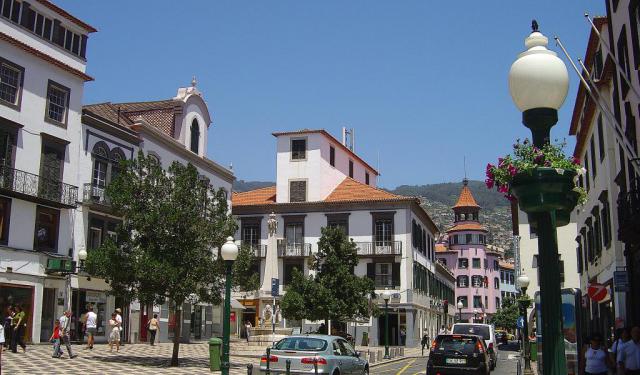
Funchal Old Town Walking Tour
Empress Elisabeth of Austria spent time in Funchal in the late 19th century seeking rest and relief from illness. She reportedly referred to Madeira as “the island of eternal spring.”
Funchal, the capital of Madeira, traces its origins to the early decades of Portuguese expansion in the Atlantic. The island was officially settled in the early 15th century after captains serving Portuguese... view more
Tour Duration: 1 Hour(s)
Travel Distance: 2.0 Km or 1.2 Miles
Funchal, the capital of Madeira, traces its origins to the early decades of Portuguese expansion in the Atlantic. The island was officially settled in the early 15th century after captains serving Portuguese... view more
Tour Duration: 1 Hour(s)
Travel Distance: 2.0 Km or 1.2 Miles
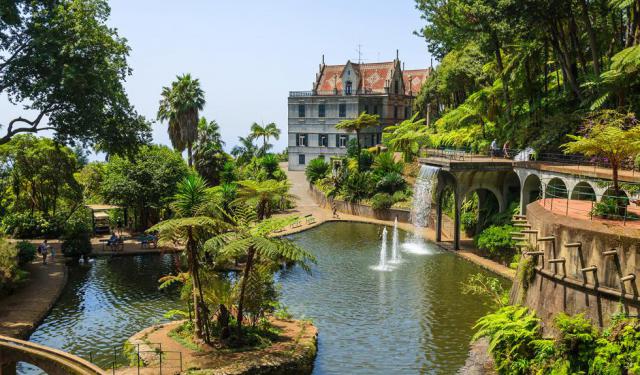
Monte Walking Tour
Monte, a spectacular hilltop area 550 meters above sea level in the northeast of Funchal, is a favored destination for many tourists visiting Madeira. Getting to and from Monte – up on the cable car and down on an exhilarating dry toboggan run – is only half the fun. The other half is exploring the unique blend of natural beauty and cultural attractions found in the area.
One of the... view more
Tour Duration: 1 Hour(s)
Travel Distance: 0.4 Km or 0.2 Miles
One of the... view more
Tour Duration: 1 Hour(s)
Travel Distance: 0.4 Km or 0.2 Miles