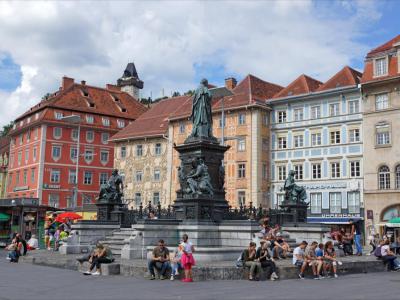


Hauptplatz (Main Square), Graz (must see)
The Main Square has been the heart of Graz since around 1160, when it was laid out by Duke Otakar III. For centuries, this broad market square served as the city's commercial, social, and political center, drawing merchants, travelers, and locals.
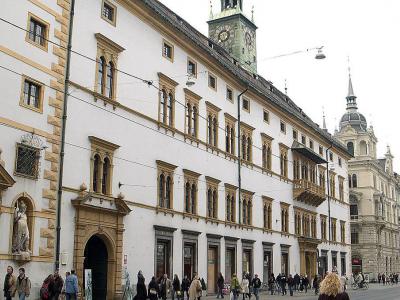
The square's distinctive trapezoidal shape reflects its medieval origins. It is surrounded by historic buildings dating from the medieval and late Gothic periods, although many façades were later remodeled in the Baroque and Biedermeier styles. Among the notable buildings are the White House, built in 1710; the Eagle Pharmacy, dating from 1535; and the Citizens' Home to the Great Christoph, which dates from the 17th century.
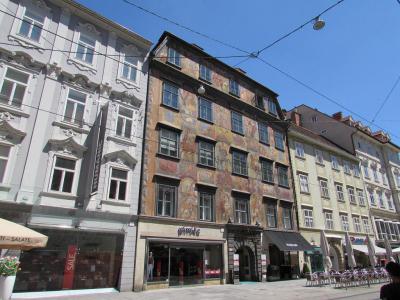
However, the architectural highlight is undoubtedly Luegg House, a 15th-century building famous for its richly decorated stucco façade and elegant arcades. To make sure you do not miss this masterpiece, stand at the busy northern corner of the square, where the house's façade wraps around the corner and continues onto Spur Street. The stucco façade is covered in deep, flowing floral scrollwork, leaves, and cleverly hidden human faces. Trace the heavy plaster fruit and flower garlands framing the windows, where, if you look closely, you will spot mouths, noses, and expressive faces emerging from the stone foliage.
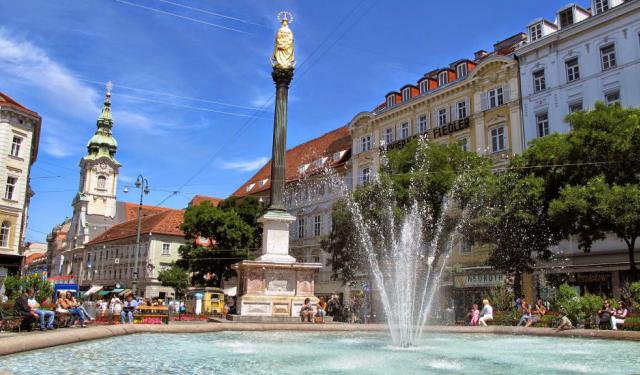
Dominating the northern half of the square since 1878 is the Archduke Johann Fountain. The landmark stands just clear of the central tram tracks, so simply walk toward the base of the fountain. The monument honors Archduke Johann of Austria, one of Styria's most beloved historical figures. Around the central statue stand four female figures representing the region's principal rivers: the Mur, Enns, Drava, and Sann. Allegorical bronze reliefs decorate the pedestal, while fountain basins occupy the four corners.
Not all of the square's history was pleasant. Until the late 18th century, it served as a venue for public punishments, including pillorying and executions. Commoners were often punished in full view of the crowd here, while nobles were typically executed inside the Town Hall. Speaking of which, its main portal is the final highlight. Look directly across the southern edge of the square to locate the Town Hall's grand, palatial entrance, which frames the building's deeply arched front doors. This late 19th-century Historicist entrance is flanked by classical stone columns and ornate balconies, reflecting the architectural ambition of Graz's golden age.
The square's distinctive trapezoidal shape reflects its medieval origins. It is surrounded by historic buildings dating from the medieval and late Gothic periods, although many façades were later remodeled in the Baroque and Biedermeier styles. Among the notable buildings are the White House, built in 1710; the Eagle Pharmacy, dating from 1535; and the Citizens' Home to the Great Christoph, which dates from the 17th century.
However, the architectural highlight is undoubtedly Luegg House, a 15th-century building famous for its richly decorated stucco façade and elegant arcades. To make sure you do not miss this masterpiece, stand at the busy northern corner of the square, where the house's façade wraps around the corner and continues onto Spur Street. The stucco façade is covered in deep, flowing floral scrollwork, leaves, and cleverly hidden human faces. Trace the heavy plaster fruit and flower garlands framing the windows, where, if you look closely, you will spot mouths, noses, and expressive faces emerging from the stone foliage.
Dominating the northern half of the square since 1878 is the Archduke Johann Fountain. The landmark stands just clear of the central tram tracks, so simply walk toward the base of the fountain. The monument honors Archduke Johann of Austria, one of Styria's most beloved historical figures. Around the central statue stand four female figures representing the region's principal rivers: the Mur, Enns, Drava, and Sann. Allegorical bronze reliefs decorate the pedestal, while fountain basins occupy the four corners.
Not all of the square's history was pleasant. Until the late 18th century, it served as a venue for public punishments, including pillorying and executions. Commoners were often punished in full view of the crowd here, while nobles were typically executed inside the Town Hall. Speaking of which, its main portal is the final highlight. Look directly across the southern edge of the square to locate the Town Hall's grand, palatial entrance, which frames the building's deeply arched front doors. This late 19th-century Historicist entrance is flanked by classical stone columns and ornate balconies, reflecting the architectural ambition of Graz's golden age.
Want to visit this sight? Check out these Self-Guided Walking Tours in Graz. Alternatively, you can download the mobile app "GPSmyCity: Walks in 1K+ Cities" from Apple App Store or Google Play Store. The app turns your mobile device to a personal tour guide and it works offline, so no data plan is needed when traveling abroad.
Download The GPSmyCity App



Hauptplatz (Main Square) on Map
Sight Name: Hauptplatz (Main Square)
Sight Location: Graz, Austria (See walking tours in Graz)
Sight Type: Attraction/Landmark
Guide(s) Containing This Sight:
Sight Location: Graz, Austria (See walking tours in Graz)
Sight Type: Attraction/Landmark
Guide(s) Containing This Sight:
Nearby Sights
Walking Tours in Graz, Austria

Create Your Own Walk in Graz
Creating your own self-guided walk in Graz is easy and fun. Choose the city attractions that you want to see and a walk route map will be created just for you. You can even set your hotel as the start point of the walk.
Graz Old Town Walking Tour
Before humanity understood how planets move, the renowned astronomer Johannes Kepler was studying the skies from Graz between 1594 and 1600. During his time here, he developed ideas that would eventually lead to his revolutionary laws of planetary motion.
Graz, the capital of the Austrian state of Styria, has a history stretching back more than a thousand years. Its name derives from the Slavic... view more
Tour Duration: 2 Hour(s)
Travel Distance: 3.0 Km or 1.9 Miles
Graz, the capital of the Austrian state of Styria, has a history stretching back more than a thousand years. Its name derives from the Slavic... view more
Tour Duration: 2 Hour(s)
Travel Distance: 3.0 Km or 1.9 Miles