

Independence Square and Four Corner Sculptures, Charlotte
Independence Square marks the historic heart of Charlotte, located at the intersection of Trade Street and Tryon Street in the city’s Uptown district. The crossroads traces its origins to the mid-1700s, when two Native American trading paths intersected here, forming the center of Charlotte’s earliest settlement. Over time the intersection became the focal point of the city’s commercial and civic life. The square takes its name from the Mecklenburg Declaration of Independence, reportedly signed nearby on May 20, 1775, when local leaders declared independence from Britain more than a year before the national Declaration of Independence.
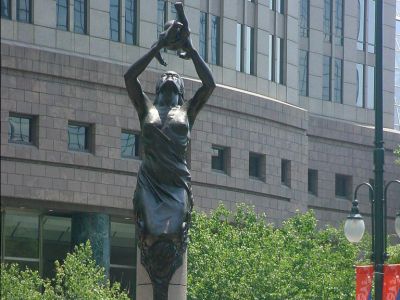
One of the most notable features of the square today is the set of Four Corner Sculptures, installed in 1995 and designed by sculptor Raymond Kaskey. Each of the four large bronze statues stands atop a granite column at one corner of the intersection and represents a key force that shaped Charlotte’s development. The statues symbolize Commerce, Industry, Transportation, and the Future, reflecting the economic and social foundations of the city’s growth.
The sculptures contain symbolic details connected with Charlotte’s history. The Commerce figure depicts a gold prospector, referencing the nearby discovery of gold and the establishment of a U.S. Mint in the 19th century. Industry is represented by a textile mill worker and child, recalling the region’s once-dominant textile industry. Transportation honors the workers who built the railroads that helped Charlotte expand into a major regional hub. The final sculpture, representing the Future, shows a mother lifting her child, symbolizing hope and the city’s continuing growth.
Together, Independence Square and its monumental sculptures serve as a symbolic crossroads of Charlotte’s past, present, and future.
One of the most notable features of the square today is the set of Four Corner Sculptures, installed in 1995 and designed by sculptor Raymond Kaskey. Each of the four large bronze statues stands atop a granite column at one corner of the intersection and represents a key force that shaped Charlotte’s development. The statues symbolize Commerce, Industry, Transportation, and the Future, reflecting the economic and social foundations of the city’s growth.
The sculptures contain symbolic details connected with Charlotte’s history. The Commerce figure depicts a gold prospector, referencing the nearby discovery of gold and the establishment of a U.S. Mint in the 19th century. Industry is represented by a textile mill worker and child, recalling the region’s once-dominant textile industry. Transportation honors the workers who built the railroads that helped Charlotte expand into a major regional hub. The final sculpture, representing the Future, shows a mother lifting her child, symbolizing hope and the city’s continuing growth.
Together, Independence Square and its monumental sculptures serve as a symbolic crossroads of Charlotte’s past, present, and future.
Want to visit this sight? Check out these Self-Guided Walking Tours in Charlotte. Alternatively, you can download the mobile app "GPSmyCity: Walks in 1K+ Cities" from Apple App Store or Google Play Store. The app turns your mobile device to a personal tour guide and it works offline, so no data plan is needed when traveling abroad.
Download The GPSmyCity App



Independence Square and Four Corner Sculptures on Map
Sight Name: Independence Square and Four Corner Sculptures
Sight Location: Charlotte, USA (See walking tours in Charlotte)
Sight Type: Attraction/Landmark
Guide(s) Containing This Sight:
Sight Location: Charlotte, USA (See walking tours in Charlotte)
Sight Type: Attraction/Landmark
Guide(s) Containing This Sight:
Nearby Sights




Walking Tours in Charlotte, North Carolina

Create Your Own Walk in Charlotte
Creating your own self-guided walk in Charlotte is easy and fun. Choose the city attractions that you want to see and a walk route map will be created just for you. You can even set your hotel as the start point of the walk.

Charlotte Uptown Walking Tour
Charlotte, the largest city in North Carolina, traces its origins to the mid-18th century, during a period of westward colonial expansion. European settlers, primarily Scots-Irish and German immigrants, established small communities in the region, which was then part of the British colony of North Carolina. The settlement grew along trading paths and near the Catawba and other local Native... view more
Tour Duration: 1 Hour(s)
Travel Distance: 2.2 Km or 1.4 Miles
Tour Duration: 1 Hour(s)
Travel Distance: 2.2 Km or 1.4 Miles

Historical Churches
Charlotte, North Carolina, is home to a variety of religious sites, representing a range of religious denominations. The city's historical churches date mostly to the first half of the 19th century and stand as both spiritual sanctuaries and architectural landmarks.
One of the notable places of worship in Charlotte is Saint Peter's Catholic Church. Founded in 1851, it boasts a... view more
Tour Duration: 1 Hour(s)
Travel Distance: 1.9 Km or 1.2 Miles
One of the notable places of worship in Charlotte is Saint Peter's Catholic Church. Founded in 1851, it boasts a... view more
Tour Duration: 1 Hour(s)
Travel Distance: 1.9 Km or 1.2 Miles

Charlotte's Historical Buildings Tour
Downtown Charlotte or Uptown (as it is colloquially called by locals) is home to a number of historic structures that remind people what the city once looked like. Fourth Ward, Charlotte's oldest surviving downtown residential district filled with flowering plants, shrubs, evergreens, and tall deciduous trees, is long known for its well-preserved Victorian-era heritage.
Among its... view more
Tour Duration: 1 Hour(s)
Travel Distance: 1.2 Km or 0.7 Miles
Among its... view more
Tour Duration: 1 Hour(s)
Travel Distance: 1.2 Km or 0.7 Miles