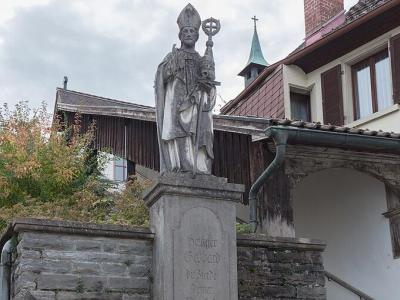


Kapuzinerkloster (Capuchin Monastery), Bregenz (must see)
Founded in 1636 and consecrated in 1639, the Kapuzinerkloster was established during the Counter-Reformation to strengthen Catholic life near Protestant territories around Lake Constance. The friars lived simply and served local communities. Although Emperor Joseph II dissolved many monasteries in the late 18th century, this house survived and continues its religious tradition today.
The complex reflects the principles of Kapuzinerstil, a style shaped by restraint and clarity. The church has no large bell tower, only a small ridge turret, and the façade avoids heavy decoration. Inside, the single-nave layout directs attention toward the altar without architectural distraction. While simplicity defines the structure, subtle Baroque features appear in side altars and devotional images, showing how regional artistic traditions influenced even an order committed to austerity.
The monastery buildings are arranged around a quiet inner courtyard that once structured the daily rhythm of prayer, manual work, and study. Covered walkways link the church to the living quarters, creating a sheltered space for reflection. The friars’ cells were simple, and small gardens provided food and quiet space for meditation. Storerooms and workshops supported daily life. From its terrace above the lower town, the monastery looks toward Lake Constance and the surrounding hills, combining seclusion with a strong link to the landscape.
Today, the monastery remains active but also serves a broader social role. With fewer friars in residence, it functions as a spiritual and community centre, cooperating with charitable organisations such as Caritas. Religious services continue alongside social outreach, reflecting the Capuchin tradition of practical service.
The complex reflects the principles of Kapuzinerstil, a style shaped by restraint and clarity. The church has no large bell tower, only a small ridge turret, and the façade avoids heavy decoration. Inside, the single-nave layout directs attention toward the altar without architectural distraction. While simplicity defines the structure, subtle Baroque features appear in side altars and devotional images, showing how regional artistic traditions influenced even an order committed to austerity.
The monastery buildings are arranged around a quiet inner courtyard that once structured the daily rhythm of prayer, manual work, and study. Covered walkways link the church to the living quarters, creating a sheltered space for reflection. The friars’ cells were simple, and small gardens provided food and quiet space for meditation. Storerooms and workshops supported daily life. From its terrace above the lower town, the monastery looks toward Lake Constance and the surrounding hills, combining seclusion with a strong link to the landscape.
Today, the monastery remains active but also serves a broader social role. With fewer friars in residence, it functions as a spiritual and community centre, cooperating with charitable organisations such as Caritas. Religious services continue alongside social outreach, reflecting the Capuchin tradition of practical service.
Want to visit this sight? Check out these Self-Guided Walking Tours in Bregenz. Alternatively, you can download the mobile app "GPSmyCity: Walks in 1K+ Cities" from Apple App Store or Google Play Store. The app turns your mobile device to a personal tour guide and it works offline, so no data plan is needed when traveling abroad.
Download The GPSmyCity App



Kapuzinerkloster (Capuchin Monastery) on Map
Sight Name: Kapuzinerkloster (Capuchin Monastery)
Sight Location: Bregenz, Austria (See walking tours in Bregenz)
Sight Type: Religious
Guide(s) Containing This Sight:
Sight Location: Bregenz, Austria (See walking tours in Bregenz)
Sight Type: Religious
Guide(s) Containing This Sight:
Nearby Sights
Walking Tours in Bregenz, Austria

Create Your Own Walk in Bregenz
Creating your own self-guided walk in Bregenz is easy and fun. Choose the city attractions that you want to see and a walk route map will be created just for you. You can even set your hotel as the start point of the walk.
A Walking Map of Historical Buildings in Bregenz
Bregenz is home to many historic buildings, several of which were built between the 13th and 16th centuries. Federal High School, the Vorarlberg Land Theater and City Hall, located near the harbor, are landmarks of the Lower Town. Take the following tour to discover Bregenz’s best historic architecture.
Tour Duration: 3 Hour(s)
Travel Distance: 5.5 Km or 3.4 Miles
Tour Duration: 3 Hour(s)
Travel Distance: 5.5 Km or 3.4 Miles
Bregenz Old Town and City Center Walking Tour
Bregenz, located where Austria meets Germany and Switzerland, contains many beautiful landmarks in both the historic and modern parts of the city. Discover Bregenz’s most popular attractions and learn about its history in the following orientation walk.
Tour Duration: 2 Hour(s)
Travel Distance: 2.5 Km or 1.6 Miles
Tour Duration: 2 Hour(s)
Travel Distance: 2.5 Km or 1.6 Miles