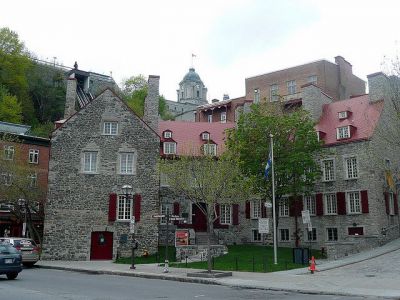


Maison Chevalier (Chevalier House), Quebec City
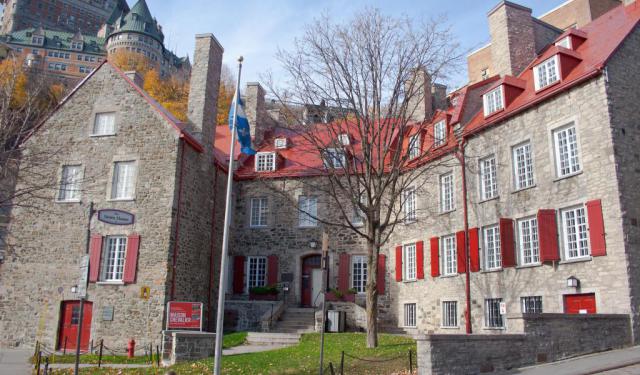
As you stand in Royal Square, look toward the row of historic stone buildings lining the northern side of it. The Chevalier House is the handsome complex of adjoining buildings with steep roofs, dormer windows, and thick stone walls, set almost directly beneath the towering silhouette of Château Frontenac high on Cap Diamant. Although it appears to be a single structure at first glance, it is in fact a combination of three separate houses built over different periods of the French colonial era. If you look closely, you can distinguish subtle differences in the masonry, rooflines, and window arrangements that reveal their separate origins.
The central and most prominent section is the former residence of shipowner Jean-Baptiste Chevalier, completed in 1752. It is joined to the elegant Frérot House, recognizable by its classic mansard roof, dating from either 1683 or 1695, while the oldest part of the ensemble is the Chesnay House, built between 1660 and 1675. Together, these buildings form one of the finest surviving examples of French urban domestic architecture in North America, illustrating how wealthy merchants once lived and conducted business in the colony of New France.
After each house was damaged by fire, the entire complex was rebuilt in 1762. Following the British conquest, the buildings gradually shifted from private residences to commercial premises. Beginning in 1807, they housed the popular London Coffee House, an inn and gathering place frequented by merchants, travelers, and local residents for more than a century.
The complex narrowly escaped demolition during the redevelopment of Old Quebec in the 1950s, when the Government of Quebec purchased and carefully restored it as part of the Royal Square revitalization. Designated a historic monument in 1965, it now forms part of the Place Royale Museum. If the museum is open, grab the opportunity to explore exhibits and archaeological remains illustrating everyday life, commerce, and architecture during the French colonial period.
Before leaving, walk a few steps back toward the center of the square and look up. From this angle, the Chevalier House, framed by the cobbled square below and the commanding Château Frontenac rising above, creates one of Old Quebec's most photographed views. If you happen to visit during the Quebec Winter Carnival in February, the square often comes alive with traditional music and cultural performances, making this historic setting even more memorable.
The central and most prominent section is the former residence of shipowner Jean-Baptiste Chevalier, completed in 1752. It is joined to the elegant Frérot House, recognizable by its classic mansard roof, dating from either 1683 or 1695, while the oldest part of the ensemble is the Chesnay House, built between 1660 and 1675. Together, these buildings form one of the finest surviving examples of French urban domestic architecture in North America, illustrating how wealthy merchants once lived and conducted business in the colony of New France.
After each house was damaged by fire, the entire complex was rebuilt in 1762. Following the British conquest, the buildings gradually shifted from private residences to commercial premises. Beginning in 1807, they housed the popular London Coffee House, an inn and gathering place frequented by merchants, travelers, and local residents for more than a century.
The complex narrowly escaped demolition during the redevelopment of Old Quebec in the 1950s, when the Government of Quebec purchased and carefully restored it as part of the Royal Square revitalization. Designated a historic monument in 1965, it now forms part of the Place Royale Museum. If the museum is open, grab the opportunity to explore exhibits and archaeological remains illustrating everyday life, commerce, and architecture during the French colonial period.
Before leaving, walk a few steps back toward the center of the square and look up. From this angle, the Chevalier House, framed by the cobbled square below and the commanding Château Frontenac rising above, creates one of Old Quebec's most photographed views. If you happen to visit during the Quebec Winter Carnival in February, the square often comes alive with traditional music and cultural performances, making this historic setting even more memorable.
Want to visit this sight? Check out these Self-Guided Walking Tours in Quebec City. Alternatively, you can download the mobile app "GPSmyCity: Walks in 1K+ Cities" from Apple App Store or Google Play Store. The app turns your mobile device to a personal tour guide and it works offline, so no data plan is needed when traveling abroad.
Download The GPSmyCity App



Maison Chevalier (Chevalier House) on Map
Sight Name: Maison Chevalier (Chevalier House)
Sight Location: Quebec City, Canada (See walking tours in Quebec City)
Sight Type: Museum/Gallery
Guide(s) Containing This Sight:
Sight Location: Quebec City, Canada (See walking tours in Quebec City)
Sight Type: Museum/Gallery
Guide(s) Containing This Sight:
Nearby Sights

Walking Tours in Quebec City, Quebec

Create Your Own Walk in Quebec City
Creating your own self-guided walk in Quebec City is easy and fun. Choose the city attractions that you want to see and a walk route map will be created just for you. You can even set your hotel as the start point of the walk.
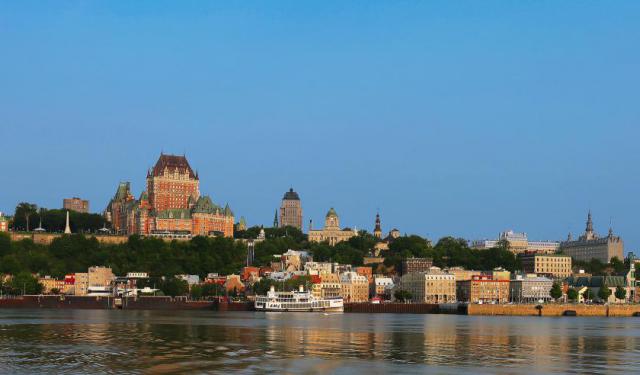
Quebec City Introduction Walking Tour
Cresting a cliff above the St. Lawrence River, Quebec City is the soul of the province of Quebec – a place all its own; a country within a country with its own traditions, architecture, and French-speaking population.
The Algonquian people had originally named this area Kébec, which means "where the river narrows", because the Saint Lawrence River indeed narrows proximate to the... view more
Tour Duration: 2 Hour(s)
Travel Distance: 3.2 Km or 2 Miles
The Algonquian people had originally named this area Kébec, which means "where the river narrows", because the Saint Lawrence River indeed narrows proximate to the... view more
Tour Duration: 2 Hour(s)
Travel Distance: 3.2 Km or 2 Miles
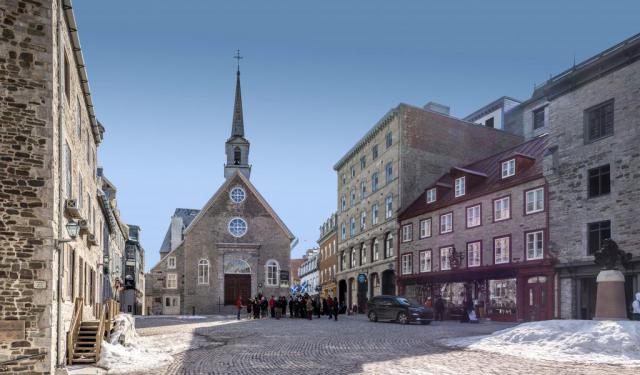
Old Quebec Walk
The historic part of Quebec City known as Old Quebec (French: Vieux-Québec), sometimes also referred to as the Latin Quarter (Quartier Latin), is the neighborhood centered around Cape Diamond (Cap Diamant), located on the eastern edge of Quebec hill promontory. The area comprises Upper Town (Haute-Ville) and Lower Town (Basse-Ville) and is currently listed among UNESCO’s World Heritage Sites.
... view more
Tour Duration: 2 Hour(s)
Travel Distance: 2.6 Km or 1.6 Miles
... view more
Tour Duration: 2 Hour(s)
Travel Distance: 2.6 Km or 1.6 Miles
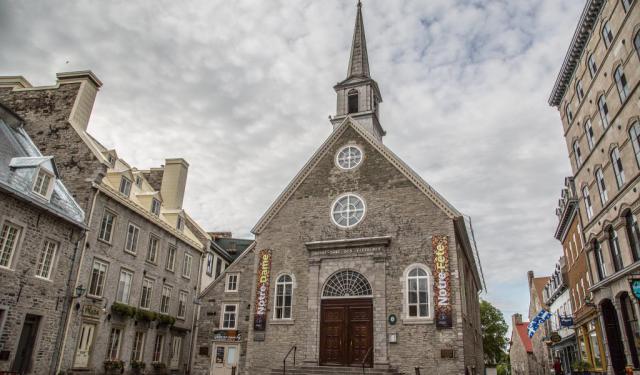
Qucbec City's Historical Churches Walking Tour
The first religious buildings in Canada were established by the Récollets and Jesuits, in 1615 and 1625, respectively, when they first arrived in New France. Later on, the French colonists brought along their culture and architectural traditions, and the establishment of British and evangelical society triggered further major developments in Quebec City.
Over the course of the 17th and 18th... view more
Tour Duration: 1 Hour(s)
Travel Distance: 2.9 Km or 1.8 Miles
Over the course of the 17th and 18th... view more
Tour Duration: 1 Hour(s)
Travel Distance: 2.9 Km or 1.8 Miles
Historical Houses Walking Tour
Quebec City, particularly evocative of Europe in its atmosphere, is often referred to as the cradle of New France. The city boasts one of the richest architectural heritages in North America, though most of its buildings had to be adapted to harsh winters and the lack of specialized workers and materials in the colony. As such, the majority of local houses were designed as simple and efficient... view more
Tour Duration: 2 Hour(s)
Travel Distance: 2.5 Km or 1.6 Miles
Tour Duration: 2 Hour(s)
Travel Distance: 2.5 Km or 1.6 Miles