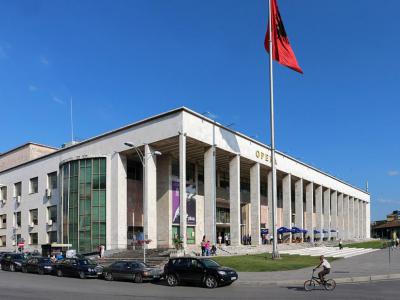


Palace of Culture of Tirana, Tirana
The Palace of Culture is an important symbol of the city's communist-era transformation. Construction began in the late 1950s as a Soviet-backed project, with Soviet leader Nikita Khrushchev symbolically laying the first brick. Completed in 1966, the building rose on a site that had once been home to Tirana's Old Bazaar and the Mahmud Muhsin Bey Stërmasi Mosque, both demolished during the communist government's efforts to reshape the capital according to socialist ideals and state atheism.
The palace is a good example of Stalinist architecture, a style widely used throughout the Eastern Bloc during the mid-20th century. Its imposing scale, long colonnades, and restrained decorative details were designed to project strength, order, and collective purpose. Unlike many similar buildings elsewhere in Eastern Europe, much of the Palace of Culture has remained largely unchanged, allowing visitors to experience architectural features that closely reflect the aesthetics and ambitions of Albania's communist period.
Today, the complex remains one of the country's most important cultural institutions. It houses the National Library of Albania, which contains millions of books, manuscripts, and historical documents, as well as the National Theater of Opera and Ballet, the nation's premier venue for opera, ballet, and classical music performances. Shops, cafés, and exhibition spaces also occupy parts of the building, ensuring that it remains a lively destination throughout the day.
The palace is a good example of Stalinist architecture, a style widely used throughout the Eastern Bloc during the mid-20th century. Its imposing scale, long colonnades, and restrained decorative details were designed to project strength, order, and collective purpose. Unlike many similar buildings elsewhere in Eastern Europe, much of the Palace of Culture has remained largely unchanged, allowing visitors to experience architectural features that closely reflect the aesthetics and ambitions of Albania's communist period.
Today, the complex remains one of the country's most important cultural institutions. It houses the National Library of Albania, which contains millions of books, manuscripts, and historical documents, as well as the National Theater of Opera and Ballet, the nation's premier venue for opera, ballet, and classical music performances. Shops, cafés, and exhibition spaces also occupy parts of the building, ensuring that it remains a lively destination throughout the day.
Want to visit this sight? Check out these Self-Guided Walking Tours in Tirana. Alternatively, you can download the mobile app "GPSmyCity: Walks in 1K+ Cities" from Apple App Store or Google Play Store. The app turns your mobile device to a personal tour guide and it works offline, so no data plan is needed when traveling abroad.
Download The GPSmyCity App



Palace of Culture of Tirana on Map
Sight Name: Palace of Culture of Tirana
Sight Location: Tirana, Albania (See walking tours in Tirana)
Sight Type: Attraction/Landmark
Guide(s) Containing This Sight:
Sight Location: Tirana, Albania (See walking tours in Tirana)
Sight Type: Attraction/Landmark
Guide(s) Containing This Sight:
Nearby Sights



BunkArt 2 (must see)
Walking Tours in Tirana, Albania

Create Your Own Walk in Tirana
Creating your own self-guided walk in Tirana is easy and fun. Choose the city attractions that you want to see and a walk route map will be created just for you. You can even set your hotel as the start point of the walk.
Tirana Downtwon Walking Tour
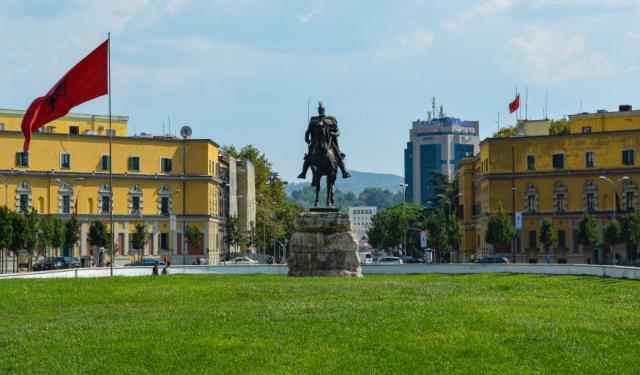
In Tirana, even apartment blocks were once given a public mission. Under artist-turned-mayor Edi Rama, gray façades from the communist years were painted in bold colors, turning ordinary streets into a visible sign of recovery after the long isolation.
Tirana, the capital of Albania, has a history shaped by crossroads, empire, isolation, and rapid reinvention. Although the wider area was... view more
Tour Duration: 1 Hour(s)
Travel Distance: 0.9 Km or 0.6 Miles
Tirana, the capital of Albania, has a history shaped by crossroads, empire, isolation, and rapid reinvention. Although the wider area was... view more
Tour Duration: 1 Hour(s)
Travel Distance: 0.9 Km or 0.6 Miles
Communist Heritage Sites
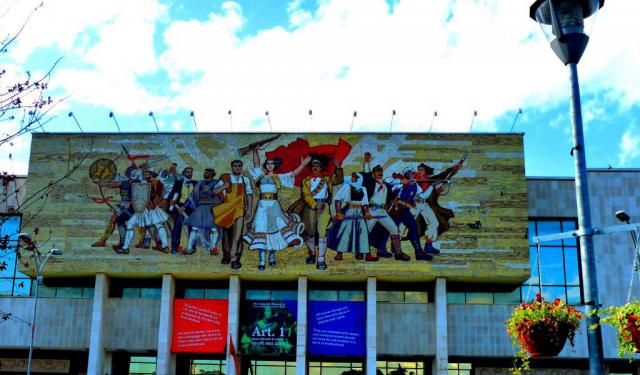
Imagine a country so afraid of invasion that it built a bunker for every four citizens. Welcome to Tirana, where fear was cast in concrete.
Tirana’s Communist Heritage Sites are best understood through the strange and severe history of Albania in the second half of the 20th century. After World War II, the country came under the rule of Enver Hoxha, who led Albania from 1944 until his death... view more
Tour Duration: 1 Hour(s)
Travel Distance: 1.8 Km or 1.1 Miles
Tirana’s Communist Heritage Sites are best understood through the strange and severe history of Albania in the second half of the 20th century. After World War II, the country came under the rule of Enver Hoxha, who led Albania from 1944 until his death... view more
Tour Duration: 1 Hour(s)
Travel Distance: 1.8 Km or 1.1 Miles