


Palazzo Pantaleo (Pantaleo Palace), Taranto
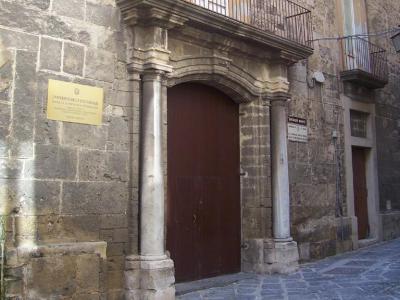
The Palazzo Pantaleo in Taranto is an 18th century building owned by the Municipality. From 2000 to 2007 it hosted some collections of the National Archaeological Museum of Taranto in the Old City. It is currently home to the Alfredo Majorano ethnographic museum. It was built in 1770 by Baron Francesco Maria Pantaleo, who created a large and sumptuous noble residence after demolishing some pre-existing structures purchased by the Chapter and Clergy of Taranto. The palace overlooks the Mar Grande, with the main entrance on the Pantaleo ramp to which it gives its name. The task of building the palace on the natural rock was entrusted to Francesco Saverio Miraglia for a fee of 3,150 silver ducats, agreeing the completion of the works within the following two years. All the material obtainable from the building to be demolished and all the carparo obtainable from the calcarenitic bank were used. Only for the door and the loggia above was the use of first quality carparo explicitly requested, to be quarried elsewhere and transported on site. The building has a unitary structure and does not have an internal courtyard. The main facade has a forepart and a large portal, from which the rounded wrought iron railing of the loggia above protrudes. Still visible on the ground floor are a vaulted entrance hall full of profiles that adorn the crenellated tower and the lion of the family coat of arms, the perfectly preserved stables, the carriage house, as well as a large service room with an independent entrance on Vico Civico. On the half floor there are the servants' apartments and the large kitchen with the original white and blue majolica tiles. A monumental double staircase leads to the first noble floor, where you can admire the reception rooms with ceilings painted by Domenico Antonio Carella in 1773, representing scenes from the Aeneid and the Iliad. These works were paid for with 235 silver ducats plus grain, oil and cheese. Finally, through another staircase, you can reach the second floor, where there are other rooms with ceilings painted on paper fixed to wooden false ceilings.
The representative office of the Municipal Administration is housed in the Palace that belonged to the Pantaleo barons. It is one of the few eighteenth-century buildings in old Taranto left intact, located in the area where the ancient port was. It has a harmonious façade with wrought iron balconies overlooking the Mar Grande. From a large portal you enter the main floor passing through the main staircase with vaults decorated with 18th century stucco, probably of Neapolitan inspiration. The halls retain sumptuous ceilings with drawings on canvas and paper and majolica floors from the late 18th century. The elegant doors date back to the same era, which the recent restoration has brought back to their original vermilion colour, enriched with gold mouldings. The most important municipal receptions and events take place in Palazzo Pantaleo.
The representative office of the Municipal Administration is housed in the building that belonged to the Pantaleo barons. It is one of the few remaining intact eighteenth-century buildings in Taranto, located in the area where the ancient port used to be. It has a harmonious facade with wrought iron balconies overlooking the Mar Grande. A large portal leads to the main floor passing through the main staircase with vaults decorated with 18th century stuccoes, probably of Neapolitan inspiration. The halls retain sumptuous ceilings with drawings on canvas and paper and majolica floors from the late 1700s. The elegant doors date back to the same period, which the recent restoration has brought back to their original vermilion color, enriched with gold moldings. The most important municipal receptions and events take place in Palazzo Pantaleo. Palazzo Pantaleo is an 18th century building and is the seat of the Alfredo Majorano Ethnographic Museum. In the museum there are various testimonies of the popular traditions of the city of Taranto and its province, collected by Alfredo Majorano (1902-1984). Much of the material was donated by the scholar to the Municipality of Taranto starting from 1978 and then by the widow in more recent years. The rich collection has as its main theme the magical-religious rituality in the Taranto area. The leitmotif of Alfredo Majorano's ethnographic collection is housed in the rooms of the second noble floor of Palazzo Pantaleo and revolves around the magical and religious rituals of Taranto. The abundance of materials that make it up document traditional life in Tarantino: from the world of festivities and magical-religious rituals it expands to document all the other ways of local associated life and, first of all, the secular ones of fatigue, to land and sea. The museum collects important documents of the intangible cultural heritage, such as the recordings of the pizzica made by Majorano in the fifties and other testimonies on the phenomenon of tarantism. ***PH***
The representative office of the Municipal Administration is housed in the Palace that belonged to the Pantaleo barons. It is one of the few eighteenth-century buildings in old Taranto left intact, located in the area where the ancient port was. It has a harmonious façade with wrought iron balconies overlooking the Mar Grande. From a large portal you enter the main floor passing through the main staircase with vaults decorated with 18th century stucco, probably of Neapolitan inspiration. The halls retain sumptuous ceilings with drawings on canvas and paper and majolica floors from the late 18th century. The elegant doors date back to the same era, which the recent restoration has brought back to their original vermilion colour, enriched with gold mouldings. The most important municipal receptions and events take place in Palazzo Pantaleo.
The representative office of the Municipal Administration is housed in the building that belonged to the Pantaleo barons. It is one of the few remaining intact eighteenth-century buildings in Taranto, located in the area where the ancient port used to be. It has a harmonious facade with wrought iron balconies overlooking the Mar Grande. A large portal leads to the main floor passing through the main staircase with vaults decorated with 18th century stuccoes, probably of Neapolitan inspiration. The halls retain sumptuous ceilings with drawings on canvas and paper and majolica floors from the late 1700s. The elegant doors date back to the same period, which the recent restoration has brought back to their original vermilion color, enriched with gold moldings. The most important municipal receptions and events take place in Palazzo Pantaleo. Palazzo Pantaleo is an 18th century building and is the seat of the Alfredo Majorano Ethnographic Museum. In the museum there are various testimonies of the popular traditions of the city of Taranto and its province, collected by Alfredo Majorano (1902-1984). Much of the material was donated by the scholar to the Municipality of Taranto starting from 1978 and then by the widow in more recent years. The rich collection has as its main theme the magical-religious rituality in the Taranto area. The leitmotif of Alfredo Majorano's ethnographic collection is housed in the rooms of the second noble floor of Palazzo Pantaleo and revolves around the magical and religious rituals of Taranto. The abundance of materials that make it up document traditional life in Tarantino: from the world of festivities and magical-religious rituals it expands to document all the other ways of local associated life and, first of all, the secular ones of fatigue, to land and sea. The museum collects important documents of the intangible cultural heritage, such as the recordings of the pizzica made by Majorano in the fifties and other testimonies on the phenomenon of tarantism. ***PH***
Want to visit this sight? Check out these Self-Guided Walking Tours in Taranto. Alternatively, you can download the mobile app "GPSmyCity: Walks in 1K+ Cities" from Apple App Store or Google Play Store. The app turns your mobile device to a personal tour guide and it works offline, so no data plan is needed when traveling abroad.
Download The GPSmyCity App



Palazzo Pantaleo (Pantaleo Palace) on Map
Sight Name: Palazzo Pantaleo (Pantaleo Palace)
Sight Location: Taranto, Italy (See walking tours in Taranto)
Sight Type: Attraction/Landmark
Sight Location: Taranto, Italy (See walking tours in Taranto)
Sight Type: Attraction/Landmark
Nearby Sights

Walking Tours in Taranto, Italy

Create Your Own Walk in Taranto
Creating your own self-guided walk in Taranto is easy and fun. Choose the city attractions that you want to see and a walk route map will be created just for you. You can even set your hotel as the start point of the walk.
Taranto Introduction Walking Tour
Taranto, the famed “city of the two seas,” sparkles on the Ionian coast of Puglia, framed by the glistening bays of Mar Grande and Mar Piccolo. This isn’t just a pretty port town-it’s a place where history, culture, and postcard-perfect views meet head-on. With its prime Mediterranean location, Taranto has been a hot spot for everyone from ancient Greeks to Roman generals, Byzantine... view more
Tour Duration: 2 Hours
Travel Distance: 2.9 Km or 1.8 Miles
Tour Duration: 2 Hours
Travel Distance: 2.9 Km or 1.8 Miles
City Walks Overview
