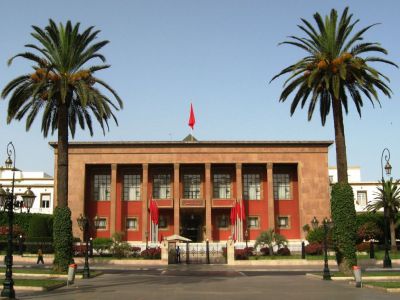


Parliament of Morocco, Rabat
The Parliament of Morocco, situated in the heart of Rabat on Avenue Mohammed V, serves as the nation’s legislative body. Since 1996, Morocco’s parliamentary system has been bicameral, consisting of two chambers: the Assembly of Representatives (lower house) and the Assembly of Councillors (upper house). Members of Parliament are drawn from across Morocco and the Moroccan-held parts of Western Sahara.
Despite the existence of an elected Parliament, Morocco remains a constitutional monarchy, where the King retains considerable authority. Among his reserve powers, the King has the right to dissolve Parliament, a power that was used extensively during the "Years of Lead" under King Hassan II. Before 1997, no elected Parliament was able to complete a full term under normal circumstances due to frequent suspensions, extensions, and dissolutions. However, since Mohammed VI ascended to the throne in 1999, the role and stability of Parliament have increased. That said, executive power remains limited, as the King appoints the Prime Minister and, based on the latter’s recommendations, the members of government.
The Parliament Building, also known as the Courthouse (Palais de Justice), was constructed in 1928 and designed by Uruguayan architect Adrien Laforgue. Its red and ochre facade, shaped like an inverted Y, gives it a distinct presence in Rabat Ville. The structure features a minimalist yet elegant architectural style, with six classical pillars supporting a slim, ornate roof. Unlike more intricate Moroccan architectural designs, this building maintains a restrained aesthetic, with very few decorative elements.
Today, the Parliament of Morocco remains a key institution in the country’s evolving political landscape, balancing between monarchical authority and legislative governance.
Despite the existence of an elected Parliament, Morocco remains a constitutional monarchy, where the King retains considerable authority. Among his reserve powers, the King has the right to dissolve Parliament, a power that was used extensively during the "Years of Lead" under King Hassan II. Before 1997, no elected Parliament was able to complete a full term under normal circumstances due to frequent suspensions, extensions, and dissolutions. However, since Mohammed VI ascended to the throne in 1999, the role and stability of Parliament have increased. That said, executive power remains limited, as the King appoints the Prime Minister and, based on the latter’s recommendations, the members of government.
The Parliament Building, also known as the Courthouse (Palais de Justice), was constructed in 1928 and designed by Uruguayan architect Adrien Laforgue. Its red and ochre facade, shaped like an inverted Y, gives it a distinct presence in Rabat Ville. The structure features a minimalist yet elegant architectural style, with six classical pillars supporting a slim, ornate roof. Unlike more intricate Moroccan architectural designs, this building maintains a restrained aesthetic, with very few decorative elements.
Today, the Parliament of Morocco remains a key institution in the country’s evolving political landscape, balancing between monarchical authority and legislative governance.
Want to visit this sight? Check out these Self-Guided Walking Tours in Rabat. Alternatively, you can download the mobile app "GPSmyCity: Walks in 1K+ Cities" from Apple App Store or Google Play Store. The app turns your mobile device to a personal tour guide and it works offline, so no data plan is needed when traveling abroad.
Download The GPSmyCity App



Parliament of Morocco on Map
Sight Name: Parliament of Morocco
Sight Location: Rabat, Morocco (See walking tours in Rabat)
Sight Type: Attraction/Landmark
Sight Location: Rabat, Morocco (See walking tours in Rabat)
Sight Type: Attraction/Landmark
Nearby Sights

Walking Tours in Rabat, Morocco

Create Your Own Walk in Rabat
Creating your own self-guided walk in Rabat is easy and fun. Choose the city attractions that you want to see and a walk route map will be created just for you. You can even set your hotel as the start point of the walk.
Rabat Introduction Walking Tour
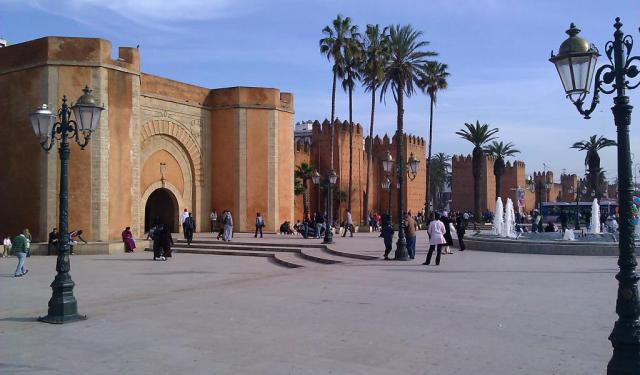
Resting on the shores of the Bouregreg River and Atlantic Ocean, the capital city of Morocco, Rabat, is known for its picturesque natural surroundings, much as for its man-made beauty manifested in a mix of old and new architecture (featuring Islamic and French-colonial styles), abundance of mosques and historic monuments. The Medina (Old City) of Rabat is a World Heritage Site.
Rabat was... view more
Tour Duration: 1 Hour(s)
Travel Distance: 2.0 Km or 1.2 Miles
Rabat was... view more
Tour Duration: 1 Hour(s)
Travel Distance: 2.0 Km or 1.2 Miles
Rabat Shopping Walk
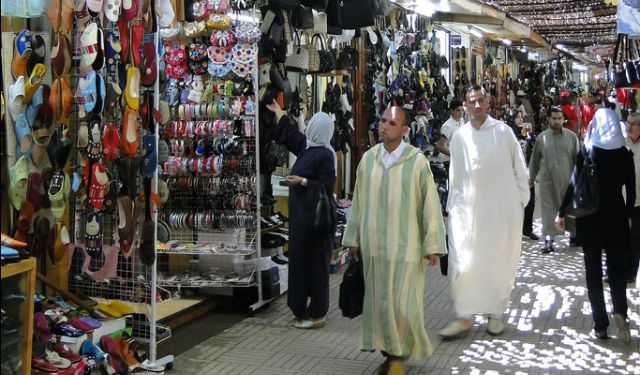
Rabat is heaven for those who love shopping. Indeed, the abundance of shopping opportunities – traditional markets and shopping streets – in this city gives no reason to doubt that. There you can find all kinds of oriental delights you can possibly think of.
One of Rabat's top shopping destinations is Consuls Street (rue des Consuls). Steeped in a 500-year history, this street houses... view more
Tour Duration: 1 Hour(s)
Travel Distance: 1.0 Km or 0.6 Miles
One of Rabat's top shopping destinations is Consuls Street (rue des Consuls). Steeped in a 500-year history, this street houses... view more
Tour Duration: 1 Hour(s)
Travel Distance: 1.0 Km or 0.6 Miles