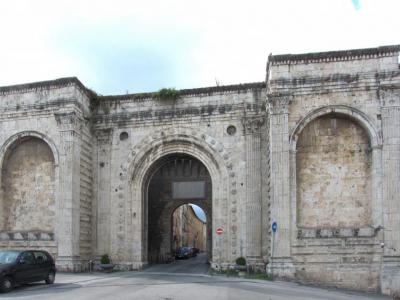


Porta San Pietro (Porta Romana), Perugia
The San Pietro Gate in Perugia, also known as the Roman Gate (Porta Romana), is a striking medieval gateway steeped in history and architectural charm. Built into the city walls of the 13th-14th centuries, this gate stands at the end of Corso Cavour and marks the start of Borgo XX Giugno, a neighborhood affectionately called the "beautiful village." The gate lends its name to the surrounding Porta San Pietro district, one of Perugia’s five historic quarters.
The outer façade of the gate, crafted between 1475 and 1480, is a Renaissance work by Agostino di Duccio, Polidoro di Stefano, and Antonio Carattoli. Inspired by Leon Battista Alberti, it echoes the Etruscan Arch and classical triumphal arches. While the central arch was intended to feature an upper tier, it remains unfinished. Flanked by two towers, the structure exudes majesty.
The inner façade, dating back to the 14th century, retains its medieval character. Its two original openings earned it the name “Porta alle Due Porte” (Gate of Two Doors), though one of these is now sealed. Above the arch, a niche houses a fresco painted in 1817 depicting the Madonna of the Rosary flanked by Saints Dominic and Francis restored in 1990.
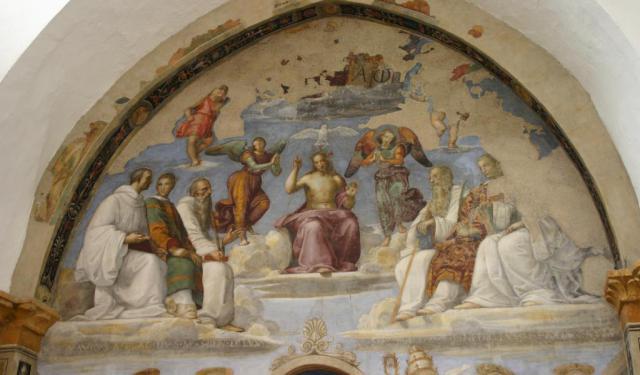
Embedded in the deep passage of the gate is the Chapel of San Giacomo, also known as the Chapel of Buon Consiglio, built in the 13th century and renovated in the 16th century. This small sanctuary honors Saint James, the protector of pilgrims, aligning with the gate's historic role as a starting point for pilgrims journeying to Rome along the Royal and Papal Street.
A commemorative plaque within the gate recalls the tragic events of the Perugia massacre on June 20, 1859, when citizens resisted Papal forces. The gate's location, orientation towards Rome, and association with pilgrimage routes underscore its nickname, Porta Romana.
Today, the San Pietro Gate is a captivating symbol of Perugia's rich architectural and cultural legacy, blending centuries of history into a single monumental structure.
The outer façade of the gate, crafted between 1475 and 1480, is a Renaissance work by Agostino di Duccio, Polidoro di Stefano, and Antonio Carattoli. Inspired by Leon Battista Alberti, it echoes the Etruscan Arch and classical triumphal arches. While the central arch was intended to feature an upper tier, it remains unfinished. Flanked by two towers, the structure exudes majesty.
The inner façade, dating back to the 14th century, retains its medieval character. Its two original openings earned it the name “Porta alle Due Porte” (Gate of Two Doors), though one of these is now sealed. Above the arch, a niche houses a fresco painted in 1817 depicting the Madonna of the Rosary flanked by Saints Dominic and Francis restored in 1990.
Embedded in the deep passage of the gate is the Chapel of San Giacomo, also known as the Chapel of Buon Consiglio, built in the 13th century and renovated in the 16th century. This small sanctuary honors Saint James, the protector of pilgrims, aligning with the gate's historic role as a starting point for pilgrims journeying to Rome along the Royal and Papal Street.
A commemorative plaque within the gate recalls the tragic events of the Perugia massacre on June 20, 1859, when citizens resisted Papal forces. The gate's location, orientation towards Rome, and association with pilgrimage routes underscore its nickname, Porta Romana.
Today, the San Pietro Gate is a captivating symbol of Perugia's rich architectural and cultural legacy, blending centuries of history into a single monumental structure.
Want to visit this sight? Check out these Self-Guided Walking Tours in Perugia. Alternatively, you can download the mobile app "GPSmyCity: Walks in 1K+ Cities" from Apple App Store or Google Play Store. The app turns your mobile device to a personal tour guide and it works offline, so no data plan is needed when traveling abroad.
Download The GPSmyCity App



Porta San Pietro (Porta Romana) on Map
Sight Name: Porta San Pietro (Porta Romana)
Sight Location: Perugia, Italy (See walking tours in Perugia)
Sight Type: Attraction/Landmark
Sight Location: Perugia, Italy (See walking tours in Perugia)
Sight Type: Attraction/Landmark
Nearby Sights


Walking Tours in Perugia, Italy

Create Your Own Walk in Perugia
Creating your own self-guided walk in Perugia is easy and fun. Choose the city attractions that you want to see and a walk route map will be created just for you. You can even set your hotel as the start point of the walk.
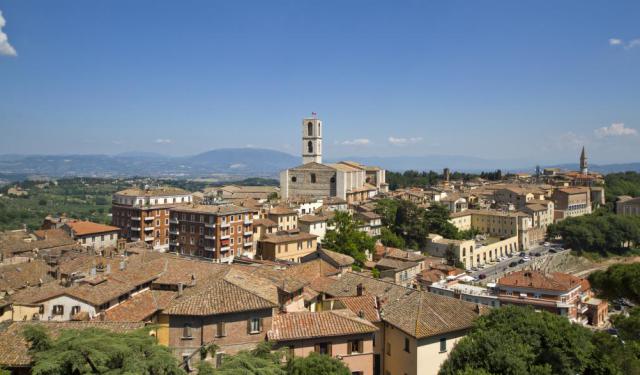
A Walk Through Perugia's Medieval Old Town
Perugia was one of the twelve foremost cities of the Etruscan Federation. It was mentioned by Quintus Fabius Pictor, a Roman historian. He tells of a military expedition of Fabius Maximus Rullianus against the Etruscan League and Perugia in 309 BC.
By 216 BC, Perugia had seen the light and allied itself with Rome in the Second Punic War against Carthage. Things went swimmingly until 41 BC.... view more
Tour Duration: 2 Hours
Travel Distance: 2.1 Km or 1.3 Miles
By 216 BC, Perugia had seen the light and allied itself with Rome in the Second Punic War against Carthage. Things went swimmingly until 41 BC.... view more
Tour Duration: 2 Hours
Travel Distance: 2.1 Km or 1.3 Miles
Perugino and Renaissance Art Walk
Perugia today is a well-known cultural and artistic center in Italy that regularly plays host to a multitude of annual festivals and events. The most glorious period in the history of the city, from an artistic standpoint, lasted from the 13th to the 16th centuries.
Perugia’s most celebrated artist, Pietro Vannucci (1450-1523), better known as “il Perugino”, nicknamed so after his... view more
Tour Duration: 1 Hour
Travel Distance: 2.3 Km or 1.4 Miles
Perugia’s most celebrated artist, Pietro Vannucci (1450-1523), better known as “il Perugino”, nicknamed so after his... view more
Tour Duration: 1 Hour
Travel Distance: 2.3 Km or 1.4 Miles
City Walks Overview
