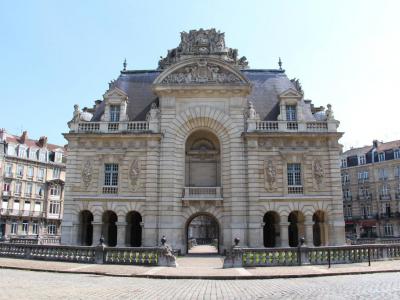


Porte de Paris (Paris Gate), Lille
King Louis IV entered the city on August 28, 1667. He passed through the Gate of the Sick and received the keys to the city from Lille’s magistrates. Although Lille’s incorporation into France was not formally confirmed until the Treaty of Aix-la-Chapelle in 1668, Louis IV already had plans for the city and its old southern gateway.
Several years later, Louis IV commissioned engineer and architect Simon Vollant to construct the Paris Gate. Built between 1685 and 1692, it was conceived as a monument celebrating Louis XIV’s conquest of Lille. The triumphal structure was erected opposite a city-side guardhouse. Around 1860, the guardhouse was demolished during the dismantling of Lille’s fortifications, while Vollant’s gate was preserved.
Between 1888 and 1895, the Paris Gate was redeveloped by architect Louis-Marie Cordonnier. He added a new façade on the city side and redesigned the surrounding area as the circular Place Simon-Vollant. Consequently, the monument now has two noticeably different façades: Vollant’s 17th-century ceremonial entrance and Cordonnier’s 19th-century city-facing addition.
As you face the original outer façade and look northwest, toward the city, Mars, the god of war, stands on the left, while Hercules, a symbol of strength, appears on the right. At the summit, two winged figures of Fame sound their trumpets, while Victory raises a crown above a medallion of Louis XIV. At ground level, a former drawbridge leads into a vaulted passage that opens toward the city.
Several years later, Louis IV commissioned engineer and architect Simon Vollant to construct the Paris Gate. Built between 1685 and 1692, it was conceived as a monument celebrating Louis XIV’s conquest of Lille. The triumphal structure was erected opposite a city-side guardhouse. Around 1860, the guardhouse was demolished during the dismantling of Lille’s fortifications, while Vollant’s gate was preserved.
Between 1888 and 1895, the Paris Gate was redeveloped by architect Louis-Marie Cordonnier. He added a new façade on the city side and redesigned the surrounding area as the circular Place Simon-Vollant. Consequently, the monument now has two noticeably different façades: Vollant’s 17th-century ceremonial entrance and Cordonnier’s 19th-century city-facing addition.
As you face the original outer façade and look northwest, toward the city, Mars, the god of war, stands on the left, while Hercules, a symbol of strength, appears on the right. At the summit, two winged figures of Fame sound their trumpets, while Victory raises a crown above a medallion of Louis XIV. At ground level, a former drawbridge leads into a vaulted passage that opens toward the city.
Want to visit this sight? Check out these Self-Guided Walking Tours in Lille. Alternatively, you can download the mobile app "GPSmyCity: Walks in 1K+ Cities" from Apple App Store or Google Play Store. The app turns your mobile device to a personal tour guide and it works offline, so no data plan is needed when traveling abroad.
Download The GPSmyCity App



Porte de Paris (Paris Gate) on Map
Sight Name: Porte de Paris (Paris Gate)
Sight Location: Lille, France (See walking tours in Lille)
Sight Type: Attraction/Landmark
Guide(s) Containing This Sight:
Sight Location: Lille, France (See walking tours in Lille)
Sight Type: Attraction/Landmark
Guide(s) Containing This Sight:
Nearby Sights






Walking Tours in Lille, France

Create Your Own Walk in Lille
Creating your own self-guided walk in Lille is easy and fun. Choose the city attractions that you want to see and a walk route map will be created just for you. You can even set your hotel as the start point of the walk.
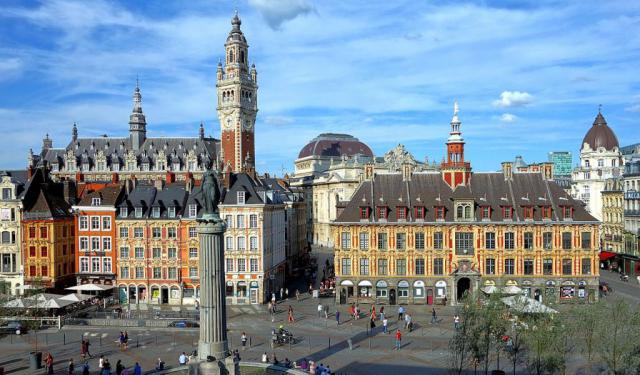
Walking Through Lille's Old Town
Often called France’s “Capital of Flanders,” Lille and its surroundings belong to the historic region of Romance Flanders. Legend has it that, in AD 620, Salvaert, Prince of Dijon, was passing through the region with his pregnant wife when he was attacked and killed by Phinaert, a local lord known as the Giant. Years later, his son, Lydéric, avenged his father by killing Phinaert and is... view more
Tour Duration: 2 Hours
Travel Distance: 4 Km or 2.5 Miles
Tour Duration: 2 Hours
Travel Distance: 4 Km or 2.5 Miles
Lille's Historical Buildings Tour
Historically, Lille's architecture differs from that of other French cities. Prior to being invaded by Louis XIV in 1667, Lille was Flemish, which is evident in its red-brick and other structures, quite uncommon for the rest of France.
Among many things, Lille is reputed for its fabulous historic center, abounding in time-honored buildings, palaces, and churches, offering a great deal of... view more
Tour Duration: 2 Hours
Travel Distance: 3.7 Km or 2.3 Miles
Among many things, Lille is reputed for its fabulous historic center, abounding in time-honored buildings, palaces, and churches, offering a great deal of... view more
Tour Duration: 2 Hours
Travel Distance: 3.7 Km or 2.3 Miles