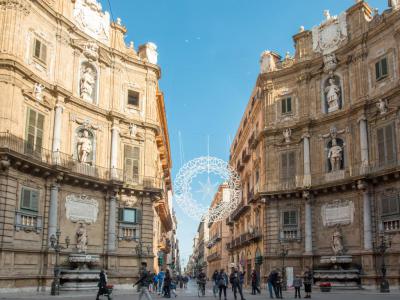


Quattro Canti (Four Corners Square), Palermo (must see)
Although it is commonly called Four Corners, the square’s formal name is Vigliena Square. It is named after the Spanish viceroy Juan Fernández Pacheco, Duke of Escalona, who governed Sicily at the time of its construction. Four Corners Square was laid out between 1608 and 1620 by order of the Spanish viceroys as part of Palermo’s urban renewal. The project was overseen by architects Giulio Lasso and Mariano Smiriglio, who conceived the ensemble as a carefully staged urban crossroads.
While usually described as a square, it was historically known as the “Octagon of the Sun”, since its plan is in fact eight-sided. This octagonal form is created by four streets intersecting at right angles and four concave Baroque facades closing off the corners. All four facades are uniform in height, deliberately symmetrical, and treated as a single architectural composition. Each one incorporates a fountain at ground level, above which a tiered sculptural program unfolds.
At the lowest level, the fountains are animated by allegorical figures of the Four Seasons, grounding the square in the rhythms of nature. Above them stand statues of the four Spanish kings of Sicily: Charles V, Philip II, Philip III, and Philip IV. The highest tier is reserved for Palermo’s four female patron saints: Saint Christina, Saint Ninfa, Saint Olivia, and Saint Agatha.
This sculptural hierarchy is also carefully oriented. On the south-facing facade, Spring, Charles V, and Saint Christina are aligned one above the other. Turning west, the facade presents Summer, Philip II, and Saint Ninfa. The north-facing facade carries Autumn, Philip III, and Saint Olivia, while the east-facing facade completes the cycle with Winter, Philip IV, and Saint Agatha.
While usually described as a square, it was historically known as the “Octagon of the Sun”, since its plan is in fact eight-sided. This octagonal form is created by four streets intersecting at right angles and four concave Baroque facades closing off the corners. All four facades are uniform in height, deliberately symmetrical, and treated as a single architectural composition. Each one incorporates a fountain at ground level, above which a tiered sculptural program unfolds.
At the lowest level, the fountains are animated by allegorical figures of the Four Seasons, grounding the square in the rhythms of nature. Above them stand statues of the four Spanish kings of Sicily: Charles V, Philip II, Philip III, and Philip IV. The highest tier is reserved for Palermo’s four female patron saints: Saint Christina, Saint Ninfa, Saint Olivia, and Saint Agatha.
This sculptural hierarchy is also carefully oriented. On the south-facing facade, Spring, Charles V, and Saint Christina are aligned one above the other. Turning west, the facade presents Summer, Philip II, and Saint Ninfa. The north-facing facade carries Autumn, Philip III, and Saint Olivia, while the east-facing facade completes the cycle with Winter, Philip IV, and Saint Agatha.
Want to visit this sight? Check out these Self-Guided Walking Tours in Palermo. Alternatively, you can download the mobile app "GPSmyCity: Walks in 1K+ Cities" from Apple App Store or Google Play Store. The app turns your mobile device to a personal tour guide and it works offline, so no data plan is needed when traveling abroad.
Download The GPSmyCity App



Quattro Canti (Four Corners Square) on Map
Sight Name: Quattro Canti (Four Corners Square)
Sight Location: Palermo, Italy (See walking tours in Palermo)
Sight Type: Attraction/Landmark
Guide(s) Containing This Sight:
Sight Location: Palermo, Italy (See walking tours in Palermo)
Sight Type: Attraction/Landmark
Guide(s) Containing This Sight:
Nearby Sights
Walking Tours in Palermo, Italy

Create Your Own Walk in Palermo
Creating your own self-guided walk in Palermo is easy and fun. Choose the city attractions that you want to see and a walk route map will be created just for you. You can even set your hotel as the start point of the walk.
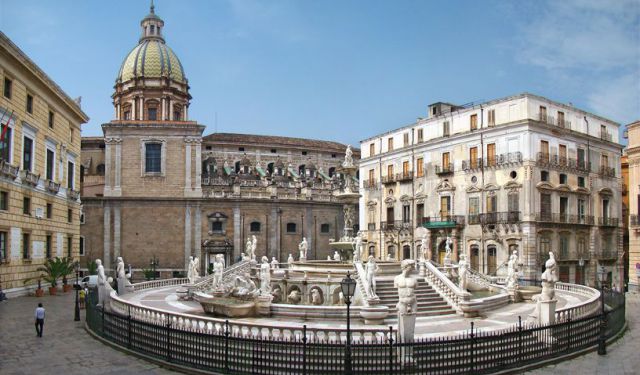
A Walk In Palermo's Historic Yet Lively City Center
The German polymath Johann Wolfgang von Goethe, who visited Sicily in 1787, wrote: “To have seen Italy without having seen Sicily is not to have seen Italy at all, for Sicily is the key to everything.”, Palermo being his main reference point.
Palermo’s story begins with a trading post established by the ancient Phoenician civilization around the 8th century BCE. The Phoenicians called it... view more
Tour Duration: 2 Hours
Travel Distance: 3.1 Km or 1.9 Miles
Palermo’s story begins with a trading post established by the ancient Phoenician civilization around the 8th century BCE. The Phoenicians called it... view more
Tour Duration: 2 Hours
Travel Distance: 3.1 Km or 1.9 Miles
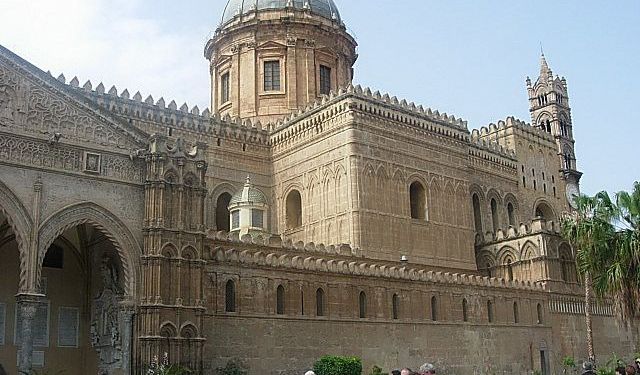
Historical Religious Buildings
Religion has always played an important role in the lives of the Italians - and the Sicilians are no exception. Thus, it is little wonder that the main city of the island, Palermo, boasts a plethora of religious buildings. The collection of historical churches found here ranges from the Arab-Norman-Byzantine to the Medieval, Gothic, Baroque and the Renaissance.
In the course of history, many of... view more
Tour Duration: 2 Hours
Travel Distance: 3.2 Km or 2 Miles
In the course of history, many of... view more
Tour Duration: 2 Hours
Travel Distance: 3.2 Km or 2 Miles
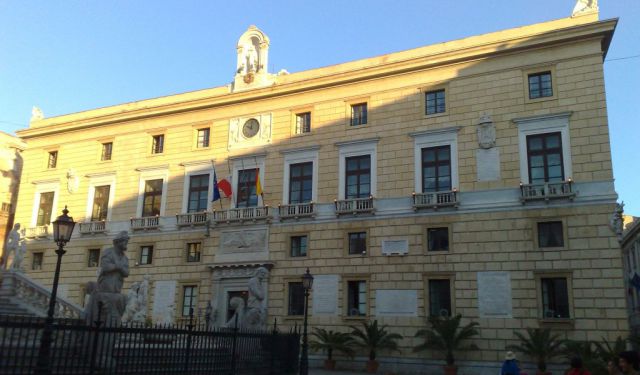
Palaces of Palermo
For centuries, Sicilian capital Palermo has been a focal point for the construction of noble dwellings and palaces. The latter were and still are a fine manifestation of the historical life in the region. They are a few hundred of them still in place, ranging chronologically from the medieval period to the first decades of the 20th century, and comprising an impressive collection of architectural... view more
Tour Duration: 1 Hour
Travel Distance: 2.6 Km or 1.6 Miles
Tour Duration: 1 Hour
Travel Distance: 2.6 Km or 1.6 Miles
City Walks Overview
