

Queen Bee Mill, Sioux Falls
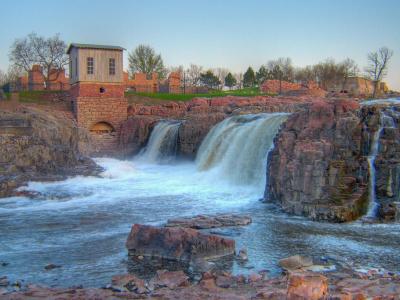
The Queen Bee Mill, a historic ruined mill complex in Falls Park, Sioux Falls, is a lasting testament to the industrial ambitions of the late 19th century. Built between 1879 and 1881 under the direction of Richard F. Pettigrew, the mill was envisioned as a powerhouse for the local wheat industry, utilizing the energy of the Big Sioux River. When it opened on October 25, 1881, it boasted a seven-story mill, a grain elevator with a 130,000-bushel capacity, a warehouse, and a cooper's workshop. Constructed from locally quarried quartzite, the complex also featured a dam, mill race, and turbine to generate power.
Despite its advanced design and high processing capacity of 1,200 barrels of grain per day, the Queen Bee Mill faced significant operational challenges. The anticipated water power proved insufficient, and the local wheat supply fell short of expectations. Within less than two years, financial struggles forced the mill to close on April 20, 1883, and its operators went bankrupt. The site remained largely dormant until 1911, when United Flour Mills of Minneapolis acquired it, electrified the mill, and resumed operations until around 1918. The Commander-Larabee Company sporadically used the facility until 1929. By 1937, the property was repurposed as warehouse space, a function it maintained until 1956.
A devastating fire in 1956 led to the destruction of the Queen Bee Mill, and by 1961, much of the structure was demolished, leaving only the foundations of the mill and grain elevator. Today, these remnants serve as a historical landmark, symbolizing both the aspirations and economic realities of early Sioux Falls. The site was officially recognized on the National Register of Historic Places on August 1, 1984, preserving its legacy for future generations.
Despite its advanced design and high processing capacity of 1,200 barrels of grain per day, the Queen Bee Mill faced significant operational challenges. The anticipated water power proved insufficient, and the local wheat supply fell short of expectations. Within less than two years, financial struggles forced the mill to close on April 20, 1883, and its operators went bankrupt. The site remained largely dormant until 1911, when United Flour Mills of Minneapolis acquired it, electrified the mill, and resumed operations until around 1918. The Commander-Larabee Company sporadically used the facility until 1929. By 1937, the property was repurposed as warehouse space, a function it maintained until 1956.
A devastating fire in 1956 led to the destruction of the Queen Bee Mill, and by 1961, much of the structure was demolished, leaving only the foundations of the mill and grain elevator. Today, these remnants serve as a historical landmark, symbolizing both the aspirations and economic realities of early Sioux Falls. The site was officially recognized on the National Register of Historic Places on August 1, 1984, preserving its legacy for future generations.
Want to visit this sight? Check out these Self-Guided Walking Tours in Sioux Falls. Alternatively, you can download the mobile app "GPSmyCity: Walks in 1K+ Cities" from Apple App Store or Google Play Store. The app turns your mobile device to a personal tour guide and it works offline, so no data plan is needed when traveling abroad.
Download The GPSmyCity App



Queen Bee Mill on Map
Sight Name: Queen Bee Mill
Sight Location: Sioux Falls, USA (See walking tours in Sioux Falls)
Sight Type: Attraction/Landmark
Sight Location: Sioux Falls, USA (See walking tours in Sioux Falls)
Sight Type: Attraction/Landmark
Nearby Sights



Walking Tours in Sioux Falls, South Dakota

Create Your Own Walk in Sioux Falls
Creating your own self-guided walk in Sioux Falls is easy and fun. Choose the city attractions that you want to see and a walk route map will be created just for you. You can even set your hotel as the start point of the walk.
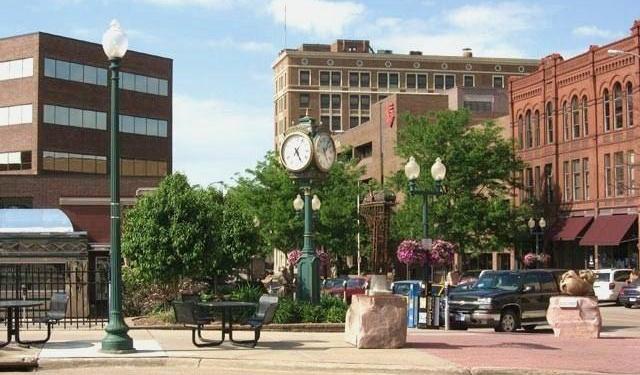
Sioux Falls Introduction Walking Tour
Sioux Falls, the largest city in South Dakota, owes its name to the powerful Sioux people who once lived in the region and the cascading waterfalls of the Big Sioux River which have shaped both the landscape and the city’s development.
European exploration of the area began in the early 18th century. First settled in 1856, the land around the falls then had to be abandoned because of... view more
Tour Duration: 2 Hour(s)
Travel Distance: 3.8 Km or 2.4 Miles
European exploration of the area began in the early 18th century. First settled in 1856, the land around the falls then had to be abandoned because of... view more
Tour Duration: 2 Hour(s)
Travel Distance: 3.8 Km or 2.4 Miles