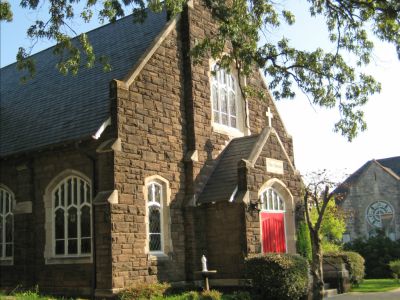


Saint Andrew's Church, Birmingham
Saint Andrew’s Episcopal Church in Birmingham is a historic and vibrant parish within the Episcopal Diocese of Alabama. Founded in 1902 as a Sunday school mission for children unable to reach the downtown Church of the Advent, it quickly grew to include full worship services and was officially incorporated in 1905. The church has been at its current location, at the corner of Eleventh Avenue and Twelfth Street South, since 1915-following the destruction of its original building by a tornado in 1913.
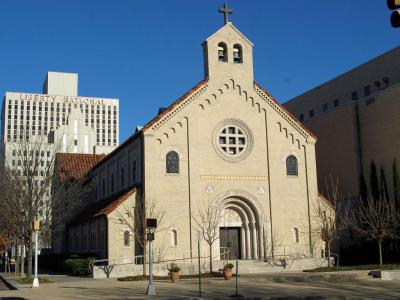
The brownstone church, completed that year, was designed by local architects Joy & Marriott in the style of traditional English Gothic parish churches. Its cornerstone was laid on Saint Andrew’s Day (November 30) in 1913 by Bishop Charles Beckwith. The building was later listed on the U.S. National Register of Historic Places in 1986, reflecting its architectural and cultural significance.
Saint Andrew’s played a foundational role in the establishment of Holy Innocents Hospital for Children in 1911, which later evolved into the Children’s Hospital of Alabama. Though the parish remained modest in scale for much of the 20th century, it began to develop a distinctive Anglo-Catholic identity in the 1940s, emphasizing Eucharistic celebration and traditional liturgy-further strengthened by priests such as Fr. Robert Yancey Marlow and Fr. Robert Woodfield.
Today, Saint Andrew’s Episcopal Church stands not just as a historic building but as a lively spiritual and cultural anchor in Birmingham-rooted in tradition, yet ever open to renewal and community engagement.
The brownstone church, completed that year, was designed by local architects Joy & Marriott in the style of traditional English Gothic parish churches. Its cornerstone was laid on Saint Andrew’s Day (November 30) in 1913 by Bishop Charles Beckwith. The building was later listed on the U.S. National Register of Historic Places in 1986, reflecting its architectural and cultural significance.
Saint Andrew’s played a foundational role in the establishment of Holy Innocents Hospital for Children in 1911, which later evolved into the Children’s Hospital of Alabama. Though the parish remained modest in scale for much of the 20th century, it began to develop a distinctive Anglo-Catholic identity in the 1940s, emphasizing Eucharistic celebration and traditional liturgy-further strengthened by priests such as Fr. Robert Yancey Marlow and Fr. Robert Woodfield.
Today, Saint Andrew’s Episcopal Church stands not just as a historic building but as a lively spiritual and cultural anchor in Birmingham-rooted in tradition, yet ever open to renewal and community engagement.
Want to visit this sight? Check out these Self-Guided Walking Tours in Birmingham. Alternatively, you can download the mobile app "GPSmyCity: Walks in 1K+ Cities" from Apple App Store or Google Play Store. The app turns your mobile device to a personal tour guide and it works offline, so no data plan is needed when traveling abroad.
Download The GPSmyCity App



Saint Andrew's Church on Map
Sight Name: Saint Andrew's Church
Sight Location: Birmingham, USA (See walking tours in Birmingham)
Sight Type: Religious
Sight Location: Birmingham, USA (See walking tours in Birmingham)
Sight Type: Religious
Nearby Sights


Walking Tours in Birmingham, Alabama

Create Your Own Walk in Birmingham
Creating your own self-guided walk in Birmingham is easy and fun. Choose the city attractions that you want to see and a walk route map will be created just for you. You can even set your hotel as the start point of the walk.
A Walking Guide to Birmingham's Revitalized Downtown
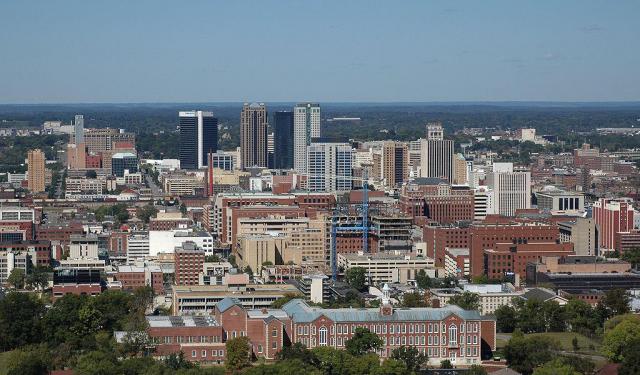
Birmingham is Alabama's biggest city and dates back to 1871, making it a Reconstruction-era city. Although initially formed from agricultural communities, the city quickly became a central railroad and industrial hub, with the iron and steel industries accounting for much of the local workforce.
Irish and Italian immigrants, as well as African Americans, made up most of this early... view more
Tour Duration: 2 Hours
Travel Distance: 3.8 Km or 2.4 Miles
Irish and Italian immigrants, as well as African Americans, made up most of this early... view more
Tour Duration: 2 Hours
Travel Distance: 3.8 Km or 2.4 Miles
Explore Birmingham's Civil Rights Historical Sites on Foot
Birmingham, Alabama is the very first destination that comes to mind at the mention of the Civil Rights Movement in the United States. Back in the 1950s and 1960s, this city saw a great deal of bloodshed and strife between civil rights leaders, seeking to shed the stigma of centuries-long injustice, and their opponents.
The area of downtown Birmingham, where several significant events in the... view more
Tour Duration: 1 Hour
Travel Distance: 0.9 Km or 0.6 Miles
The area of downtown Birmingham, where several significant events in the... view more
Tour Duration: 1 Hour
Travel Distance: 0.9 Km or 0.6 Miles
City Walks Overview
