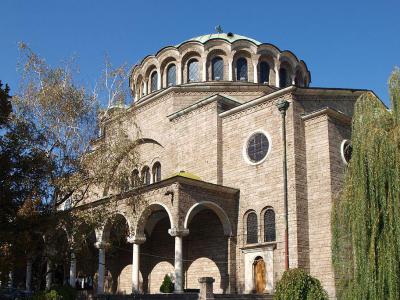


St. Nedelya Church, Sofia (must see)
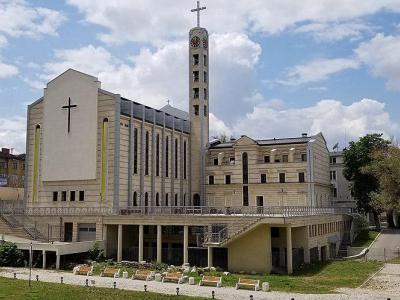
Saint Nedelya Church, meaning “Holy Sunday”, reflects centuries of Christian worship and linguistic tradition. Built in the medieval period, the church has been destroyed, rebuilt, expanded, and even targeted in a deadly political attack. The first version of Saint Nedelya is believed to have been built in the 10th century. Its foundation was of stone, but the rest of the structure was wooden. By the 18th century, it had become a bishop’s residence and the resting place of Serbian King Stefan Milutin, whose relics had been moved several times since 1460 before finding a home here.
The old church was demolished in 1856 to make way for a larger cathedral. Construction faced setbacks, including damage from an earthquake in 1858, but the new church was completed in 1863. In May 1867, it was inaugurated in front of an enormous crowd of 20,000 people. A new belfry was added in 1879 to house a carillon donated by Prince Alexander M. Dondukov-Korsakov.
In 1925, Saint Nedelya became the site of the deadliest political attack in Bulgarian history, when Communist militants bombed the church during a state funeral, killing more than 150 people. The church was rebuilt between 1927 and 1933, preserving its size while adding a central dome that rises 93 feet above the floor.
Renovation continued into modern times. By 1994, the floor had been replaced and the north colonnade reglazed, and in 2000 the façade received a full cleaning. Today, Saint Nedelya remains an active place of worship and a powerful symbol of Sofia’s endurance through centuries of upheaval.
The old church was demolished in 1856 to make way for a larger cathedral. Construction faced setbacks, including damage from an earthquake in 1858, but the new church was completed in 1863. In May 1867, it was inaugurated in front of an enormous crowd of 20,000 people. A new belfry was added in 1879 to house a carillon donated by Prince Alexander M. Dondukov-Korsakov.
In 1925, Saint Nedelya became the site of the deadliest political attack in Bulgarian history, when Communist militants bombed the church during a state funeral, killing more than 150 people. The church was rebuilt between 1927 and 1933, preserving its size while adding a central dome that rises 93 feet above the floor.
Renovation continued into modern times. By 1994, the floor had been replaced and the north colonnade reglazed, and in 2000 the façade received a full cleaning. Today, Saint Nedelya remains an active place of worship and a powerful symbol of Sofia’s endurance through centuries of upheaval.
Want to visit this sight? Check out these Self-Guided Walking Tours in Sofia. Alternatively, you can download the mobile app "GPSmyCity: Walks in 1K+ Cities" from Apple App Store or Google Play Store. The app turns your mobile device to a personal tour guide and it works offline, so no data plan is needed when traveling abroad.
Download The GPSmyCity App



St. Nedelya Church on Map
Sight Name: St. Nedelya Church
Sight Location: Sofia, Bulgaria (See walking tours in Sofia)
Sight Type: Religious
Guide(s) Containing This Sight:
Sight Location: Sofia, Bulgaria (See walking tours in Sofia)
Sight Type: Religious
Guide(s) Containing This Sight:
Nearby Sights
Walking Tours in Sofia, Bulgaria

Create Your Own Walk in Sofia
Creating your own self-guided walk in Sofia is easy and fun. Choose the city attractions that you want to see and a walk route map will be created just for you. You can even set your hotel as the start point of the walk.
Sofia City Center Walking Tour
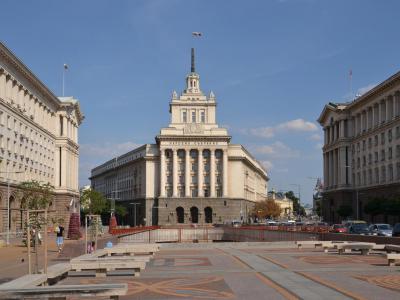
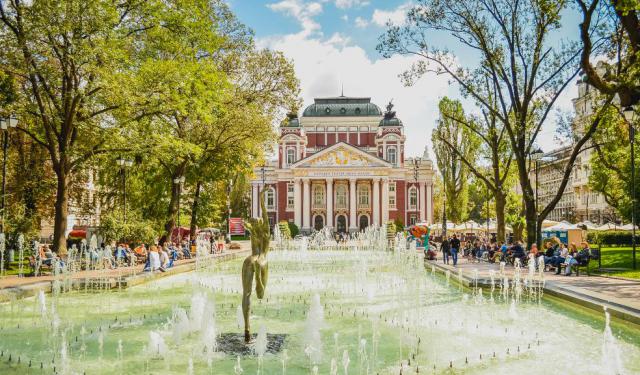
Sofia, the capital of Bulgaria, is one of Europe’s oldest continuously inhabited cities, with archaeological traces of settlement dating back at least 7,000 years. Its fertile valley, abundant mineral springs, and position on major east–west and north–south routes made it a natural crossroads for ancient peoples.
The Thracian tribe Serdi established a settlement here in the 1st... view more
Tour Duration: 2 Hour(s)
Travel Distance: 2.6 Km or 1.6 Miles
The Thracian tribe Serdi established a settlement here in the 1st... view more
Tour Duration: 2 Hour(s)
Travel Distance: 2.6 Km or 1.6 Miles
Communist Era Landmarks Walk
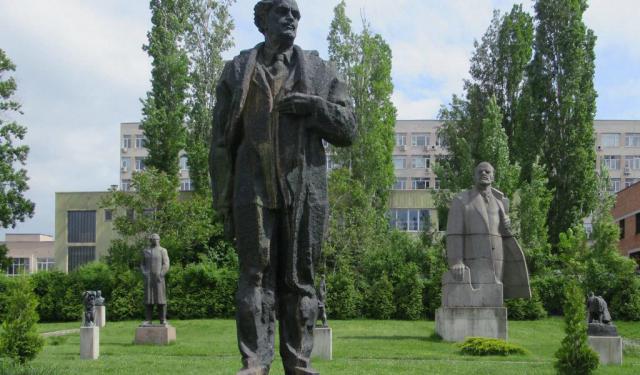
In the not-so-distant past Bulgaria was part of the Soviet-led Eastern Bloc. Today, this is one of the few countries where you can still find numerous relics of the Communist era manifested in monumental architectural landmarks. Concrete and metal were the main materials as a symbol of the industrialized nation, and the size was important too as a common architectural characteristic prescribed by... view more
Tour Duration: 3 Hour(s)
Travel Distance: 6.6 Km or 4.1 Miles
Tour Duration: 3 Hour(s)
Travel Distance: 6.6 Km or 4.1 Miles
Useful Travel Guides for Planning Your Trip

Sofia Shopping: 15 Things To Memorize Bulgaria By
Increasingly popular tourist destination in recent years, Bulgaria has opened up to the outer world, revealing colorful identity, manifested in rich craftsmanship, culinary and cultural traditions and history. The country's capital city Sofia is a lovely alloy of Eastern and Western European...