

Stratford House, Birmingham
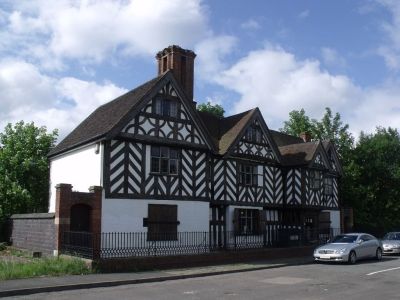
Stratford House is one of Birmingham’s oldest surviving domestic buildings, a Grade II* listed structure dating back to 1601. Built by Ambrose and Bridget Rotton-whose initials remain carved above the porch-the house began life as the centrepiece of a 20-acre farm, where livestock once filled the surrounding fields. Its timber-framed character reflects the Tudor period, while small details such as the historic insurance plate on the façade quietly trace the building’s long passage through time. Today, its setting near the busy Camp Hill junction contrasts sharply with its rural origins, offering a glimpse into a much earlier landscape.
Over the centuries, Stratford House has repeatedly faced the threat of disappearance. The arrival of the Midland Railway in the 19th century brought industrial pressure to the area, and by 1926 the house was earmarked for demolition-plans that were halted only after public opposition. A similar fate loomed again in 1950 when the building had fallen into disrepair, but its purchase and restoration in 1954 ensured its survival. Later, in an unexpected turn, the house even played a role in Birmingham’s music scene, serving as office space for Network Records during the rise of UK techno in the late 20th century.
More recent years have added further layers to its story, including a controversial period in the mid-2010s when it briefly operated as a private members’ venue, followed by damage from a fire in 2015. Careful restoration soon followed, and by 2020 the building had taken on a new, community-focused role as the home of Age UK Birmingham and Age UK Sandwell. With plans approved in 2021 to create a formal knot garden and reduce traffic nearby, Stratford House continues to evolve-its long history shaped as much by preservation efforts as by the changing character of the city around it.
Over the centuries, Stratford House has repeatedly faced the threat of disappearance. The arrival of the Midland Railway in the 19th century brought industrial pressure to the area, and by 1926 the house was earmarked for demolition-plans that were halted only after public opposition. A similar fate loomed again in 1950 when the building had fallen into disrepair, but its purchase and restoration in 1954 ensured its survival. Later, in an unexpected turn, the house even played a role in Birmingham’s music scene, serving as office space for Network Records during the rise of UK techno in the late 20th century.
More recent years have added further layers to its story, including a controversial period in the mid-2010s when it briefly operated as a private members’ venue, followed by damage from a fire in 2015. Careful restoration soon followed, and by 2020 the building had taken on a new, community-focused role as the home of Age UK Birmingham and Age UK Sandwell. With plans approved in 2021 to create a formal knot garden and reduce traffic nearby, Stratford House continues to evolve-its long history shaped as much by preservation efforts as by the changing character of the city around it.
Want to visit this sight? Check out these Self-Guided Walking Tours in Birmingham. Alternatively, you can download the mobile app "GPSmyCity: Walks in 1K+ Cities" from Apple App Store or Google Play Store. The app turns your mobile device to a personal tour guide and it works offline, so no data plan is needed when traveling abroad.
Download The GPSmyCity App



Stratford House on Map
Sight Name: Stratford House
Sight Location: Birmingham, England (See walking tours in Birmingham)
Sight Type: Attraction/Landmark
Guide(s) Containing This Sight:
Sight Location: Birmingham, England (See walking tours in Birmingham)
Sight Type: Attraction/Landmark
Guide(s) Containing This Sight:
Nearby Sights

Walking Tours in Birmingham, England

Create Your Own Walk in Birmingham
Creating your own self-guided walk in Birmingham is easy and fun. Choose the city attractions that you want to see and a walk route map will be created just for you. You can even set your hotel as the start point of the walk.
Birmingham Historical Buildings Tour
Although existent as a settlement since the early 7th century AD, Birmingham, UK is a relatively young city that has grown rapidly, as a result of the Industrial Revolution, from the 18th century onward. Thus, the local architecture is overwhelmingly a product of the 18th, 19th, and 20th centuries, with little survived from the earlier days.
Traces of the ancient settlement, dating back to... view more
Tour Duration: 2 Hours
Travel Distance: 4 Km or 2.5 Miles
Traces of the ancient settlement, dating back to... view more
Tour Duration: 2 Hours
Travel Distance: 4 Km or 2.5 Miles
Birmingham Introduction Walking Tour
The name Birmingham derives from the Old English Beormingahām, meaning “the home or settlement of Beorma’s people.” The Beormingas were therefore the people or followers of someone called Beorma. Who exactly was Beorma? No one really knows. He may have been a local leader, an ancestor, or even a legendary figure. What is certain is that a small Anglo-Saxon settlement was established here... view more
Tour Duration: 2 Hours
Travel Distance: 3.2 Km or 2 Miles
Tour Duration: 2 Hours
Travel Distance: 3.2 Km or 2 Miles