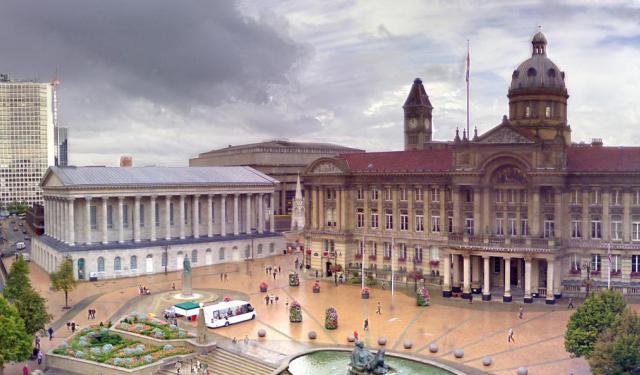


Birmingham Historical Buildings Tour, Birmingham

Birmingham Historical Buildings Tour (Self Guided), Birmingham

Although existent as a settlement since the early 7th century AD, Birmingham, UK is a relatively young city that has grown rapidly, as a result of the Industrial Revolution, from the 18th century onward. Thus, the local architecture is overwhelmingly a product of the 18th, 19th, and 20th centuries, with little survived from the earlier days.

Traces of the ancient settlement, dating back to 1166, were found when the church of St. Martin in the Bull Ring was built on the site of its 13th-century predecessor in 1873. Another evidence from the medieval period of Birmingham, still intact, is The Old Crown in Deritend, famously the oldest pub in the city, built in 1368 or rather between 1450 and 1500.

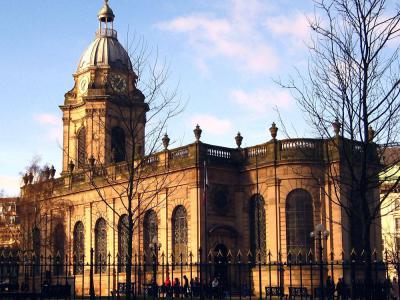
As Birmingham continued to expand, the increased population demanded more places of worship, which subsequently led to the construction of St. Philip's Cathedral, first built as a parish church in 1715 and converted to a cathedral in 1905.

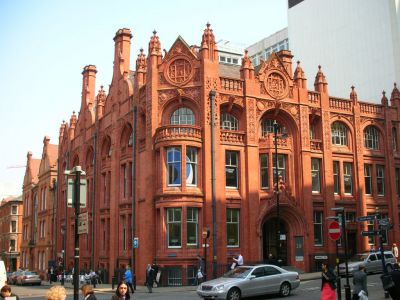
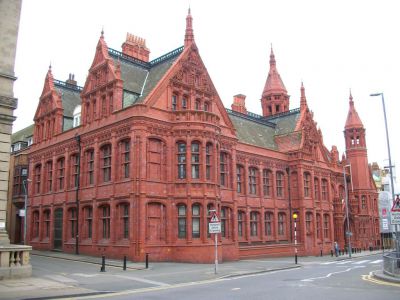
Along with the expansion, Birmingham acquired a variety of new architectural styles, including the use of red brick and terracotta. 17 & 19 Newhall Street, popularly known as The Exchange, is a red brick and architectural terracotta edifice from that period. Victoria Law Courts, completed in 1891, also feature extensive use of terracotta on the exterior.

If you wish to learn more about these and other wonderful historic buildings in Birmingham and to hear their stories, take this self-guided walking tour.
How it works: Download the app "GPSmyCity: Walks in 1K+ Cities" from Apple App Store or Google Play Store to your mobile phone or tablet. The app turns your mobile device into a personal tour guide and its built-in GPS navigation functions guide you from one tour stop to next. The app works offline, so no data plan is needed when traveling abroad.

Download The GPSmyCity App

Birmingham Historical Buildings Tour Map

Guide Name: Birmingham Historical Buildings Tour
Guide Location: England » Birmingham (See other walking tours in Birmingham)
Guide Type: Self-guided Walking Tour (Sightseeing)
# of Attractions: 8
Tour Duration: 2 Hour(s)
Travel Distance: 4.0 Km or 2.5 Miles
Author: VictoriaP
Sight(s) Featured in This Guide:
  • St. Philip's Cathedral
  • 17 & 19 Newhall Street
  • St. Chad's Cathedral
  • Methodist Central Hall
  • Victoria Law Courts
  • St. Martin's Church
  • The Old Crown
  • Stratford House
1
St. Philip's Cathedral

1) St. Philip's Cathedral

The Cathedral Church of Saint Philip, commonly known as Saint Philip's Cathedral, is a Church of England cathedral located on Colmore Row in central Birmingham. Originally built as a parish church, it was designed in the Baroque style by Thomas Archer and consecrated in 1715. The church became the cathedral of the newly formed Diocese of Birmingham in 1905.

Saint Philip's Cathedral is a Grade I listed building. The church's construction began in 1711 and was completed by 1715, with the tower finished by 1725 and additional urns added to the parapet in 1756. Archer's design was influenced by Italian Baroque architecture, specifically the churches of Borromini, and features a rectangular hall church interior with fluted pillars and Tuscan capitals supporting an arcade with a prominent cornice. Wooden galleries span the pillars, a common feature in English Baroque churches.

The cathedral's exterior is characterized by tall windows separated by pilasters, a roof-level balustrade, and a single tower with a lead-covered dome and lantern. The building is brick and faced with stone from Archer's estate at Umberslade. In the late 19th century, the eastern apse was extended by J. A. Chatwin, who also refaced the exterior due to the softness of the original stone. Chatwin's design included strongly projecting Corinthian columns and richly marbled surfaces.

Edward Burne-Jones, a local artist, contributed several stained glass windows to the cathedral, including three at the eastern end and one at the west end dedicated to Henry Bowlby. The cathedral also features several heritage-listed monuments, including those commemorating workers who died during the construction of Birmingham Town Hall and victims of the 1974 Birmingham pub bombings. A statue of Charles Gore, the first Bishop of Birmingham, stands at the west entrance.
2
17 & 19 Newhall Street

2) 17 & 19 Newhall Street

Located in the heart of Birmingham, at the intersection of Newhall Street and Edmund Street, the building at 17 & 19 Newhall Street stands as a significant architectural and historical landmark. Known as "The Exchange" and formerly referred to as the "Bell Edison Telephone Building," this Grade I listed structure is renowned for its distinctive red brick and architectural terracotta facade.

Designed by Frederick Martin of Martin & Chamberlain, the building was inaugurated in 1887 to accommodate the Central Telephone Exchange along with offices for the National Telephone Company (NTC). At the time, with 5,000 subscribers, it was the largest telephone exchange in the country. The building originally bore the postal address of 19 Newhall Street and was internally known within the NTC as "Telephone Buildings." The wrought iron gates at the main entrance proudly display the NTC logo, featuring the names of innovators Bell and Edison, highlighting its origins in the telecommunications industry.

In 1912, the Postmaster General took over the NTC, transferring the building to the General Post Office (GPO). Over the years, it served as a TAS exchange, the Birmingham office for the Post Office Engineering Union, and the Midland headquarters for the air raid warning system during World War I. In 1936, telephone exchange operations were moved to Telephone House, making space for various tenants in the subsequent decades.

Today, 17 & 19 Newhall Street is a vibrant hub for businesses, including Core Marketing, Mitchell Adam, and GBR Phoenix Beard, reflecting its ongoing relevance in modern commerce. The basement, with an entrance on Edmund Street, is home to the bar Bushwackers, adding a recreational aspect to this historic building's contemporary use.
3
St. Chad's Cathedral

3) St. Chad's Cathedral

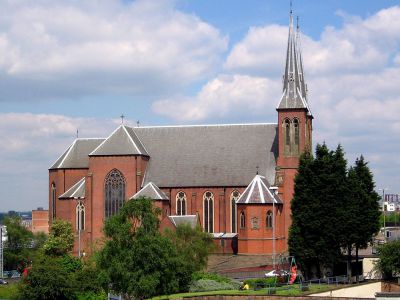
Saint Chad's Cathedral, officially known as The Metropolitan Cathedral Church and Basilica of Saint Chad, is a prominent historical and religious landmark in Birmingham. It holds the distinction of being the mother church of the Archdiocese of Birmingham. This cathedral is one of the first four Catholic churches erected in England after the English Reformation.

The cathedral's design was crafted by Augustus Welby Pugin, a celebrated figure in the Gothic Revival architectural movement in England. Pugin is known for his meticulous attention to detail, which is evident in the cathedral's construction, completed substantially by 1841. In 1852, it was elevated to the status of cathedral.

Saint Chad's is located in the Gunmakers Quarter of Birmingham and has a dramatic history, particularly during World War II. On November 22, 1940, the cathedral was nearly destroyed when an incendiary bomb pierced the roof. Miraculously, water from burst central heating pipes, damaged by the bomb, extinguished the resulting fire. This event is commemorated by a thanksgiving tablet on the transept ceiling that reads "Deo Gratias 22 Nov 1940," expressing gratitude for the cathedral's survival.

In recognition of its significant historical connections, Pope Pius XII declared Saint Chad's a Minor Basilica in 1941, a rare honor as there are only four such basilicas in England. The cathedral is dedicated to Saint Chad, a 7th-century Bishop of Mercia. It houses relics of Saint Chad, enshrined in the canopy above the altar.

Further architectural contributions were made in 1932 with the addition of Saint Edward's Chapel, designed by Sebastian Pugin Powell, Pugin's grandson. However, the 1960s brought less favorable changes; several of Pugin's original fittings were removed, and the interior was repainted, altering the initial aesthetic envisioned by Pugin.

Today, Saint Chad's Cathedral stands near Birmingham Snow Hill station, surrounded by a green public space known as Saint Chad's Queensway, named in honor of the cathedral. Although only some of Pugin's original work remains, the cathedral still serves as a significant spiritual and cultural site in Birmingham.
4
Methodist Central Hall

4) Methodist Central Hall

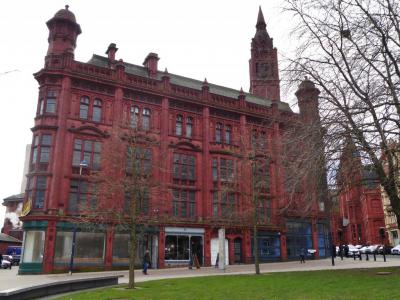
The Methodist Central Hall in Birmingham is a prominent historical building distinguished by its architectural and cultural significance. This three-story structure, completed between 1903 and 1904, is a Grade II* listed building, notable for its red brick and terracotta facade. The building features a prominent tower and is located at the northern end of Corporation Street within the Steelhouse Conservation Area.

Designed by architects Ewan Harper & James A. Harper, the Methodist Central Hall's architectural style complements the nearby Victoria Law Courts, which are also crafted in terracotta. The design incorporates eclectic elements, such as corner turrets that resemble Indian Chattris, adding an exotic flair to its appearance.

Originally built to serve as a Methodist church, the main hall of the building could seat 2,000 people and included over 30 additional rooms, among them three school halls. The street level of the building features twelve bays of shops, four of which retain their original fronts, extending along Ryder Street where more original shop fronts can be seen.

In 1991, the Methodist Church was transformed into a nightclub, a function it served until its closure in 2002. Since then, the building has been largely vacant and has suffered from poor maintenance, leading to its deteriorating condition. This has resulted in its addition to Historic England's Heritage at Risk Register.

Despite its current state, the Methodist Central Hall has been the focus of various redevelopment proposals, including conversions into apartments and offices. In 2018, Birmingham City Council approved plans to restore and renovate the building, with the new design incorporating a 147-bed hotel, promising a potential revitalization of this historic landmark.
5
Victoria Law Courts

5) Victoria Law Courts

The Victoria Law Courts in Birmingham is an example of Victorian architectural splendor. Situated on Corporation Street, this Grade I listed building is currently home to the Birmingham Magistrates' Court. Designed by the London-based architects Aston Webb & Ingress Bell in 1886, it was built to establish the first Assize Courts for the burgeoning town of Birmingham. Local construction firm John Bowen & Sons executed the design, which won out in a competitive selection process. The courts were ceremonially opened on July 21, 1891, by the Prince and Princess of Wales.

The exterior of the Victoria Law Courts is notably crafted from deep red terracotta, giving it a distinct and vibrant appearance. This material choice not only highlights the intricate terracotta ornamentation that adorns the building but also ties the structure visually to other civic buildings in the area, like the Methodist Central Hall across the street. Notably, Queen Victoria laid the foundation stone herself on March 23, 1887, during her Golden Jubilee year, which is commemorated by a statue of the Queen crafted by Harry Bates positioned above the main entrance.

Internally, the building retains much of its original grandeur. The Great Hall, in particular, is a standout feature, adorned with sandy-yellow terracotta and detailed ornamentation. Its chandeliers, which mimic the design of Queen Victoria's coronation crown, were notably the first outside London to be powered by electricity. The courtrooms themselves, five of which are original, maintain their historical integrity with extensive timber detailing, original furniture, and paneling.

Over the years, the building has undergone various extensions, including the addition of a projecting bow window from 1891 to 1894 and further expansion along Newton Street in 1914. Despite these enhancements, the Victoria Law Courts have preserved their historical essence and continue to serve as a functional and symbolic cornerstone of legal proceedings in Birmingham.
6
St. Martin's Church

6) St. Martin's Church

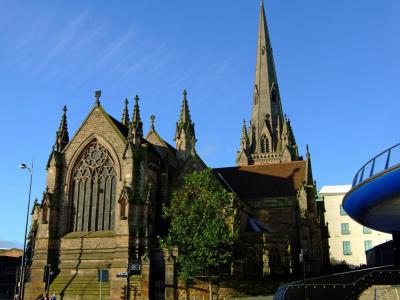
Saint Martin's is the original parish church of Birmingham. It stands by the Bull Ring Shopping Centre and the markets. The church is a Victorian neo-Gothic building. It has a high nave and chancel and a spire. The spire was rebuilt many times and thrice struck by lightning.

The church was demolished and rebuilt in 1873 by the architect J. A. Chatwin. The exterior is of Grinshill stone. The inside is of sandstone. Victorian floor tiles by Minton show the arms of the de Bermingham family.

The Blitz of World War II destroyed all the stained glass windows except the near irreplaceable Burne-Jones window. The other windows were replaced by 1954.

The church is provided with 16 bells. This is unusual. Other than Saint Martin's, only three rings of sixteen bells exist in the world.

The pipe organ in use today is by Harrison & Harrison. It dates from 1906. Since 2004 the church has stopped using the organ for the 11am service but it is still played at the 9.30am communion and at the 6pm Choral Service.
7
The Old Crown

7) The Old Crown

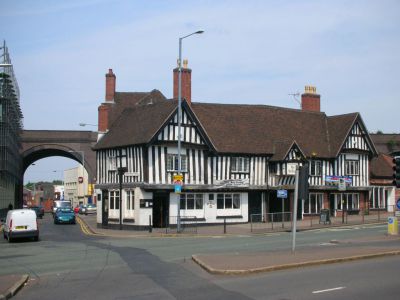
The Old Crown in Deritend, Birmingham, stands as one of the city’s most historic treasures and is among the oldest surviving secular buildings in the area. With its origins dating back to 1368, this Grade II listed structure exemplifies traditional "black and white" timber framing. While the building as it currently stands primarily dates from between 1450 and 1500, there is evidence of construction from as early as 1492.

Originally constructed as the Guildhall and School of Saint John, Deritend, the building was later purchased in 1589 by John Dyckson, also known as Bayleys. It remained in the ownership of the Dixon alias Baylis family, later known simply as Dixon, for approximately a century. By 1626, it began serving as an inn and was officially recognized as "The Crowne" by 1666.

Significant alterations occurred over the centuries: it was converted into two houses in 1684 and into three houses by 1693, a division that lasted until the 19th century. During this century, the Old Crown faced the threat of demolition three times-1851, 1856, and 1862-but each time it was successfully preserved. Noteworthy features from its earlier days include a central hall, and a courtyard with a 26-foot-deep well surrounded by large stones, which was refurbished in 1863 with an iron gate to maintain its accessibility while preserving its structure.

In 1991, the building was acquired by a local pub company, which undertook extensive restorations to bring the Old Crown back to its historical splendor. Today, it operates as a vibrant pub, celebrating its rich history and architectural heritage, continuing to serve as a beloved landmark in Birmingham.
8
Stratford House

8) Stratford House

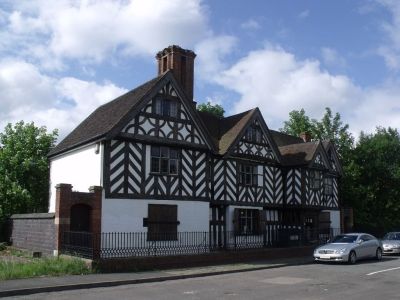
Stratford House is one of Birmingham’s oldest surviving domestic buildings, a Grade II* listed structure dating back to 1601. Built by Ambrose and Bridget Rotton—whose initials remain carved above the porch—the house began life as the centrepiece of a 20-acre farm, where livestock once filled the surrounding fields. Its timber-framed character reflects the Tudor period, while small details such as the historic insurance plate on the façade quietly trace the building’s long passage through time. Today, its setting near the busy Camp Hill junction contrasts sharply with its rural origins, offering a glimpse into a much earlier landscape.

Over the centuries, Stratford House has repeatedly faced the threat of disappearance. The arrival of the Midland Railway in the 19th century brought industrial pressure to the area, and by 1926 the house was earmarked for demolition—plans that were halted only after public opposition. A similar fate loomed again in 1950 when the building had fallen into disrepair, but its purchase and restoration in 1954 ensured its survival. Later, in an unexpected turn, the house even played a role in Birmingham’s music scene, serving as office space for Network Records during the rise of UK techno in the late 20th century.

More recent years have added further layers to its story, including a controversial period in the mid-2010s when it briefly operated as a private members’ venue, followed by damage from a fire in 2015. Careful restoration soon followed, and by 2020 the building had taken on a new, community-focused role as the home of Age UK Birmingham and Age UK Sandwell. With plans approved in 2021 to create a formal knot garden and reduce traffic nearby, Stratford House continues to evolve—its long history shaped as much by preservation efforts as by the changing character of the city around it.

Walking Tours in Birmingham, England

Create Your Own Walk in Birmingham

Create Your Own Walk in Birmingham

Creating your own self-guided walk in Birmingham is easy and fun. Choose the city attractions that you want to see and a walk route map will be created just for you. You can even set your hotel as the start point of the walk.
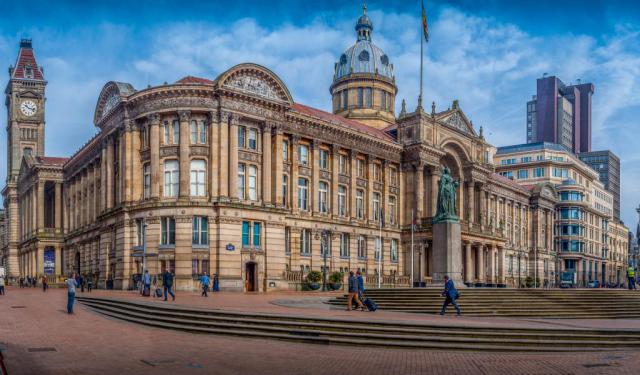
Birmingham Introduction Walking Tour

Birmingham Introduction Walking Tour

The word Birmingham derives from the Old English term "Beormingas." A Beorminga was a person who was one of "Beorma's people." Who was Beorma? Who knows? Something was always stirring around Birmingham.

In 1166, Peter de Bermingham received a charter from the King, Henry II, to build a market at his castle (Peter's castle, not Henry's). As Lord of the Manor...  view more

Tour Duration: 2 Hour(s)
Travel Distance: 3.2 Km or 2 Miles