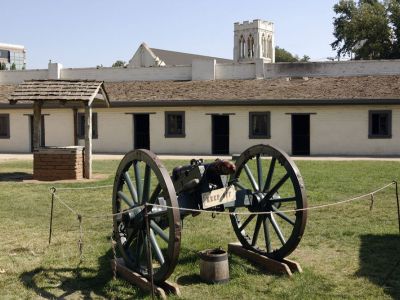


Sutter's Fort, Sacramento (must see)
The California Gold Rush did not begin at Sutter's Fort itself, but the fort played a central role in the events that set it in motion. John Sutter established his settlement, which he called "New Helvetia," in Mexican Alta California in 1839, and construction of the fort began in 1840. The name was a homage to Switzerland, which Sutter considered his homeland. Being conveniently located near the end of the California Trail and along routes connecting California with the north, the fort was a foundational component of Sacramento's future development.
On January 24, 1848, James Marshall discovered gold while building Sutter's sawmill at Coloma, about 45 miles northeast of the fort, on the South Fork of the American River. Marshall later brought samples of the gold to Sutter at the fort. After the Gold Rush got underway, workers abandoned Sutter's enterprises, newcomers overran his lands, and his businesses rapidly declined. Sutter eventually lost much of his property and was bankrupt by 1852.
Towards the end of the 19th century, many citizens worked to protect landmarks from the pioneer days. The Native Sons of the Golden West helped acquire the surviving fort property and presented it to the State of California in 1891. The central building was repaired and the fort's outer walls and rooms, which had largely disappeared, were reconstructed between 1891 and 1893. The site became part of the California State Park System in 1947.
California State Parks maintains the fort today. The two-story Central Building is the only original building still standing; most of the surrounding fort is a reconstruction. You'll find period furnishings, exhibits, and recreated historic rooms. The original fort housed a bakery, grist mill, blanket factory, gunsmith, distillery, and blacksmith and carpenter shops. As many as 300 people may have worked at the fort during the day, although far fewer actually lived within its walls.
On January 24, 1848, James Marshall discovered gold while building Sutter's sawmill at Coloma, about 45 miles northeast of the fort, on the South Fork of the American River. Marshall later brought samples of the gold to Sutter at the fort. After the Gold Rush got underway, workers abandoned Sutter's enterprises, newcomers overran his lands, and his businesses rapidly declined. Sutter eventually lost much of his property and was bankrupt by 1852.
Towards the end of the 19th century, many citizens worked to protect landmarks from the pioneer days. The Native Sons of the Golden West helped acquire the surviving fort property and presented it to the State of California in 1891. The central building was repaired and the fort's outer walls and rooms, which had largely disappeared, were reconstructed between 1891 and 1893. The site became part of the California State Park System in 1947.
California State Parks maintains the fort today. The two-story Central Building is the only original building still standing; most of the surrounding fort is a reconstruction. You'll find period furnishings, exhibits, and recreated historic rooms. The original fort housed a bakery, grist mill, blanket factory, gunsmith, distillery, and blacksmith and carpenter shops. As many as 300 people may have worked at the fort during the day, although far fewer actually lived within its walls.
Want to visit this sight? Check out these Self-Guided Walking Tours in Sacramento. Alternatively, you can download the mobile app "GPSmyCity: Walks in 1K+ Cities" from Apple App Store or Google Play Store. The app turns your mobile device to a personal tour guide and it works offline, so no data plan is needed when traveling abroad.
Download The GPSmyCity App



Sutter's Fort on Map
Sight Name: Sutter's Fort
Sight Location: Sacramento, USA (See walking tours in Sacramento)
Sight Type: Attraction/Landmark
Guide(s) Containing This Sight:
Sight Location: Sacramento, USA (See walking tours in Sacramento)
Sight Type: Attraction/Landmark
Guide(s) Containing This Sight:
Nearby Sights




Walking Tours in Sacramento, California

Create Your Own Walk in Sacramento
Creating your own self-guided walk in Sacramento is easy and fun. Choose the city attractions that you want to see and a walk route map will be created just for you. You can even set your hotel as the start point of the walk.
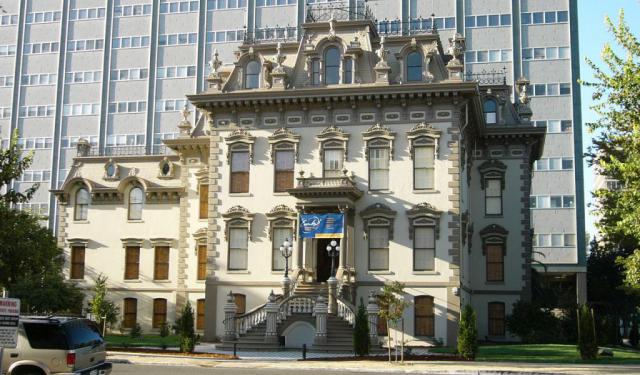
Historical Buildings Walking Tour
The Gold Rush of the mid-1800s brought a large number of gold miners and prospects to Sacramento. The city expanded further when the California State Legislature moved here in 1854. Some of Sacramento’s historic buildings date back to that period and used to accommodate the flood of gold seekers and growing government business.
The elegant Governor's Mansion State Historic Park once... view more
Tour Duration: 2 Hour(s)
Travel Distance: 3.5 Km or 2.2 Miles
The elegant Governor's Mansion State Historic Park once... view more
Tour Duration: 2 Hour(s)
Travel Distance: 3.5 Km or 2.2 Miles

A Walk Through Old Sacramento and Downtown
Though little physical evidence of their early settlements is visible today, the Sacramento Valley was home to the Nisenan, Plains Miwok, and Patwin Wintun Native American peoples for thousands of years before the arrival of Spanish explorers and later American settlers. John Sutter Sr. arrived near the confluence of the American and Sacramento Rivers in 1839. In 1841, the Mexican government... view more
Tour Duration: 2 Hour(s)
Travel Distance: 4.2 Km or 2.6 Miles
Tour Duration: 2 Hour(s)
Travel Distance: 4.2 Km or 2.6 Miles