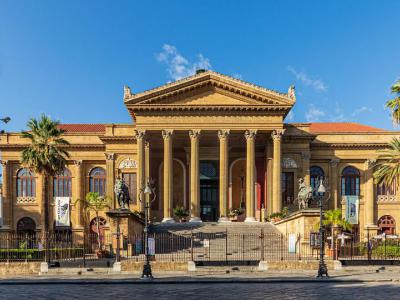


Teatro Massimo (Massimo Theater), Palermo (must see)
The Massimo Theater is the largest opera house in Italy, often cited as the third largest after the Paris Opera and Vienna State Opera. In 1864, the Palermo City Council launched an international competition to design a new opera house, intended to express the cultural ambitions of newly unified Italy. The winning design was by architect Giovanni Battista Filippo Basile, a leading figure in Sicilian historicist architecture. After his death in 1891, construction was continued and completed by his son, Ernesto Basile. The theater officially opened in 1897.
Basile drew inspiration from classical Sicilian architecture, particularly the monumental forms of the ancient Greek temples of Agrigento, combined with elements of Neoclassicism and late Renaissance revival. The massive portico, broad steps, and temple-like massing give the building a solemn, ceremonial presence.
Inside, the auditorium seats approximately 1,300 spectators and is arranged in the traditional horseshoe shape, designed for optimal acoustics. It features seven levels, including stalls, boxes, and galleries. The stage is slightly inclined, while the seating rises steadily away from it, enhancing sightlines and sound projection.
In 1974, the theater closed for restoration and modernization. What was initially planned as a relatively short renovation became a 23-year closure. It finally reopened in 1997, regaining its role as Palermo’s principal cultural venue. Since reopening, the theater has resumed an active international program of opera, ballet, and concerts. While administrative and financial challenges have periodically affected its management, the Massimo remains a central symbol of Palermo’s cultural life and ambitions.
Basile drew inspiration from classical Sicilian architecture, particularly the monumental forms of the ancient Greek temples of Agrigento, combined with elements of Neoclassicism and late Renaissance revival. The massive portico, broad steps, and temple-like massing give the building a solemn, ceremonial presence.
Inside, the auditorium seats approximately 1,300 spectators and is arranged in the traditional horseshoe shape, designed for optimal acoustics. It features seven levels, including stalls, boxes, and galleries. The stage is slightly inclined, while the seating rises steadily away from it, enhancing sightlines and sound projection.
In 1974, the theater closed for restoration and modernization. What was initially planned as a relatively short renovation became a 23-year closure. It finally reopened in 1997, regaining its role as Palermo’s principal cultural venue. Since reopening, the theater has resumed an active international program of opera, ballet, and concerts. While administrative and financial challenges have periodically affected its management, the Massimo remains a central symbol of Palermo’s cultural life and ambitions.
Want to visit this sight? Check out these Self-Guided Walking Tours in Palermo. Alternatively, you can download the mobile app "GPSmyCity: Walks in 1K+ Cities" from Apple App Store or Google Play Store. The app turns your mobile device to a personal tour guide and it works offline, so no data plan is needed when traveling abroad.
Download The GPSmyCity App



Teatro Massimo (Massimo Theater) on Map
Sight Name: Teatro Massimo (Massimo Theater)
Sight Location: Palermo, Italy (See walking tours in Palermo)
Sight Type: Attraction/Landmark
Guide(s) Containing This Sight:
Sight Location: Palermo, Italy (See walking tours in Palermo)
Sight Type: Attraction/Landmark
Guide(s) Containing This Sight:
Nearby Sights
Walking Tours in Palermo, Italy

Create Your Own Walk in Palermo
Creating your own self-guided walk in Palermo is easy and fun. Choose the city attractions that you want to see and a walk route map will be created just for you. You can even set your hotel as the start point of the walk.
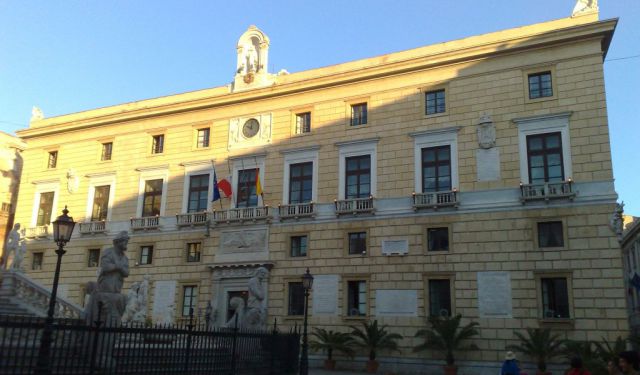
Palaces of Palermo
For centuries, Sicilian capital Palermo has been a focal point for the construction of noble dwellings and palaces. The latter were and still are a fine manifestation of the historical life in the region. They are a few hundred of them still in place, ranging chronologically from the medieval period to the first decades of the 20th century, and comprising an impressive collection of architectural... view more
Tour Duration: 1 Hour(s)
Travel Distance: 2.6 Km or 1.6 Miles
Tour Duration: 1 Hour(s)
Travel Distance: 2.6 Km or 1.6 Miles
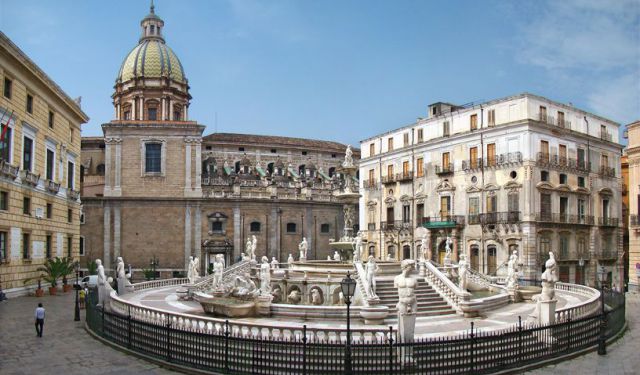
A Walk In Palermo's Historic Yet Lively City Center
The German polymath Johann Wolfgang von Goethe, who visited Sicily in 1787, wrote: “To have seen Italy without having seen Sicily is not to have seen Italy at all, for Sicily is the key to everything.”, Palermo being his main reference point.
Palermo’s story begins with a trading post established by the ancient Phoenician civilization around the 8th century BCE. The Phoenicians called it... view more
Tour Duration: 2 Hour(s)
Travel Distance: 3.1 Km or 1.9 Miles
Palermo’s story begins with a trading post established by the ancient Phoenician civilization around the 8th century BCE. The Phoenicians called it... view more
Tour Duration: 2 Hour(s)
Travel Distance: 3.1 Km or 1.9 Miles
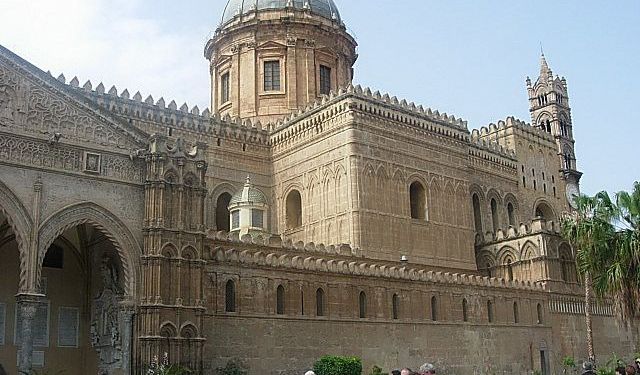
Historical Religious Buildings
Religion has always played an important role in the lives of the Italians – and the Sicilians are no exception. Thus, it is little wonder that the main city of the island, Palermo, boasts a plethora of religious buildings. The collection of historical churches found here ranges from the Arab-Norman-Byzantine to the Medieval, Gothic, Baroque and the Renaissance.
In the course of history, many... view more
Tour Duration: 2 Hour(s)
Travel Distance: 3.2 Km or 2 Miles
In the course of history, many... view more
Tour Duration: 2 Hour(s)
Travel Distance: 3.2 Km or 2 Miles