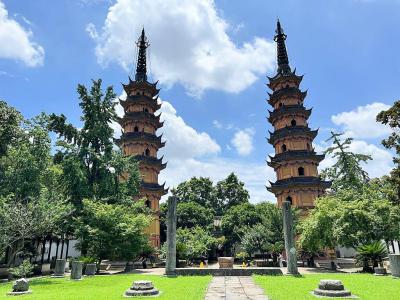


Twin Pagodas, Suzhou
The Twin Pagodas of Suzhou stand as the most prominent survivors of the former Dinghui Temple, once an influential Buddhist complex with a history stretching back more than a thousand years. Constructed in 982 AD during the Northern Song period, the pagodas were funded by Wang Wenhan and his brother and originally formed part of a temple known by several names over the centuries, including Banruo, Luohan, the West Temple, and finally Dinghui. Although the temple was repeatedly rebuilt after fires-most notably in the late Yuan dynasty and again after its destruction during the Second Opium War in 1860-it never regained its former scale. Today, scattered columns, plinths, and decapitated statues from the Tang era offer a quiet reminder of the site’s long and layered past.
What makes the Twin Pagodas exceptional is their rarity in Chinese temple architecture, where a single pagoda was the norm. Built of brick and rising to about 30 metres, the Reliquary Pagoda and the Beneficial Virtue Reliquary Pagoda share nearly identical forms: octagonal, seven-storey structures with square rooms rotated 45 degrees at each level, except for the octagonal second floor. Their unusually long iron steeples add a distinctive silhouette seldom seen in ancient Chinese pagodas.
The site also carries a literary connection. Su Shi, one of the Song dynasty’s most celebrated writers, maintained a close friendship with Dinghui Temple’s abbot, Shou Qin. Their exchanged poems were once engraved on the temple walls, and a playful local saying likened the Twin Pagodas to a pair of scholars’ brushes beside a nearby “inkstone” tower-an enduring nod to Suzhou’s cultural imagination.
What makes the Twin Pagodas exceptional is their rarity in Chinese temple architecture, where a single pagoda was the norm. Built of brick and rising to about 30 metres, the Reliquary Pagoda and the Beneficial Virtue Reliquary Pagoda share nearly identical forms: octagonal, seven-storey structures with square rooms rotated 45 degrees at each level, except for the octagonal second floor. Their unusually long iron steeples add a distinctive silhouette seldom seen in ancient Chinese pagodas.
The site also carries a literary connection. Su Shi, one of the Song dynasty’s most celebrated writers, maintained a close friendship with Dinghui Temple’s abbot, Shou Qin. Their exchanged poems were once engraved on the temple walls, and a playful local saying likened the Twin Pagodas to a pair of scholars’ brushes beside a nearby “inkstone” tower-an enduring nod to Suzhou’s cultural imagination.
Want to visit this sight? Check out these Self-Guided Walking Tours in Suzhou. Alternatively, you can download the mobile app "GPSmyCity: Walks in 1K+ Cities" from Apple App Store or Google Play Store. The app turns your mobile device to a personal tour guide and it works offline, so no data plan is needed when traveling abroad.
Download The GPSmyCity App



Twin Pagodas on Map
Sight Name: Twin Pagodas
Sight Location: Suzhou, China (See walking tours in Suzhou)
Sight Type: Religious
Sight Location: Suzhou, China (See walking tours in Suzhou)
Sight Type: Religious
Nearby Sights

Walking Tours in Suzhou, China

Create Your Own Walk in Suzhou
Creating your own self-guided walk in Suzhou is easy and fun. Choose the city attractions that you want to see and a walk route map will be created just for you. You can even set your hotel as the start point of the walk.

Suzhou Old City Walking Tour
"Above there is heaven; below there is Suzhou (and Hangzhou)." Often spoken of in conjunction with Hangzhou, another picturesque city in China, Suzhou is located in the eastern part of the country and is colloquially referred to as the "Water Town of the East," renowned for its waterways and classical gardens, together creating an idyllic setting.
As the cradle of Wu... view more
Tour Duration: 2 Hours
Travel Distance: 4.6 Km or 2.9 Miles
As the cradle of Wu... view more
Tour Duration: 2 Hours
Travel Distance: 4.6 Km or 2.9 Miles