

Via Maesta delle Volte (Maesta delle Volte Street), Perugia
Maesta delle Volte Street, a hidden gem in the heart of Perugia’s historic center, offers a compact yet captivating journey through the city’s medieval and Renaissance heritage. Despite its modest length of just over 100 meters, this picturesque street weaves an intricate narrative of Perugia’s architectural evolution and artistic history.
Nestled between IV Novembre Square and Cavallotti Square, the street's name originates from a 14th-century fresco, Maestà delle Volte, depicting the Madonna with Child. This artwork, believed to have been painted to deter criminal activity in the once-dark passage, now resides within the rebuilt Oratory of the Maestà delle Volte, dating back to 1567.
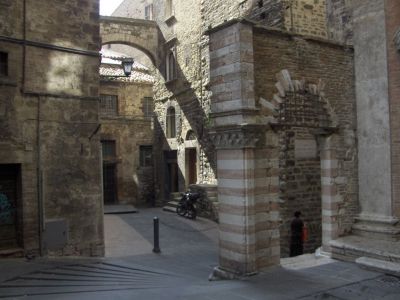
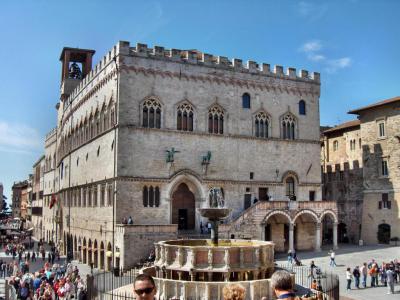
The street showcases remnants of the Podestà Palace, destroyed by fire, including a striking Gothic portico with red and white stone bands. A nearby 13th-14th century tower house features arches that frame Fratti Street, further accentuating the area’s historical depth.
One of the highlights is the Fountain of Maestà delle Volte Street, constructed in 1928 by architect Pietro Angelini. Its medieval-style design seamlessly integrates with its surroundings, standing beneath a 15th-century arch. A carved griffin, the emblem of Perugia, adorns the fountain’s central basin, accompanied by an inscription that subtly reveals its 20th-century origins.
For visitors, the street offers not only architectural marvels but also charming artisan shops tucked behind unassuming doors. These spaces, often under brick barrel vaults, showcase handcrafted sculptures and wooden objects-perfect mementos of this enchanting walk.
Maesta delle Volte Street epitomizes Perugia's ability to preserve its past while embracing modernity. Its narrow, vaulted path invites visitors to step back in time, offering a profound sense of the city's layered history in one of Umbria’s most atmospheric corners.
Nestled between IV Novembre Square and Cavallotti Square, the street's name originates from a 14th-century fresco, Maestà delle Volte, depicting the Madonna with Child. This artwork, believed to have been painted to deter criminal activity in the once-dark passage, now resides within the rebuilt Oratory of the Maestà delle Volte, dating back to 1567.
The street showcases remnants of the Podestà Palace, destroyed by fire, including a striking Gothic portico with red and white stone bands. A nearby 13th-14th century tower house features arches that frame Fratti Street, further accentuating the area’s historical depth.
One of the highlights is the Fountain of Maestà delle Volte Street, constructed in 1928 by architect Pietro Angelini. Its medieval-style design seamlessly integrates with its surroundings, standing beneath a 15th-century arch. A carved griffin, the emblem of Perugia, adorns the fountain’s central basin, accompanied by an inscription that subtly reveals its 20th-century origins.
For visitors, the street offers not only architectural marvels but also charming artisan shops tucked behind unassuming doors. These spaces, often under brick barrel vaults, showcase handcrafted sculptures and wooden objects-perfect mementos of this enchanting walk.
Maesta delle Volte Street epitomizes Perugia's ability to preserve its past while embracing modernity. Its narrow, vaulted path invites visitors to step back in time, offering a profound sense of the city's layered history in one of Umbria’s most atmospheric corners.
Want to visit this sight? Check out these Self-Guided Walking Tours in Perugia. Alternatively, you can download the mobile app "GPSmyCity: Walks in 1K+ Cities" from Apple App Store or Google Play Store. The app turns your mobile device to a personal tour guide and it works offline, so no data plan is needed when traveling abroad.
Download The GPSmyCity App



Via Maesta delle Volte (Maesta delle Volte Street) on Map
Sight Name: Via Maesta delle Volte (Maesta delle Volte Street)
Sight Location: Perugia, Italy (See walking tours in Perugia)
Sight Type: Attraction/Landmark
Sight Location: Perugia, Italy (See walking tours in Perugia)
Sight Type: Attraction/Landmark
Nearby Sights



Walking Tours in Perugia, Italy

Create Your Own Walk in Perugia
Creating your own self-guided walk in Perugia is easy and fun. Choose the city attractions that you want to see and a walk route map will be created just for you. You can even set your hotel as the start point of the walk.
A Walk Through Perugia's Medieval Old Town
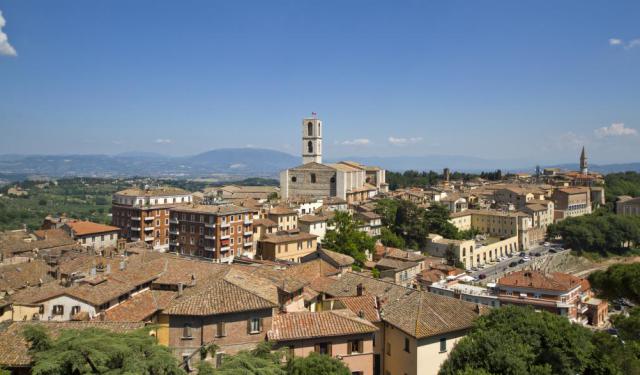
Perugia was one of the twelve foremost cities of the Etruscan Federation. It was mentioned by Quintus Fabius Pictor, a Roman historian. He tells of a military expedition of Fabius Maximus Rullianus against the Etruscan League and Perugia in 309 BC.
By 216 BC, Perugia had seen the light and allied itself with Rome in the Second Punic War against Carthage. Things went swimmingly until 41 BC.... view more
Tour Duration: 2 Hour(s)
Travel Distance: 2.1 Km or 1.3 Miles
By 216 BC, Perugia had seen the light and allied itself with Rome in the Second Punic War against Carthage. Things went swimmingly until 41 BC.... view more
Tour Duration: 2 Hour(s)
Travel Distance: 2.1 Km or 1.3 Miles
Perugino and Renaissance Art Walk
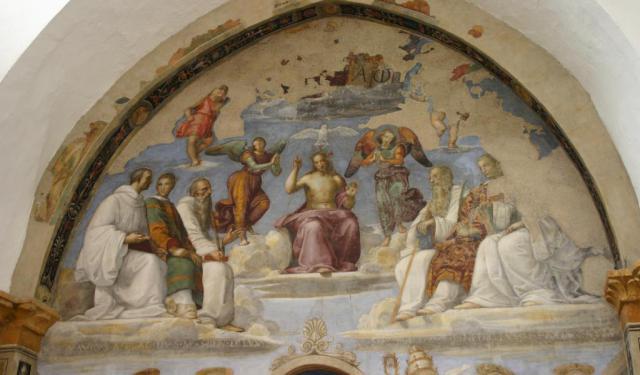
Perugia today is a well-known cultural and artistic center in Italy that regularly plays host to a multitude of annual festivals and events. The most glorious period in the history of the city, from an artistic standpoint, lasted from the 13th to the 16th centuries.
Perugia’s most celebrated artist, Pietro Vannucci (1450–1523), better known as “il Perugino”, nicknamed so after his... view more
Tour Duration: 1 Hour(s)
Travel Distance: 2.3 Km or 1.4 Miles
Perugia’s most celebrated artist, Pietro Vannucci (1450–1523), better known as “il Perugino”, nicknamed so after his... view more
Tour Duration: 1 Hour(s)
Travel Distance: 2.3 Km or 1.4 Miles