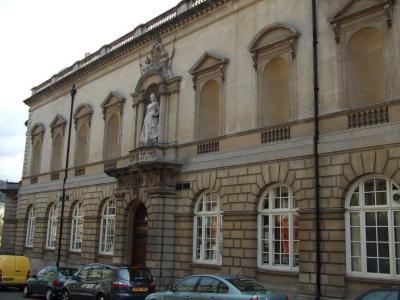


Victoria Art Gallery, Bath
The Victoria Art Gallery in Bath is a prominent public art venue with a substantial history and an outstanding collection. It was inaugurated in 1900 to commemorate Queen Victoria's Diamond Jubilee. Over time, it has garnered recognition as a Grade II* listed building, a testament to its architectural and historical importance.
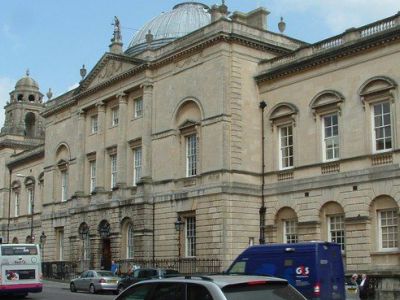
Designed by John McKean Brydon in 1897, the building initially served a dual purpose, housing both a public library and art exhibitions. However, in 1990, it underwent a transformation to exclusively display art works. The structure is notable for its limestone ashlar construction, with the upper half rendered distinctively. Occupying a corner site, this two-storey building features an attic tower capped with a lead-covered dome. The Victoria Art Gallery is divided into two main sections: the Upper Gallery and the Lower Gallery, connected by a marble hallway and a grand staircase, adding to its grandeur.
Externally, the building is adorned with artistic elements, including niches with the central one being more prominent, flanked by Ionic columns and pilasters. This niche houses a statue of Queen Victoria by Andrea Carlo Lucchesi, and is accompanied by friezes of classical figures by George Anderson Lawson on either side.
The gallery's collection is extensive, boasting over 1,500 objects of art. Among these are a remarkable array of British oil paintings, with pieces dating from the 1700s to the present day. The collection includes works by renowned artists such as Thomas Gainsborough, Thomas Jones Barker, and Walter Sickert. In addition to paintings, the gallery showcases a variety of decorative arts, including sculptures, glassware, and other artistic objects, making it a treasure trove of artistic heritage and an essential cultural landmark in Bath.
Designed by John McKean Brydon in 1897, the building initially served a dual purpose, housing both a public library and art exhibitions. However, in 1990, it underwent a transformation to exclusively display art works. The structure is notable for its limestone ashlar construction, with the upper half rendered distinctively. Occupying a corner site, this two-storey building features an attic tower capped with a lead-covered dome. The Victoria Art Gallery is divided into two main sections: the Upper Gallery and the Lower Gallery, connected by a marble hallway and a grand staircase, adding to its grandeur.
Externally, the building is adorned with artistic elements, including niches with the central one being more prominent, flanked by Ionic columns and pilasters. This niche houses a statue of Queen Victoria by Andrea Carlo Lucchesi, and is accompanied by friezes of classical figures by George Anderson Lawson on either side.
The gallery's collection is extensive, boasting over 1,500 objects of art. Among these are a remarkable array of British oil paintings, with pieces dating from the 1700s to the present day. The collection includes works by renowned artists such as Thomas Gainsborough, Thomas Jones Barker, and Walter Sickert. In addition to paintings, the gallery showcases a variety of decorative arts, including sculptures, glassware, and other artistic objects, making it a treasure trove of artistic heritage and an essential cultural landmark in Bath.
Want to visit this sight? Check out these Self-Guided Walking Tours in Bath. Alternatively, you can download the mobile app "GPSmyCity: Walks in 1K+ Cities" from Apple App Store or Google Play Store. The app turns your mobile device to a personal tour guide and it works offline, so no data plan is needed when traveling abroad.
Download The GPSmyCity App



Victoria Art Gallery on Map
Sight Name: Victoria Art Gallery
Sight Location: Bath, England (See walking tours in Bath)
Sight Type: Museum/Gallery
Sight Location: Bath, England (See walking tours in Bath)
Sight Type: Museum/Gallery
Nearby Sights
Walking Tours in Bath, England

Create Your Own Walk in Bath
Creating your own self-guided walk in Bath is easy and fun. Choose the city attractions that you want to see and a walk route map will be created just for you. You can even set your hotel as the start point of the walk.
Historical Homes Walking Tour
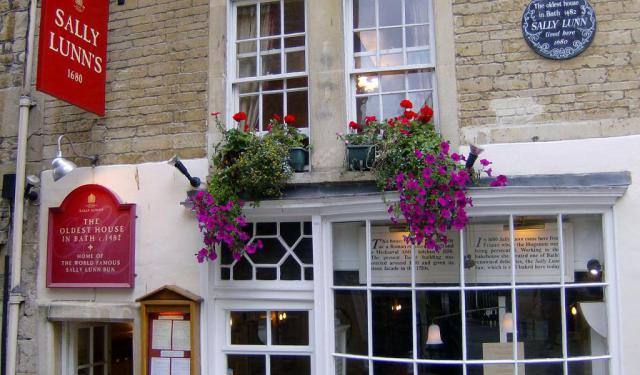
Apart from its Roman thermae, the city of Bath is renowned for its prominent residents who used to live here a long time ago. Their former dwellings – historical monuments in their own right – now offer a captivating glimpse into the city's glorious past.
Among the most famous of them, undoubtedly, is the Jane Austen Centre. This charming Georgian townhouse provides a fascinating look... view more
Tour Duration: 1 Hour(s)
Travel Distance: 1.6 Km or 1 Miles
Among the most famous of them, undoubtedly, is the Jane Austen Centre. This charming Georgian townhouse provides a fascinating look... view more
Tour Duration: 1 Hour(s)
Travel Distance: 1.6 Km or 1 Miles
Georgian Architecture Walking Tour
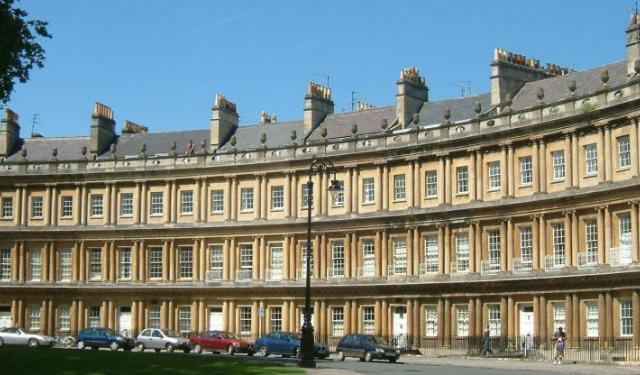
Another prominent attraction of Bath is its wonderful Georgian architecture. Many a street and square here are richly adorned with distinctively stylish buildings. In large part, the city owes it to two architects – father and son: John Wood, the Elder, and John Wood, the Younger. Constructed mostly from Bath Stone, a creamy limestone obtained in Combe Down and Bathampton Down Miles, these... view more
Tour Duration: 1 Hour(s)
Travel Distance: 2.2 Km or 1.4 Miles
Tour Duration: 1 Hour(s)
Travel Distance: 2.2 Km or 1.4 Miles
Jane Austen Walking Tour
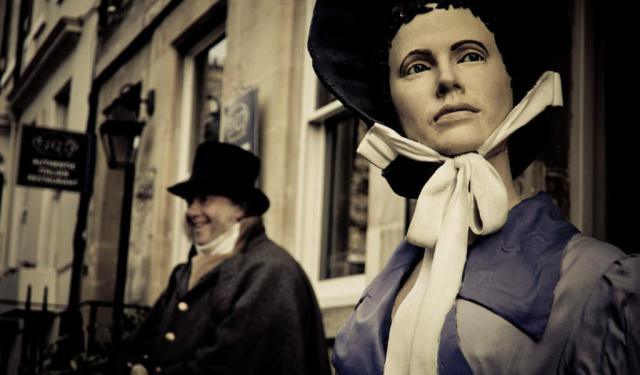
Bath has a long history as a spa town, dating back to Roman times, when its natural hot springs made it a centre for bathing and healing. By the 18th century, it had transformed into one of Britain’s most fashionable destinations, known for its elegant Georgian architecture, social rituals, and a seasonal influx of wealthy visitors.
This was the Bath that shaped Jane Austen’s experience.... view more
Tour Duration: 2 Hour(s)
Travel Distance: 2.5 Km or 1.6 Miles
This was the Bath that shaped Jane Austen’s experience.... view more
Tour Duration: 2 Hour(s)
Travel Distance: 2.5 Km or 1.6 Miles
Bath Historic City Center Walking Tour
Bath, a city in southwest England, is one of the country’s most historically layered urban centres, shaped by Roman engineering, medieval religion, and Georgian elegance. Its name comes from the Old English word meaning “bath,” a direct reference to the natural hot springs that have defined the site for millennia. The surrounding hills reveal even earlier activity, with archaeological finds... view more
Tour Duration: 2 Hour(s)
Travel Distance: 2.2 Km or 1.4 Miles
Tour Duration: 2 Hour(s)
Travel Distance: 2.2 Km or 1.4 Miles