Custom Walk in Malmo, Sweden by prebengyda8888 created on 2022-11-10
Guide Location: Sweden » Malmo
Guide Type: Custom Walk
# of Sights: 8
Tour Duration: 3 Hour(s)
Travel Distance: 7.4 Km or 4.6 Miles
Share Key: Z926F
Guide Type: Custom Walk
# of Sights: 8
Tour Duration: 3 Hour(s)
Travel Distance: 7.4 Km or 4.6 Miles
Share Key: Z926F
How It Works
Please retrieve this walk in the GPSmyCity app. Once done, the app will guide you from one tour stop to the next as if you had a personal tour guide. If you created the walk on this website or come to the page via a link, please follow the instructions below to retrieve the walk in the app.
Retrieve This Walk in App
Step 1. Download the app "GPSmyCity: Walks in 1K+ Cities" on Apple App Store or Google Play Store.



Step 2. In the GPSmyCity app, download(or launch) the guide "Malmo Map and Walking Tours".
Step 3. Tap the menu button located at upper right corner of the "Walks" screen and select "Retrieve custom walk". Enter the share key: Z926F

1) Profilhotels Garden
This custom location is created on gpsmycity.com website.
2) Ebba Hus (Ebba's House)
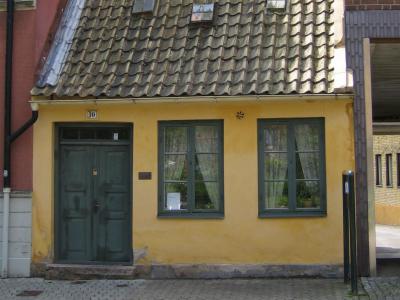
Tucked away in the heart of Malmö, Ebba’s House (Ebba Hus) is the city’s smallest museum and a cherished time capsule of a bygone era. Built in the 18th century, this modest street house stands as a testament to the everyday life of Malmö’s working-class families over two centuries ago. The house has remained relatively unchanged since then, preserving the essence of a typical household in Malmö from that period.
The story of Ebba’s House is intertwined with the Olsson family, who owned it for more than a century. It was purchased by Jöns Olsson, a city surveyor, in 1873 and later passed on to his son Olof in 1911. The family consisted of Olof, his wife Anna, and their two children, Ebba and Thure. After the passing of her parents in 1961, Ebba, a lacemaker by profession, continued living in the house on her own.
As Malmö modernized around her, with many old buildings being torn down during the 1960s, Ebba remained steadfast. Despite lacking modern amenities-relying on an outdoor toilet and cold water-she refused to sell her home and stayed until 1984. Eventually, Ebba and her sister-in-law decided to donate the property to the Malmö Museums, ensuring that its historical value would be preserved for future generations.
After Ebba died in 1989, the museum acquired her original furniture and restored the house to its early 20th-century state. Since opening to the public in 1991, Ebba’s House has offered visitors a unique opportunity to step back in time. The well-preserved interior, complete with the original wood stove, outdoor toilet, and period-specific furniture, provides an authentic look into daily life in Malmö during the early 1900s. Today, it stands as a humble yet powerful reminder of the resilience and traditions of the city's past.
The story of Ebba’s House is intertwined with the Olsson family, who owned it for more than a century. It was purchased by Jöns Olsson, a city surveyor, in 1873 and later passed on to his son Olof in 1911. The family consisted of Olof, his wife Anna, and their two children, Ebba and Thure. After the passing of her parents in 1961, Ebba, a lacemaker by profession, continued living in the house on her own.
As Malmö modernized around her, with many old buildings being torn down during the 1960s, Ebba remained steadfast. Despite lacking modern amenities-relying on an outdoor toilet and cold water-she refused to sell her home and stayed until 1984. Eventually, Ebba and her sister-in-law decided to donate the property to the Malmö Museums, ensuring that its historical value would be preserved for future generations.
After Ebba died in 1989, the museum acquired her original furniture and restored the house to its early 20th-century state. Since opening to the public in 1991, Ebba’s House has offered visitors a unique opportunity to step back in time. The well-preserved interior, complete with the original wood stove, outdoor toilet, and period-specific furniture, provides an authentic look into daily life in Malmö during the early 1900s. Today, it stands as a humble yet powerful reminder of the resilience and traditions of the city's past.
3) Gamla Kyrkogarden (Old Graveyard)
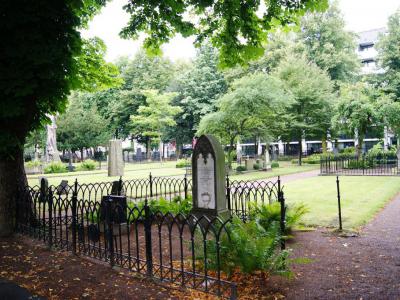
The Old Graveyard (Gamla Kyrkogarden), located at Gustav Adolfs Square in the heart of Malmö, is a tranquil and historically significant site dating back to the early 19th century. The cemetery was established between 1820 and 1822, and officially consecrated on November 24, 1822, with Bishop Wilhelm Faxe presiding over the inauguration. Initially known as the New Cemetery, it retained this title until 1870, when the northern section of Saint Pauli Cemetery opened, prompting the older site to be renamed the Old Graveyard.
The cemetery offers a peaceful retreat for locals and visitors, serving as both a place of reflection and a unique open-air museum of Malmö’s past. Strolling along the shaded paths, one can discover inscriptions on gravestones that tell the stories of families who were instrumental in shaping Malmö's development during the 1800s and early 1900s. The diversity of memorials, ranging from modest headstones to elaborate sculptures adorned with intricate inscriptions, adds to the graveyard’s charm and historic ambiance.
One of the notable features of the Old Graveyard is a sculpture by the renowned Swedish artist Carl Milles. Titled “God the Father on the Arch of Heaven,” the sculpture depicts an angel peering upward, assisting God the Father as he arranges the stars. Although this piece is a smaller model of a grander work that was never completed, it stands as a testament to Milles’ artistic vision and serves as a point of interest for art enthusiasts and history buffs alike.
Despite being an active cemetery with occasional urn burials, the Old Graveyard is primarily maintained as a cultural heritage site. Since 1988, a memorial grove has been available for those seeking a final resting place in this historic ground. Preservation efforts ensure that gravestones, iron fences, and other memorials are carefully restored and maintained to retain the graveyard’s historic integrity and picturesque atmosphere.
The cemetery offers a peaceful retreat for locals and visitors, serving as both a place of reflection and a unique open-air museum of Malmö’s past. Strolling along the shaded paths, one can discover inscriptions on gravestones that tell the stories of families who were instrumental in shaping Malmö's development during the 1800s and early 1900s. The diversity of memorials, ranging from modest headstones to elaborate sculptures adorned with intricate inscriptions, adds to the graveyard’s charm and historic ambiance.
One of the notable features of the Old Graveyard is a sculpture by the renowned Swedish artist Carl Milles. Titled “God the Father on the Arch of Heaven,” the sculpture depicts an angel peering upward, assisting God the Father as he arranges the stars. Although this piece is a smaller model of a grander work that was never completed, it stands as a testament to Milles’ artistic vision and serves as a point of interest for art enthusiasts and history buffs alike.
Despite being an active cemetery with occasional urn burials, the Old Graveyard is primarily maintained as a cultural heritage site. Since 1988, a memorial grove has been available for those seeking a final resting place in this historic ground. Preservation efforts ensure that gravestones, iron fences, and other memorials are carefully restored and maintained to retain the graveyard’s historic integrity and picturesque atmosphere.
4) Slottsmöllan (Castle Mill)
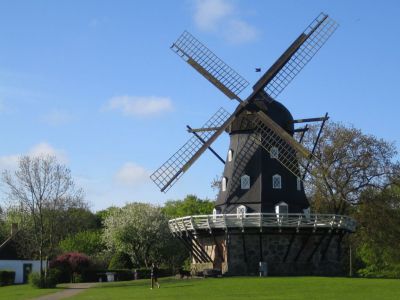
Castle Mill (Slottsmöllan) in Malmö is a historical windmill located at Mölleplatsen, near the iconic Malmö Castle. Built in 1851, this beautiful Dutch-style mill stands on the former site of the Bastion Stenbock, replacing an earlier 17th-century mill that burned down in 1849. The mill operated using wind power until 1879 when it briefly switched to steam power until 1895 and later returned to wind operation until the 1930s. Regular milling ceased in 1945, and today the site is managed by Malmö museums.
Castle Mill remains a popular tourist attraction due to its picturesque setting near Malmö Castle and the lush Castle Garden (Slottsträdgården), home to a variety of plants and themed sections. The complex also includes a fully furnished miller's house and garden, offering visitors a glimpse into the 19th-century life of a miller's family. The surrounding area, Mölleplatsen, hosts numerous outdoor events and concerts, especially during the summer, further adding to its charm as a historical and cultural hub in Malmö.
Castle Mill remains a popular tourist attraction due to its picturesque setting near Malmö Castle and the lush Castle Garden (Slottsträdgården), home to a variety of plants and themed sections. The complex also includes a fully furnished miller's house and garden, offering visitors a glimpse into the 19th-century life of a miller's family. The surrounding area, Mölleplatsen, hosts numerous outdoor events and concerts, especially during the summer, further adding to its charm as a historical and cultural hub in Malmö.
5) Slottsträdgården (Castle Garden)
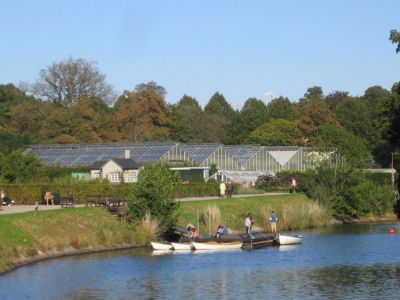
Castle Garden (Slottsträdgården) in Malmö is a tranquil oasis located on the fortress island, just behind the Malmöhus Castle. Spanning about 12,000 square meters, this garden offers a variety of themed areas, including a kitchen garden, orchard, rose garden, perennial garden, and a serene Japanese garden. Operated by a private club, the garden is managed using ecological principles, making it a haven for garden enthusiasts who value organic cultivation and sustainability.
The garden was born out of an initiative by local Malmö residents passionate about gardening, who in 1994 proposed the creation of an ecological garden within the city. By 1997, their dream became a reality, with the garden officially opening in 1998 on the grounds of a former municipal tree nursery. Today, it’s a space not only for plants but also for relaxation, where visitors can enjoy a picnic or a visit to the garden café, open from April to October.
Castle Garden is located in a prime spot, less than 10 minutes from Malmö’s Central Train Station and close to Lilla Torg. This hidden gem allows visitors to unwind and connect with nature, surrounded by both the historical Malmö Castle and the scenic parklands of Slottsparken and Kungsparken. The garden also plays a role in education, with a dedicated school garden designed to engage children in ecological practices and gardening activities.
Castle Garden is open year-round, offering a peaceful retreat and a beautiful backdrop for observing Malmö’s changing seasons. Whether you come across it by accident or seek it out, the garden’s charm and commitment to ecological integrity make it a must-visit spot in the city.
The garden was born out of an initiative by local Malmö residents passionate about gardening, who in 1994 proposed the creation of an ecological garden within the city. By 1997, their dream became a reality, with the garden officially opening in 1998 on the grounds of a former municipal tree nursery. Today, it’s a space not only for plants but also for relaxation, where visitors can enjoy a picnic or a visit to the garden café, open from April to October.
Castle Garden is located in a prime spot, less than 10 minutes from Malmö’s Central Train Station and close to Lilla Torg. This hidden gem allows visitors to unwind and connect with nature, surrounded by both the historical Malmö Castle and the scenic parklands of Slottsparken and Kungsparken. The garden also plays a role in education, with a dedicated school garden designed to engage children in ecological practices and gardening activities.
Castle Garden is open year-round, offering a peaceful retreat and a beautiful backdrop for observing Malmö’s changing seasons. Whether you come across it by accident or seek it out, the garden’s charm and commitment to ecological integrity make it a must-visit spot in the city.
6) Turning Torso Skyscraper
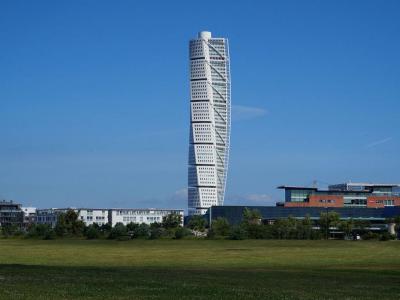
Turning Torso is a neo-futurist residential skyscraper located in Malmö, standing as a landmark of architectural innovation. Designed by the renowned Spanish architect and structural engineer Santiago Calatrava, it was officially opened on 27 August 2005. Reaching a height of 190 meters (620 feet) and consisting of 54 stories, it was the tallest building in the Nordic region until 2022, when it was surpassed by Karlatornet in Gothenburg.
Inspired by Calatrava’s sculpture, Twisting Torso, which depicts the dynamic form of a twisting human body, the building is a unique addition to the Malmö skyline. Its structure is composed of nine segments, each consisting of five pentagon-shaped stories that rotate around a central core. As the structure ascends, the topmost segment twists 90 degrees clockwise from the base, giving it the iconic "twisting" appearance.
Commissioned by the Swedish cooperative housing association HSB, Turning Torso has a dual-purpose layout. The lower two segments serve as office spaces, while segments three to nine accommodate 147 residential apartments. It also boasts a public observation deck on the 49th floor and hosts private club facilities, a reception area, and a restaurant on floors 50–52. The top two floors, 53 and 54, are dedicated conference spaces managed by Sky High Meetings.
Turning Torso’s architectural prowess has been recognized with several awards, including the 2005 Gold Emporis Skyscraper Award and the 2015 10-Year Award from the Council on Tall Buildings and Urban Habitat. It is considered the world’s second twisted skyscraper after the Telekom Tower in Malaysia.
One of the building’s most remarkable events took place on 18 August 2006, when Austrian skydiver Felix Baumgartner parachuted onto its structure and then base-jumped off it, cementing its status as a daring feat of modern engineering. Today, the Turning Torso remains a symbol of Malmö’s skyline, embodying a seamless fusion of art, architecture, and engineering ingenuity.
Inspired by Calatrava’s sculpture, Twisting Torso, which depicts the dynamic form of a twisting human body, the building is a unique addition to the Malmö skyline. Its structure is composed of nine segments, each consisting of five pentagon-shaped stories that rotate around a central core. As the structure ascends, the topmost segment twists 90 degrees clockwise from the base, giving it the iconic "twisting" appearance.
Commissioned by the Swedish cooperative housing association HSB, Turning Torso has a dual-purpose layout. The lower two segments serve as office spaces, while segments three to nine accommodate 147 residential apartments. It also boasts a public observation deck on the 49th floor and hosts private club facilities, a reception area, and a restaurant on floors 50–52. The top two floors, 53 and 54, are dedicated conference spaces managed by Sky High Meetings.
Turning Torso’s architectural prowess has been recognized with several awards, including the 2005 Gold Emporis Skyscraper Award and the 2015 10-Year Award from the Council on Tall Buildings and Urban Habitat. It is considered the world’s second twisted skyscraper after the Telekom Tower in Malaysia.
One of the building’s most remarkable events took place on 18 August 2006, when Austrian skydiver Felix Baumgartner parachuted onto its structure and then base-jumped off it, cementing its status as a daring feat of modern engineering. Today, the Turning Torso remains a symbol of Malmö’s skyline, embodying a seamless fusion of art, architecture, and engineering ingenuity.
7) Chokladfabriken (Chocolate Factory)
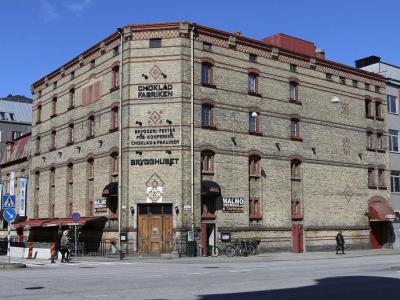
The Chocolate Factory in Malmö (Malmö Chokladfabrik) is a must-visit for any chocolate lover. Housed in the historic Mazetti factory, this museum and factory shop offers a unique glimpse into the world of chocolate-making, showcasing over 120 years of local tradition and craftsmanship. Established in the late 1800s by Danish chocolatier Emil Mazetti Nissen, the factory originally operated as Malmö Chocolate & Confectionery Factory before later rebranding to Mazetti.
While the museum's exhibitions tell the story of Malmö’s rich chocolate history, visitors can also witness the entire process of chocolate preparation-from bean to bar-within the factory. This is the only place in Malmö where such an experience is possible, making it a true haven for anyone curious about the art of chocolate making.
The Chocolate Factory prides itself on using organic cacao beans and maintaining a nut-free production environment, setting a high standard for allergen-free manufacturing in the region. Their commitment to quality and sustainability is evident in their use of Fairtrade raw materials and their collaboration with like-minded partners.
In addition to a wide range of chocolates under the 1888 brand, the factory produces various other delectable confections using traditional methods. The factory shop offers a complete assortment at discounted prices, and chocolate lovers are invited to sample these treats during guided tours.
The Chocolate Factory’s dedication to preserving Mazetti’s global spirit and passion for innovation continues to thrive. From its historical roots to its modern-day operations, this chocolate factory not only creates mouthwatering products but also strives to make a positive impact on the world.
While the museum's exhibitions tell the story of Malmö’s rich chocolate history, visitors can also witness the entire process of chocolate preparation-from bean to bar-within the factory. This is the only place in Malmö where such an experience is possible, making it a true haven for anyone curious about the art of chocolate making.
The Chocolate Factory prides itself on using organic cacao beans and maintaining a nut-free production environment, setting a high standard for allergen-free manufacturing in the region. Their commitment to quality and sustainability is evident in their use of Fairtrade raw materials and their collaboration with like-minded partners.
In addition to a wide range of chocolates under the 1888 brand, the factory produces various other delectable confections using traditional methods. The factory shop offers a complete assortment at discounted prices, and chocolate lovers are invited to sample these treats during guided tours.
The Chocolate Factory’s dedication to preserving Mazetti’s global spirit and passion for innovation continues to thrive. From its historical roots to its modern-day operations, this chocolate factory not only creates mouthwatering products but also strives to make a positive impact on the world.

8) Folkets Park
Located in the heart of Malmö, Folkets Park is a cherished cultural landmark and one of the oldest public parks in the country. Since its establishment in 1891, the park has grown to become a beloved gathering spot for both locals and visitors, offering a dynamic blend of leisure, food, and entertainment options.
One of the park’s standout features is its inviting playground, a colorful and vibrant space that caters to children of all ages. With swings, slides, climbing frames, and more, the playground is a delightful area where families can relax and children can let their imaginations run wild. Meanwhile, parents and guardians can unwind in the surrounding green spaces, confident that their young ones are safe and having fun.
The park’s culinary offerings are diverse, ranging from food stalls serving quick snacks to restaurants offering more substantial fare. Visitors can savor traditional Swedish dishes, try a variety of international cuisine, or simply grab a refreshing drink while taking in the lively atmosphere of the park. Whether you’re looking for a sit-down meal or a quick bite on the go, Folkets Park has something to please every palate.
Folkets Park is not just a place for relaxation and play-it’s a thriving cultural hub. The park hosts numerous events throughout the year, from open-air concerts and theater performances to markets showcasing local artisans. This ever-changing lineup ensures there’s always something new to experience. In the summer, the park comes alive with music festivals and dance events, making it a key venue for Malmö’s cultural scene.
One of the park’s standout features is its inviting playground, a colorful and vibrant space that caters to children of all ages. With swings, slides, climbing frames, and more, the playground is a delightful area where families can relax and children can let their imaginations run wild. Meanwhile, parents and guardians can unwind in the surrounding green spaces, confident that their young ones are safe and having fun.
The park’s culinary offerings are diverse, ranging from food stalls serving quick snacks to restaurants offering more substantial fare. Visitors can savor traditional Swedish dishes, try a variety of international cuisine, or simply grab a refreshing drink while taking in the lively atmosphere of the park. Whether you’re looking for a sit-down meal or a quick bite on the go, Folkets Park has something to please every palate.
Folkets Park is not just a place for relaxation and play-it’s a thriving cultural hub. The park hosts numerous events throughout the year, from open-air concerts and theater performances to markets showcasing local artisans. This ever-changing lineup ensures there’s always something new to experience. In the summer, the park comes alive with music festivals and dance events, making it a key venue for Malmö’s cultural scene.
