Custom Walk in Milan, Italy by maureencoorey2374 created on 2023-03-22
Guide Location: Italy » Milan
Guide Type: Custom Walk
# of Sights: 11
Tour Duration: 5 Hour(s)
Travel Distance: 11.3 Km or 7 Miles
Share Key: CUY49
Guide Type: Custom Walk
# of Sights: 11
Tour Duration: 5 Hour(s)
Travel Distance: 11.3 Km or 7 Miles
Share Key: CUY49
How It Works
Please retrieve this walk in the GPSmyCity app. Once done, the app will guide you from one tour stop to the next as if you had a personal tour guide. If you created the walk on this website or come to the page via a link, please follow the instructions below to retrieve the walk in the app.
Retrieve This Walk in App
Step 1. Download the app "GPSmyCity: Walks in 1K+ Cities" on Apple App Store or Google Play Store.



Step 2. In the GPSmyCity app, download(or launch) the guide "Milan Map and Walking Tours".
Step 3. Tap the menu button located at upper right corner of the "Walks" screen and select "Retrieve custom walk". Enter the share key: CUY49
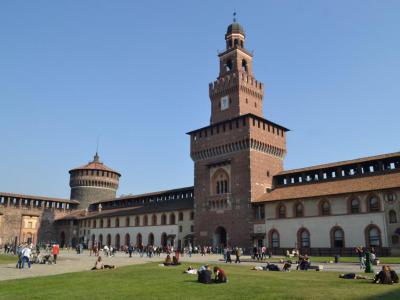
1) Castello Sforzesco (Sforzesco Castle) (must see)
Castello Sforzesco, one of the largest fortresses in Europe, was originally built in the 14th century to house the Duchy of Milan. Despite its long history of battles, invasions, sacking and destruction, the castle has endured and been restored many times. One of its towers, the Filarete tower, once used to store ammunition, famously exploded in 1521 after being struck by lightning, causing many casualties and significant damage to the fortress.
During the Napoleonic era, the castle was severely damaged and used as quarters for troops, including stables in the frescoed rooms on the ground floor of the Corte Ducale. However, following Italy's Unification in the late 19th century, the castle was reconstructed by architect Luca Beltrami and returned to the city of Milan in 1905. Today, it is a prominent hub of art and culture, boasting seven museums accessible to the public.
The interior of is adorned with exquisitely detailed works of art, notably the intricate ceiling fresco in the magnificent Sala delle Asse, painted by Leonardo da Vinci, who was commissioned by his patrons, the Sforza family. The fresco depicts a pergola in a garden with 16 mulberry trees held together by a golden rope.
Why You Should Visit:
Each room herein is a treasure, not only for the exhibited items, but also for the ceiling frescoes which are wonders in their own right.
Entrance to the castle is free, so if you're on a budget, just walk through and admire the courtyards and architecture. As for the "all museums" fee, it is quite reasonable.
Tip:
Exploring the entire Castello Sforzesco, complete with its gardens, may take a few days.
Try to go on Tuesday around 2pm to get free entry (entry on the 1st and 3rd Tuesday of every month is free for all public museums).
There's no way to access the battlements or the "inside" (aside from the museums) except by a guided tour, so consider booking one in advance.
During the Napoleonic era, the castle was severely damaged and used as quarters for troops, including stables in the frescoed rooms on the ground floor of the Corte Ducale. However, following Italy's Unification in the late 19th century, the castle was reconstructed by architect Luca Beltrami and returned to the city of Milan in 1905. Today, it is a prominent hub of art and culture, boasting seven museums accessible to the public.
The interior of is adorned with exquisitely detailed works of art, notably the intricate ceiling fresco in the magnificent Sala delle Asse, painted by Leonardo da Vinci, who was commissioned by his patrons, the Sforza family. The fresco depicts a pergola in a garden with 16 mulberry trees held together by a golden rope.
Why You Should Visit:
Each room herein is a treasure, not only for the exhibited items, but also for the ceiling frescoes which are wonders in their own right.
Entrance to the castle is free, so if you're on a budget, just walk through and admire the courtyards and architecture. As for the "all museums" fee, it is quite reasonable.
Tip:
Exploring the entire Castello Sforzesco, complete with its gardens, may take a few days.
Try to go on Tuesday around 2pm to get free entry (entry on the 1st and 3rd Tuesday of every month is free for all public museums).
There's no way to access the battlements or the "inside" (aside from the museums) except by a guided tour, so consider booking one in advance.
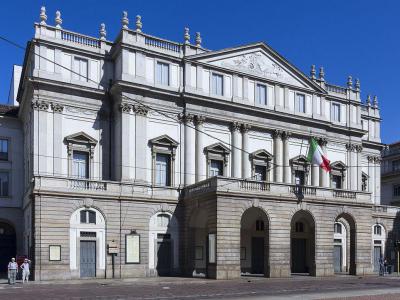
2) La Scala (Opera House and Museum) (must see)
The La Scala Theatre Chorus, Ballet, and Orchestra make it one of the premier musical theaters worldwide. Inaugurated in 1778, the famous opera house in Milan has welcomed some of the finest singers from Italy and around the globe.
After the Teatro Regio Ducale burned down in 1776, a new theater was erected on the site of the former church of Santa Maria alla Scala, from which it derived its name. The cost of building the theater was covered by sales of theatrical boxes, which were exquisitely decorated and made a lasting impression on guests, including the prominent French author Stendhal. Soon, La Scala became a preferred gathering spot for high society. In accordance with the tradition of the time, the main floor had no chairs, and audiences had to stand to watch the shows. Additionally, the orchestra pit had yet to be constructed.
Badly damaged during World War II, La Scala underwent a complete restoration before reopening in 1946. To commemorate the occasion, Arturo Toscanini arranged an unforgettable concert featuring a sensational solo by Renata Tebaldi. From 2002 to 2004, the theater underwent a major renovation. Despite its plain facade, the La Scala interior is stunningly elegant and intimate, surpassing that of opera houses in New York and London.
Why You Should Visit:
The La Scala Orchestra, comprising 135 musicians, is one of the world's most outstanding orchestras for opera productions, known for its ability to produce a uniform and distinguished sound. The theater is also internationally acclaimed for its symphonic activities. The La Scala museum houses one of the richest and most coveted collections of music-themed artifacts worldwide. A tour of the theater provides a rare opportunity to sit in its most prominent box and take photos.
Tip:
Do not buy second-row balcony tickets unless you are quite tall.
After 6pm, same-day tickets are sold at a substantial discount.
After the Teatro Regio Ducale burned down in 1776, a new theater was erected on the site of the former church of Santa Maria alla Scala, from which it derived its name. The cost of building the theater was covered by sales of theatrical boxes, which were exquisitely decorated and made a lasting impression on guests, including the prominent French author Stendhal. Soon, La Scala became a preferred gathering spot for high society. In accordance with the tradition of the time, the main floor had no chairs, and audiences had to stand to watch the shows. Additionally, the orchestra pit had yet to be constructed.
Badly damaged during World War II, La Scala underwent a complete restoration before reopening in 1946. To commemorate the occasion, Arturo Toscanini arranged an unforgettable concert featuring a sensational solo by Renata Tebaldi. From 2002 to 2004, the theater underwent a major renovation. Despite its plain facade, the La Scala interior is stunningly elegant and intimate, surpassing that of opera houses in New York and London.
Why You Should Visit:
The La Scala Orchestra, comprising 135 musicians, is one of the world's most outstanding orchestras for opera productions, known for its ability to produce a uniform and distinguished sound. The theater is also internationally acclaimed for its symphonic activities. The La Scala museum houses one of the richest and most coveted collections of music-themed artifacts worldwide. A tour of the theater provides a rare opportunity to sit in its most prominent box and take photos.
Tip:
Do not buy second-row balcony tickets unless you are quite tall.
After 6pm, same-day tickets are sold at a substantial discount.
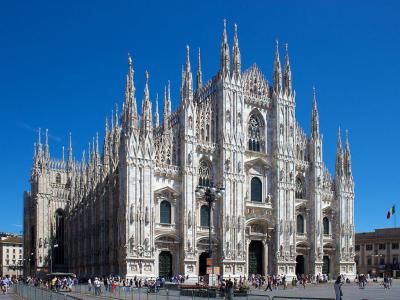
3) Duomo di Milano (Milan Cathedral) (must see)
The Milan Cathedral, otherwise known as the Duomo, is the seat of the Archbishop of Milan and the largest church in Italy (the third largest in Europe and the fourth largest in the world), covering an area of 12,000 sqm and weighing a staggering 325,000 tons!
The cathedral is dedicated to Saint Mary Nascent and has been the epicenter of the city's life since 1386. Its foundation was laid by Gian Galeazzo Visconti, who died in 1402 when only half of the structure had been finished, upon which the construction came to a standstill for almost 80 years because of the lack of funds and ideas. It resumed only in 1500, and by 1510 the octagonal dome was completed – embellished with four series of 15 statues representing different characters from the Bible.
In 1805, Napoleon Bonaparte forced completion of the façade, which overall took another seven years of work. In honor of his efforts, a statue of Napoleon was erected at the top of one of the spires. Later, the Duomo also hosted his crowning ceremony. However, it wasn't until the 20th century, with the completion of the last gate, that the centuries-long construction of the cathedral was finally over, marked by inauguration on January 6, 1965.
A climb to the roof, much as a descend to the Paleo Christian baptistery beneath the west side of the Duomo are the highlights of a visit here. The rooftop offers a closer look at the intricate details of the spires and the gargoyles adorning it, plus a breathtaking view over of the city, some 70 meters above ground, replete with myriads of statues, pinnacles, tracery and flying buttresses. In order to get there, visitors have to traverse 201 stairs up through a winding narrow passageway, which is a bit tiring. Still, those who wish, can spare the effort and use an elevator.
Why You Should Visit:
Milan's one truly must-visit sight – a vast riot of ornate religious sculpture on the exterior, and the interior sublimely huge.
Tip:
Buy an online skip-the-line ticket that covers entry and access to the elevator.
The surrounding piazza comes at its finest at night when the cathedral's façade is lit by white lights.
The cathedral is dedicated to Saint Mary Nascent and has been the epicenter of the city's life since 1386. Its foundation was laid by Gian Galeazzo Visconti, who died in 1402 when only half of the structure had been finished, upon which the construction came to a standstill for almost 80 years because of the lack of funds and ideas. It resumed only in 1500, and by 1510 the octagonal dome was completed – embellished with four series of 15 statues representing different characters from the Bible.
In 1805, Napoleon Bonaparte forced completion of the façade, which overall took another seven years of work. In honor of his efforts, a statue of Napoleon was erected at the top of one of the spires. Later, the Duomo also hosted his crowning ceremony. However, it wasn't until the 20th century, with the completion of the last gate, that the centuries-long construction of the cathedral was finally over, marked by inauguration on January 6, 1965.
A climb to the roof, much as a descend to the Paleo Christian baptistery beneath the west side of the Duomo are the highlights of a visit here. The rooftop offers a closer look at the intricate details of the spires and the gargoyles adorning it, plus a breathtaking view over of the city, some 70 meters above ground, replete with myriads of statues, pinnacles, tracery and flying buttresses. In order to get there, visitors have to traverse 201 stairs up through a winding narrow passageway, which is a bit tiring. Still, those who wish, can spare the effort and use an elevator.
Why You Should Visit:
Milan's one truly must-visit sight – a vast riot of ornate religious sculpture on the exterior, and the interior sublimely huge.
Tip:
Buy an online skip-the-line ticket that covers entry and access to the elevator.
The surrounding piazza comes at its finest at night when the cathedral's façade is lit by white lights.
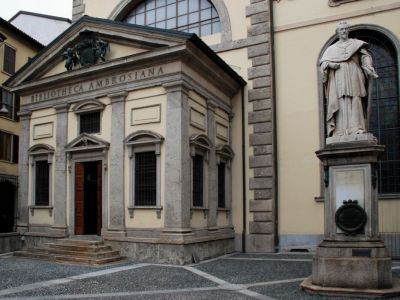
4) Biblioteca Ambrosiana (Ambrosian Library & Art Gallery) (must see)
In the bustling city of Milan, amidst its grandeur and energy, lies a place of quiet contemplation, the Ambrosiana Library and Art Gallery. Its origins date back to 1603 when local Cardinal Federico Borromeo, who had just returned from Rome's artistic circles, founded this sanctuary of knowledge and beauty. With over 36,000 manuscripts and more than 750,000 prints, the library is a true treasure trove of intellectual inquiry and spiritual reflection. Named after the patron saint of Milan, Ambrose, it is a testament to the intersection of religion, intellectualism, and aesthetics that defined the Renaissance period.
One of the main attractions here is the Codex Atlanticus, a collection of twelve volumes of drawings and manuscripts created by Leonardo da Vinci between 1478 and 1519. Containing the artist's drawings, sketches and fables, it is undoubtedly the largest collection of Leonardo's writings on practically every area of human knowledge: mechanics, mathematics, astronomy, botany, geography, physics, chemistry, architecture and philosophy.
Part of the library is the famous Pinacoteca Ambrosiana, the art gallery, featuring da Vinci's "Portrait of a Musician", Caravaggio's "Basket of Fruit", as well as Raffaello's life-size, pencil and carbon sketch of the "The School of Athens", a full-color final version of which is displayed in the Vatican.
Among other major acquisitions here are Islamic manuscripts, 11th-century diwan of poets and the oldest copy of the 'Kitab Sibawahaihi', plus a complete set of manuscripts from the Benedictine monastery of Bobbio (1606) and those from Vincenzo Pinelli of Padua, comprising more than 800 pieces, including the famous Ilias Picta (Ambrosian Iliad).
Why You Should Visit:
A chance to immerse yourself in the world of academic tomes and works of art, experience the tranquil ambiance that has enchanted scholars and art lovers for centuries, see art restorers at work on peculiar Renaissance masterpieces -- and in a brilliant building, too.
Tip:
On a weekday, you can practically have the entire place to yourself. The provided map/guide is quite clear, with all the main highlights identified, but if you're pressed for time, taking a guided tour is advisable.
One of the main attractions here is the Codex Atlanticus, a collection of twelve volumes of drawings and manuscripts created by Leonardo da Vinci between 1478 and 1519. Containing the artist's drawings, sketches and fables, it is undoubtedly the largest collection of Leonardo's writings on practically every area of human knowledge: mechanics, mathematics, astronomy, botany, geography, physics, chemistry, architecture and philosophy.
Part of the library is the famous Pinacoteca Ambrosiana, the art gallery, featuring da Vinci's "Portrait of a Musician", Caravaggio's "Basket of Fruit", as well as Raffaello's life-size, pencil and carbon sketch of the "The School of Athens", a full-color final version of which is displayed in the Vatican.
Among other major acquisitions here are Islamic manuscripts, 11th-century diwan of poets and the oldest copy of the 'Kitab Sibawahaihi', plus a complete set of manuscripts from the Benedictine monastery of Bobbio (1606) and those from Vincenzo Pinelli of Padua, comprising more than 800 pieces, including the famous Ilias Picta (Ambrosian Iliad).
Why You Should Visit:
A chance to immerse yourself in the world of academic tomes and works of art, experience the tranquil ambiance that has enchanted scholars and art lovers for centuries, see art restorers at work on peculiar Renaissance masterpieces -- and in a brilliant building, too.
Tip:
On a weekday, you can practically have the entire place to yourself. The provided map/guide is quite clear, with all the main highlights identified, but if you're pressed for time, taking a guided tour is advisable.
5) Colonne di San Lorenzo (Columns of San Lorenzo)
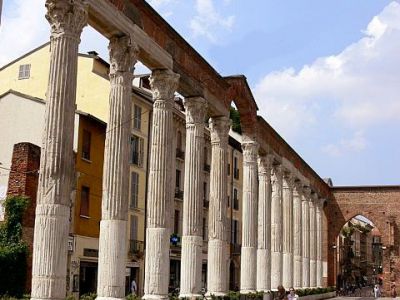
The Columns of San Lorenzo is a popular group of ancient Roman ruins, located in front of the Basilica of San Lorenzo in central Milan, which dates back to the 4th century AD. Consisting mainly of 16 tall Corinthian columns in a row, extracted from a likely 2nd-century pagan temple or public bath house structure, the collonade now fronts an open square. South of the columns, one of the medieval gates still has some Roman marble decoration in place.
Up until 1935, the space between the church and columns was entirely occupied by old houses abutting onto the façade of the church itself. Despite the plans to conserve this ancient urban fabric, the renovations led to the demolition of the old houses and the isolation of the monument on the front side. Following bombing during World War II, the church complex became further isolated on the rear side, where the fenced park now stands, allowing popular views of the Basilica.
A great place to explore and soak up the atmosphere of Milan.
Up until 1935, the space between the church and columns was entirely occupied by old houses abutting onto the façade of the church itself. Despite the plans to conserve this ancient urban fabric, the renovations led to the demolition of the old houses and the isolation of the monument on the front side. Following bombing during World War II, the church complex became further isolated on the rear side, where the fenced park now stands, allowing popular views of the Basilica.
A great place to explore and soak up the atmosphere of Milan.
6) Basilica di San Lorenzo (Basilica of St. Lawrence - oldest church in Milan)
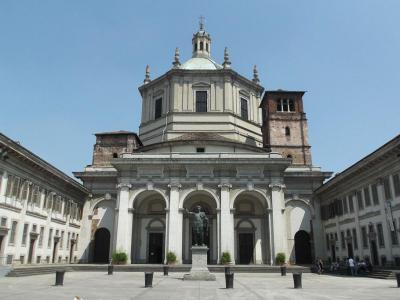
One cannot help but be struck by the seemingly hodgepodge array of towers, lodges, apses and domes that make up this often overlooked architectural landmark. Despite its unconventional appearance, this basilica, established in the 4th century, was actually one of the largest church buildings in all of Europe at the time. The mammoth blocks used for its foundation were taken from other Roman sites, and its interior is uniquely adorned with marble on the lower half and mosaics on the upper.
The chapel, with its octagonal structure, is considered to be one of the most magnificent examples of this style among the remaining Roman octagonal buildings, having played a fundamental role in the history of western art and architecture and having been imitated many times.
A remnant of a Romanesque atrium leads visitors to the heart of the church, where sixteen ancient Roman columns stand guard, now serving as a favorite hangout spot for young couples. The most precious treasures, however, are the fragments of aforementioned mosaics that once adorned the entire structure.
Tip:
Behind the chapel altar you can descend a flight of stairs to view the foundations laid down in Roman times.
The chapel, with its octagonal structure, is considered to be one of the most magnificent examples of this style among the remaining Roman octagonal buildings, having played a fundamental role in the history of western art and architecture and having been imitated many times.
A remnant of a Romanesque atrium leads visitors to the heart of the church, where sixteen ancient Roman columns stand guard, now serving as a favorite hangout spot for young couples. The most precious treasures, however, are the fragments of aforementioned mosaics that once adorned the entire structure.
Tip:
Behind the chapel altar you can descend a flight of stairs to view the foundations laid down in Roman times.
7) Quartiere Navigli (Navigli District)
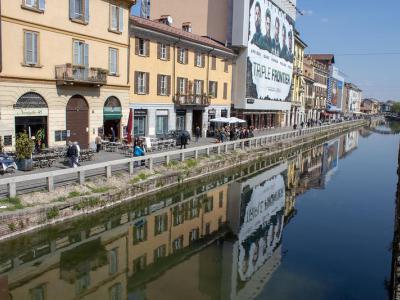
Milan's Navigli District is a lively and vibrant area known for its picturesque canals, which were once used to transport goods throughout the city, and which now provide a scenic backdrop for the many bars, restaurants, and cafes that line their banks.
As the city's liveliest neighbourhood, Navigli is particularly popular with young people, and is known for its nightlife, with many bars and clubs staying open until the early hours of the morning. During the day, the area is a hub of activity, with a bustling street market selling everything from vintage clothing to handmade crafts.
Picturesque remnants of the city's ancient past, including the Roman basilica of San Lorenzo, the early-Christian church of Saint Eustorgius, and the 19th-century triumphal arch on Piazza XXIV Maggio, serve as a backdrop to the scene.
A unique blend of history, culture, and contemporary urban living, the Navigli district is a must-visit destination.
As the city's liveliest neighbourhood, Navigli is particularly popular with young people, and is known for its nightlife, with many bars and clubs staying open until the early hours of the morning. During the day, the area is a hub of activity, with a bustling street market selling everything from vintage clothing to handmade crafts.
Picturesque remnants of the city's ancient past, including the Roman basilica of San Lorenzo, the early-Christian church of Saint Eustorgius, and the 19th-century triumphal arch on Piazza XXIV Maggio, serve as a backdrop to the scene.
A unique blend of history, culture, and contemporary urban living, the Navigli district is a must-visit destination.
8) Museo della Scienza e della Tecnologia Leonardo da Vinci (Museum of Science and Technology) (must see)
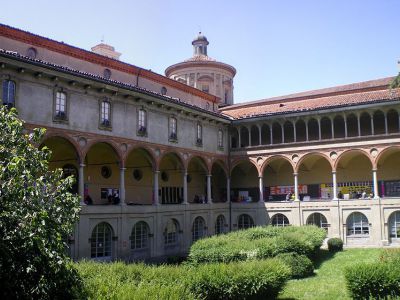
The National Museum of Science and Technology “Leonardo da Vinci” in Milan, inaugurated on February 15, 1953, stands as one of Europe’s foremost institutions dedicated to scientific and technological culture. Initially founded as “Technics,” it now operates as a private law foundation supported by ministries, public bodies, and Milanese universities.
The museum’s permanent exhibitions reveal the breadth of human invention across centuries. The Leonardo da Vinci Galleries, spanning 1,300 square meters, form the world’s largest display devoted to Da Vinci as both engineer and humanist. Through 170 models, artworks, and manuscripts, visitors trace his life from 15th-century Florence to Milan, exploring his ideas on flight, war, architecture, and waterways. The galleries reinterpret Da Vinci’s genius as a dialogue between art and science, celebrating his enduring curiosity and interdisciplinary thinking.
Other sections highlight Italy’s industrial and creative mastery. The Classic Cars exhibition honors Italian craftsmanship through models like the 1903 Bianchi 8HP and the Alfa Romeo 8C series, presented in a reflective red-lit setting that transforms them into “sculptures in motion.” Each car tells a story of innovation, from early automobile pioneers to experimental postwar designs such as the 1955 Bisiluro DaMolNar.
The museum also explores major transport revolutions. The Air Transport section recounts Lombardy’s pioneering role in aviation—from Enrico Forlanini’s 1877 helicopter to World War II aircraft—while Rail Transport showcases early steam and electric locomotives that connected industrial Italy. The Naval Transport collection, one of Italy’s richest, features over 3,300 artifacts including the submarine Enrico Toti and the training ship Ebe.
Further exhibits bridge science and art. The Music and Theatre section displays part of Teatro alla Scala’s historic hydraulic stage, instruments from the nineteenth century, and early sound devices like Edison phonographs. In turn, the Space exhibition invites visitors to engage with cosmic exploration—from ancient astronomy to modern missions—featuring Italy’s only fragment of lunar rock. Together, these galleries embody the museum’s mission: to preserve the past, inspire curiosity, and connect scientific progress with human imagination.
The museum’s permanent exhibitions reveal the breadth of human invention across centuries. The Leonardo da Vinci Galleries, spanning 1,300 square meters, form the world’s largest display devoted to Da Vinci as both engineer and humanist. Through 170 models, artworks, and manuscripts, visitors trace his life from 15th-century Florence to Milan, exploring his ideas on flight, war, architecture, and waterways. The galleries reinterpret Da Vinci’s genius as a dialogue between art and science, celebrating his enduring curiosity and interdisciplinary thinking.
Other sections highlight Italy’s industrial and creative mastery. The Classic Cars exhibition honors Italian craftsmanship through models like the 1903 Bianchi 8HP and the Alfa Romeo 8C series, presented in a reflective red-lit setting that transforms them into “sculptures in motion.” Each car tells a story of innovation, from early automobile pioneers to experimental postwar designs such as the 1955 Bisiluro DaMolNar.
The museum also explores major transport revolutions. The Air Transport section recounts Lombardy’s pioneering role in aviation—from Enrico Forlanini’s 1877 helicopter to World War II aircraft—while Rail Transport showcases early steam and electric locomotives that connected industrial Italy. The Naval Transport collection, one of Italy’s richest, features over 3,300 artifacts including the submarine Enrico Toti and the training ship Ebe.
Further exhibits bridge science and art. The Music and Theatre section displays part of Teatro alla Scala’s historic hydraulic stage, instruments from the nineteenth century, and early sound devices like Edison phonographs. In turn, the Space exhibition invites visitors to engage with cosmic exploration—from ancient astronomy to modern missions—featuring Italy’s only fragment of lunar rock. Together, these galleries embody the museum’s mission: to preserve the past, inspire curiosity, and connect scientific progress with human imagination.
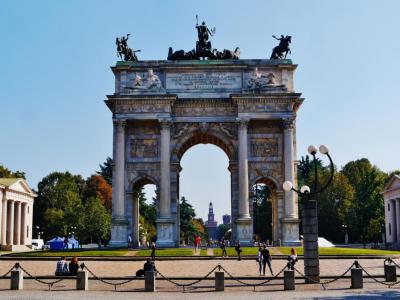
9) Arco della Pace (Arch of Peace)
At the northwestern corner of Parco Sempione, lies a Napoleon's triumphal arch, a neoclassical wonder standing tall at a height of 25 meters and spanning an impressive width of 24 meters. Designed by architect Luigi Cagnola in 1807, this imposing structure mirrors Paris' famed Arc de Triomphe and beckons one towards Corso Sempione, the principal avenue that connects Milan to Paris via the Simplon (Sempione) Pass.
The grandeur of this arch is matched only by its intricate details, with numerous bas-reliefs, statues, and Corinthian columns adorning its façade. Made from a plethora of materials, including marble, bronze, wood, and stucco, these embellishments pay tribute to various significant events in the history of Italy and Europe. For instance, some bas-reliefs honor the Battle of Leipzig, the Congress of Vienna, and the founding of the Kingdom of Lombardy–Venetia. Meanwhile, classical mythology also takes center stage, with depictions of Mars, Ceres, Minerva, Apollo, and Victoria-Nike adorning the arch. Even the great rivers of North Italy, such as the Po, the Adige, and the Ticino, find representation through a group of allegorical statues.
A true testament to the beauty of neoclassical architecture and the grandeur of Italy's history and culture, Arco della Pace could only have been possible with the collaboration of notable artists, including Pompeo Marchesi, Luigi Acquisti, Grazioso Rusca, Luigi Buzzi Leone, and more.
The grandeur of this arch is matched only by its intricate details, with numerous bas-reliefs, statues, and Corinthian columns adorning its façade. Made from a plethora of materials, including marble, bronze, wood, and stucco, these embellishments pay tribute to various significant events in the history of Italy and Europe. For instance, some bas-reliefs honor the Battle of Leipzig, the Congress of Vienna, and the founding of the Kingdom of Lombardy–Venetia. Meanwhile, classical mythology also takes center stage, with depictions of Mars, Ceres, Minerva, Apollo, and Victoria-Nike adorning the arch. Even the great rivers of North Italy, such as the Po, the Adige, and the Ticino, find representation through a group of allegorical statues.
A true testament to the beauty of neoclassical architecture and the grandeur of Italy's history and culture, Arco della Pace could only have been possible with the collaboration of notable artists, including Pompeo Marchesi, Luigi Acquisti, Grazioso Rusca, Luigi Buzzi Leone, and more.
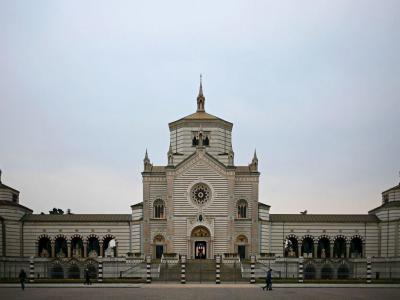
10) Cimitero Monumentale di Milano (Monumental Cemetery) (must see)
The Cimitero Monumentale ("Monumental Cemetery"), designed by Carlo Maciachini, is one of Milan's two largest cemeteries, along with the Cimitero Maggiore. It was created to unite small cemeteries spread throughout the city and provide a single location away from the densely populated central city area. Officially opened in 1866, it has since then been filled with a wide range of contemporary and classical Italian sculptures, Greek temples, elaborate obelisks, and other original works, such as a scaled-down version of Trajan's Column. Many of the tombs belong to notable industrialist dynasties.
The large Famedio, a massive Hall of Fame-like Neo-Medieval style building made of marble and stone, serves as the main entrance and contains the tombs of some of the city's and the country's most esteemed citizens, including that of novelist Alessandro Manzoni.
The Civico Mausoleo Palanti, designed by architect Mario Palanti, is a tomb built for the deserving citizens of Milan.
The memorial of about 800 Milanese killed in Nazi concentration camps is located in the center and is the work of the group BBPR, formed by leading exponents of Italian rationalist architecture that included Gianluigi Banfi.
Also featured is a special section for those who do not belong to the Catholic religion and a Jewish section.
An exhibition near the entrance showcases prints, photographs, and maps that trace the cemetery's historical development, including two battery-operated electric hearses built in the 1920s.
The sculptures and structures of the Monumental Cemetery showcase its artistic history from Realism and Eclecticism to Liberty and Symbolism, and into the contemporary age. In other words, nothing short of a real open-air museum that one should not miss!
Why You Should Visit:
Even if you're not big on cemeteries, this is something else and it's honestly impressive, as it features unique works by some of Milan's best sculptors and artists.
The cemetery's urban design resembles a city, as it is composed of rectangular blocks framed by streets and avenues that separate tombs instead of houses.
Tip:
Summer visitors: try to avoid wearing open-toed sandals as you'll be walking on gravel paths and thus will have to keep stopping and emptying your shoes!
The large Famedio, a massive Hall of Fame-like Neo-Medieval style building made of marble and stone, serves as the main entrance and contains the tombs of some of the city's and the country's most esteemed citizens, including that of novelist Alessandro Manzoni.
The Civico Mausoleo Palanti, designed by architect Mario Palanti, is a tomb built for the deserving citizens of Milan.
The memorial of about 800 Milanese killed in Nazi concentration camps is located in the center and is the work of the group BBPR, formed by leading exponents of Italian rationalist architecture that included Gianluigi Banfi.
Also featured is a special section for those who do not belong to the Catholic religion and a Jewish section.
An exhibition near the entrance showcases prints, photographs, and maps that trace the cemetery's historical development, including two battery-operated electric hearses built in the 1920s.
The sculptures and structures of the Monumental Cemetery showcase its artistic history from Realism and Eclecticism to Liberty and Symbolism, and into the contemporary age. In other words, nothing short of a real open-air museum that one should not miss!
Why You Should Visit:
Even if you're not big on cemeteries, this is something else and it's honestly impressive, as it features unique works by some of Milan's best sculptors and artists.
The cemetery's urban design resembles a city, as it is composed of rectangular blocks framed by streets and avenues that separate tombs instead of houses.
Tip:
Summer visitors: try to avoid wearing open-toed sandals as you'll be walking on gravel paths and thus will have to keep stopping and emptying your shoes!
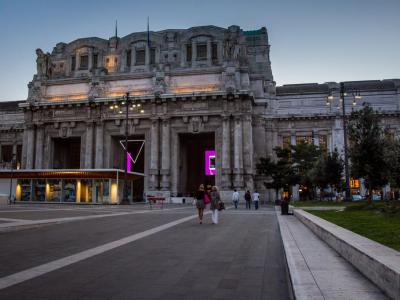
11) Milano Centrale railway station
The grand and iconic Milano Centrale railway station located in the heart of Milan was designed by architect Ulisse Stacchini and opened in 1931 as part of the city's urban renewal project.
The station features a distinctive Art Deco style, with a grand entrance hall adorned with marble floors and a vast glass dome that serves as the station's centerpiece. The station's exterior is equally impressive, with a neoclassical façade that features numerous decorative elements such as columns, statues, and reliefs.
Throughout its history, Milano Centrale has played a significant role in Italian transportation, serving as a major hub for both domestic and international trains. The station features 24 platforms, with numerous trains departing and arriving every day, making it a bustling and vibrant hub of activity.
Over the years, Milano Centrale has undergone several renovations and upgrades to modernize its facilities and services. Today, it offers a wide range of amenities and services, including restaurants, cafes, shops, a post office, a pharmacy, and a bank, making it a convenient and accessible destination for travelers.
Milano Centrale's grand architecture and rich history have also made it a popular cultural landmark and tourist attraction in Milan. The station has appeared in numerous movies and TV shows over the years and is a popular destination for architecture enthusiasts and history buffs.
The station features a distinctive Art Deco style, with a grand entrance hall adorned with marble floors and a vast glass dome that serves as the station's centerpiece. The station's exterior is equally impressive, with a neoclassical façade that features numerous decorative elements such as columns, statues, and reliefs.
Throughout its history, Milano Centrale has played a significant role in Italian transportation, serving as a major hub for both domestic and international trains. The station features 24 platforms, with numerous trains departing and arriving every day, making it a bustling and vibrant hub of activity.
Over the years, Milano Centrale has undergone several renovations and upgrades to modernize its facilities and services. Today, it offers a wide range of amenities and services, including restaurants, cafes, shops, a post office, a pharmacy, and a bank, making it a convenient and accessible destination for travelers.
Milano Centrale's grand architecture and rich history have also made it a popular cultural landmark and tourist attraction in Milan. The station has appeared in numerous movies and TV shows over the years and is a popular destination for architecture enthusiasts and history buffs.
