Custom Walk in Singapore, Singapore by johntaylorsound_72a4e created on 2025-01-15
Guide Location: Singapore » Singapore
Guide Type: Custom Walk
# of Sights: 13
Tour Duration: 6 Hour(s)
Travel Distance: 14 Km or 8.7 Miles
Share Key: WKRUS
Guide Type: Custom Walk
# of Sights: 13
Tour Duration: 6 Hour(s)
Travel Distance: 14 Km or 8.7 Miles
Share Key: WKRUS
How It Works
Please retrieve this walk in the GPSmyCity app. Once done, the app will guide you from one tour stop to the next as if you had a personal tour guide. If you created the walk on this website or come to the page via a link, please follow the instructions below to retrieve the walk in the app.
Retrieve This Walk in App
Step 1. Download the app "GPSmyCity: Walks in 1K+ Cities" on Apple App Store or Google Play Store.



Step 2. In the GPSmyCity app, download(or launch) the guide "Singapore Map and Walking Tours".
Step 3. Tap the menu button located at upper right corner of the "Walks" screen and select "Retrieve custom walk". Enter the share key: WKRUS
1) Chinatown (must see)
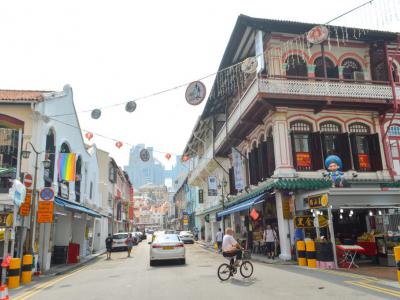
Once a hub for Chinese immigrants in Singapore, today's Chinatown seamlessly blends the past with the present. This cherished district boasts a harmonious coexistence of historical temples and medicinal halls alongside award-winning bars and restaurants.
A day spent exploring this lively area, which encompasses Tanjong Pagar, Bukit Pasoh, Kreta Ayer, and Telok Ayer neighborhoods, promises a variety of experiences. Whether you're delving into centuries-old temples or immersing yourself in the trendy atmosphere of hip watering holes, Chinatown offers a constant stream of fresh encounters.
For culture enthusiasts eager to dive into Singapore's diverse multi-ethnic culture, Chinatown stands as an unparalleled destination. Remarkably, this district is the only Chinatown globally to feature a Buddhist temple, a mosque, and a Hindu temple all within a single street.
Start your exploration of Singapore's religious traditions at the Buddha Tooth Relic Temple & Museum, featuring a mandala-inspired interior symbolizing universal connectivity. Discover hidden gems like a rooftop pagoda garden and a vegetarian food court within the temple compound.
From the Buddha Tooth Relic Temple & Museum, take a brief stroll down South Bridge Road and keep an eye out for the Sri Mariamman Temple, Singapore's oldest Hindu temple. Although the temple's patron deity statue is unveiled only on special occasions, its interior boasts a treasure trove of murals and shrines dedicated to deities like Shiva and Durga.
Whether you prefer traditional or fusion cuisine, Chinatown offers diverse food options. Michelin-starred restaurants like Cure, Meta, and Euphoria are found in its four neighborhoods. For hearty hawker fare, check out Amoy Street Food Centre, Maxwell Food Centre, or Chinatown Complex Food Centre.
In addition to its rich culture and traditions, Chinatown is a vibrant neighborhood with bustling bars where you can socialize over a drink. Many of these establishments have earned accolades on the list of Asia's 50 Best Bars and include renowned spots like Jigger & Pony, known for its modern take on classic cocktails, the innovative Tipping Club, and charming speakeasies such as Sago House.
A day spent exploring this lively area, which encompasses Tanjong Pagar, Bukit Pasoh, Kreta Ayer, and Telok Ayer neighborhoods, promises a variety of experiences. Whether you're delving into centuries-old temples or immersing yourself in the trendy atmosphere of hip watering holes, Chinatown offers a constant stream of fresh encounters.
For culture enthusiasts eager to dive into Singapore's diverse multi-ethnic culture, Chinatown stands as an unparalleled destination. Remarkably, this district is the only Chinatown globally to feature a Buddhist temple, a mosque, and a Hindu temple all within a single street.
Start your exploration of Singapore's religious traditions at the Buddha Tooth Relic Temple & Museum, featuring a mandala-inspired interior symbolizing universal connectivity. Discover hidden gems like a rooftop pagoda garden and a vegetarian food court within the temple compound.
From the Buddha Tooth Relic Temple & Museum, take a brief stroll down South Bridge Road and keep an eye out for the Sri Mariamman Temple, Singapore's oldest Hindu temple. Although the temple's patron deity statue is unveiled only on special occasions, its interior boasts a treasure trove of murals and shrines dedicated to deities like Shiva and Durga.
Whether you prefer traditional or fusion cuisine, Chinatown offers diverse food options. Michelin-starred restaurants like Cure, Meta, and Euphoria are found in its four neighborhoods. For hearty hawker fare, check out Amoy Street Food Centre, Maxwell Food Centre, or Chinatown Complex Food Centre.
In addition to its rich culture and traditions, Chinatown is a vibrant neighborhood with bustling bars where you can socialize over a drink. Many of these establishments have earned accolades on the list of Asia's 50 Best Bars and include renowned spots like Jigger & Pony, known for its modern take on classic cocktails, the innovative Tipping Club, and charming speakeasies such as Sago House.
2) Buddha Tooth Relic Temple & Museum (must see)
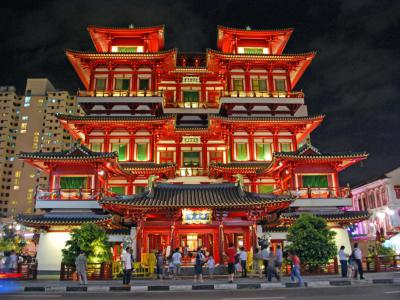
Situated right in the heart of Singapore’s Chinatown, this temple isn't shy to announce its presence. The local Chinese community treasures it, and once you see the lavish façade, you’ll understand why. Step inside and the drama continues, with an interior that matches the exterior’s grandeur note for note.
You’ll notice the lights glowing even at midnight because the temple never closes. What does close, however, is the dress code loophole. Shoulders must be covered for women, conservative dress or slacks advised for the lower part, and for men—sorry, no shorts or tank tops allowed. Strangely, shoes are completely fine, and you can take non-flash photos in selected areas, just not in the relic chamber and other sacred spots.
As you walk through, don’t be surprised if you hear a monk chanting into a microphone. It’s all part of the rhythm of daily worship. At the back, you’ll spot rows of Buddha statues linked to the astrological signs. Front and centre in the main hall is Maitreya—the future Buddha—represented by a wooden statue said to be nearly a thousand years old.
One whole floor is packed with statues, including Guan Yin, the Bodhisattva of Compassion, Mercy, and Kindness. Head upstairs and you’ll find life-sized wax figures of temple leaders, both past and present. The level of detail is impressive—down to the wrinkles—and could give some wax museums a confidence crisis. From here, a balcony lets you peek through drapes into the enormous prayer hall below.
But the real treasure sits on the 4th floor: the Buddha Tooth Relic Stupa. This golden chamber reportedly houses a tooth of Gautama Buddha, found in Myanmar in 1980. You can’t get right up to it, but for a closer look, a helpful scale model stands nearby.
Before you step back outside, take a detour to the rooftop orchid garden. Hidden from most visitors, it’s calm, colourful, and home to a giant prayer wheel surrounded by 10,000 small Buddha images. It’s the perfect quiet moment before diving back into the vibrant streets of Chinatown.
You’ll notice the lights glowing even at midnight because the temple never closes. What does close, however, is the dress code loophole. Shoulders must be covered for women, conservative dress or slacks advised for the lower part, and for men—sorry, no shorts or tank tops allowed. Strangely, shoes are completely fine, and you can take non-flash photos in selected areas, just not in the relic chamber and other sacred spots.
As you walk through, don’t be surprised if you hear a monk chanting into a microphone. It’s all part of the rhythm of daily worship. At the back, you’ll spot rows of Buddha statues linked to the astrological signs. Front and centre in the main hall is Maitreya—the future Buddha—represented by a wooden statue said to be nearly a thousand years old.
One whole floor is packed with statues, including Guan Yin, the Bodhisattva of Compassion, Mercy, and Kindness. Head upstairs and you’ll find life-sized wax figures of temple leaders, both past and present. The level of detail is impressive—down to the wrinkles—and could give some wax museums a confidence crisis. From here, a balcony lets you peek through drapes into the enormous prayer hall below.
But the real treasure sits on the 4th floor: the Buddha Tooth Relic Stupa. This golden chamber reportedly houses a tooth of Gautama Buddha, found in Myanmar in 1980. You can’t get right up to it, but for a closer look, a helpful scale model stands nearby.
Before you step back outside, take a detour to the rooftop orchid garden. Hidden from most visitors, it’s calm, colourful, and home to a giant prayer wheel surrounded by 10,000 small Buddha images. It’s the perfect quiet moment before diving back into the vibrant streets of Chinatown.
3) Clarke Quay (must see)
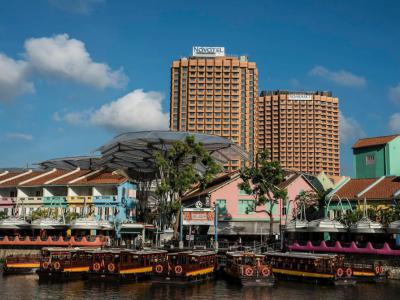
Clarke Quay is a historic riverside area in Singapore, situated in the Singapore River Planning Area. It can be found upstream from the mouth of the Singapore River and Boat Quay.
The name Clarke Quay is derived from Sir Andrew Clarke, who served as Singapore's second Governor and Governor of the Straits Settlements from 1873 to 1875. He played a pivotal role in establishing Singapore as the primary port for the Malay states of Perak, Selangor, and Sungei Ujong.
Starting in the early 1800s, Clarke Quay functioned as a dock for loading and unloading goods destined for the warehouses and commercial establishments along the Singapore River. As port activities gradually shifted to Keppel Harbour and other locations starting in the mid-1800s, coupled with a cleanup effort of the river in the early 1980s, Clarke Quay declined in importance. However, in 1989, it was designated as a heritage conservation area and subsequently transformed into a commercial and entertainment hub.
Upon its reopening in November 1993, Clarke Quay was marketed as a family-friendly attraction featuring over 170 retail stores, 17 dining establishments, and an adventure ride incorporating elements from Singapore's history.
To evoke a sense of nostalgia, the streets were adorned with 80 gaslights that were manually lit every evening. Additional historical elements included river cruises and tongkangs, which were preserved as floating dining platforms. Visitors could enjoy wandering minstrels, street performances, and even performances on Read Bridge, occasionally used as a stage for buskers, similar to the Teochew storytellers of the past.
Over the years, Clarke Quay has attracted notable tenants and introduced various attractions. In 1994, a popular Sunday flea market started, offering second-hand items, curios, and antiques. That year, Singapore's first virtual reality ride, Reality Rocket, was launched. In 1995, the famous Satay Club from the 1940s relocated to Clarke Quay after leaving its previous location at the Esplanade, which was being developed for the arts. After redevelopment, Clarke Quay became a venue for events like Mid-Autumn by the River, the Singapore Food Festival, and the Singapore Million Dollar Duck Race. This revitalization turned Clarke Quay into a bustling destination.
Tip:
Take your pick of Asian: Clarke Quay has Chinese, Indian and Malay (Indonesian) restaurants, as well as Japanese, Vietnamese, and Thai. Western choices include an Aussie seafood house, British and Irish pubs, a steakhouse, a Spanish tapas bar, German and Cuban restaurants, as well as more downscale taco joints, chicken wing joints, etc. Also lots of serious bars and other nightlife.
The name Clarke Quay is derived from Sir Andrew Clarke, who served as Singapore's second Governor and Governor of the Straits Settlements from 1873 to 1875. He played a pivotal role in establishing Singapore as the primary port for the Malay states of Perak, Selangor, and Sungei Ujong.
Starting in the early 1800s, Clarke Quay functioned as a dock for loading and unloading goods destined for the warehouses and commercial establishments along the Singapore River. As port activities gradually shifted to Keppel Harbour and other locations starting in the mid-1800s, coupled with a cleanup effort of the river in the early 1980s, Clarke Quay declined in importance. However, in 1989, it was designated as a heritage conservation area and subsequently transformed into a commercial and entertainment hub.
Upon its reopening in November 1993, Clarke Quay was marketed as a family-friendly attraction featuring over 170 retail stores, 17 dining establishments, and an adventure ride incorporating elements from Singapore's history.
To evoke a sense of nostalgia, the streets were adorned with 80 gaslights that were manually lit every evening. Additional historical elements included river cruises and tongkangs, which were preserved as floating dining platforms. Visitors could enjoy wandering minstrels, street performances, and even performances on Read Bridge, occasionally used as a stage for buskers, similar to the Teochew storytellers of the past.
Over the years, Clarke Quay has attracted notable tenants and introduced various attractions. In 1994, a popular Sunday flea market started, offering second-hand items, curios, and antiques. That year, Singapore's first virtual reality ride, Reality Rocket, was launched. In 1995, the famous Satay Club from the 1940s relocated to Clarke Quay after leaving its previous location at the Esplanade, which was being developed for the arts. After redevelopment, Clarke Quay became a venue for events like Mid-Autumn by the River, the Singapore Food Festival, and the Singapore Million Dollar Duck Race. This revitalization turned Clarke Quay into a bustling destination.
Tip:
Take your pick of Asian: Clarke Quay has Chinese, Indian and Malay (Indonesian) restaurants, as well as Japanese, Vietnamese, and Thai. Western choices include an Aussie seafood house, British and Irish pubs, a steakhouse, a Spanish tapas bar, German and Cuban restaurants, as well as more downscale taco joints, chicken wing joints, etc. Also lots of serious bars and other nightlife.
4) Merlion Park and Statue (must see)
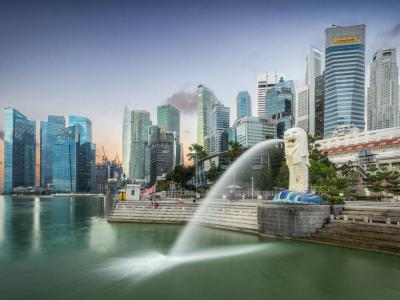
No visit to Singapore feels quite “official” until you’ve met the Merlion—the city’s most famous resident who, despite being made of stone, still manages to greet more tourists than anyone else. This half-fish, half-lion creature has been Singapore’s mascot since 1964, and its design sums up the country’s story in one glance: the fish nods to old Temasek, a humble fishing village, while the lion’s head traces back to the legend that inspired the name “Singapura,” or the “Lion City” in Sanskrit.
The Merlion may look unique, but it actually has distant cousins scattered across history. Lions with fishtails show up on ancient murals in Ajanta and Mathura in India, appear on Etruscan coins, and even swim through Western heraldry. Variations of this creature decorate the coats of arms of Portsmouth and Great Yarmouth in the UK, the City of Manila, and the old East India Company. In other words, Singapore didn’t invent the sea-lion—it just made it iconic.
Kitschy or not, the Merlion knows how to work a crowd. At nine meters tall and constantly spouting water, it offers prime views over Marina Bay, with the city’s skyscrapers rising behind it and the Singapore Flyer peeking in—that is, if you stand in just the right spot. And if you’ve already toasted the city with a Singapore Sling (an iconic gin-based cocktail invented at the Long Bar in Singapore's Raffles Hotel), dropping by to see the Merlion feels like the natural sequel.
Yes, it gets crowded. Everyone wants their moment with the stone celebrity. But the flow of people moves fast, and with a bit of patience, you’ll get your photo. Or, even better, take a breather, look around, and enjoy the scene. The Merlion may be quirky, but its little corner of the bay has a charm that always lands with visitors...
The Merlion may look unique, but it actually has distant cousins scattered across history. Lions with fishtails show up on ancient murals in Ajanta and Mathura in India, appear on Etruscan coins, and even swim through Western heraldry. Variations of this creature decorate the coats of arms of Portsmouth and Great Yarmouth in the UK, the City of Manila, and the old East India Company. In other words, Singapore didn’t invent the sea-lion—it just made it iconic.
Kitschy or not, the Merlion knows how to work a crowd. At nine meters tall and constantly spouting water, it offers prime views over Marina Bay, with the city’s skyscrapers rising behind it and the Singapore Flyer peeking in—that is, if you stand in just the right spot. And if you’ve already toasted the city with a Singapore Sling (an iconic gin-based cocktail invented at the Long Bar in Singapore's Raffles Hotel), dropping by to see the Merlion feels like the natural sequel.
Yes, it gets crowded. Everyone wants their moment with the stone celebrity. But the flow of people moves fast, and with a bit of patience, you’ll get your photo. Or, even better, take a breather, look around, and enjoy the scene. The Merlion may be quirky, but its little corner of the bay has a charm that always lands with visitors...
5) Cloud Forest (must see)
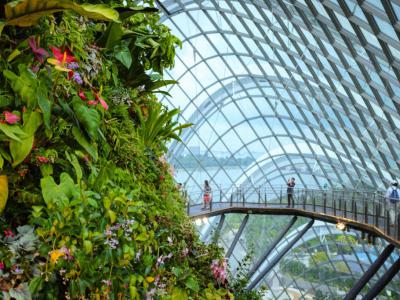
The Cloud Forest at Gardens by the Bay stands as one of Singapore's most remarkable attractions. This extraordinary glass dome, resembling a massive greenhouse, is visible from afar and is equally captivating from the inside. This expansive, climate-controlled structure boasts winding pathways and boasts one of the world's tallest indoor waterfalls, cascading from a height of over 30 meters.
Given Singapore's perennially hot climate, a visit to the Cloud Forest offers more than just a respite from the heat. Thanks to modern cooling systems, the dispersal of refreshing mist, and the presence of the majestic waterfall, the interior maintains a cool atmosphere, simulating the humid conditions found in misty tropical mountains ranging from 900 to 2,700 meters above sea level. Notably, the centerpiece of this attraction is the 42-meter "Cloud Mountain." After taking an elevator to its summit, visitors descend along a circular path that passes under the 35-meter waterfall several times.
The "Cloud Mountain" itself is a complex structure enveloped in epiphytic plants like orchids, ferns, peacock ferns, spike- and clubmosses, bromeliads, and anthuriums. The design, conceived by Grant Associates, draws inspiration from the Maiden Hair Fungus and features multiple tiers, each with a unique theme, including The Lost World, The Cavern, The Waterfall View, The Crystal Mountain, The Cloud Forest Gallery, The Cloud Forest Theatre, and The Secret Garden.
Given Singapore's perennially hot climate, a visit to the Cloud Forest offers more than just a respite from the heat. Thanks to modern cooling systems, the dispersal of refreshing mist, and the presence of the majestic waterfall, the interior maintains a cool atmosphere, simulating the humid conditions found in misty tropical mountains ranging from 900 to 2,700 meters above sea level. Notably, the centerpiece of this attraction is the 42-meter "Cloud Mountain." After taking an elevator to its summit, visitors descend along a circular path that passes under the 35-meter waterfall several times.
The "Cloud Mountain" itself is a complex structure enveloped in epiphytic plants like orchids, ferns, peacock ferns, spike- and clubmosses, bromeliads, and anthuriums. The design, conceived by Grant Associates, draws inspiration from the Maiden Hair Fungus and features multiple tiers, each with a unique theme, including The Lost World, The Cavern, The Waterfall View, The Crystal Mountain, The Cloud Forest Gallery, The Cloud Forest Theatre, and The Secret Garden.
6) Supertree Grove and Observatory Space (must see)
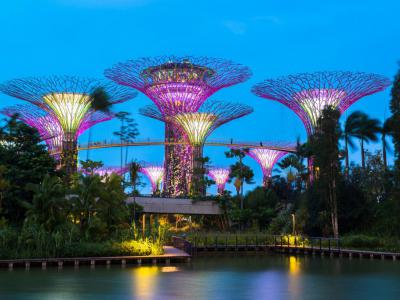
Supertrees are a set of 18 tree-like structures that dominate the landscape of the Gardens. They vary in height from 25 meters (82 feet) to 50 meters (160 feet). These structures essentially function as vertical gardens, serving multiple purposes, including planting, providing shade, and acting as environmental tools for the gardens.
Within the Supertrees, you'll find clusters of unique and exotic plant species like ferns, vines, orchids, and a wide assortment of bromeliads, such as Tillandsia. They incorporate environmental technologies designed to mimic the ecological roles of natural trees. For instance, they have photovoltaic cells that capture solar energy, much like how trees photosynthesize, and they collect rainwater for use in irrigation and fountain displays, similar to how trees absorb rainwater for growth. Additionally, the Supertrees contribute to the cooling systems of the conservatories by serving as air intake and exhaust components.
Visitors can enjoy an elevated walkway called the OCBC Skyway, which connects two of the larger Supertrees and offers a panoramic aerial view of the Gardens. Every evening at 7:45pm and 8:45pm, the Supertree Grove hosts a coordinated light and music show known as the Garden Rhapsody. The music for the show changes monthly, featuring themes like "A World of Wonder" and "A Night of Musical Theatre," which include excerpts from movies such as Jurassic Park and Pirates of the Caribbean.
There's also a relatively new attraction known as the Supertree Observatory, which opened on December 27, 2019. It is housed within the tallest Supertree, standing at 50 meters tall, and consists of three levels: the ground floor, the Observatory Space, and the Open-Air Rooftop Deck. Visitors can take an elevator to the Observatory Space and then climb a flight of stairs to reach the Rooftop Deck. The Observatory Space features an indoor area with floor-to-ceiling glass windows and an outdoor walkway around the perimeter. Here, visitors can experience a message about the impacts of climate change conveyed through digital media. The Open-Air Rooftop Deck, situated atop this Supertree canopy, provides unobstructed 360-degree views of the Gardens and the Marina Bay area.
Within the Supertrees, you'll find clusters of unique and exotic plant species like ferns, vines, orchids, and a wide assortment of bromeliads, such as Tillandsia. They incorporate environmental technologies designed to mimic the ecological roles of natural trees. For instance, they have photovoltaic cells that capture solar energy, much like how trees photosynthesize, and they collect rainwater for use in irrigation and fountain displays, similar to how trees absorb rainwater for growth. Additionally, the Supertrees contribute to the cooling systems of the conservatories by serving as air intake and exhaust components.
Visitors can enjoy an elevated walkway called the OCBC Skyway, which connects two of the larger Supertrees and offers a panoramic aerial view of the Gardens. Every evening at 7:45pm and 8:45pm, the Supertree Grove hosts a coordinated light and music show known as the Garden Rhapsody. The music for the show changes monthly, featuring themes like "A World of Wonder" and "A Night of Musical Theatre," which include excerpts from movies such as Jurassic Park and Pirates of the Caribbean.
There's also a relatively new attraction known as the Supertree Observatory, which opened on December 27, 2019. It is housed within the tallest Supertree, standing at 50 meters tall, and consists of three levels: the ground floor, the Observatory Space, and the Open-Air Rooftop Deck. Visitors can take an elevator to the Observatory Space and then climb a flight of stairs to reach the Rooftop Deck. The Observatory Space features an indoor area with floor-to-ceiling glass windows and an outdoor walkway around the perimeter. Here, visitors can experience a message about the impacts of climate change conveyed through digital media. The Open-Air Rooftop Deck, situated atop this Supertree canopy, provides unobstructed 360-degree views of the Gardens and the Marina Bay area.
7) Gardens by the Bay (must see)
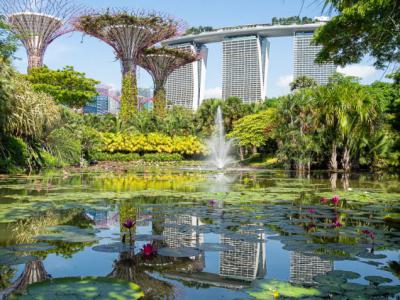
Gardens by the Bay is a sprawling natural park that covers 101 hectares (about 250 acres) in the Central Region of Singapore, right next to the Marina Reservoir. This park is divided into three distinct waterfront gardens: Bay South Garden in Marina South, Bay East Garden in Marina East, and Bay Central Garden in Downtown Core and Kallang. The largest among them is Bay South Garden, which spans 54 hectares (approximately 130 acres) and was designed by Grant Associates.
The establishment of Gardens by the Bay was part of Singapore's strategic plan to transform its identity from a "Garden City" into a "City in a Garden." The overarching goal was to elevate the residents' quality of life by increasing the presence of green spaces and diverse flora within the urban environment. The initiative was first introduced by Prime Minister Lee Hsien Loong during Singapore's National Day Rally in 2005, with the intention of making Gardens by the Bay a premier outdoor recreational area in the city and a national symbol.
The conservatory complex within Gardens by the Bay consists of two temperature-controlled conservatories: the Flower Dome and the Cloud Forest, strategically positioned along the Marina Reservoir shoreline. These conservatories, designed by WilkinsonEyre and Grant Associates, serve as impressive demonstrations of sustainable building techniques and offer an all-weather educational and entertainment space within the gardens. Each of these structures is quite spacious, covering around 2.5 acres, and the Flower Dome holds the distinction of being the world's largest glasshouse without interior support columns.
Why You Should Visit:
Once you're here, you'll just cry in endless admiration for all the beauty and technological advancement.
They constantly bring in seasonal flowers and plants from all over the world and you get to enjoy all this in the comfort of cool temperature and humidity.
Some of the sculptures are a bit kitschy and clearly aimed at children but nevertheless, the place is quite fascinating and unlike anything you've seen before.
Tip:
There's an evening sound & light show (7:45pm / 8:45pm) you can enjoy from the skyway but you have to buy tickets in advance (and the opening depends on the weather), although you can still take many beautiful pictures from the ground. If you want to see a light show please arrive early in order to get a seat.
The establishment of Gardens by the Bay was part of Singapore's strategic plan to transform its identity from a "Garden City" into a "City in a Garden." The overarching goal was to elevate the residents' quality of life by increasing the presence of green spaces and diverse flora within the urban environment. The initiative was first introduced by Prime Minister Lee Hsien Loong during Singapore's National Day Rally in 2005, with the intention of making Gardens by the Bay a premier outdoor recreational area in the city and a national symbol.
The conservatory complex within Gardens by the Bay consists of two temperature-controlled conservatories: the Flower Dome and the Cloud Forest, strategically positioned along the Marina Reservoir shoreline. These conservatories, designed by WilkinsonEyre and Grant Associates, serve as impressive demonstrations of sustainable building techniques and offer an all-weather educational and entertainment space within the gardens. Each of these structures is quite spacious, covering around 2.5 acres, and the Flower Dome holds the distinction of being the world's largest glasshouse without interior support columns.
Why You Should Visit:
Once you're here, you'll just cry in endless admiration for all the beauty and technological advancement.
They constantly bring in seasonal flowers and plants from all over the world and you get to enjoy all this in the comfort of cool temperature and humidity.
Some of the sculptures are a bit kitschy and clearly aimed at children but nevertheless, the place is quite fascinating and unlike anything you've seen before.
Tip:
There's an evening sound & light show (7:45pm / 8:45pm) you can enjoy from the skyway but you have to buy tickets in advance (and the opening depends on the weather), although you can still take many beautiful pictures from the ground. If you want to see a light show please arrive early in order to get a seat.
8) Sands Skypark and Observation Deck (must see)
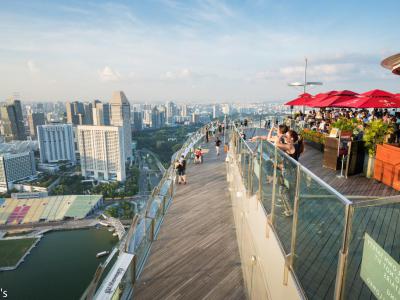
To some, it may appear as a giant celestial surfboard balancing on three skyscrapers, or maybe a sleek spaceship touching down for refuelling. Either way, the Sands SkyPark is hard to miss. Spanning 1.2 hectares across the tops of the three 55-storey Marina Bay Sands towers, it looks like it’s defying gravity for the sheer fun of it.
Dreamed up by architect Moshe Safdie, the SkyPark isn’t just big—it’s “longer-than-the-Eiffel-Tower-lying-on-its-side” big. In fact, there’s room up there for four and a half A380 jumbo jets (!!!), though luckily the only things landing are visitors armed with cameras and enthusiasm.
Once you step onto the platform, the surprise continues. You’ll find gardens filled with trees and plants that seem almost too relaxed for a rooftop setting. Scattered among the greenery are some of Marina Bay’s most talked-about bars, restaurants, and nightlife spots. These include the likes of Michelin-starred CUT by Wolfgang Puck, Black Tap Craft Burgers and Beer, AVENUE Singapore, LAVO Italian Restaurant & Rooftop Bar, and the ever-iconic Cé La Vi. It’s a place where fine dining meets high altitude, and nobody complains about the view.
But the real scene-stealer is the SkyPark’s 150-meter infinity pool—also known as the world’s largest elevated outdoor pool and quite possibly the most dramatic spot to float around at 191 meters above the ground. With a vanishing edge stretching 146 meters, it creates a perfect illusion of swimming straight into the skyline. The only catch is—you need to be a Marina Bay Sands hotel guest to slip in for a dip or access the SkyPark for free.
If you’re not staying overnight, don’t worry—the public observation deck is your VIP pass to the panorama. Cantilevered above the city, it delivers a full 360-degree sweep of Marina Bay. Open from 11:30 a.m. to 8:00 p.m., the deck lets you soak up the views, browse the souvenir shop, and tune into an audio guide that points out Singapore’s landmarks while you gaze down at them.
Up here, everything feels a little unreal—and that’s exactly the point.
Dreamed up by architect Moshe Safdie, the SkyPark isn’t just big—it’s “longer-than-the-Eiffel-Tower-lying-on-its-side” big. In fact, there’s room up there for four and a half A380 jumbo jets (!!!), though luckily the only things landing are visitors armed with cameras and enthusiasm.
Once you step onto the platform, the surprise continues. You’ll find gardens filled with trees and plants that seem almost too relaxed for a rooftop setting. Scattered among the greenery are some of Marina Bay’s most talked-about bars, restaurants, and nightlife spots. These include the likes of Michelin-starred CUT by Wolfgang Puck, Black Tap Craft Burgers and Beer, AVENUE Singapore, LAVO Italian Restaurant & Rooftop Bar, and the ever-iconic Cé La Vi. It’s a place where fine dining meets high altitude, and nobody complains about the view.
But the real scene-stealer is the SkyPark’s 150-meter infinity pool—also known as the world’s largest elevated outdoor pool and quite possibly the most dramatic spot to float around at 191 meters above the ground. With a vanishing edge stretching 146 meters, it creates a perfect illusion of swimming straight into the skyline. The only catch is—you need to be a Marina Bay Sands hotel guest to slip in for a dip or access the SkyPark for free.
If you’re not staying overnight, don’t worry—the public observation deck is your VIP pass to the panorama. Cantilevered above the city, it delivers a full 360-degree sweep of Marina Bay. Open from 11:30 a.m. to 8:00 p.m., the deck lets you soak up the views, browse the souvenir shop, and tune into an audio guide that points out Singapore’s landmarks while you gaze down at them.
Up here, everything feels a little unreal—and that’s exactly the point.
9) Singapore Flyer (must see)
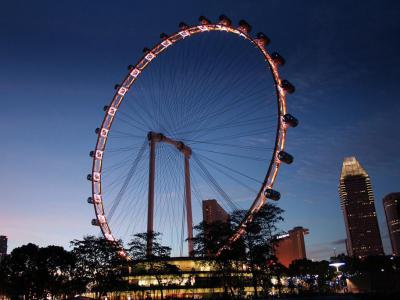
If you're interested in getting a fantastic panoramic view of Singapore, especially the bay area, consider taking a ride on the Singapore Flyer on a clear day. This impressive Ferris wheel stands at a towering height of 165 meters, and it used to be the world's tallest until the Las Vegas "High Roller" surpassed it in 2014 by just 2.6 meters (9 feet). Similar to the "High Roller," the Singapore Flyer revolves slowly, taking about half an hour to complete a full rotation. This gives you ample time to enjoy the breathtaking views and capture numerous photos before descending back to a lush rainforest-covered park below.
The Singapore Flyer consists of 28 cabins, each capable of accommodating 28 passengers. However, during off-peak times, you might find it relatively empty, allowing for a more private experience. If you're worried about acrophobia, rest assured that the capsules are designed to make you feel secure, and the ride is exceptionally smooth, minimizing any sensation of height or rotation. Furthermore, the cabins are equipped with air-conditioning and panoramic screens that provide informative details about the various landmarks and surroundings.
For the best experience, consider visiting the Flyer on weekdays or just before or after sunset to enjoy the city's illuminated beauty at night. They offer various packages, including the signature Singapore Sling Flight, where you can savor drinks while taking in the incredible views for an added touch of style and luxury.
Tip:
The best time for having a Flyer ride is on weekdays as well as before or just after sunset to see the city at night.
The Singapore Flyer consists of 28 cabins, each capable of accommodating 28 passengers. However, during off-peak times, you might find it relatively empty, allowing for a more private experience. If you're worried about acrophobia, rest assured that the capsules are designed to make you feel secure, and the ride is exceptionally smooth, minimizing any sensation of height or rotation. Furthermore, the cabins are equipped with air-conditioning and panoramic screens that provide informative details about the various landmarks and surroundings.
For the best experience, consider visiting the Flyer on weekdays or just before or after sunset to enjoy the city's illuminated beauty at night. They offer various packages, including the signature Singapore Sling Flight, where you can savor drinks while taking in the incredible views for an added touch of style and luxury.
Tip:
The best time for having a Flyer ride is on weekdays as well as before or just after sunset to see the city at night.
10) Marina Bay (must see)
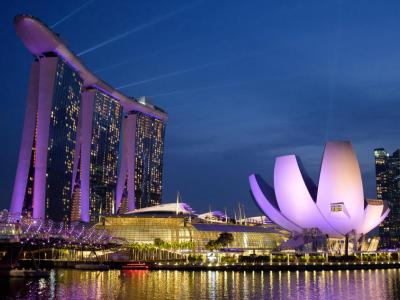
Roll into Marina Bay, and you quickly realise you’ve stepped into Singapore’s favourite showroom—an entire 360-hectare stage built on reclaimed land and polished into what many now call the city’s “new downtown.” Surrounded by the Downtown Core, Marina East, Marina South, and Straits View, the bay feels like the point where Singapore looked at the sea and probably thought, “Why not have a bit more land here?” and then went ahead and made it happen.
Here, the skyline performs graciously. Marina Bay Sands leans in with its iconic three-tower silhouette, Marina Bay Financial Centre and Asia Square compete for the title of “Most Serious Business Address,” and The Sail@Marina Bay stretches upward like it’s trying to catch a breeze that doesn’t exist. Marina One rounds out the cast with lush greenery tucked between its futuristic curves. The Urban Redevelopment Authority treats this whole district like its prized project, imagining Marina Bay as a 24-hour playground where you can work all day, enjoy dinner with a view, and still squeeze in a late-night stroll without ever leaving the neighbourhood.
And if you think the place only looks dramatic, wait until you hear it. Since 2008, the Formula One Singapore Grand Prix has turned the streets around the bay into a glowing, high-speed racetrack. The Float@Marina Bay—built in 2007—has hosted everything from National Day Parades and New Year’s Eve countdowns to fireworks festivals and the Opening and Closing Ceremonies of the first-ever Youth Olympic Games in 2010. It’s basically the city’s open-air living room, only with better lighting and a much larger guest list.
For something gentler but just as striking, the annual i Light Marina Bay festival transforms the waterfront with glowing, eco-friendly art installations. It’s a reminder that even in the middle of all the steel and glass, Singapore still enjoys a moment of creative play.
In other words, Marina Bay is where Singapore is showing off, and doing it very well...
Here, the skyline performs graciously. Marina Bay Sands leans in with its iconic three-tower silhouette, Marina Bay Financial Centre and Asia Square compete for the title of “Most Serious Business Address,” and The Sail@Marina Bay stretches upward like it’s trying to catch a breeze that doesn’t exist. Marina One rounds out the cast with lush greenery tucked between its futuristic curves. The Urban Redevelopment Authority treats this whole district like its prized project, imagining Marina Bay as a 24-hour playground where you can work all day, enjoy dinner with a view, and still squeeze in a late-night stroll without ever leaving the neighbourhood.
And if you think the place only looks dramatic, wait until you hear it. Since 2008, the Formula One Singapore Grand Prix has turned the streets around the bay into a glowing, high-speed racetrack. The Float@Marina Bay—built in 2007—has hosted everything from National Day Parades and New Year’s Eve countdowns to fireworks festivals and the Opening and Closing Ceremonies of the first-ever Youth Olympic Games in 2010. It’s basically the city’s open-air living room, only with better lighting and a much larger guest list.
For something gentler but just as striking, the annual i Light Marina Bay festival transforms the waterfront with glowing, eco-friendly art installations. It’s a reminder that even in the middle of all the steel and glass, Singapore still enjoys a moment of creative play.
In other words, Marina Bay is where Singapore is showing off, and doing it very well...
11) National Museum of Singapore (must see)
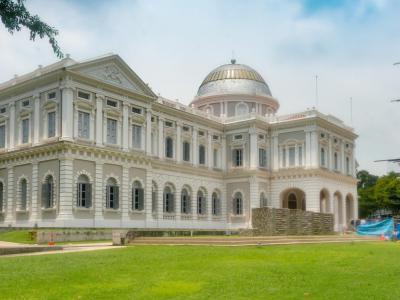
The National Museum of Singapore, situated in the Civic District within the Downtown Core area, serves as a prominent institution dedicated to the preservation and exhibition of Singaporean art, culture, and historical artifacts. With its inception dating back to 1849 by the Singapore Institution Committee, it holds the distinction of being Singapore's oldest museum, a fact reflected in its 19th-century architectural style.
Originally named the Raffles Library and Museum, it initially operated as a section within the Singapore Institution's library before relocating to its current location on Stamford Road in 1887 after several moves.
During its history, the museum briefly bore the name "Singapore History Museum" from 1993 to March 2006, but it ultimately returned to its original title, the National Museum of Singapore, which was first bestowed upon it in 1965. Over the years, the museum has seen numerous expansions and renovations, including a substantial three-and-a-half-year restoration completed on December 2, 2006. The museum's official reopening on December 7, 2006, was presided over by Singaporean President S. R. Nathan and the Minister for Information, Communications, and the Arts, Lee Boon Yang.
Furthermore, the National Museum of Singapore holds the distinction of being designated as a National Monument of Singapore on February 14, 1992, by the National Heritage Board.
Why You Should Visit:
A good place to understand Singapore's national pride and collective identity.
The building itself is flashy, with a very modern addition and interesting details all around.
Tip:
Be sure to take one of the complimentary guided tours. They last an hour and the guides are knowledgeable and entertaining.
The 3rd level of the museum has an exit to Fort Canning Park. From there you can explore the park and visit the Battlebox, a museum/tour of a military bunker located inside the hill.
Originally named the Raffles Library and Museum, it initially operated as a section within the Singapore Institution's library before relocating to its current location on Stamford Road in 1887 after several moves.
During its history, the museum briefly bore the name "Singapore History Museum" from 1993 to March 2006, but it ultimately returned to its original title, the National Museum of Singapore, which was first bestowed upon it in 1965. Over the years, the museum has seen numerous expansions and renovations, including a substantial three-and-a-half-year restoration completed on December 2, 2006. The museum's official reopening on December 7, 2006, was presided over by Singaporean President S. R. Nathan and the Minister for Information, Communications, and the Arts, Lee Boon Yang.
Furthermore, the National Museum of Singapore holds the distinction of being designated as a National Monument of Singapore on February 14, 1992, by the National Heritage Board.
Why You Should Visit:
A good place to understand Singapore's national pride and collective identity.
The building itself is flashy, with a very modern addition and interesting details all around.
Tip:
Be sure to take one of the complimentary guided tours. They last an hour and the guides are knowledgeable and entertaining.
The 3rd level of the museum has an exit to Fort Canning Park. From there you can explore the park and visit the Battlebox, a museum/tour of a military bunker located inside the hill.
12) Orchard Road (must see)
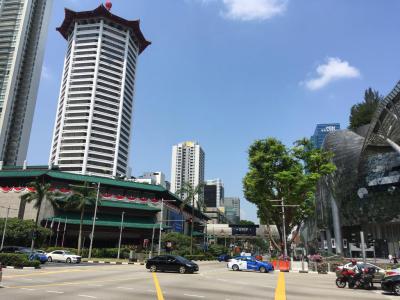
Orchard Road, often informally referred to as Orchard, is a prominent 2.5-kilometer (1.6-mile) long street situated in the Central Area of Singapore. This well-known destination is a high-end shopping district, featuring numerous internationally acclaimed department stores, restaurants, and coffee shops in its vicinity.
The Orchard Planning Area is a designated urban planning region outlined by the Urban Redevelopment Authority. It forms a part of the Central Area within the broader Central Region of Singapore. Orchard is flanked by Newton to the east and north, Tanglin to the west, River Valley to the south, and Museum to the southeast.
The name Orchard Road originates from the nutmeg, pepper, and fruit orchards or plantations that were once found at the end of this road. Such plantations were prevalent in the area during the 19th century.
At the eastern terminus of Orchard Road stands the Istana, the official residence of the President of Singapore, surrounded by Nibong palms. The house of Singapore's first Prime Minister, Lee Kuan Yew, is situated on Oxley Road, just south of Orchard Road. On the western side lies the UNESCO World Heritage Site, the Singapore Botanic Gardens.
Approximately midway down the road, you'll find Cairnhill and Emerald Hill, which are residential neighborhoods. Adjacent to Emerald Hill is Centrepoint, housing the oldest business in the area, Cold Storage. Specialists' Shopping Centre replaced Pavilion Cinema but was subsequently demolished to make room for Orchard Gateway. Scotts Road, located just off Orchard Road, was once home to Singapore's inaugural food court, which was replaced by Scotts Square in June 2007.
Notable shopping malls along Orchard Road include ION Orchard, Wisma Atria, Ngee Ann City, Orchard Central, Orchard Gateway, 313 @ Somerset, Orchard Plaza, Plaza Singapura, The Centrepoint, The Heeren, Mandarin Gallery, Cathay Cineleisure Orchard, Wheelock Place, Liat Towers, Shaw House, and Scotts Square.
Why You Should Visit:
Shopping malls after shopping malls after shopping malls... all air-conditioned and sometimes interconnected.
This is a very happening street, with all the street artists performing and the bargains on the roadside.
Tip:
The best time to visit is at night time when the street is lit up!
For budget travelers, go to food courts at the bottom levels of plazas.
You can buy spirits & wines at a bargain price at “Bottles & Bottles” at Center Point.
The Orchard Planning Area is a designated urban planning region outlined by the Urban Redevelopment Authority. It forms a part of the Central Area within the broader Central Region of Singapore. Orchard is flanked by Newton to the east and north, Tanglin to the west, River Valley to the south, and Museum to the southeast.
The name Orchard Road originates from the nutmeg, pepper, and fruit orchards or plantations that were once found at the end of this road. Such plantations were prevalent in the area during the 19th century.
At the eastern terminus of Orchard Road stands the Istana, the official residence of the President of Singapore, surrounded by Nibong palms. The house of Singapore's first Prime Minister, Lee Kuan Yew, is situated on Oxley Road, just south of Orchard Road. On the western side lies the UNESCO World Heritage Site, the Singapore Botanic Gardens.
Approximately midway down the road, you'll find Cairnhill and Emerald Hill, which are residential neighborhoods. Adjacent to Emerald Hill is Centrepoint, housing the oldest business in the area, Cold Storage. Specialists' Shopping Centre replaced Pavilion Cinema but was subsequently demolished to make room for Orchard Gateway. Scotts Road, located just off Orchard Road, was once home to Singapore's inaugural food court, which was replaced by Scotts Square in June 2007.
Notable shopping malls along Orchard Road include ION Orchard, Wisma Atria, Ngee Ann City, Orchard Central, Orchard Gateway, 313 @ Somerset, Orchard Plaza, Plaza Singapura, The Centrepoint, The Heeren, Mandarin Gallery, Cathay Cineleisure Orchard, Wheelock Place, Liat Towers, Shaw House, and Scotts Square.
Why You Should Visit:
Shopping malls after shopping malls after shopping malls... all air-conditioned and sometimes interconnected.
This is a very happening street, with all the street artists performing and the bargains on the roadside.
Tip:
The best time to visit is at night time when the street is lit up!
For budget travelers, go to food courts at the bottom levels of plazas.
You can buy spirits & wines at a bargain price at “Bottles & Bottles” at Center Point.
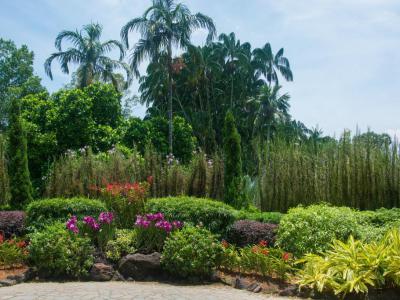
13) Singapore Botanic Gardens (must see)
The Singapore Botanic Gardens is a tropical garden with a history spanning 164 years, situated on the outskirts of the Orchard Road shopping district in Singapore. Among the three gardens in the area, it stands as the sole tropical garden to be recognized as a UNESCO World Heritage Site. In 2012, it earned the prestigious title of Garden of the Year at the International Garden Tourism Awards.
Established in 1859 at its current location by the Agri-horticultural Society, the Botanic Gardens played a crucial role in the early twentieth-century rubber trade boom in the region. Under the leadership of its first scientific director, Henry Nicholas Ridley, the garden conducted research on rubber plant cultivation. This effort led to the refinement of rubber extraction techniques still in use today and the promotion of its economic significance to planters in the area. Consequently, rubber production witnessed rapid growth, with the Malayan peninsula dominating half of global latex production during its peak in the 1920s.
Within the main gardens lies the National Orchid Garden, renowned for its leadership in orchid studies and hybrid cultivation. This complements Singapore's status as a significant exporter of cut orchids. The equatorial climate lends its support to housing an impressive orchid collection, boasting 1,200 species and 2,000 hybrids.
In the early years of Singapore's independence, the expertise of the Singapore Botanic Gardens played a pivotal role in transforming the island into a tropical "Garden City," a widely recognized image and nickname for the nation. In 1981, the hybrid climbing orchid, Vanda Miss Joaquim, was designated as Singapore's national flower. The practice of "orchid diplomacy" involves honoring visiting heads of states, dignitaries, and celebrities by naming exceptional orchid hybrids after them. These are prominently showcased at the VIP Orchid Gardens, a popular attraction.
Encompassing an area of 82 hectares (equivalent to 200 acres), the Botanic Gardens boasts a rich diversity of over 10,000 plant species, spanning a vertical stretch. The longest distance between its northern and southern ends measures 2.5 kilometers (1.6 miles). The Botanic Gardens consistently draws in approximately 4.5 million visitors each year.
Why You Should Visit:
Beautifully set out; just a stunning, relaxing, tranquil place to be.
It's come a long way and grown more beautiful (and visitor-friendly) with time.
Like the mini NY Central Park of Singapore, although much cleaner and greener.
Tip:
Grab a map when you enter the park, be sure to have some water to hydrate, wear good shoes for walking and enjoy this gem!
Established in 1859 at its current location by the Agri-horticultural Society, the Botanic Gardens played a crucial role in the early twentieth-century rubber trade boom in the region. Under the leadership of its first scientific director, Henry Nicholas Ridley, the garden conducted research on rubber plant cultivation. This effort led to the refinement of rubber extraction techniques still in use today and the promotion of its economic significance to planters in the area. Consequently, rubber production witnessed rapid growth, with the Malayan peninsula dominating half of global latex production during its peak in the 1920s.
Within the main gardens lies the National Orchid Garden, renowned for its leadership in orchid studies and hybrid cultivation. This complements Singapore's status as a significant exporter of cut orchids. The equatorial climate lends its support to housing an impressive orchid collection, boasting 1,200 species and 2,000 hybrids.
In the early years of Singapore's independence, the expertise of the Singapore Botanic Gardens played a pivotal role in transforming the island into a tropical "Garden City," a widely recognized image and nickname for the nation. In 1981, the hybrid climbing orchid, Vanda Miss Joaquim, was designated as Singapore's national flower. The practice of "orchid diplomacy" involves honoring visiting heads of states, dignitaries, and celebrities by naming exceptional orchid hybrids after them. These are prominently showcased at the VIP Orchid Gardens, a popular attraction.
Encompassing an area of 82 hectares (equivalent to 200 acres), the Botanic Gardens boasts a rich diversity of over 10,000 plant species, spanning a vertical stretch. The longest distance between its northern and southern ends measures 2.5 kilometers (1.6 miles). The Botanic Gardens consistently draws in approximately 4.5 million visitors each year.
Why You Should Visit:
Beautifully set out; just a stunning, relaxing, tranquil place to be.
It's come a long way and grown more beautiful (and visitor-friendly) with time.
Like the mini NY Central Park of Singapore, although much cleaner and greener.
Tip:
Grab a map when you enter the park, be sure to have some water to hydrate, wear good shoes for walking and enjoy this gem!
