Custom Walk in Vilnius, Lithuania by d_j_kay_592c9 created on 2025-03-28
Guide Location: Lithuania » Vilnius
Guide Type: Custom Walk
# of Sights: 14
Tour Duration: 3 Hour(s)
Travel Distance: 6 Km or 3.7 Miles
Share Key: Z34ZE
Guide Type: Custom Walk
# of Sights: 14
Tour Duration: 3 Hour(s)
Travel Distance: 6 Km or 3.7 Miles
Share Key: Z34ZE
How It Works
Please retrieve this walk in the GPSmyCity app. Once done, the app will guide you from one tour stop to the next as if you had a personal tour guide. If you created the walk on this website or come to the page via a link, please follow the instructions below to retrieve the walk in the app.
Retrieve This Walk in App
Step 1. Download the app "GPSmyCity: Walks in 1K+ Cities" on Apple App Store or Google Play Store.



Step 2. In the GPSmyCity app, download(or launch) the guide "Vilnius Map and Walking Tours".
Step 3. Tap the menu button located at upper right corner of the "Walks" screen and select "Retrieve custom walk". Enter the share key: Z34ZE
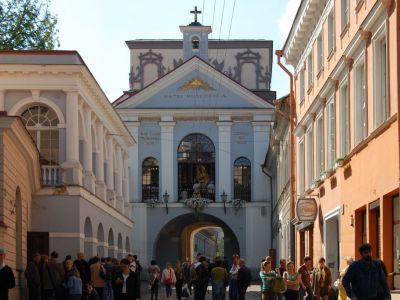
1) Gate of Dawn and the Chapel (must see)
The Gate of Dawn is a city gate in Vilnius, and one of its most important religious, historical and cultural monuments. It is a major site of Catholic pilgrimage in Lithuania.
The Gate of Dawn was built between 1503 and 1522 as a part of defensive fortifications for the city of Vilnius, the capital of the Grand Duchy of Lithuania. Of the nine city gates, only the Gate of Dawn remains, while the others were destroyed by the order of the government at the end of the 18th century.
In the 16th century city gates often contained religious artifacts intended to guard the city from attacks and to bless travelers. The Chapel in the Gate of Dawn contains an icon of The Blessed Virgin Mary Mother of Mercy, said to have miraculous powers. For centuries the picture has been one of the symbols of the city and an object of veneration for both Roman Catholic and Orthodox inhabitants.
The Gate of Dawn was built between 1503 and 1522 as a part of defensive fortifications for the city of Vilnius, the capital of the Grand Duchy of Lithuania. Of the nine city gates, only the Gate of Dawn remains, while the others were destroyed by the order of the government at the end of the 18th century.
In the 16th century city gates often contained religious artifacts intended to guard the city from attacks and to bless travelers. The Chapel in the Gate of Dawn contains an icon of The Blessed Virgin Mary Mother of Mercy, said to have miraculous powers. For centuries the picture has been one of the symbols of the city and an object of veneration for both Roman Catholic and Orthodox inhabitants.
Sight description based on Wikipedia.
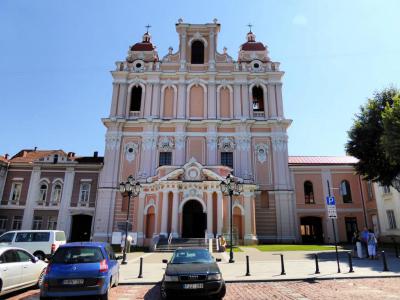
2) St. Casimir's Church
The Church of Saint Casimir in Vilnius is a remarkable example of Baroque architecture, and it holds great cultural and historical significance for the people of Lithuania. The church was built in the early 17th century by the Jesuits, with funding from prominent nobles and Chancellor Lew Sapieha, as a tribute to Saint Casimir, a holy prince who is revered as the patron of Lithuania. The church's design was inspired by the Church of Jesus in Rome, and it features a stepped lantern cupola with a crown that is unique to the region.
Over the centuries, the Church of Saint Casimir has undergone various transformations, including periods of occupation and damage during wars. In the 18th century, architect Thomas Zebrowski oversaw a reconstruction of the church, which resulted in the addition of the impressive cupola. During the Soviet era, the church was closed down and converted into a Museum of Atheism, and it suffered significant damage. However, in 1991, the church was reconsecrated and returned to the Catholic community.
Today, the Church of Saint Casimir continues to hold regular services in Lithuanian and Russian, and it is also renowned for its excellent acoustics and organ concerts featuring internationally renowned musicians. The church's interior boasts three late Baroque artificial marble altars, with paintings by Antanas Kmieliauskas depicting scenes from the life of Saint Casimir and other saints.
Overall, the Church of Saint Casimir is a significant religious and cultural landmark in Vilnius, and it represents an important piece of Lithuania's history and heritage. Its rich architectural and artistic features, as well as its connection to Saint Casimir, make it a must-visit destination for tourists and locals alike.
Over the centuries, the Church of Saint Casimir has undergone various transformations, including periods of occupation and damage during wars. In the 18th century, architect Thomas Zebrowski oversaw a reconstruction of the church, which resulted in the addition of the impressive cupola. During the Soviet era, the church was closed down and converted into a Museum of Atheism, and it suffered significant damage. However, in 1991, the church was reconsecrated and returned to the Catholic community.
Today, the Church of Saint Casimir continues to hold regular services in Lithuanian and Russian, and it is also renowned for its excellent acoustics and organ concerts featuring internationally renowned musicians. The church's interior boasts three late Baroque artificial marble altars, with paintings by Antanas Kmieliauskas depicting scenes from the life of Saint Casimir and other saints.
Overall, the Church of Saint Casimir is a significant religious and cultural landmark in Vilnius, and it represents an important piece of Lithuania's history and heritage. Its rich architectural and artistic features, as well as its connection to Saint Casimir, make it a must-visit destination for tourists and locals alike.
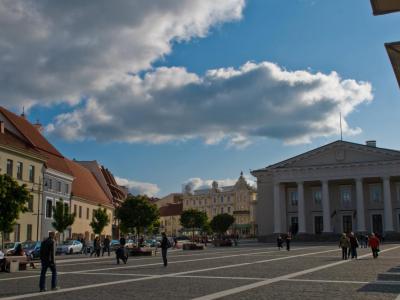
3) Town Hall and Town Hall Square
Vilnius has had a town hall since 1432. The first one was Gothic, but over the centuries it was rebuilt several times. The well-known Lithuanian architect Laurynas Gucevičius, who studied in France, designed the current version after the old one collapsed. Completed in 1799, it’s a fine example of neoclassical architecture and one of Gucevičius’s greatest works-alongside Vilnius Cathedral and the bishops’ summer palace in Verkiai.
For centuries, the Town Hall was the center of civic life. It served as a theatre, hosted the city’s first opera performance, and housed the merchants’ society, shops, the treasury, and even a prison. Today, it continues to be a lively cultural venue for exhibitions, concerts, and official events. Visitors can also explore the Town Hall’s underground catacombs, where traces of the city’s early history remain.
Outside, the spacious Town Hall Square is a favorite meeting place for locals and visitors alike. Once the site of markets, performances, and public punishments, it’s now used for fairs and celebrations. In winter, it sparkles with a giant Christmas tree, while in summer, people gather by the illuminated fountain. Around the square, you can spot Vilnius’s coat of arms-St. Christopher carrying the Christ Child-symbolizing protection and endurance.
For centuries, the Town Hall was the center of civic life. It served as a theatre, hosted the city’s first opera performance, and housed the merchants’ society, shops, the treasury, and even a prison. Today, it continues to be a lively cultural venue for exhibitions, concerts, and official events. Visitors can also explore the Town Hall’s underground catacombs, where traces of the city’s early history remain.
Outside, the spacious Town Hall Square is a favorite meeting place for locals and visitors alike. Once the site of markets, performances, and public punishments, it’s now used for fairs and celebrations. In winter, it sparkles with a giant Christmas tree, while in summer, people gather by the illuminated fountain. Around the square, you can spot Vilnius’s coat of arms-St. Christopher carrying the Christ Child-symbolizing protection and endurance.
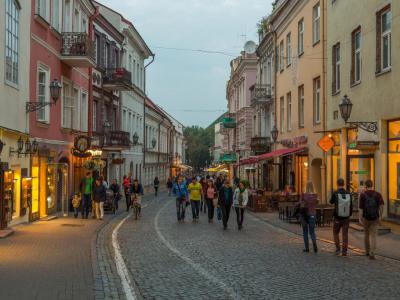
4) Pilies Street (Castle Street)
Castle Street, known locally as Pilies Street, is one of the most vibrant and historic streets in Vilnius Old Town. Stretching between Cathedral Square and Town Hall Square, it has long been the beating heart of the city’s cultural life. Today, it’s alive with the rhythm of street performers, local artisans, and the hum of conversations drifting from cozy cafés and shops.
The street’s lively market atmosphere draws both locals and visitors. Folk artists from across Lithuania come here to sell their handmade crafts, from delicate linen clothing to gleaming amber jewelry-perfect souvenirs of a visit to Vilnius. Every March, the street bursts into color during the Kaziukas Fair, one of the city’s oldest and most beloved folk festivals, when artisans fill the street with music, crafts, and traditional treats.
Throughout the year, Castle Street is also a focal point for celebrations. It becomes a festive promenade during Christmas and Easter, as well as on March 11, the Day of the Restoration of Independence. When Lithuania’s basketball team wins a major game, joyful processions often spill down this same street, echoing with cheers and song.
Castle Street is also steeped in history. First mentioned in 1530, it is the oldest street in Vilnius, lined with an architectural mix of Gothic, Renaissance, and Baroque buildings.
Notable landmarks on Pilies Street include the House of the Signatories, where the Declaration of Independence was signed in 1918, and Vilnius University's headquarters. The university occupied a quarter of the city beside Pilies Street, and its professors used to live there. The street is also home to St. John's Church, which has a beautiful Baroque pediment and offers a stunning view of Gediminas Tower.
The street’s lively market atmosphere draws both locals and visitors. Folk artists from across Lithuania come here to sell their handmade crafts, from delicate linen clothing to gleaming amber jewelry-perfect souvenirs of a visit to Vilnius. Every March, the street bursts into color during the Kaziukas Fair, one of the city’s oldest and most beloved folk festivals, when artisans fill the street with music, crafts, and traditional treats.
Throughout the year, Castle Street is also a focal point for celebrations. It becomes a festive promenade during Christmas and Easter, as well as on March 11, the Day of the Restoration of Independence. When Lithuania’s basketball team wins a major game, joyful processions often spill down this same street, echoing with cheers and song.
Castle Street is also steeped in history. First mentioned in 1530, it is the oldest street in Vilnius, lined with an architectural mix of Gothic, Renaissance, and Baroque buildings.
Notable landmarks on Pilies Street include the House of the Signatories, where the Declaration of Independence was signed in 1918, and Vilnius University's headquarters. The university occupied a quarter of the city beside Pilies Street, and its professors used to live there. The street is also home to St. John's Church, which has a beautiful Baroque pediment and offers a stunning view of Gediminas Tower.
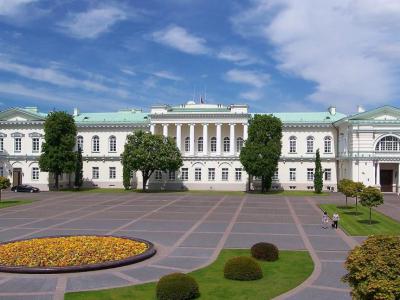
5) Presidential Palace
The Presidential Palace in Vilnius has a long and significant history. First constructed in the 14th century, it has undergone multiple enlargements and renovations over the centuries.
In the 16th century, it served as the residence of the bishops of Vilnius. After major fire damage in 1737 and 1748, architect Laurynas Gucevičius supervised its reconstruction around 1750. When Lithuania became part of the Russian Empire in the late 18th century, the palace was turned into the residence of the Governor-General of Vilnius.
Over time, it welcomed several notable figures, including Russian Tsar Alexander I, Emperor Napoleon Bonaparte, and Louis XVIII of France during his exile in 1804.
Between 1824 and 1834, the building was remodeled in the Empire architectural style, with St. Petersburg architect Vasily Stasov overseeing the project. Today, it serves as the official office of the President of Lithuania, and the presidential flag is raised when the President is present.
A daily changing of the guard can be observed in front of the palace. Each Sunday at 12:00 PM, a more ceremonial event takes place, featuring both modern and medieval uniforms and the formal flag-hoisting.
In the 16th century, it served as the residence of the bishops of Vilnius. After major fire damage in 1737 and 1748, architect Laurynas Gucevičius supervised its reconstruction around 1750. When Lithuania became part of the Russian Empire in the late 18th century, the palace was turned into the residence of the Governor-General of Vilnius.
Over time, it welcomed several notable figures, including Russian Tsar Alexander I, Emperor Napoleon Bonaparte, and Louis XVIII of France during his exile in 1804.
Between 1824 and 1834, the building was remodeled in the Empire architectural style, with St. Petersburg architect Vasily Stasov overseeing the project. Today, it serves as the official office of the President of Lithuania, and the presidential flag is raised when the President is present.
A daily changing of the guard can be observed in front of the palace. Each Sunday at 12:00 PM, a more ceremonial event takes place, featuring both modern and medieval uniforms and the formal flag-hoisting.
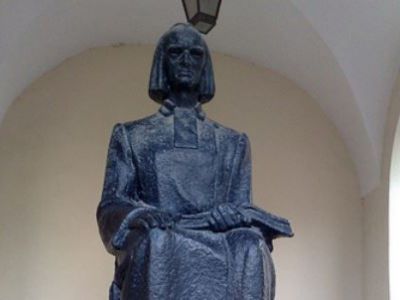
6) Monument to Kristijonas Donelaitis
The Monument to Kristijonas Donelaitis in Vilnius is a tribute to one of Lithuania's most renowned poets. Situated in the Vilnius University ensemble, the sculpture was erected to commemorate the 250th anniversary of the poet's birth. The monument is made of glass plastic and was designed by the sculptor Konstantinas Bogdanas. It depicts the poet sitting in a dignified pose with an open book on his lap.
The monument's pedestal bears the poet's name, as well as the dates of his birth and death, and the year the monument was erected. Donelaitis (01/01/1714 – 18/02/1780) is widely recognized outside of Lithuania, with his work receiving international acclaim. His poem, Metai (The Year), has been translated into multiple foreign languages and was added to UNESCO's Library of European Literary Masterpieces in 1977, alongside the epic works of Homer and Virgil.
The Monument to Kristijonas Donelaitis is a fitting tribute to the poet's legacy, recognizing his literary contributions to Lithuania and the world. His work remains relevant today and is still awaiting new research and interpretation. As such, the monument serves as a reminder of the importance of literature and the impact it can have on a culture and a society.
The monument's pedestal bears the poet's name, as well as the dates of his birth and death, and the year the monument was erected. Donelaitis (01/01/1714 – 18/02/1780) is widely recognized outside of Lithuania, with his work receiving international acclaim. His poem, Metai (The Year), has been translated into multiple foreign languages and was added to UNESCO's Library of European Literary Masterpieces in 1977, alongside the epic works of Homer and Virgil.
The Monument to Kristijonas Donelaitis is a fitting tribute to the poet's legacy, recognizing his literary contributions to Lithuania and the world. His work remains relevant today and is still awaiting new research and interpretation. As such, the monument serves as a reminder of the importance of literature and the impact it can have on a culture and a society.
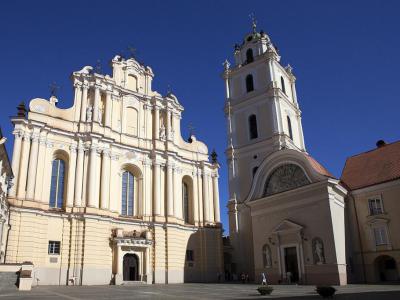
7) Sts. Johns' Church
The Church of Saint Johns, Saint John the Baptist and Saint John the Apostle and Evangelist is a historical landmark located in the Old Town of Vilnius. The church has been an important religious and cultural center since its establishment in 1388-1426. The Jesuit Academy professors and students used to pray in the church, and Vilnius theologians gave sermons. It was also a place for performances and disputes, where theses were defended and kings greeted.
The church has undergone many changes and renovations throughout history. The tower, separate from the church, was built in the 16th century. After a fire in 1737, the church was reconstructed by architect Johann Christoph Glaubitz in the late Baroque style. However, during the reconstruction of 1827-28, architect Karol Podczaszynski destroyed much of the sumptuous Baroque interior, including nearly 3000 carts of altars, sculptures, and stucco works. Despite the destruction, the church still retains its original Gothic layout, with a 28-by-69-metre (92 ft × 226 ft) hall church with three naves and seven asymmetrical chapels.
The central focus of the church interior is a unique composition of 10 presbytery altars positioned in a semi-circle on varying planes and levels. The Gothic presbytery windows allow light to illuminate the altars, which are abundantly decorated with paintings and sculptures. The church also contains 18 sculptures, 12 of which represent various saints bearing the name of John, located in the central nave at the pillars. All frescoes in the church date from the 18th century and were restored in the 1970s. The church contains many memorial monuments, including those to Konstantinas Sirvydas, Adam Mickiewicz, and Simonas Daukantas.
In addition to its religious and cultural significance, the Church of Saint Johns played a role in Lithuania's political history. During Hitler's occupation, Reverend Alfonsas Lipniūnas delivered rebellious sermons in the church, for which he was later imprisoned by the Nazis in the Stutthof camp and perished. In 1991, the church was returned to its parishioners, and in 1993, Pope John Paul II held a meeting with intellectuals here.
The church has undergone many changes and renovations throughout history. The tower, separate from the church, was built in the 16th century. After a fire in 1737, the church was reconstructed by architect Johann Christoph Glaubitz in the late Baroque style. However, during the reconstruction of 1827-28, architect Karol Podczaszynski destroyed much of the sumptuous Baroque interior, including nearly 3000 carts of altars, sculptures, and stucco works. Despite the destruction, the church still retains its original Gothic layout, with a 28-by-69-metre (92 ft × 226 ft) hall church with three naves and seven asymmetrical chapels.
The central focus of the church interior is a unique composition of 10 presbytery altars positioned in a semi-circle on varying planes and levels. The Gothic presbytery windows allow light to illuminate the altars, which are abundantly decorated with paintings and sculptures. The church also contains 18 sculptures, 12 of which represent various saints bearing the name of John, located in the central nave at the pillars. All frescoes in the church date from the 18th century and were restored in the 1970s. The church contains many memorial monuments, including those to Konstantinas Sirvydas, Adam Mickiewicz, and Simonas Daukantas.
In addition to its religious and cultural significance, the Church of Saint Johns played a role in Lithuania's political history. During Hitler's occupation, Reverend Alfonsas Lipniūnas delivered rebellious sermons in the church, for which he was later imprisoned by the Nazis in the Stutthof camp and perished. In 1991, the church was returned to its parishioners, and in 1993, Pope John Paul II held a meeting with intellectuals here.
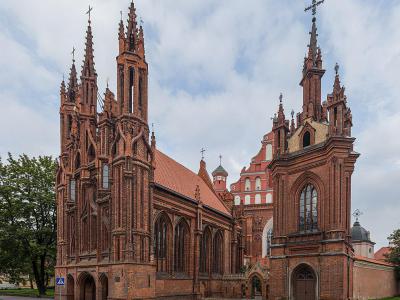
8) St. Anne's Church (must see)
St. Anne’s Church is a well-known landmark in Vilnius, located on the left bank of the Vilnia River. This Roman Catholic church is admired for its impressive Flamboyant and Brick Gothic architecture and is one of the important monuments that contributed to Vilnius Old Town being included on the UNESCO World Heritage List.
The site’s first church, a wooden structure, was built in 1394 for German Catholics and other foreign visitors. While a legend connects it to Anna, Grand Duchess of Lithuania, who was a known benefactor, historical evidence suggests the church was not originally built specifically for her. After the wooden church was destroyed by fire in 1419, King of Poland and Grand Duke of Lithuania Alexander I Jagiellon commissioned the construction of the current brick church between 1495 and 1500. Its exterior has remained virtually unchanged since that time.
According to local legend, Emperor Napoleon was so captivated by the church during his 1812 campaign that he wished he could carry it back to Paris “in the palm of his hand.” The story has become part of Vilnius’ folklore, reflecting the deep admiration this elegant structure continues to inspire.
The church’s facade is a masterpiece of balance and rhythm, combining pointed Gothic arches with rectangular frames and vertical lines that create a sense of graceful movement. Built from 33 different types of clay bricks, the red-brick surface shimmers beautifully in the sunlight. Inside, the simpler Baroque interior, redesigned in 1749, contrasts with the richly detailed exterior, offering a calm and contemplative space for worship.
A neo-Gothic bell tower, added in the 1870s, complements the church’s architecture and completes this harmonious ensemble. Today, St. Anne’s Church remains one of the finest symbols of Vilnius-an enduring blend of legend, artistry, and faith that continues to enchant visitors, just as it once captivated Napoleon himself.
The site’s first church, a wooden structure, was built in 1394 for German Catholics and other foreign visitors. While a legend connects it to Anna, Grand Duchess of Lithuania, who was a known benefactor, historical evidence suggests the church was not originally built specifically for her. After the wooden church was destroyed by fire in 1419, King of Poland and Grand Duke of Lithuania Alexander I Jagiellon commissioned the construction of the current brick church between 1495 and 1500. Its exterior has remained virtually unchanged since that time.
According to local legend, Emperor Napoleon was so captivated by the church during his 1812 campaign that he wished he could carry it back to Paris “in the palm of his hand.” The story has become part of Vilnius’ folklore, reflecting the deep admiration this elegant structure continues to inspire.
The church’s facade is a masterpiece of balance and rhythm, combining pointed Gothic arches with rectangular frames and vertical lines that create a sense of graceful movement. Built from 33 different types of clay bricks, the red-brick surface shimmers beautifully in the sunlight. Inside, the simpler Baroque interior, redesigned in 1749, contrasts with the richly detailed exterior, offering a calm and contemplative space for worship.
A neo-Gothic bell tower, added in the 1870s, complements the church’s architecture and completes this harmonious ensemble. Today, St. Anne’s Church remains one of the finest symbols of Vilnius-an enduring blend of legend, artistry, and faith that continues to enchant visitors, just as it once captivated Napoleon himself.
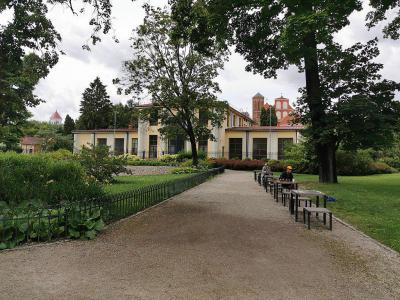
9) Bernardinai Garden
The Bernardine Garden in Vilnius is a beautiful public park located on the right bank of the Vilnia River. Covering over 9 hectares, it offers a diverse range of recreational opportunities for visitors. The park's territory is divided into three main sections: the botanic exposition, the monastery exposition, and other recreational territories.
The botanic exposition is the perfect place for those who love plants. It features various plants sorted by groups and classes. In the centre of this exposition is a small pool containing sacred water plants. The monastery exposition is dedicated to medicinal herbs, potherbs, and edible and tea plants. It also features a small fountain in the centre and a pergola covered in climbing plants.
The rest of the park offers a range of recreational activities for visitors of all ages. There are two fountains in the park, with the main one located in the centre of the Bernardine garden. During weekends in the warm period of the year, the fountain works all day. On workdays, it operates only from 9 pm to 10 pm as a light and music show. There is also a rockery, a carousel, a playing ground for children, a giant chessboard, and checkers and chess tables. In addition, during the warm period of the year, visitors can enjoy different expositions of sculptures.
Bernardine Garden was created in 1469 after the Lithuanian pagan saint oaks wood was cut down when Christianity was introduced. The Bernardine monks rearranged the territory and organized various events. However, in 1864 the Russian tsarist government closed the Bernardine garden. It was recovered by the townspeople about twenty years later and reconstructed according to the A. V. Strauss and Jakub Jasiński project. During World War II, the garden was destroyed, but it was reconstructed for the second time under Soviet rule and renamed Jaunimo sodas ("The Youth Garden"). In 2013, it was reconstructed for the third time, and it is now one of the most attractive public parks in the Vilnius Old Town.
The Bernardine Garden in Vilnius is a must-visit destination for those who love nature, history, and recreational activities. Its diverse range of attractions offers something for everyone, and its rich history adds to its charm.
The botanic exposition is the perfect place for those who love plants. It features various plants sorted by groups and classes. In the centre of this exposition is a small pool containing sacred water plants. The monastery exposition is dedicated to medicinal herbs, potherbs, and edible and tea plants. It also features a small fountain in the centre and a pergola covered in climbing plants.
The rest of the park offers a range of recreational activities for visitors of all ages. There are two fountains in the park, with the main one located in the centre of the Bernardine garden. During weekends in the warm period of the year, the fountain works all day. On workdays, it operates only from 9 pm to 10 pm as a light and music show. There is also a rockery, a carousel, a playing ground for children, a giant chessboard, and checkers and chess tables. In addition, during the warm period of the year, visitors can enjoy different expositions of sculptures.
Bernardine Garden was created in 1469 after the Lithuanian pagan saint oaks wood was cut down when Christianity was introduced. The Bernardine monks rearranged the territory and organized various events. However, in 1864 the Russian tsarist government closed the Bernardine garden. It was recovered by the townspeople about twenty years later and reconstructed according to the A. V. Strauss and Jakub Jasiński project. During World War II, the garden was destroyed, but it was reconstructed for the second time under Soviet rule and renamed Jaunimo sodas ("The Youth Garden"). In 2013, it was reconstructed for the third time, and it is now one of the most attractive public parks in the Vilnius Old Town.
The Bernardine Garden in Vilnius is a must-visit destination for those who love nature, history, and recreational activities. Its diverse range of attractions offers something for everyone, and its rich history adds to its charm.
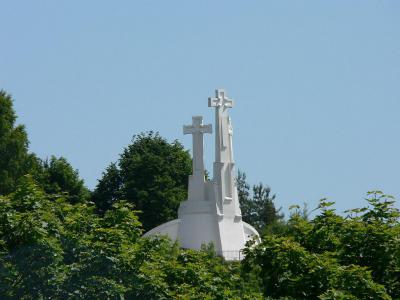
10) Hill of Three Crosses (must see)
The Hill of Three Crosses is a monument in Vilnius, created by the Polish architect Antoni Wiwulski in 1916. Three white crosses located near Gediminas Tower on a bank of Vilna river represent Lithuanians' gloom and hope. The monument stands in the place, where the three wooden crosses used to stand at least since 1636. The wooden crosses collapsed in 1869 and tsarist authorities did not allow for them to be rebuilt.
The new monument by Antoni Wiwulski was covertly erected in 1916. It was blown up under the order of the Soviet Government on 30 May 1950. Eventually the crosses were restored and consecrated on 14 June 1989. The origins of the monument are explained in a fictitious legend, written in the Bychowiec Chronicle among others, according to which seven monks, who were invited to Vilnius, were tortured to death. A chapel was erected on the spot where they died and the crosses were added later on.
The new monument by Antoni Wiwulski was covertly erected in 1916. It was blown up under the order of the Soviet Government on 30 May 1950. Eventually the crosses were restored and consecrated on 14 June 1989. The origins of the monument are explained in a fictitious legend, written in the Bychowiec Chronicle among others, according to which seven monks, who were invited to Vilnius, were tortured to death. A chapel was erected on the spot where they died and the crosses were added later on.
Sight description based on Wikipedia.
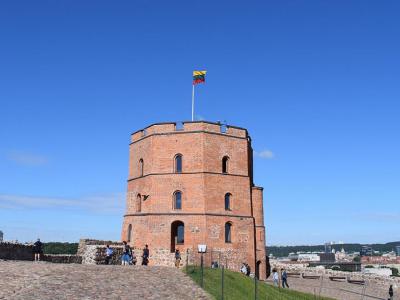
11) Gediminas Tower (must see)
Gediminas Tower is one of Vilnius’ most iconic landmarks, visible from many points across the city. The tower appears on old Lithuanian currency and is celebrated in folk songs and poems. It stands on the site of the Upper Castle, a fortress that originally existed as a wooden structure in the 14th century. According to legend, Grand Duke Gediminas dreamed of an iron wolf howling atop the hill, interpreted as a sign that a great city would rise there-Vilnius.
The first brick castle was completed in 1409 by Gediminas’ grandson, Grand Duke Vytautas the Great. Today, Gediminas Tower is the only visible remnant of the original castle, though archaeological remains of the fortifications can still be found on the hill. The tower served multiple purposes over the centuries, including housing Vilnius’ first telegraph station in 1838.
The top floors of the tower had been dismantled during the 19th century under Russian rule, and the current three-story tower was rebuilt in the 20th century, with Polish architect Jan Borowski overseeing restoration work during the interwar period.
Gediminas Tower is now part of the National Museum of Lithuania. The museum showcases Vilnius’ rich history, the heritage of the Grand Duchy of Lithuania, and archaeological discoveries from the Upper Castle site. Exhibits highlight the 1863–1864 uprising, military artifacts, and Baltic jewelry. Visitors can also learn about the Baltic Way, a peaceful 1989 demonstration when two million people joined hands across the Baltic states to protest Soviet rule.
Climbing to the tower’s observation platform offers panoramic views of Vilnius, with the Old Town, Neris River, and Gediminas Hill stretching in every direction.
The first brick castle was completed in 1409 by Gediminas’ grandson, Grand Duke Vytautas the Great. Today, Gediminas Tower is the only visible remnant of the original castle, though archaeological remains of the fortifications can still be found on the hill. The tower served multiple purposes over the centuries, including housing Vilnius’ first telegraph station in 1838.
The top floors of the tower had been dismantled during the 19th century under Russian rule, and the current three-story tower was rebuilt in the 20th century, with Polish architect Jan Borowski overseeing restoration work during the interwar period.
Gediminas Tower is now part of the National Museum of Lithuania. The museum showcases Vilnius’ rich history, the heritage of the Grand Duchy of Lithuania, and archaeological discoveries from the Upper Castle site. Exhibits highlight the 1863–1864 uprising, military artifacts, and Baltic jewelry. Visitors can also learn about the Baltic Way, a peaceful 1989 demonstration when two million people joined hands across the Baltic states to protest Soviet rule.
Climbing to the tower’s observation platform offers panoramic views of Vilnius, with the Old Town, Neris River, and Gediminas Hill stretching in every direction.
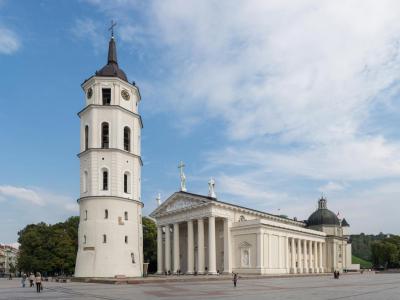
12) Vilnius Cathedral (must see)
The Vilnius Cathedral is the heart of Catholic spiritual life in Lithuania. The first cathedral was built in 1251 after King Mindaugas converted to Christianity, on a site that had previously been used for pagan worship. Archaeological remains of that earlier structure can still be found beneath the current building, offering a glimpse into the city’s layered history.
After Lithuania’s official conversion to Christianity in 1387, a Gothic cathedral was commissioned, which burned down in 1419. Grand Duke Vytautas oversaw the construction of a new cathedral in 1429, intended for his coronation, although the ceremony never took place. Later additions included a bell tower in 1522 and multiple chapels and crypts between 1534 and 1557, reflecting the growing importance of the cathedral in the city’s religious and civic life.
The Chapel of Saint Casimir, added in 1636, features Baroque decoration with frescoes by Michelangelo Palloni and an altar and stuccowork by Pietro Perti. Statues within the chapel represent key political figures connected to the Jagiellonian dynasty, offering insight into the cathedral’s historical and cultural significance.
After the southern tower collapsed in 1769, the cathedral was rebuilt in its current Neoclassical style, with sculpted saints adorning the façade and roof. The nearby bell tower houses an exhibition on the cathedral’s history and provides panoramic views of Vilnius’s Old Town.
In 1993, Pope John Paul II began his visit to Lithuania at the cathedral, underscoring its enduring role in the nation’s history.
After Lithuania’s official conversion to Christianity in 1387, a Gothic cathedral was commissioned, which burned down in 1419. Grand Duke Vytautas oversaw the construction of a new cathedral in 1429, intended for his coronation, although the ceremony never took place. Later additions included a bell tower in 1522 and multiple chapels and crypts between 1534 and 1557, reflecting the growing importance of the cathedral in the city’s religious and civic life.
The Chapel of Saint Casimir, added in 1636, features Baroque decoration with frescoes by Michelangelo Palloni and an altar and stuccowork by Pietro Perti. Statues within the chapel represent key political figures connected to the Jagiellonian dynasty, offering insight into the cathedral’s historical and cultural significance.
After the southern tower collapsed in 1769, the cathedral was rebuilt in its current Neoclassical style, with sculpted saints adorning the façade and roof. The nearby bell tower houses an exhibition on the cathedral’s history and provides panoramic views of Vilnius’s Old Town.
In 1993, Pope John Paul II began his visit to Lithuania at the cathedral, underscoring its enduring role in the nation’s history.
13) Gediminas Avenue
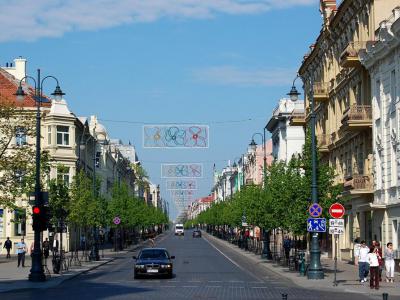
Gediminas Avenue is the main thoroughfare of Vilnius, named after Grand Duke Gediminas, who ruled from 1315 to 1341 and is credited with founding the Lithuanian state and expanding its territory from the Baltic to the Black Sea.
Established in 1836, the street has undergone several name changes over the centuries: St. George Avenue, Mickiewicz Street during Polish rule, Adolf Hitler Street under Nazi occupation, and Stalin and Lenin Avenue during the Soviet era.
The section from Vilnius Cathedral to Vincas Kudirka Square was reconstructed in 2003 to mark the 750th anniversary of King Mindaugas’s coronation. Archaeological findings uncovered during construction have been documented and can be explored in local museums.
Gediminas Avenue hosts many of Lithuania’s governmental institutions, including the parliament and Constitutional Court, as well as cultural landmarks such as the Lithuanian Academy of Music, the Lithuanian National Drama Theatre, and the Martynas Mažvydas National Library. In the evenings and on weekends, motorized traffic is restricted, allowing pedestrians to stroll and enjoy the cityscape.
The avenue offers a vibrant mix of shopping and dining. Visitors can browse boutiques, international brands, and local shops selling fashion, accessories, and Lithuanian crafts. Cafés, bistros, and restaurants serve both traditional Lithuanian dishes and international cuisine. Outdoor terraces provide ideal spots to enjoy a coffee or a meal while observing the lively street life, making Gediminas Avenue a cultural and culinary hub in Vilnius.
Established in 1836, the street has undergone several name changes over the centuries: St. George Avenue, Mickiewicz Street during Polish rule, Adolf Hitler Street under Nazi occupation, and Stalin and Lenin Avenue during the Soviet era.
The section from Vilnius Cathedral to Vincas Kudirka Square was reconstructed in 2003 to mark the 750th anniversary of King Mindaugas’s coronation. Archaeological findings uncovered during construction have been documented and can be explored in local museums.
Gediminas Avenue hosts many of Lithuania’s governmental institutions, including the parliament and Constitutional Court, as well as cultural landmarks such as the Lithuanian Academy of Music, the Lithuanian National Drama Theatre, and the Martynas Mažvydas National Library. In the evenings and on weekends, motorized traffic is restricted, allowing pedestrians to stroll and enjoy the cityscape.
The avenue offers a vibrant mix of shopping and dining. Visitors can browse boutiques, international brands, and local shops selling fashion, accessories, and Lithuanian crafts. Cafés, bistros, and restaurants serve both traditional Lithuanian dishes and international cuisine. Outdoor terraces provide ideal spots to enjoy a coffee or a meal while observing the lively street life, making Gediminas Avenue a cultural and culinary hub in Vilnius.
14) KGB Museum (must see)
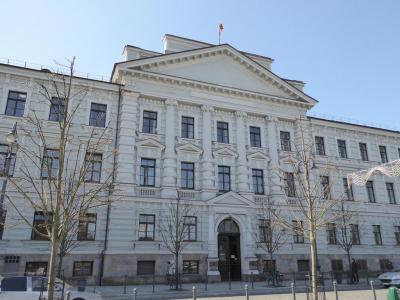
The KGB Museum, also known as the Museum of Occupations and Freedom Fights, is housed in the former headquarters of the Soviet secret police in Vilnius. The building was used by the KGB from 1944 to 1991 for offices, interrogations, and imprisonment. During the early Soviet period, over 1,000 prisoners accused of resisting the occupation were executed here.
The museum’s exhibitions focus on Lithuania’s struggle against Soviet and Nazi oppression. Visitors can explore displays on non-violent resistance, including books, documents, and photographs, as well as the armed efforts of the Forest Brothers, who fought for the country’s independence.
The museum also highlights the victims of arrests, deportations, and executions, providing a sobering insight into the human cost of occupation. In recent years, the museum expanded its exhibits on the Holocaust in Lithuania, commemorating the tragedy in which roughly 95% of the country’s Jewish population was killed.
A visit to the KGB Museum offers a deeply moving perspective on Lithuania’s history, providing both historical context and personal stories that illuminate the courage and resilience of those who lived under occupation.
The museum’s exhibitions focus on Lithuania’s struggle against Soviet and Nazi oppression. Visitors can explore displays on non-violent resistance, including books, documents, and photographs, as well as the armed efforts of the Forest Brothers, who fought for the country’s independence.
The museum also highlights the victims of arrests, deportations, and executions, providing a sobering insight into the human cost of occupation. In recent years, the museum expanded its exhibits on the Holocaust in Lithuania, commemorating the tragedy in which roughly 95% of the country’s Jewish population was killed.
A visit to the KGB Museum offers a deeply moving perspective on Lithuania’s history, providing both historical context and personal stories that illuminate the courage and resilience of those who lived under occupation.
