Custom Walk in Funchal, Portugal by yannick_kocks_7677e created on 2025-04-10
Guide Location: Portugal » Funchal
Guide Type: Custom Walk
# of Sights: 11
Tour Duration: 5 Hour(s)
Travel Distance: 11.6 Km or 7.2 Miles
Share Key: GVPNU
Guide Type: Custom Walk
# of Sights: 11
Tour Duration: 5 Hour(s)
Travel Distance: 11.6 Km or 7.2 Miles
Share Key: GVPNU
How It Works
Please retrieve this walk in the GPSmyCity app. Once done, the app will guide you from one tour stop to the next as if you had a personal tour guide. If you created the walk on this website or come to the page via a link, please follow the instructions below to retrieve the walk in the app.
Retrieve This Walk in App
Step 1. Download the app "GPSmyCity: Walks in 1K+ Cities" on Apple App Store or Google Play Store.



Step 2. In the GPSmyCity app, download(or launch) the guide "Funchal Map and Walking Tours".
Step 3. Tap the menu button located at upper right corner of the "Walks" screen and select "Retrieve custom walk". Enter the share key: GVPNU

1) Praça do Povo (People's Square)
The bay area of Funchal boasts the People's Square (Praça do Povo), a remarkable gateway to Madeira and a significant attraction for the island. This leisure zone, which opened in 2014, offers breathtaking views of the Atlantic on one side and the city of Funchal on the other, stretching up to the mountains.
People's Square is an expansive and delightful recreational area, ideal for walking, jogging, cycling, rollerblading, or just unwinding. Visitors can find benches scattered throughout the area, providing a tranquil spot to appreciate the stunning scenery.
The hiking trail that passes through the center of Funchal and across People's Square is adorned with lush green carpets of plants and flowers, further enhancing the beauty of the surroundings. Due to its central location and ample space, People's Square is a remarkable venue for cultural events such as concerts, exhibitions, shows, and fairs, especially during the summer.
To the north of the square, several notable buildings stand, including the Legislative Assembly of Madeira, the National Republican Guard, the Captaincy of the Port of Funchal, and the Funchal Customs (Alfândega do Funchal).
People's Square is an expansive and delightful recreational area, ideal for walking, jogging, cycling, rollerblading, or just unwinding. Visitors can find benches scattered throughout the area, providing a tranquil spot to appreciate the stunning scenery.
The hiking trail that passes through the center of Funchal and across People's Square is adorned with lush green carpets of plants and flowers, further enhancing the beauty of the surroundings. Due to its central location and ample space, People's Square is a remarkable venue for cultural events such as concerts, exhibitions, shows, and fairs, especially during the summer.
To the north of the square, several notable buildings stand, including the Legislative Assembly of Madeira, the National Republican Guard, the Captaincy of the Port of Funchal, and the Funchal Customs (Alfândega do Funchal).
2) Avenida Arriaga (Arriaga Avenue)
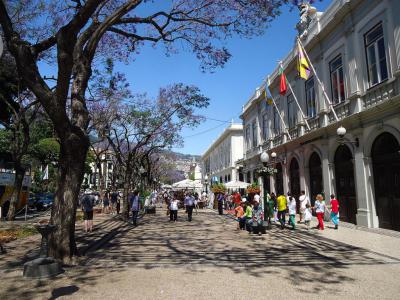
Arriaga Avenue (Avenida Arriaga) is one of the liveliest streets in the city of Funchal. It is a cultural, historical, and commercial hub that is an essential part of daily life in the capital of Madeira and, therefore, well worth a stroll.
The construction of this avenue started in 1914, and it would later become central to life in Funchal. The road begins at Largo Dom Manuel I Square, also known as Largo da Sé, and ends at Rotunda do Infante. The entire length of this pedestrian walkway is paved with the noble Portuguese calçada, a traditional-style pavement used for many pedestrian areas in Portugal, consisting of small flat pieces of stones arranged in a pattern or image, like a mosaic. Arriaga Avenue stands out for being lined with majestic large trees, along with its valuable historical and architectural heritage.
It is the area where visitors can find some of Funchal's most outstanding museums and monuments, such as the statue of João Gonçalves Zarco, one of the island's discoverers, or the Cathedral of Funchal, the archipelago's main religious temple, built in the 15th century.
From emblematic cafés to the Municipal Theatre, traditional shopping areas, or the Municipal Garden, strolling along Arriaga Avenue is an experience not to be missed.
The construction of this avenue started in 1914, and it would later become central to life in Funchal. The road begins at Largo Dom Manuel I Square, also known as Largo da Sé, and ends at Rotunda do Infante. The entire length of this pedestrian walkway is paved with the noble Portuguese calçada, a traditional-style pavement used for many pedestrian areas in Portugal, consisting of small flat pieces of stones arranged in a pattern or image, like a mosaic. Arriaga Avenue stands out for being lined with majestic large trees, along with its valuable historical and architectural heritage.
It is the area where visitors can find some of Funchal's most outstanding museums and monuments, such as the statue of João Gonçalves Zarco, one of the island's discoverers, or the Cathedral of Funchal, the archipelago's main religious temple, built in the 15th century.
From emblematic cafés to the Municipal Theatre, traditional shopping areas, or the Municipal Garden, strolling along Arriaga Avenue is an experience not to be missed.

3) Santa Catarina Park
Santa Catarina Park, situated between Infante Avenue (Avenida do Infante) and Sá Carneiro Avenue (Avenida Sá Carneiro), offers one of the best viewpoints of Funchal Bay, which is a renowned attraction of the Madeira archipelago. Covering an area of 36,000 m², this green park is not only popular due to its central location but also for its impressive features.
Visitors can appreciate the beauty of Funchal Bay from the park's vast lawn, surrounded by flowerbeds containing a diverse range of trees, shrubs, and herbs from around the globe. Moreover, the park includes a small pond, providing a haven for birds to rest and breed.
Established in 1966, the park boasts several landmarks such as statues of Prince Henry the Navigator and Christopher Columbus, a children's play area, and the Chapel of Santa Catarina. However, the real highlight of this attraction is undoubtedly the stunning panoramic view of Funchal Bay extending from Ponta do Garajau.
Visitors can appreciate the beauty of Funchal Bay from the park's vast lawn, surrounded by flowerbeds containing a diverse range of trees, shrubs, and herbs from around the globe. Moreover, the park includes a small pond, providing a haven for birds to rest and breed.
Established in 1966, the park boasts several landmarks such as statues of Prince Henry the Navigator and Christopher Columbus, a children's play area, and the Chapel of Santa Catarina. However, the real highlight of this attraction is undoubtedly the stunning panoramic view of Funchal Bay extending from Ponta do Garajau.
4) Jardim Municipal (Municipal Garden)
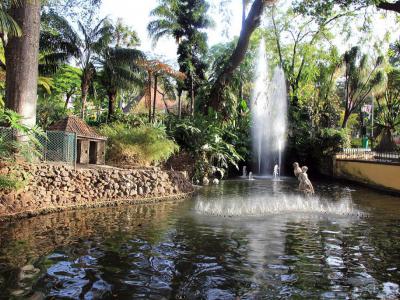
The Funchal Municipal Garden, also known as Dona Amélia Garden, is situated in a prime location, enhancing the beauty of this distinguished area with its lush and vibrant flora. This natural haven in the heart of the city attracts both locals and tourists, providing a serene escape.
Spanning across 8,300 square meters, the garden is located on the north side of Arriaga Avenue (Avenida Arriaga), opposite the Municipal Theatre, on the site where the Convent of São Francisco once stood. The Coat of Arms of the convent can still be admired on one of the lawns.
The garden boasts a vast collection of botanical species, including plants indigenous to Madeira and other regions of the world, making it a fascinating destination for nature enthusiasts. Visitors can explore a variety of captivating species during their visit.
Established in 1880, the Funchal Municipal Garden offers ample space for relaxation and entertainment. Its leisure area features shaded trees, a lake, and a stream inhabited by fish, ducks, and swans. The garden also houses an amphitheater, hosting numerous cultural events, and an esplanade.
Spanning across 8,300 square meters, the garden is located on the north side of Arriaga Avenue (Avenida Arriaga), opposite the Municipal Theatre, on the site where the Convent of São Francisco once stood. The Coat of Arms of the convent can still be admired on one of the lawns.
The garden boasts a vast collection of botanical species, including plants indigenous to Madeira and other regions of the world, making it a fascinating destination for nature enthusiasts. Visitors can explore a variety of captivating species during their visit.
Established in 1880, the Funchal Municipal Garden offers ample space for relaxation and entertainment. Its leisure area features shaded trees, a lake, and a stream inhabited by fish, ducks, and swans. The garden also houses an amphitheater, hosting numerous cultural events, and an esplanade.
5) Arcadas de São Francisco (San Francisco Arcades)
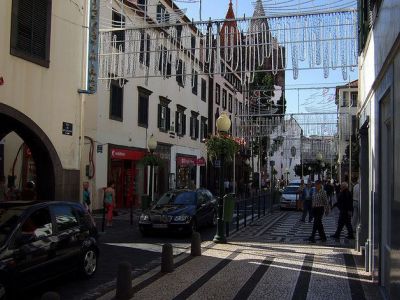
San Francisco Arcades (Arcadas São Francisco), situated near the Vicentes Photography Museum and Municipal Garden of Funchal, is more than just a shopping center. This space boasts ancient architecture perfectly blended with the city center. With a variety of shops, cafes, and restaurants, visitors can find everything they need in this large area.
Inaugurated in 1995, San Francisco Arcades were built in a space that dates back to 1811, following public policies that aimed to value the city's historical testimonies. This commercial area is part of a building that was adjacent to the former convent of San Francisco. Acquired by Charles Ridpath Blandy in 1840, the building was later transformed into a wine cellar. Take the opportunity to visit the São Francisco Cellars "The Old Blandy Wine Lodges" and learn more about the history of Madeira Wine, as well as taste and purchase some copies.
The San Francisco Arcades, a set of historical heritage in the place, are covered walkways in the form of arches, housing commercial and cultural points, art galleries, and antique shops. They were part of the unfinished church of São Francisco.
Inaugurated in 1995, San Francisco Arcades were built in a space that dates back to 1811, following public policies that aimed to value the city's historical testimonies. This commercial area is part of a building that was adjacent to the former convent of San Francisco. Acquired by Charles Ridpath Blandy in 1840, the building was later transformed into a wine cellar. Take the opportunity to visit the São Francisco Cellars "The Old Blandy Wine Lodges" and learn more about the history of Madeira Wine, as well as taste and purchase some copies.
The San Francisco Arcades, a set of historical heritage in the place, are covered walkways in the form of arches, housing commercial and cultural points, art galleries, and antique shops. They were part of the unfinished church of São Francisco.
6) Câmara Municipal (City Hall)
The first Funchal town hall was built in 1486 on Duque Square. The town council moved several times afterward, finally settling in Cathedral Square in 1802. Still dissatisfied with the facilities, the council eventually purchased the Carvalhal Esmeraldo Palace in 1883, adjoining the present-day Municipal Square.
Francisco António Camara Leme built his home, the Carvalhal Esmeraldo Palace in 1758. Although the original structure dates from the mid-18th century, it was later remodeled by the renowned Portuguese architects Raul Lino and Carlos Ramos during intensive restoration works around 1940. Construction materials included masonry, stone, wood, cast iron, and decorative tiles.
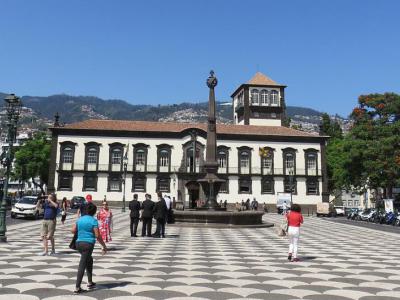
As you approach the City Hall, pay attention to the impressive entrance doorway carved in gray stone. On the second floor, the reception area is lined with eleven windows, each with its own small balcony. The ground-floor windows retain 17th-century wrought-iron security gratings. From the entrance, an extravagant interior staircase leads to the central courtyard. Here visitors encounter the sculpture “Leda and the Swan”, created by Madeiran sculptor Germano José Salles. The sculpture depicts the myth in which Zeus, disguised as a swan, approaches Leda—an ancient legend long admired for its symbolism and dramatic narrative.
Francisco António Camara Leme built his home, the Carvalhal Esmeraldo Palace in 1758. Although the original structure dates from the mid-18th century, it was later remodeled by the renowned Portuguese architects Raul Lino and Carlos Ramos during intensive restoration works around 1940. Construction materials included masonry, stone, wood, cast iron, and decorative tiles.
As you approach the City Hall, pay attention to the impressive entrance doorway carved in gray stone. On the second floor, the reception area is lined with eleven windows, each with its own small balcony. The ground-floor windows retain 17th-century wrought-iron security gratings. From the entrance, an extravagant interior staircase leads to the central courtyard. Here visitors encounter the sculpture “Leda and the Swan”, created by Madeiran sculptor Germano José Salles. The sculpture depicts the myth in which Zeus, disguised as a swan, approaches Leda—an ancient legend long admired for its symbolism and dramatic narrative.
7) Carros de Cesto (Basket Carts Toboggan Downhill)
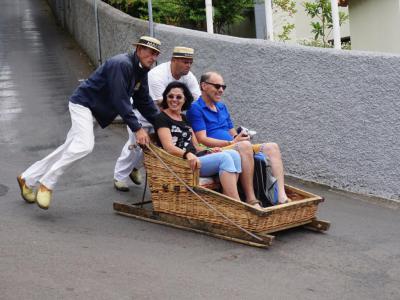
Basket Carts Toboggan Downhill (Carros de Cesto) is a popular tourist attraction in Funchal. The ride takes visitors down a thrilling descent from the village of Monte to the city of Funchal in a traditional basket sled that dates back to the early 19th century.
Originally used as a means of transport by residents to quickly travel between Monte and Funchal, the toboggan ride has become an iconic symbol of Madeira Island and a must-do activity for visitors. The descent covers a distance of approximately 2 kilometers and takes about 10 minutes to complete.
The basket sleds are operated by two runners dressed in white and wearing traditional straw boater hats. The runners control the speed of the sled using their rubber-soled boots as brakes. The ride can reach speeds of up to 30 kilometers per hour, providing a thrilling and unforgettable experience for visitors.
The route from Monte to Livramento is located in a picturesque area and offers spectacular views of the surrounding scenery. Monte is renowned for its lush gardens and stunning views over the city and beyond, making it an ideal spot for visitors to explore before or after their toboggan ride.
Originally used as a means of transport by residents to quickly travel between Monte and Funchal, the toboggan ride has become an iconic symbol of Madeira Island and a must-do activity for visitors. The descent covers a distance of approximately 2 kilometers and takes about 10 minutes to complete.
The basket sleds are operated by two runners dressed in white and wearing traditional straw boater hats. The runners control the speed of the sled using their rubber-soled boots as brakes. The ride can reach speeds of up to 30 kilometers per hour, providing a thrilling and unforgettable experience for visitors.
The route from Monte to Livramento is located in a picturesque area and offers spectacular views of the surrounding scenery. Monte is renowned for its lush gardens and stunning views over the city and beyond, making it an ideal spot for visitors to explore before or after their toboggan ride.
8) Tropical Gardens of Monte Palace (must see)
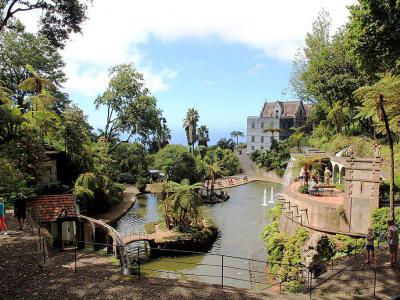
Monte Palace was once the 18th century private residence of the British Consul Charles Murray. Later it was a hotel and then, in the late 1980s, it was purchased by Jose Bernardo, a retired tobacco magnate. Jose had dreams and fantasies of a magical palace in a place of fountains, grottos, follies, sculptures and mysterious exotic plants.
There are two oriental gardens, one Japanese and one Chinese. The theme of these gardens is the role of Portugal in the Age of Discovery of these nations. Bernardo had visited both these countries. The gardens contain stone lanterns and Buddhas, Shinto gates, pagodas and tiles telling the story of the Portuguese impact in Japan.
Recent tiles, 40 in number, are by Argentinian artist Alberto Cedron. They depict Portuguese history from the early monarchies to the 1974 Revolution. Garden flora include South African cycads and native plants of Madeira: Laurel, dragon trees, mahogany, and Pride of Madeira. There are carps in the ponds, black and white swans, and peacocks.
The museum is on three floors. Two floors are devoted to mostly African sculptures. The third floor holds minerals and precious stones from all over the world. The gardens are open every day from 9:30 am to 6 pm. The Monte Palace can be reached via the exciting Teleferico cable car, which stops in front of the entrance.
There are two oriental gardens, one Japanese and one Chinese. The theme of these gardens is the role of Portugal in the Age of Discovery of these nations. Bernardo had visited both these countries. The gardens contain stone lanterns and Buddhas, Shinto gates, pagodas and tiles telling the story of the Portuguese impact in Japan.
Recent tiles, 40 in number, are by Argentinian artist Alberto Cedron. They depict Portuguese history from the early monarchies to the 1974 Revolution. Garden flora include South African cycads and native plants of Madeira: Laurel, dragon trees, mahogany, and Pride of Madeira. There are carps in the ponds, black and white swans, and peacocks.
The museum is on three floors. Two floors are devoted to mostly African sculptures. The third floor holds minerals and precious stones from all over the world. The gardens are open every day from 9:30 am to 6 pm. The Monte Palace can be reached via the exciting Teleferico cable car, which stops in front of the entrance.

9) Botanical Garden (must see)
Located in the center of Funchal, Botanical Garden is a place that comprises luscious plants as orchids, magnolias, lilies, cactus, azaleas and exotic birds including canaries, talking parrots and others. It represents a combination of harmonious shapes, contrasting colours and beautiful landscapes of the Funchal Bay and the surrounding mountains.
10) Mercado dos Lavradores (The Workers Market) (must see)
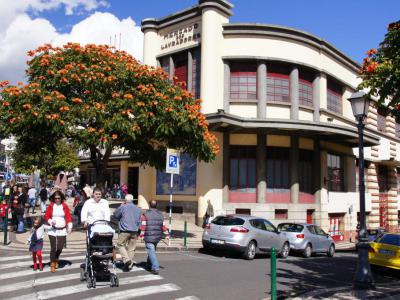
At the far end of Fernão Ornelas Street stands the Workers’ Market of Funchal, created in the late 1930s as part of a citywide modernization plan aimed at organizing food commerce and improving sanitary conditions. Designed by architect Edmundo Tavares and opened in 1940, the building reflects the Estado Novo political regime’s preference for strong geometric forms and practical public architecture. Its facade is lined with blue-and-white azulejo panels, illustrating scenes of Madeiran life and celebrating the island’s agricultural and fishing traditions.
As soon as you enter through the main Art Deco doorway, the flower hall is immediately on your left. This is where you’ll see rows of flower vendors, along with stalls selling seeds and bulbs—some in operation for more than fifty years. To continue into the market, walk straight ahead from the entrance and you will step into the central patio, where fruit and vegetable stands fill the open space. Small cafes, wine shops, and souvenir stalls line the perimeter on your right-hand side.
From the central patio, head straight across to the far end of the square. The Fish Hall is through the large doorway directly opposite the entrance. As you walk in, fishmongers line both the left and right sides, with long marble counters displaying black scabbardfish, tuna, octopus, and other local catches. The walls around you are decorated with tile illustrations of regional sea life.
To reach the upper level, turn right as you exit the Fish Hall and you’ll find the staircase leading to the second floor. Once upstairs, vendors selling exotic fruits, dried berries, spices, teas, and cork goods stretch out to your left and right along the balcony walkway. Keep walking to the far corner and you’ll reach the terrace, where two large cafes overlook the market. From here, you can look down into the central patio and even catch views of the surrounding rooftops.
The market neighborhood is always busy, but nothing compares to the night before Christmas Eve. This is when Market Night transforms the Workers’ Market into one of Funchal’s biggest street celebrations. Stalls spill into the streets, live music fills the air, people sing carols, and food and drink flow freely. It is one of Madeira’s most beloved traditions and a festive way to experience the island’s community spirit.
As soon as you enter through the main Art Deco doorway, the flower hall is immediately on your left. This is where you’ll see rows of flower vendors, along with stalls selling seeds and bulbs—some in operation for more than fifty years. To continue into the market, walk straight ahead from the entrance and you will step into the central patio, where fruit and vegetable stands fill the open space. Small cafes, wine shops, and souvenir stalls line the perimeter on your right-hand side.
From the central patio, head straight across to the far end of the square. The Fish Hall is through the large doorway directly opposite the entrance. As you walk in, fishmongers line both the left and right sides, with long marble counters displaying black scabbardfish, tuna, octopus, and other local catches. The walls around you are decorated with tile illustrations of regional sea life.
To reach the upper level, turn right as you exit the Fish Hall and you’ll find the staircase leading to the second floor. Once upstairs, vendors selling exotic fruits, dried berries, spices, teas, and cork goods stretch out to your left and right along the balcony walkway. Keep walking to the far corner and you’ll reach the terrace, where two large cafes overlook the market. From here, you can look down into the central patio and even catch views of the surrounding rooftops.
The market neighborhood is always busy, but nothing compares to the night before Christmas Eve. This is when Market Night transforms the Workers’ Market into one of Funchal’s biggest street celebrations. Stalls spill into the streets, live music fills the air, people sing carols, and food and drink flow freely. It is one of Madeira’s most beloved traditions and a festive way to experience the island’s community spirit.
11) Teleférico Funchal-Monte (Funchal-Monte Cable Car) (must see)
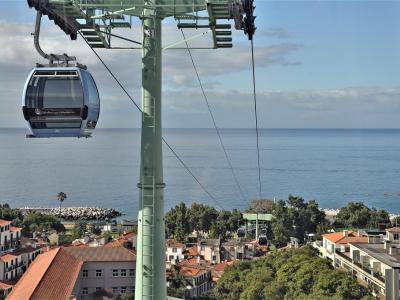
The Funchal–Monte Cable Car offers one of Madeira’s most memorable experiences, gliding from the edge of Funchal’s old town up to the hillside village of Monte. Inaugurated in 2000, this modern gondola lift travels along a 3,200-meter cable line with a vertical rise of around 560 meters. The ride takes about fifteen minutes each way, carrying up to six passengers per cabin. The views unfold dramatically—the harbor, the city’s red rooftops, and the blue Atlantic opening out beneath you.
The cabins are comfortable and fitted with large, clear windows that offer panoramas over gardens, ravines, homes, and terraced hillsides. The ascent feels smooth rather than frightening, making it appealing even to those unsure about heights. Midway along the route, the landscape becomes greener and more rural until the line reaches its upper station, positioned between Babosas Village and the Mount Garden.
Stepping out at the top, visitors find themselves in Monte, a quieter, cooler village first established in 1565 as the parish of Our Lady of the Mount. Its leafy gardens, narrow lanes, small cafes, and scenic viewpoints offer a gentler pace compared to downtown Funchal. From here, travelers can explore nearby gardens, enjoy refreshments in Babosas Village or continue their visit to the Church of Our Lady of the Monte.
When it is time to return, there are two options. One is simply to board the cable car for a glide back down to the city. The other is the island’s famous traditional wicker-basket toboggan ride: a hand-guided descent on wooden runners, steered by two drivers who expertly guide passengers down the winding streets toward Funchal. Safe, lively, and entirely unique to Madeira, it provides a playful contrast to the calm, scenic ascent by cable car.
The cabins are comfortable and fitted with large, clear windows that offer panoramas over gardens, ravines, homes, and terraced hillsides. The ascent feels smooth rather than frightening, making it appealing even to those unsure about heights. Midway along the route, the landscape becomes greener and more rural until the line reaches its upper station, positioned between Babosas Village and the Mount Garden.
Stepping out at the top, visitors find themselves in Monte, a quieter, cooler village first established in 1565 as the parish of Our Lady of the Mount. Its leafy gardens, narrow lanes, small cafes, and scenic viewpoints offer a gentler pace compared to downtown Funchal. From here, travelers can explore nearby gardens, enjoy refreshments in Babosas Village or continue their visit to the Church of Our Lady of the Monte.
When it is time to return, there are two options. One is simply to board the cable car for a glide back down to the city. The other is the island’s famous traditional wicker-basket toboggan ride: a hand-guided descent on wooden runners, steered by two drivers who expertly guide passengers down the winding streets toward Funchal. Safe, lively, and entirely unique to Madeira, it provides a playful contrast to the calm, scenic ascent by cable car.
