Custom Walk in Pisa, Italy by angelica_deguzman09_aaf99 created on 2025-05-05
Guide Location: Italy » Pisa
Guide Type: Custom Walk
# of Sights: 6
Tour Duration: 1 Hour(s)
Travel Distance: 2.5 Km or 1.6 Miles
Share Key: CNWCR
Guide Type: Custom Walk
# of Sights: 6
Tour Duration: 1 Hour(s)
Travel Distance: 2.5 Km or 1.6 Miles
Share Key: CNWCR
How It Works
Please retrieve this walk in the GPSmyCity app. Once done, the app will guide you from one tour stop to the next as if you had a personal tour guide. If you created the walk on this website or come to the page via a link, please follow the instructions below to retrieve the walk in the app.
Retrieve This Walk in App
Step 1. Download the app "GPSmyCity: Walks in 1K+ Cities" on Apple App Store or Google Play Store.



Step 2. In the GPSmyCity app, download(or launch) the guide "Pisa Map and Walking Tours".
Step 3. Tap the menu button located at upper right corner of the "Walks" screen and select "Retrieve custom walk". Enter the share key: CNWCR
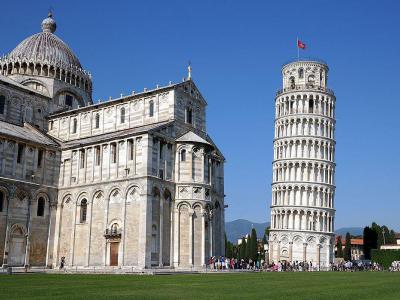
1) The Leaning Tower (must see)
The Leaning Tower of Pisa is the most famous freestanding bell tower in the world. It was built between 1173 and 1372 as a companion to the Pisa Cathedral.
The ground floor features a blind arcade with Corinthian columns. The second floor was added in 1178, and the tower began to sink in the soft, sandy soil. Construction was then halted for almost a century as the Republic of Pisa engaged in battles with their neighbors.
Construction restarted in 1272, and the upper floors were built with one side taller than the other to compensate for the already leaning tower. Finally, in 1319, the seventh floor was completed, and the bell tower was added in 1372.
Between 1589 and 1592, Galileo Galilei (then professor of mathematics at the University of Pisa) dropped two spheres of different masses from the Leaning Tower of Pisa to demonstrate that their time of descent was independent of their mass. Galileo discovered through this experiment that the objects fell with the same acceleration, proving his prediction true, while at the same time disproving Aristotle's theory of gravity which states that objects fall at speed proportional to their mass.
The tower has impressively survived at least four major earthquakes. The combination of the height of the tower and the soft soil helped it resist earthquake damage.
In more recent years, efforts have been made to stabilize the tower, stop it from toppling over, and keep this historic building intact as a Pisa landmark. The tower was closed from 1990-2001 to effect this stabilization. At that time, the tower was leaning at a 5.5-degree angle (4.5 meters or 15 feet).
In 1990, the bells were removed to take away some of the weight of the building. Cables were added to the third level and anchored hundreds of meters away. Counterweights were added in 1993 to keep the tower from toppling over. Engineers worked to reduce the tilt by shifting soil from underneath the tower. The tilt was reduced by 45 centimeters and matched the 1838 tilt level.
The structural interventions were so successful that the tower has been stable, and no additional leaning has occurred.
The Leaning Tower now leans by 3.97 degrees, or 3.9 meters (12 feet 10 inches). The original height of the tower was 60 meters. Today it is 56.67 meters on the high side and 55.86 meters on the low side.
Why You Should Visit:
No visit to Pisa is complete without seeing this iconic landmark in person. Don't forget your camera for cheesy "holding up the tower" photos and the view from the top.
Tips:
Visitors can climb the 251 steps and enjoy the fantastic views from the top. Children under eight are not permitted to climb. It's advisable to buy tickets in advance to this busy and popular attraction.
The ground floor features a blind arcade with Corinthian columns. The second floor was added in 1178, and the tower began to sink in the soft, sandy soil. Construction was then halted for almost a century as the Republic of Pisa engaged in battles with their neighbors.
Construction restarted in 1272, and the upper floors were built with one side taller than the other to compensate for the already leaning tower. Finally, in 1319, the seventh floor was completed, and the bell tower was added in 1372.
Between 1589 and 1592, Galileo Galilei (then professor of mathematics at the University of Pisa) dropped two spheres of different masses from the Leaning Tower of Pisa to demonstrate that their time of descent was independent of their mass. Galileo discovered through this experiment that the objects fell with the same acceleration, proving his prediction true, while at the same time disproving Aristotle's theory of gravity which states that objects fall at speed proportional to their mass.
The tower has impressively survived at least four major earthquakes. The combination of the height of the tower and the soft soil helped it resist earthquake damage.
In more recent years, efforts have been made to stabilize the tower, stop it from toppling over, and keep this historic building intact as a Pisa landmark. The tower was closed from 1990-2001 to effect this stabilization. At that time, the tower was leaning at a 5.5-degree angle (4.5 meters or 15 feet).
In 1990, the bells were removed to take away some of the weight of the building. Cables were added to the third level and anchored hundreds of meters away. Counterweights were added in 1993 to keep the tower from toppling over. Engineers worked to reduce the tilt by shifting soil from underneath the tower. The tilt was reduced by 45 centimeters and matched the 1838 tilt level.
The structural interventions were so successful that the tower has been stable, and no additional leaning has occurred.
The Leaning Tower now leans by 3.97 degrees, or 3.9 meters (12 feet 10 inches). The original height of the tower was 60 meters. Today it is 56.67 meters on the high side and 55.86 meters on the low side.
Why You Should Visit:
No visit to Pisa is complete without seeing this iconic landmark in person. Don't forget your camera for cheesy "holding up the tower" photos and the view from the top.
Tips:
Visitors can climb the 251 steps and enjoy the fantastic views from the top. Children under eight are not permitted to climb. It's advisable to buy tickets in advance to this busy and popular attraction.
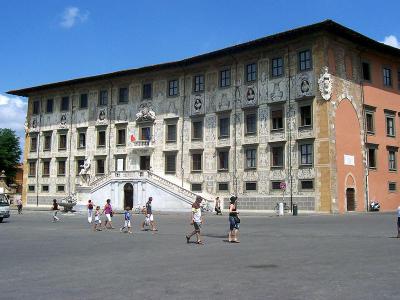
2) University of Pisa
The University of Pisa was founded in 1343 by a Papal edict. It's the tenth oldest university in Italy and the 19th oldest in the world. The University of Pisa is also home to the Orto Botanico, the world's oldest academic botanical garden.
In 1486, the University constructed the Palazzo della Sapienza (The Building of Knowledge) in the Piazza del Granofor. A representation of a cherub above the Gate 'Dell'Abbondanza' (the Gate of Abundance) that leads to square. The cherub is now a favorite symbol of The University of Pisa.
Five popes, five Italian prime ministers, and three Nobel Laureates have come from this esteemed institution. One of the university's most famous alumni and professors was Galileo Galilei.
Galileo Galilei enrolled at the University of Pisa and sought a medical degree in the early 1580s. However, he left Pisa in 1585 without completing his medical studies.
Supported by the famous and influential Medici family, he became the Chair of Mathematics at the University of Pisa in 1589. He wrote De Motu during his time at the University of Pisa, but he never published these writings on the theory of motion. In 1592, Galileo left the University of Pisa in favor of the University of Padua.
Today, the University of Pisa remains an essential cornerstone of education and continues the tradition of preparing tomorrow's leaders.
In 1486, the University constructed the Palazzo della Sapienza (The Building of Knowledge) in the Piazza del Granofor. A representation of a cherub above the Gate 'Dell'Abbondanza' (the Gate of Abundance) that leads to square. The cherub is now a favorite symbol of The University of Pisa.
Five popes, five Italian prime ministers, and three Nobel Laureates have come from this esteemed institution. One of the university's most famous alumni and professors was Galileo Galilei.
Galileo Galilei enrolled at the University of Pisa and sought a medical degree in the early 1580s. However, he left Pisa in 1585 without completing his medical studies.
Supported by the famous and influential Medici family, he became the Chair of Mathematics at the University of Pisa in 1589. He wrote De Motu during his time at the University of Pisa, but he never published these writings on the theory of motion. In 1592, Galileo left the University of Pisa in favor of the University of Padua.
Today, the University of Pisa remains an essential cornerstone of education and continues the tradition of preparing tomorrow's leaders.
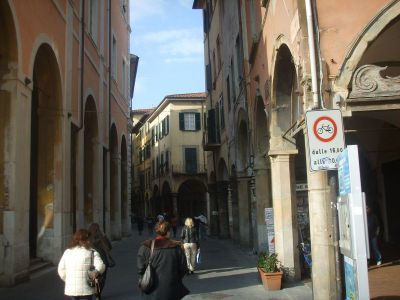
3) Borgo Stretto (Narrow Street) (must see)
If you want to do some shopping or simply wander through the narrow streets of medieval Pisa, you should go to the Narrow Street. This long street is mostly pedestrian and filled with shops from simple stores selling books and souvenirs to some of the most exclusive shops in the city.
Most of the street is lined on each side with arcades supported by Corinthian columns. In the arcades you will find plenty of bars, restaurants and shops. Look for Café Settimelli. Over the arched entrance to the Café Settimelli a sign proudly announces that this was once the house of the Galilei family and Galileo was born there.
The two and three story houses on both sides of the street were once the homes of rich merchant families. On the corner of via San Francesco you will find the 15 century Poschi Palace. There are plenty of narrow side streets leading off the Narrow Street and some of these will lead you to delightful open air markets that sell flowers, fresh fruits and vegetables.
Most of the street is lined on each side with arcades supported by Corinthian columns. In the arcades you will find plenty of bars, restaurants and shops. Look for Café Settimelli. Over the arched entrance to the Café Settimelli a sign proudly announces that this was once the house of the Galilei family and Galileo was born there.
The two and three story houses on both sides of the street were once the homes of rich merchant families. On the corner of via San Francesco you will find the 15 century Poschi Palace. There are plenty of narrow side streets leading off the Narrow Street and some of these will lead you to delightful open air markets that sell flowers, fresh fruits and vegetables.
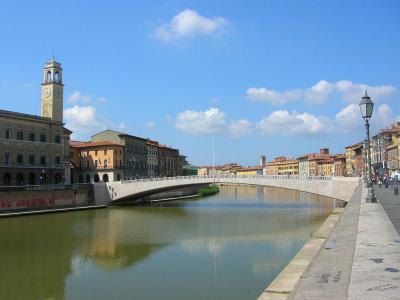
4) Ponte di Mezzo (Middle Bridge)
To get from the north side of the River Arno to the south side, you will cross the river by the Middle Bridge. In Roman times a wooden bridge spanned the river a little further upstream. This bridge was replaced by a stone one in 1035 and was restored in 1388. In 1635 it collapsed and was rebuilt in 1660. The “new” bridge was an elegant affair with three arches and carved balustrades and named “Middle” as it was (more-or-less) in the center of the city. This bridge was destroyed in 1944 during wartime bombing.
The bridge you will cross today was built in 1950 out of reinforced concrete sheathed in white Verona stone. It is 89 meters long and had one arch of 72 meters. At the four corners of the bridge are marbles globes from the former bridge. In the center of the bridge you will see the Pisan cross laid out in white stone paving.
If you are lucky enough to be in the city in June, you will certainly take part in the Pisa June which is a series of carnivals that re-enact historical events. The highlight of the Pisa June is the Bridge Game, held on the last Saturday of the month, when rival teams from the Mezzoiorno District and the Tramontana District “battle” for control of the bridge. The two teams of twenty pit their strength against each other by pushing against a heavy cart set on tracks in the middle of the bridge. The team who manages to push the cart to the “enemy” camp, wins the game.
The bridge you will cross today was built in 1950 out of reinforced concrete sheathed in white Verona stone. It is 89 meters long and had one arch of 72 meters. At the four corners of the bridge are marbles globes from the former bridge. In the center of the bridge you will see the Pisan cross laid out in white stone paving.
If you are lucky enough to be in the city in June, you will certainly take part in the Pisa June which is a series of carnivals that re-enact historical events. The highlight of the Pisa June is the Bridge Game, held on the last Saturday of the month, when rival teams from the Mezzoiorno District and the Tramontana District “battle” for control of the bridge. The two teams of twenty pit their strength against each other by pushing against a heavy cart set on tracks in the middle of the bridge. The team who manages to push the cart to the “enemy” camp, wins the game.
5) Caffe Dell'Ussero
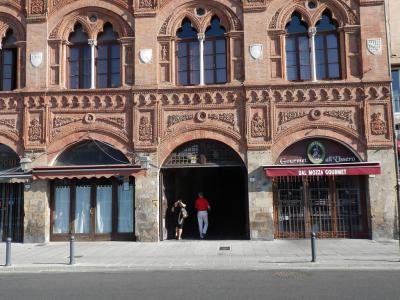
Caffè dell'Ussero is situated in the historic Agostini Palace, a stunning fifteenth-century structure. Known alternatively as Ussero Palace
(Palazzo dell'Ussero), it belonged to the Agostini Fantini Venerosi della Seta family, notable Pisan aristocrats. Established in 1775, it ranks as Italy's third oldest café, following Venice's Florian (1720) and Rome's Greco (1760).
In the late 1700s and early 1800s, the café was a hub for Enlightenment and Risorgimento movements. It's famed for planning the University battalion's Curtatone and Montanara expedition. The name 'Ussero' traces back to French explorer hussars residing in the building.
Over the years, the café and its building have been known by various names, including "Caffè delle Stanze," linked to the Civic Rooms club upstairs, and "Caffè dell 'Unione" for hosting the first Italian Congress of Scientists from 1839. Its walls still bear the legacy of notable visitors.
Prominent Risorgimento figures like Domenico Guerrazzi, suspended from university for discussing the Carbonari uprisings here, Giuseppe Montanelli, Giuseppe Giusti, famous from his "Memoirs of Pisa" (1841), Giosuè Carducci, who penned a heroic-comic poem here, and Garibaldi's associate Mazzini, were regulars.
During World War II, it was taken over by the allied forces, particularly the American army, in 1944 and reopened in 1945 as a café-tobacconist named "Usserino," shifting to adjacent spaces. It returned to its original site in 1959 after restoration.
Today, Caffè dell'Ussero continues to serve as a bar-cafeteria on Lungarno Pacinotti, a spot Leopardi called the most beautiful in Pisa, and perhaps even Florence.
(Palazzo dell'Ussero), it belonged to the Agostini Fantini Venerosi della Seta family, notable Pisan aristocrats. Established in 1775, it ranks as Italy's third oldest café, following Venice's Florian (1720) and Rome's Greco (1760).
In the late 1700s and early 1800s, the café was a hub for Enlightenment and Risorgimento movements. It's famed for planning the University battalion's Curtatone and Montanara expedition. The name 'Ussero' traces back to French explorer hussars residing in the building.
Over the years, the café and its building have been known by various names, including "Caffè delle Stanze," linked to the Civic Rooms club upstairs, and "Caffè dell 'Unione" for hosting the first Italian Congress of Scientists from 1839. Its walls still bear the legacy of notable visitors.
Prominent Risorgimento figures like Domenico Guerrazzi, suspended from university for discussing the Carbonari uprisings here, Giuseppe Montanelli, Giuseppe Giusti, famous from his "Memoirs of Pisa" (1841), Giosuè Carducci, who penned a heroic-comic poem here, and Garibaldi's associate Mazzini, were regulars.
During World War II, it was taken over by the allied forces, particularly the American army, in 1944 and reopened in 1945 as a café-tobacconist named "Usserino," shifting to adjacent spaces. It returned to its original site in 1959 after restoration.
Today, Caffè dell'Ussero continues to serve as a bar-cafeteria on Lungarno Pacinotti, a spot Leopardi called the most beautiful in Pisa, and perhaps even Florence.
6) Piazza dei Miracoli (Miracles Square) (must see)
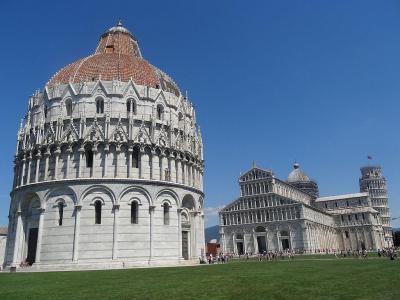
The Miracles Square is, of course, at the top of your “must see” list in Pisa. It is the most famous and most visited square in Europe after Saint Peter’s Square in Rome. It is a walled area and its real name is the Cathedral Square but the writer Gabriele D’Annunzio dubbed it the Square of Miracles in one of his books and the name stuck. Many people misguidedly call it the "Field of Miracles" but that field was invented by Carlo Collodi in his book “The Adventures of Pinocchio”. In Collodi's book, two scoundrels, the Cat and the Fox, told Pinocchio that if he planted his gold there it would grow into money trees.
The square is made up of an area that is partly paved and partly neatly trimmed lawns and some of the most famous buildings in Pisa are found on this square. The three buildings (Baptistery, Cathedral, Hospital) and the Cemetery are said to represent the four stages of human.
If we take them in these stages in chronological order, we start with the Pisa Baptistery, dedicated to Saint John the Baptist, represents Birth. The Pisa Cathedral portrays Life, while the New Hospital of the Holy Spirit represents Illness and the end of life. The cemetery, of course, represents Death.
The other famous building on the square, the bell tower of the Cathedral – also known as the Leaning Tower – doesn’t come into the allegory, but if you are in a whimsical frame of mind you might say that it represents the rather shaky path humans take during their Life!
The square is made up of an area that is partly paved and partly neatly trimmed lawns and some of the most famous buildings in Pisa are found on this square. The three buildings (Baptistery, Cathedral, Hospital) and the Cemetery are said to represent the four stages of human.
If we take them in these stages in chronological order, we start with the Pisa Baptistery, dedicated to Saint John the Baptist, represents Birth. The Pisa Cathedral portrays Life, while the New Hospital of the Holy Spirit represents Illness and the end of life. The cemetery, of course, represents Death.
The other famous building on the square, the bell tower of the Cathedral – also known as the Leaning Tower – doesn’t come into the allegory, but if you are in a whimsical frame of mind you might say that it represents the rather shaky path humans take during their Life!
