Custom Walk in Florence, Italy by angelica_deguzman09_aaf99 created on 2025-05-05
Guide Location: Italy » Florence
Guide Type: Custom Walk
# of Sights: 7
Tour Duration: 2 Hour(s)
Travel Distance: 3.6 Km or 2.2 Miles
Share Key: LHJWM
Guide Type: Custom Walk
# of Sights: 7
Tour Duration: 2 Hour(s)
Travel Distance: 3.6 Km or 2.2 Miles
Share Key: LHJWM
How It Works
Please retrieve this walk in the GPSmyCity app. Once done, the app will guide you from one tour stop to the next as if you had a personal tour guide. If you created the walk on this website or come to the page via a link, please follow the instructions below to retrieve the walk in the app.
Retrieve This Walk in App
Step 1. Download the app "GPSmyCity: Walks in 1K+ Cities" on Apple App Store or Google Play Store.



Step 2. In the GPSmyCity app, download(or launch) the guide "Florence Map and Walking Tours".
Step 3. Tap the menu button located at upper right corner of the "Walks" screen and select "Retrieve custom walk". Enter the share key: LHJWM
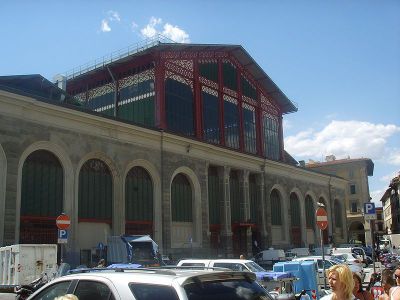
1) Mercato Centrale (Central Market) (must see)
Florence's 19th-century Central Market, dating back to the 19th century, is divided into two distinct areas. The covered section is dedicated to all things food, while the outdoor area extends onto the surrounding streets, offering a variety of leather goods, clothing, and affordable souvenirs, including leather coats, jackets, and purses at great prices.
For those seeking Tuscan cuisine, the indoor area is the place to be. On the ground floor, you'll find a vibrant assortment of butchers, fishmongers, fruits, vegetables, and specialty shops. These specialty shops offer an array of local products such as olive oils, truffle honey, cured meats, cheeses, and sauces. Many of them even provide free samples, allowing visitors to taste before purchasing.
Upstairs, the food court awaits, featuring a host of delicious local culinary delights. Here, you not only have the opportunity to savor delicious food but also to observe the skilled artisans in action through glass windows. Watch as bread is freshly baked, bufala cheese is carefully crafted, and artisanal gelato is made from scratch. To fully enjoy your dining experience, it is recommended to visit outside of peak dining hours when the crowds are less overwhelming.
Some of the highlights include:
~ Il Pane e la Pasticceria: Witness the expertise of French baker and Bakery World Cup champion David Bedu as he creates a variety of bread, from baguettes to traditional loaves, and exquisite French pastries like choux and éclairs.
~ Martino Bellincampi's Shop: Indulge in buffalo mozzarella served in a classic Roman-style salad or enjoy the ultimate guilty pleasure of a Neapolitan "mozzarella in carrozza," a fried mozzarella sandwich.
~ ARÀ: Delight in Sicilian delicacies such as arancini (deep-fried rice balls with various fillings), cannoli, cassatini, and refreshing granita.
~ Il Tartufo: Experience the excellence of seasonal black & white truffles in dishes such as pasta, salads, sandwiches, spreads... even beer.
~ La Pizzeria: Savor Marco Fierro's perfectly crispy, fresh, wood oven-baked pizzas made with the finest Italian ingredients.
~ Pasta Fresca: Sample both classic and creative pasta dishes while attending cooking shows.
~ Il Vegeteriano e il Vegano: A haven for vegetarians and vegans, offering a wide selection of delectable options.
While the outdoor market closes in the afternoon, the food court stays open until midnight, offering an ideal spot for late-night cravings.
For those seeking Tuscan cuisine, the indoor area is the place to be. On the ground floor, you'll find a vibrant assortment of butchers, fishmongers, fruits, vegetables, and specialty shops. These specialty shops offer an array of local products such as olive oils, truffle honey, cured meats, cheeses, and sauces. Many of them even provide free samples, allowing visitors to taste before purchasing.
Upstairs, the food court awaits, featuring a host of delicious local culinary delights. Here, you not only have the opportunity to savor delicious food but also to observe the skilled artisans in action through glass windows. Watch as bread is freshly baked, bufala cheese is carefully crafted, and artisanal gelato is made from scratch. To fully enjoy your dining experience, it is recommended to visit outside of peak dining hours when the crowds are less overwhelming.
Some of the highlights include:
~ Il Pane e la Pasticceria: Witness the expertise of French baker and Bakery World Cup champion David Bedu as he creates a variety of bread, from baguettes to traditional loaves, and exquisite French pastries like choux and éclairs.
~ Martino Bellincampi's Shop: Indulge in buffalo mozzarella served in a classic Roman-style salad or enjoy the ultimate guilty pleasure of a Neapolitan "mozzarella in carrozza," a fried mozzarella sandwich.
~ ARÀ: Delight in Sicilian delicacies such as arancini (deep-fried rice balls with various fillings), cannoli, cassatini, and refreshing granita.
~ Il Tartufo: Experience the excellence of seasonal black & white truffles in dishes such as pasta, salads, sandwiches, spreads... even beer.
~ La Pizzeria: Savor Marco Fierro's perfectly crispy, fresh, wood oven-baked pizzas made with the finest Italian ingredients.
~ Pasta Fresca: Sample both classic and creative pasta dishes while attending cooking shows.
~ Il Vegeteriano e il Vegano: A haven for vegetarians and vegans, offering a wide selection of delectable options.
While the outdoor market closes in the afternoon, the food court stays open until midnight, offering an ideal spot for late-night cravings.
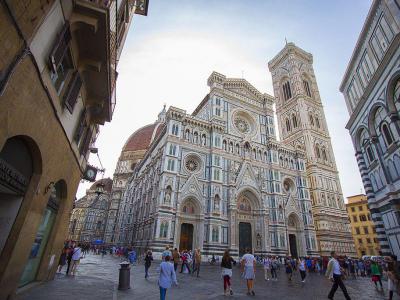
2) Cattedrale di Santa Maria del Fiore (Florence Cathedral) (must see)
Towering over the city of Florence, the Florence Cathedral is a true Renaissance masterpiece-best known for its massive masonry dome, the largest of its kind in the world. Completed in 1465, this remarkable double-shell structure is entirely self-supporting and remains one of the greatest engineering marvels of its time.
The cathedral’s story begins in 1296, when construction of its Gothic design first got underway. The real breakthrough, however, came nearly 150 years later, when architect Filippo Brunelleschi stepped in to solve what many thought was an impossible challenge-building the dome. Inspired by the ancient Pantheon in Rome, Brunelleschi ran countless experiments using large-scale models and even invented custom machinery to get the job done.
Among his most remarkable inventions were lifting devices and pulley systems capable of raising over 37,000 tons of materials-including more than four million bricks. His work impressed a young apprentice named Leonardo da Vinci, who sketched the machines-drawings that were later mistakenly credited to him. But history has remembered the true innovator. Today, Brunelleschi’s statue stands in the piazza outside the Cathedral as a tribute to his genius.
Step inside, and you’ll find more treasures-like the fresco “Dante and the Divine Comedy” by Domenico di Michelino, painted in 1465. It shows the poet holding his famous book, surrounded by vivid imagery of Hell, Purgatory, and Heaven, along with a detailed view of Florence as it looked in the 15th century-ironically, a version of the city Dante himself never saw. To see it up close, be prepared to climb about 450 steps up a narrow staircase that spirals inside the dome.
And then there's the exterior-a stunning patchwork of colorful marbles so intricate it almost looks painted. The craftsmanship is nothing short of extraordinary.
Tip: When booking online, you’ll get free access to the top of the dome-but you’ll need to reserve a time slot separately. The reward is a 360-degree view of Florence, the Tuscan countryside, and the mountains beyond. Totally worth the climb.
The cathedral’s story begins in 1296, when construction of its Gothic design first got underway. The real breakthrough, however, came nearly 150 years later, when architect Filippo Brunelleschi stepped in to solve what many thought was an impossible challenge-building the dome. Inspired by the ancient Pantheon in Rome, Brunelleschi ran countless experiments using large-scale models and even invented custom machinery to get the job done.
Among his most remarkable inventions were lifting devices and pulley systems capable of raising over 37,000 tons of materials-including more than four million bricks. His work impressed a young apprentice named Leonardo da Vinci, who sketched the machines-drawings that were later mistakenly credited to him. But history has remembered the true innovator. Today, Brunelleschi’s statue stands in the piazza outside the Cathedral as a tribute to his genius.
Step inside, and you’ll find more treasures-like the fresco “Dante and the Divine Comedy” by Domenico di Michelino, painted in 1465. It shows the poet holding his famous book, surrounded by vivid imagery of Hell, Purgatory, and Heaven, along with a detailed view of Florence as it looked in the 15th century-ironically, a version of the city Dante himself never saw. To see it up close, be prepared to climb about 450 steps up a narrow staircase that spirals inside the dome.
And then there's the exterior-a stunning patchwork of colorful marbles so intricate it almost looks painted. The craftsmanship is nothing short of extraordinary.
Tip: When booking online, you’ll get free access to the top of the dome-but you’ll need to reserve a time slot separately. The reward is a 360-degree view of Florence, the Tuscan countryside, and the mountains beyond. Totally worth the climb.
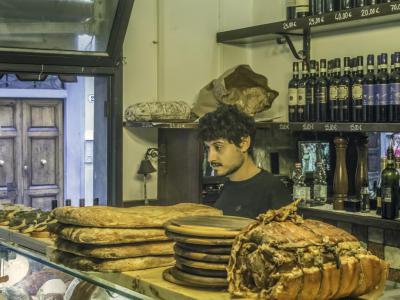
3) All'Antico Vinaio
Boasting locations on both sides of the street – two dedicated to take-out and one offering sit-down service – this place has earned an international reputation. For a mere €5, you can savor an exceptional sandwich crafted with fresh focaccia bread, mouthwatering cheeses, and expertly carved meats like porchetta, salami, and prosciutto, prepared right before your eyes. These sandwiches are colossal, generously loaded with an array of toppings such as truffle cream, eggplant, zucchini, and an abundance of other options (feel free to customize your own creation). If you crave some heat, don't hesitate to try the "Inferno" – a spicy delight. While vegetarian options may not be listed on the menu, the staff will happily accommodate your preferences on the spot.
Simply choose the shorter queue, purchase your sandwich, and find a picturesque spot by the Arno River or in Signoria Square ("Piazza della Signoria") to indulge in one of the city's finest culinary experiences.
Tip:
For those seeking a more sit-down dining experience, the same owners provide limited seating at the back. Although sandwiches are not available in this area, you can relish a delightful assortment of meats, cheeses, and vegetables served on a tray accompanied by bread. Enhance your meal with authentic local pasta or indulge in an amazing "secondo" (second course) for a truly satisfying dining experience.
Simply choose the shorter queue, purchase your sandwich, and find a picturesque spot by the Arno River or in Signoria Square ("Piazza della Signoria") to indulge in one of the city's finest culinary experiences.
Tip:
For those seeking a more sit-down dining experience, the same owners provide limited seating at the back. Although sandwiches are not available in this area, you can relish a delightful assortment of meats, cheeses, and vegetables served on a tray accompanied by bread. Enhance your meal with authentic local pasta or indulge in an amazing "secondo" (second course) for a truly satisfying dining experience.
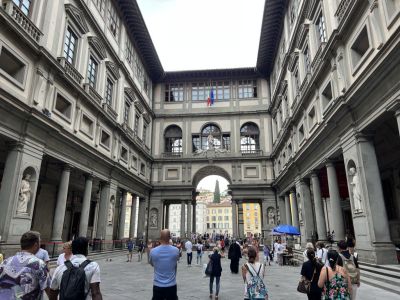
4) Piazzale degli Uffizi (Uffizi Courtyard)
The Uffizi Courtyard is a grand and elegant space in the heart of Florence, framed by the historic Uffizi Gallery. Before its transformation, this area was far from refined-home to tanners, dyers, and widespread prostitution, earning it the Red-Light District nickname. Seeking to bring order and centralization to the city’s administration, Cosimo de’ Medici commissioned Giorgio Vasari in 1560 to design a new building that would house all major public offices near his residence at the Old Palace. Inspired by Venetian architecture, Vasari created a symmetrical row of buildings with graceful arches and columns, transforming the area into one of structured beauty and civic pride.
After Vasari’s death, construction continued, and by 1580, the Uffizi complex was connected to nearby buildings like the Mint and the Loggia dei Lanzi. The addition of the Vasari Corridor, an elevated walkway leading from the Uffizi to the Pitti Palace, allowed the Medici family to traverse the city in private. Today, the courtyard is a lively and symbolic space-bridging Florence’s gritty past with its Renaissance grandeur. It serves as both a cultural landmark and a busy walkway, often animated by artists, musicians, and the steady stream of visitors heading toward one of the world’s most important art museums.
Outside the Uffizi Gallery, twenty-eight marble statues of prominent Tuscans line the niches of the portico’s pillars, including four that overlook the Arno along Lungarno Anna Maria Luisa de' Medici; these sculptures, completed between 1842 and 1856 by some of the finest artists of the era, celebrate the region’s intellectual and artistic legacy. At the far end of the courtyard, just to the right of the archway leading to the Arno embankment, stands a full-length statue of Galileo Galilei, gazing thoughtfully skyward with a telescope in hand-a tribute sculpted by Aristodemus Costoli and gifted by Crown Prince Ferdinand, located on the square-facing side of the Verone Loggia.
After Vasari’s death, construction continued, and by 1580, the Uffizi complex was connected to nearby buildings like the Mint and the Loggia dei Lanzi. The addition of the Vasari Corridor, an elevated walkway leading from the Uffizi to the Pitti Palace, allowed the Medici family to traverse the city in private. Today, the courtyard is a lively and symbolic space-bridging Florence’s gritty past with its Renaissance grandeur. It serves as both a cultural landmark and a busy walkway, often animated by artists, musicians, and the steady stream of visitors heading toward one of the world’s most important art museums.
Outside the Uffizi Gallery, twenty-eight marble statues of prominent Tuscans line the niches of the portico’s pillars, including four that overlook the Arno along Lungarno Anna Maria Luisa de' Medici; these sculptures, completed between 1842 and 1856 by some of the finest artists of the era, celebrate the region’s intellectual and artistic legacy. At the far end of the courtyard, just to the right of the archway leading to the Arno embankment, stands a full-length statue of Galileo Galilei, gazing thoughtfully skyward with a telescope in hand-a tribute sculpted by Aristodemus Costoli and gifted by Crown Prince Ferdinand, located on the square-facing side of the Verone Loggia.
5) Ponte Vecchio (Old Bridge) (must see)
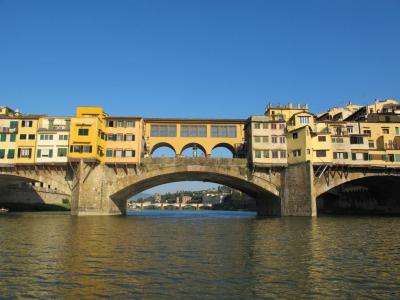
Ponte Vecchio, or The Old Bridge, first appeared in written records all the way back in 996. Of the six bridges that span the Arno River in Florence, it’s the only one that survived World War II intact-spared by retreating German forces. Today, this medieval stone arch structure stands as a powerful reminder of how a ruler’s vision can shape a city’s legacy.
As in the Middle Ages, the bridge is still lined with shops-but what’s sold here has changed quite a bit over time. Originally, it was occupied by butchers, who were know for tossing animal waste directly into the river-hardly ideal for anyone strolling by. That all changed in the 16th century, when Grand Duke Ferdinando de’ Medici had the meat merchants removed and replaced with goldsmiths. Not only did this improve the smell, but it also turned the bridge into one of the most glittering, upscale corners of Florence.
Take a look from a distance, and you might spot something unusual-a raised corridor running above the shops. This hidden passage is part of the Vasari Corridor, a nearly kilometer-long tunnel that connects the Pitti Palace with the Old Palace. It was built so that the Grand Duke could move between his residence and government offices without mingling with the crowds. Although closed since 2016 for safety reasons, there are plans to reopen it for visitors.
There’s even a bit of financial folklore tied to this spot, which is said to be the birthplace of the term “bankruptcy.” When a moneylender couldn’t pay his debts, soldiers smashed his trading bench-called a banco-to pieces, a symbolic act that left him unable to operate. Hence the term “bancorotto”, or “broken bench”, was born.
These days, the Old Bridge is a lovely place for a walk-especially at sunset, when the light casts a golden glow over the Arno. Early mornings are just as magical, with soft reflections on the water and, if you’re lucky, the bridge nearly all to yourself.
As in the Middle Ages, the bridge is still lined with shops-but what’s sold here has changed quite a bit over time. Originally, it was occupied by butchers, who were know for tossing animal waste directly into the river-hardly ideal for anyone strolling by. That all changed in the 16th century, when Grand Duke Ferdinando de’ Medici had the meat merchants removed and replaced with goldsmiths. Not only did this improve the smell, but it also turned the bridge into one of the most glittering, upscale corners of Florence.
Take a look from a distance, and you might spot something unusual-a raised corridor running above the shops. This hidden passage is part of the Vasari Corridor, a nearly kilometer-long tunnel that connects the Pitti Palace with the Old Palace. It was built so that the Grand Duke could move between his residence and government offices without mingling with the crowds. Although closed since 2016 for safety reasons, there are plans to reopen it for visitors.
There’s even a bit of financial folklore tied to this spot, which is said to be the birthplace of the term “bankruptcy.” When a moneylender couldn’t pay his debts, soldiers smashed his trading bench-called a banco-to pieces, a symbolic act that left him unable to operate. Hence the term “bancorotto”, or “broken bench”, was born.
These days, the Old Bridge is a lovely place for a walk-especially at sunset, when the light casts a golden glow over the Arno. Early mornings are just as magical, with soft reflections on the water and, if you’re lucky, the bridge nearly all to yourself.
6) Mercato di Santo Spirito (Santo Spirito Vintage Market)
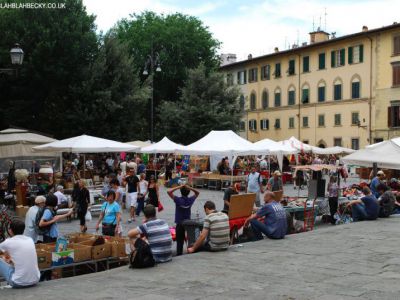
The Santo Spirito market was established in Florence in June 1986 and has been a recurring event held on the second Sunday of every month, except for July and August.
Piazza Santo Spirito, one of Florence's most enchanting squares, transforms into a vibrant hub where thousands of visitors gather and connect during the market.
With approximately 100 vendors specializing in small antiques, artisanal crafts, production, and restoration, the market also features a dedicated section for organic food, plants, and flowers.
Exploring the market offers an opportunity to discover a wide range of items, including furniture, diverse objects, books, prints, collectibles, vintage clothing, and captivating handmade artifacts.
Piazza Santo Spirito, one of Florence's most enchanting squares, transforms into a vibrant hub where thousands of visitors gather and connect during the market.
With approximately 100 vendors specializing in small antiques, artisanal crafts, production, and restoration, the market also features a dedicated section for organic food, plants, and flowers.
Exploring the market offers an opportunity to discover a wide range of items, including furniture, diverse objects, books, prints, collectibles, vintage clothing, and captivating handmade artifacts.
7) Via Maggio (broadest street in Florence)
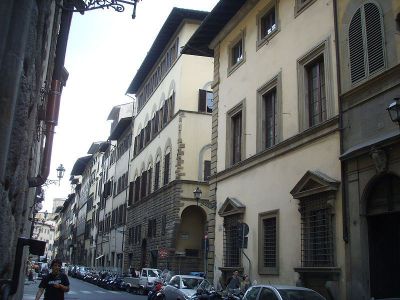
Via Maggio is one of the most elegant and historically layered streets in Florence, nestled in the Oltrarno district. Its roots stretch back to the Renaissance, when it was known as Via Maggiore, or “Broad Street”-a name reflecting both its stature and literal broadness. Once a prestigious address for nobles and diplomats, it still carries an air of refinement. Grand palaces from the 15th and 16th centuries line the road, many now housing antique shops, galleries, and stylish boutiques. It's a perfect destination for anyone drawn to Florence’s artistic soul and aristocratic past.
The street truly flourished during the Medici era, especially after the court settled into the nearby Pitti Palace. Wanting to stay close to influence and wealth, Florence’s elite built sumptuous residences here. Among the most notable is the Bianca Cappello Palace, named after the Venetian noblewoman who rose from mistress to Grand Duchess as the wife of Francesco de’ Medici. Its façade, richly adorned with sgraffito, still catches the eye today.
Walking here feels like stepping through a living museum. Window displays often rival those in museums, showcasing everything from oil paintings to vintage furniture, marble sculptures, tapestries, and even antique weaponry. For those with a taste for the contemporary, several modern galleries add fresh energy with rotating exhibitions by both Italian and international artists.
When you’re ready to rest, you’ll also find cozy cafés, stylish trattorias, and intimate wine bars lining the street. Sit back with a glass of Chianti or a rich espresso and let the Oltrarno atmosphere work its quiet magic.
The street truly flourished during the Medici era, especially after the court settled into the nearby Pitti Palace. Wanting to stay close to influence and wealth, Florence’s elite built sumptuous residences here. Among the most notable is the Bianca Cappello Palace, named after the Venetian noblewoman who rose from mistress to Grand Duchess as the wife of Francesco de’ Medici. Its façade, richly adorned with sgraffito, still catches the eye today.
Walking here feels like stepping through a living museum. Window displays often rival those in museums, showcasing everything from oil paintings to vintage furniture, marble sculptures, tapestries, and even antique weaponry. For those with a taste for the contemporary, several modern galleries add fresh energy with rotating exhibitions by both Italian and international artists.
When you’re ready to rest, you’ll also find cozy cafés, stylish trattorias, and intimate wine bars lining the street. Sit back with a glass of Chianti or a rich espresso and let the Oltrarno atmosphere work its quiet magic.
