Custom Walk in Adelaide, Australia by glenntully63_52639 created on 2025-05-15
Guide Location: Australia » Adelaide
Guide Type: Custom Walk
# of Sights: 8
Tour Duration: 3 Hour(s)
Travel Distance: 5.6 Km or 3.5 Miles
Share Key: 4WUCV
Guide Type: Custom Walk
# of Sights: 8
Tour Duration: 3 Hour(s)
Travel Distance: 5.6 Km or 3.5 Miles
Share Key: 4WUCV
How It Works
Please retrieve this walk in the GPSmyCity app. Once done, the app will guide you from one tour stop to the next as if you had a personal tour guide. If you created the walk on this website or come to the page via a link, please follow the instructions below to retrieve the walk in the app.
Retrieve This Walk in App
Step 1. Download the app "GPSmyCity: Walks in 1K+ Cities" on Apple App Store or Google Play Store.



Step 2. In the GPSmyCity app, download(or launch) the guide "Adelaide Map and Walking Tours".
Step 3. Tap the menu button located at upper right corner of the "Walks" screen and select "Retrieve custom walk". Enter the share key: 4WUCV
1) Adelaide Central Market (must see)
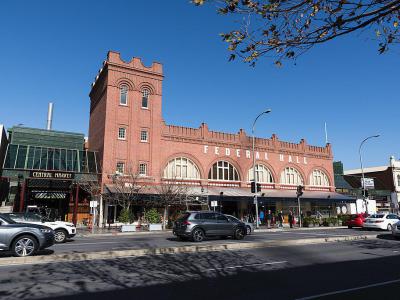
The Adelaide Central Market, located in Adelaide, is one of the largest and oldest undercover fresh produce markets in the Southern Hemisphere. With over 70 traders under one roof, it is a vibrant hub for fresh food, multicultural cuisine, and a wide range of specialty products. The market offers an extensive selection of fresh produce, including fruits, vegetables, meat, poultry, seafood, cheeses, baked goods, small goods, and health foods. It is also home to some of Adelaide’s most popular cafes and eateries, making it a premier destination for both locals and tourists alike.
Established in 1869, the market originally began as the City Market, with traders moving from the East End Markets to the new site on Grote Street. The market officially opened in 1870 with 50 to 100 produce carts selling a variety of goods such as vegetables, fruit, hay, fish, and game. Over the years, it expanded and developed into the bustling marketplace it is today, now boasting over 76 stalls in a single undercover area. The market is managed by the Adelaide Central Market Authority, a subsidiary of the City of Adelaide, which is responsible for maintaining its iconic status and ensuring its smooth operation.
In addition to its rich history and wide range of fresh produce, the Adelaide Central Market is surrounded by the Central Market Arcade, Adelaide China Town, and Market Plaza, further enhancing its appeal as a key destination in the city. The market attracts more than 8.5 million visitors annually, cementing its place as a cultural and culinary landmark in Adelaide. Notably, the market's Grote Street exterior features a large Father Christmas statue, a beloved figure that once graced John Martin's and David Jones in Rundle Mall, adding to its unique charm and historical significance.
Established in 1869, the market originally began as the City Market, with traders moving from the East End Markets to the new site on Grote Street. The market officially opened in 1870 with 50 to 100 produce carts selling a variety of goods such as vegetables, fruit, hay, fish, and game. Over the years, it expanded and developed into the bustling marketplace it is today, now boasting over 76 stalls in a single undercover area. The market is managed by the Adelaide Central Market Authority, a subsidiary of the City of Adelaide, which is responsible for maintaining its iconic status and ensuring its smooth operation.
In addition to its rich history and wide range of fresh produce, the Adelaide Central Market is surrounded by the Central Market Arcade, Adelaide China Town, and Market Plaza, further enhancing its appeal as a key destination in the city. The market attracts more than 8.5 million visitors annually, cementing its place as a cultural and culinary landmark in Adelaide. Notably, the market's Grote Street exterior features a large Father Christmas statue, a beloved figure that once graced John Martin's and David Jones in Rundle Mall, adding to its unique charm and historical significance.
2) Adelaide Town Hall
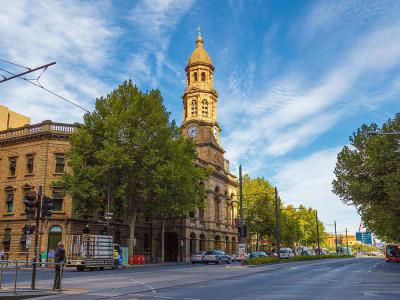
Adelaide Town Hall is city landmark and today serves as a venue for private events like weddings and celebrations. It is also regularly used for performances by the Adelaide Symphony Orchestra, Australian Chamber Orchestra and the Australian String Quartet.
The Adelaide Town Hall was constructed from 1863 through 1866. It was designed by Edmund Write and E.J. Woods. In 1865, American photographer Townsend Duryea took a series photographs from the Town Hall's clock tower. The photographs, known as Panorama of Adelaide, provided a birds-eye view of colonial Adelaide in the mid-19th century.
One of the most notable events that took place at the Adelaide Town Hall was an appearance by the Beatles in 1964. A crowd of about 300,000, the Beatles' largest, amassed to get a look at the Fab Four. It was also the location of the inaugural meeting of the Australasian Federation League of South Australia.
Visitors can tour the Adelaide Town Hall at any time between 9 AM and 5 PM from Monday to Friday. They will see the beautifully preserved historical rooms, admire the 1989 pipe organ, and stand on the same balcony that once stood by the Beatles.
The Adelaide Town Hall was constructed from 1863 through 1866. It was designed by Edmund Write and E.J. Woods. In 1865, American photographer Townsend Duryea took a series photographs from the Town Hall's clock tower. The photographs, known as Panorama of Adelaide, provided a birds-eye view of colonial Adelaide in the mid-19th century.
One of the most notable events that took place at the Adelaide Town Hall was an appearance by the Beatles in 1964. A crowd of about 300,000, the Beatles' largest, amassed to get a look at the Fab Four. It was also the location of the inaugural meeting of the Australasian Federation League of South Australia.
Visitors can tour the Adelaide Town Hall at any time between 9 AM and 5 PM from Monday to Friday. They will see the beautifully preserved historical rooms, admire the 1989 pipe organ, and stand on the same balcony that once stood by the Beatles.
3) Haigh's Chocolates
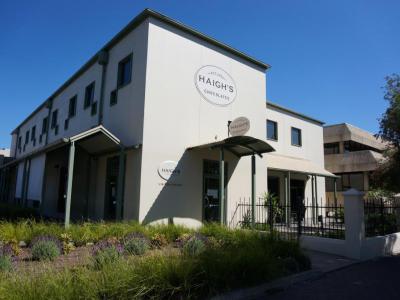
Haigh's Chocolates is a prestigious Australian family-owned chocolate-making company, renowned for its commitment to quality and tradition. Based in Adelaide, the company was founded by Alfred E. Haigh in 1915, with its first shop located on King William Street. This store later moved to the iconic Beehive Corner in Rundle Mall in 1922, where it continues to operate with its original décor.
The company's dedication to excellence in chocolate manufacturing is evident in its bean-to-bar process, ensuring that Haigh's chocolates are crafted with the highest quality ingredients. This passion for perfection was furthered by John Haigh, Alfred's grandson, who traveled to Switzerland to train with Lindt & Sprüngli, bringing back advanced chocolate-making techniques to Australia.
Haigh's Chocolates has expanded beyond Adelaide, with retail outlets in Melbourne, Sydney, and Canberra. Adelaide is home to seven stores, including the historic Beehive Corner store and a Visitor Centre at the Parkside factory, which offers tours showcasing the chocolate-making process.
In addition to its extensive retail presence, Haigh's Chocolates produces a wide variety of chocolate-based confections, from bars and blocks to seasonal and gift products. The company's commitment to innovation and growth is highlighted by its plans to open a new purpose-built factory in Salisbury South by late 2025, which will double its production capacity from 1,000 tonnes to 2,000 tonnes of chocolate annually.
Haigh's Chocolates has garnered significant recognition for its quality and craftsmanship, including receiving a consumer award at the 2022 South Australian Premier’s Food and Beverage Industry Awards. As one of Australia's oldest and most respected chocolatiers, Haigh's continues to delight customers with its rich history and exquisite chocolates.
The company's dedication to excellence in chocolate manufacturing is evident in its bean-to-bar process, ensuring that Haigh's chocolates are crafted with the highest quality ingredients. This passion for perfection was furthered by John Haigh, Alfred's grandson, who traveled to Switzerland to train with Lindt & Sprüngli, bringing back advanced chocolate-making techniques to Australia.
Haigh's Chocolates has expanded beyond Adelaide, with retail outlets in Melbourne, Sydney, and Canberra. Adelaide is home to seven stores, including the historic Beehive Corner store and a Visitor Centre at the Parkside factory, which offers tours showcasing the chocolate-making process.
In addition to its extensive retail presence, Haigh's Chocolates produces a wide variety of chocolate-based confections, from bars and blocks to seasonal and gift products. The company's commitment to innovation and growth is highlighted by its plans to open a new purpose-built factory in Salisbury South by late 2025, which will double its production capacity from 1,000 tonnes to 2,000 tonnes of chocolate annually.
Haigh's Chocolates has garnered significant recognition for its quality and craftsmanship, including receiving a consumer award at the 2022 South Australian Premier’s Food and Beverage Industry Awards. As one of Australia's oldest and most respected chocolatiers, Haigh's continues to delight customers with its rich history and exquisite chocolates.
4) Rundle Mall Four Pigs Statues
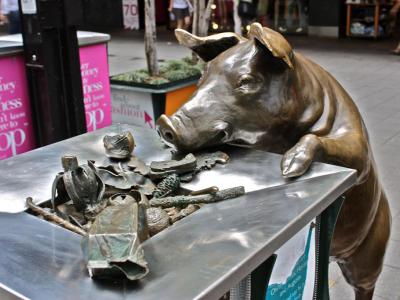
On 3 July 1999, Rundle Mall welcomed new residents - a group of four life-size bronze pigs. The charming squeakers proved so popular with the public that a competition was held to name them as follows: Oliver (the one rearing up to dig through the rubbish bin for food scraps), Horatio (sitting), Truffles (sniffing the ground), and Augusta (observing the other three and greeting passers-by). A pertinent brass plaque with the name of each piggy and the person who named it is fixed accordingly.
Equally loved by children and adults, these cute hoggies, other than being a sheer fun to look at, don't mind being sat on or hugged for pictures. Seemingly indifferent to their celebrity status, they enjoy a great day out on the town, fooling and rooting around.
Created by South African-born, Sydney-based sculptor Marguerite Derricourt, the four grunters, she says, were partly inspired by Pietro Tacca’s 1612 fountain in Florence, Italy, that features the Il Porcellino (“piglet”) bronze sculpture of a boar.
As part of the 2013-2014 Rundle Mall upgrade, the pigs had a “night out” when they literally flew – hoisted by cranes onto trucks for a restoration, prior to being returned to their place on the mall. Some people reckon, the pigs symbolize shoppers sniffing out a bargain.
Equally loved by children and adults, these cute hoggies, other than being a sheer fun to look at, don't mind being sat on or hugged for pictures. Seemingly indifferent to their celebrity status, they enjoy a great day out on the town, fooling and rooting around.
Created by South African-born, Sydney-based sculptor Marguerite Derricourt, the four grunters, she says, were partly inspired by Pietro Tacca’s 1612 fountain in Florence, Italy, that features the Il Porcellino (“piglet”) bronze sculpture of a boar.
As part of the 2013-2014 Rundle Mall upgrade, the pigs had a “night out” when they literally flew – hoisted by cranes onto trucks for a restoration, prior to being returned to their place on the mall. Some people reckon, the pigs symbolize shoppers sniffing out a bargain.
5) Adelaide Festival Centre
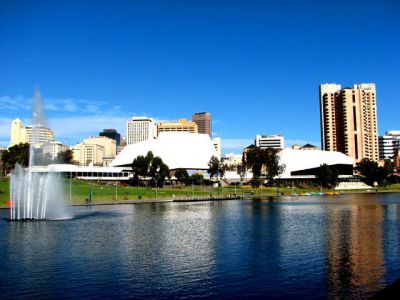
The Adelaide Festival Centre is a landmark of cultural significance and the nation's first multi-purpose arts center built in a capital city. Designed by Hassell Architects and constructed in the 1970s, this iconic complex is situated on Kaurna Yarta, near the banks of the River Torrens and adjacent to Elder Park. The Festival Theatre, the centerpiece of the complex, opened in June 1973, followed by the completion of the entire center shortly thereafter.
The complex is easily recognizable by its two striking white geometric dome roofs and its unique positioning at a 45-degree angle to Adelaide's city grid. It includes several key venues: the Festival Theatre, the Dunstan Playhouse (formerly known as The Playhouse and Optima Playhouse), and the Space Theatre (formerly The Space), along with various gallery and function spaces.
The Adelaide Festival Centre is a vibrant hub for the arts, hosting the Adelaide Festival and numerous other major festivals throughout the year, such as the Adelaide Cabaret Festival, OzAsia Festival, DreamBIG Children's Festival, Adelaide Guitar Festival, and OUR MOB. It serves as the home for several prestigious arts organizations, including the Adelaide Symphony Orchestra, State Opera South Australia, Australian Dance Theatre, State Theatre Company South Australia, The Australian Ballet, Brink, and Windmill Theatre Company.
The Festival Centre was built on the site of the historic Adelaide City Baths, which had been a fixture in the city for over a century. Recently, the site underwent significant redevelopment, initiated in 2016 and completed in February 2022, with the theatre spaces remaining operational throughout the process. This redevelopment has modernized the facilities while preserving the center's role as a cornerstone of Adelaide's cultural life.
The complex is easily recognizable by its two striking white geometric dome roofs and its unique positioning at a 45-degree angle to Adelaide's city grid. It includes several key venues: the Festival Theatre, the Dunstan Playhouse (formerly known as The Playhouse and Optima Playhouse), and the Space Theatre (formerly The Space), along with various gallery and function spaces.
The Adelaide Festival Centre is a vibrant hub for the arts, hosting the Adelaide Festival and numerous other major festivals throughout the year, such as the Adelaide Cabaret Festival, OzAsia Festival, DreamBIG Children's Festival, Adelaide Guitar Festival, and OUR MOB. It serves as the home for several prestigious arts organizations, including the Adelaide Symphony Orchestra, State Opera South Australia, Australian Dance Theatre, State Theatre Company South Australia, The Australian Ballet, Brink, and Windmill Theatre Company.
The Festival Centre was built on the site of the historic Adelaide City Baths, which had been a fixture in the city for over a century. Recently, the site underwent significant redevelopment, initiated in 2016 and completed in February 2022, with the theatre spaces remaining operational throughout the process. This redevelopment has modernized the facilities while preserving the center's role as a cornerstone of Adelaide's cultural life.
6) Adelaide Oval (must see)
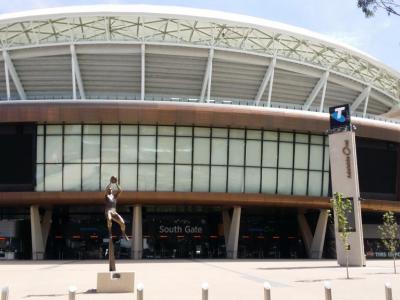
The Adelaide Oval is a renowned sports ground, nestled between the city's center and North Adelaide in a scenic parkland setting. Established in 1871, the Oval has a long-standing history as a versatile venue, predominantly hosting cricket and Australian rules football but also serving as a stage for rugby league, rugby union, soccer, tennis, and major concerts.
Significant redevelopment of the Adelaide Oval took place between 2012 and 2014, modernizing its facilities while preserving its historic charm. The stadium features three grandstands-the Riverbank Stand, Eastern Stand, and Western Stand-and boasts a heritage-listed scoreboard that complements a new digital scoreboard. In 2024, the Oval further expanded its offerings by opening Australia's first stadium hotel, aptly named the Oval Hotel.
Adelaide Oval has been the headquarters of the South Australian Cricket Association since its inception in 1871 and became the base for the South Australian National Football League (SANFL) in 2014. The venue is managed by the Adelaide Oval Stadium Management Authority.
The Oval has been a prominent location for significant events, including hosting the AFLW Grand Final three times since 2019. It holds a record cricket crowd of 55,317, achieved during the Second Ashes Test on December 2, 2017, and a record Australian rules football attendance of 62,543 during the 1965 SANFL Grand Final. A 2017 concert by Adele set a new audience record with 70,000 attendees.
Adelaide Oval is celebrated not only for its functionality but also for its aesthetic appeal. Austadiums.com praised it in 2012 as "one of the most picturesque Test cricket grounds in Australia, if not the world." After its redevelopment, sports journalist Gerard Whateley lauded the venue as "the most perfect piece of modern architecture" for blending contemporary design with its historical character.
For those interested in exploring the Oval's rich history and facilities, 90-minute guided walking tours are available, led by volunteers, offering visitors, including children, an in-depth look at this iconic Australian sports ground.
Significant redevelopment of the Adelaide Oval took place between 2012 and 2014, modernizing its facilities while preserving its historic charm. The stadium features three grandstands-the Riverbank Stand, Eastern Stand, and Western Stand-and boasts a heritage-listed scoreboard that complements a new digital scoreboard. In 2024, the Oval further expanded its offerings by opening Australia's first stadium hotel, aptly named the Oval Hotel.
Adelaide Oval has been the headquarters of the South Australian Cricket Association since its inception in 1871 and became the base for the South Australian National Football League (SANFL) in 2014. The venue is managed by the Adelaide Oval Stadium Management Authority.
The Oval has been a prominent location for significant events, including hosting the AFLW Grand Final three times since 2019. It holds a record cricket crowd of 55,317, achieved during the Second Ashes Test on December 2, 2017, and a record Australian rules football attendance of 62,543 during the 1965 SANFL Grand Final. A 2017 concert by Adele set a new audience record with 70,000 attendees.
Adelaide Oval is celebrated not only for its functionality but also for its aesthetic appeal. Austadiums.com praised it in 2012 as "one of the most picturesque Test cricket grounds in Australia, if not the world." After its redevelopment, sports journalist Gerard Whateley lauded the venue as "the most perfect piece of modern architecture" for blending contemporary design with its historical character.
For those interested in exploring the Oval's rich history and facilities, 90-minute guided walking tours are available, led by volunteers, offering visitors, including children, an in-depth look at this iconic Australian sports ground.
7) Adelaide Botanic Garden (must see)
The Adelaide Botanic Garden is a 51-hectare (130-acre) public garden located in the northeast corner of the Adelaide city center, nestled within the Adelaide Park Lands. Officially opened to the public on October 4, 1857, the garden serves as an oasis of greenery and tranquility in the heart of the city, offering beautifully landscaped gardens, majestic tree-lined avenues, and striking architectural features.
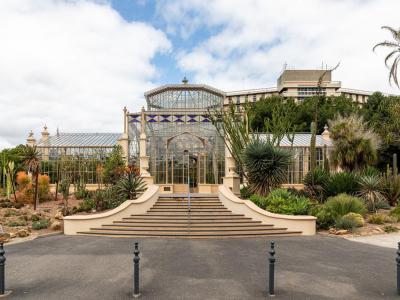
Among the garden's many highlights is the magnificently restored Palm House, a Victorian-era glasshouse designed by German architect Gustav Runge. Imported from Bremen, Germany, in 1875 and opened in 1877, the Palm House is the second-oldest glasshouse in Australia and the only remaining one of its kind from that period, as others were destroyed during World War II. Originally home to tropical flora, the Palm House now showcases a collection of arid plants from Madagascar due to the challenges posed by corrosion.
Another significant feature is the Museum of Economic Botany, dedicated to the collection and interpretation of useful plants. Established by Schomburgk in 1879 and opened in 1881, this museum is notable for being the last purpose-built colonial museum in the world. It has been meticulously restored, with much of its original collection from 1881 reinstated, including replicas of various fruits and fungi. The museum also features displays of Aboriginal artifacts, curated in collaboration with the South Australian Museum.
Visitors can also explore the Amazon Waterlily Pavilion, the Bicentennial Conservatory, and the award-winning Rose Garden, which blooms from October to April. For those looking to relax and enjoy a meal, the garden offers several dining options, including the casual cafés Simpson Kiosk and Evergreen Deli, and the award-winning Restaurant Botanic for a fine dining experience.
The Adelaide Botanic Garden is a historic and cultural landmark, offering a serene escape in the bustling city while showcasing some of Australia’s finest plant collections and architectural heritage.
Among the garden's many highlights is the magnificently restored Palm House, a Victorian-era glasshouse designed by German architect Gustav Runge. Imported from Bremen, Germany, in 1875 and opened in 1877, the Palm House is the second-oldest glasshouse in Australia and the only remaining one of its kind from that period, as others were destroyed during World War II. Originally home to tropical flora, the Palm House now showcases a collection of arid plants from Madagascar due to the challenges posed by corrosion.
Another significant feature is the Museum of Economic Botany, dedicated to the collection and interpretation of useful plants. Established by Schomburgk in 1879 and opened in 1881, this museum is notable for being the last purpose-built colonial museum in the world. It has been meticulously restored, with much of its original collection from 1881 reinstated, including replicas of various fruits and fungi. The museum also features displays of Aboriginal artifacts, curated in collaboration with the South Australian Museum.
Visitors can also explore the Amazon Waterlily Pavilion, the Bicentennial Conservatory, and the award-winning Rose Garden, which blooms from October to April. For those looking to relax and enjoy a meal, the garden offers several dining options, including the casual cafés Simpson Kiosk and Evergreen Deli, and the award-winning Restaurant Botanic for a fine dining experience.
The Adelaide Botanic Garden is a historic and cultural landmark, offering a serene escape in the bustling city while showcasing some of Australia’s finest plant collections and architectural heritage.
8) Himeji Garden (must see)
Himeji Garden in Adelaide is a serene and meticulously crafted Japanese garden, located in Park 18 (Peppermint Park / Wita Wirra), part of the southern Adelaide Park Lands. This traditional Japanese garden was gifted to Adelaide by its sister city, Himeji, in 1982, as a symbol of the enduring friendship between the two cities.
Initially designed by Adelaide City Council staff in collaboration with the local Japanese community, the garden faced criticism for some of its design elements, such as the use of a cyclone fence and a perceived lack of detail. Recognizing the need for refinement, in 1986, the council enlisted the expertise of Japanese landscape designer Yoshitaka Kumada to revamp the garden.
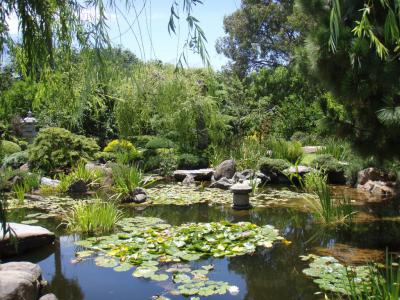
Kumada's redesign, which began after a Shinto ground-breaking ceremony in 1987, introduced significant changes, including reshaping the lake, expanding the Sea of Sand, and integrating a selection of trees, shrubs, and stones sourced from Melbourne and the Adelaide region. The centerpiece of the garden, a granite Okunoin lantern, was a gift from the City of Himeji in 1985, further enhancing the garden's authenticity and cultural significance.
By 1989, the garden's redesign was fully implemented, but Kumada's influence continued into the early 1990s as he made annual visits to Adelaide, fine-tuning details and imparting traditional gardening techniques to the council's horticulture team. These techniques are still in use today, ensuring that the garden remains true to its original design principles.
The garden is divided into two distinct areas: the sansui, or "mountain and lake garden," and the kare-sansui, or "dry rock garden," which symbolizes mountains surrounded by water. The Sea of Sand, a key feature of the kare-sansui, is carefully maintained to depict waves lapping against islands, with straight lines representing the ocean, embodying the peaceful and contemplative spirit of Japanese garden design.
Himeji Garden stands as a tranquil retreat in the heart of Adelaide, where visitors can slow down, reflect, and appreciate the timeless beauty and meticulous craftsmanship that went into its creation.
Initially designed by Adelaide City Council staff in collaboration with the local Japanese community, the garden faced criticism for some of its design elements, such as the use of a cyclone fence and a perceived lack of detail. Recognizing the need for refinement, in 1986, the council enlisted the expertise of Japanese landscape designer Yoshitaka Kumada to revamp the garden.
Kumada's redesign, which began after a Shinto ground-breaking ceremony in 1987, introduced significant changes, including reshaping the lake, expanding the Sea of Sand, and integrating a selection of trees, shrubs, and stones sourced from Melbourne and the Adelaide region. The centerpiece of the garden, a granite Okunoin lantern, was a gift from the City of Himeji in 1985, further enhancing the garden's authenticity and cultural significance.
By 1989, the garden's redesign was fully implemented, but Kumada's influence continued into the early 1990s as he made annual visits to Adelaide, fine-tuning details and imparting traditional gardening techniques to the council's horticulture team. These techniques are still in use today, ensuring that the garden remains true to its original design principles.
The garden is divided into two distinct areas: the sansui, or "mountain and lake garden," and the kare-sansui, or "dry rock garden," which symbolizes mountains surrounded by water. The Sea of Sand, a key feature of the kare-sansui, is carefully maintained to depict waves lapping against islands, with straight lines representing the ocean, embodying the peaceful and contemplative spirit of Japanese garden design.
Himeji Garden stands as a tranquil retreat in the heart of Adelaide, where visitors can slow down, reflect, and appreciate the timeless beauty and meticulous craftsmanship that went into its creation.
