Custom Walk in Bogota, Colombia by emurphy_74f69 created on 2025-05-16
Guide Location: Colombia » Bogota
Guide Type: Custom Walk
# of Sights: 5
Tour Duration: 4 Hour(s)
Travel Distance: 12 Km or 7.5 Miles
Share Key: M84LA
Guide Type: Custom Walk
# of Sights: 5
Tour Duration: 4 Hour(s)
Travel Distance: 12 Km or 7.5 Miles
Share Key: M84LA
How It Works
Please retrieve this walk in the GPSmyCity app. Once done, the app will guide you from one tour stop to the next as if you had a personal tour guide. If you created the walk on this website or come to the page via a link, please follow the instructions below to retrieve the walk in the app.
Retrieve This Walk in App
Step 1. Download the app "GPSmyCity: Walks in 1K+ Cities" on Apple App Store or Google Play Store.



Step 2. In the GPSmyCity app, download(or launch) the guide "Bogota Map and Walking Tours".
Step 3. Tap the menu button located at upper right corner of the "Walks" screen and select "Retrieve custom walk". Enter the share key: M84LA
1) Parque de Diversiones Salitre Magico (Salitre Magico Amusement Park)
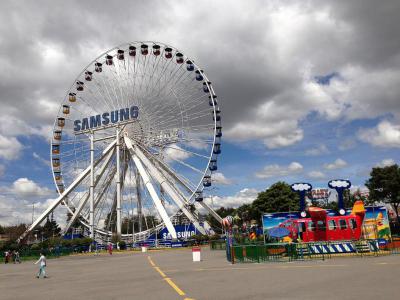
Salitre Magico, located within Bogota's El Salitre Park, is one of the city's largest and most iconic amusement parks. Established in 1973 as "Parque El Salitre," the park was celebrated as a modern marvel in Latin American entertainment. Positioned near the bustling Simon Bolivar Park, it quickly became a family favorite, offering state-of-the-art attractions for the time.
In 1999, the park underwent a major transformation after its acquisition by the Mexican entertainment giant Corporacion Interamericana de Entretenimiento (CIE). Following extensive renovations, it reopened in December 2000 under the name Salitre Magico, boasting 29 rides, including a U.S.-imported roller coaster nicknamed "The Screw" for its spiraling design, and the Rueda Millenium (Millennium Wheel), a 40-meter-tall Ferris wheel providing stunning views of Bogotá.
Today, Salitre Magico features 39 mechanical attractions catering to thrill-seekers, families, and children alike. Highlights include high-impact rides like the Tornado, Double Loop, and The Screw, which offer exhilarating experiences with heights of up to 15 meters and tracks extending 500 meters. For younger visitors, classic attractions such as the Carousel, Flying Swings, and mini-wheel ensure hours of entertainment.
A standout attraction is the ''Castle of Horror" (Castillo del Terror), a chilling experience that adds a unique twist to the park's offerings. The park also includes aquatic attractions and hosts live shows, making it a versatile destination for visitors of all ages.
Salitre Magico remains a cornerstone of Bogota's entertainment landscape, continuing to provide unforgettable experiences for locals and tourists alike.
In 1999, the park underwent a major transformation after its acquisition by the Mexican entertainment giant Corporacion Interamericana de Entretenimiento (CIE). Following extensive renovations, it reopened in December 2000 under the name Salitre Magico, boasting 29 rides, including a U.S.-imported roller coaster nicknamed "The Screw" for its spiraling design, and the Rueda Millenium (Millennium Wheel), a 40-meter-tall Ferris wheel providing stunning views of Bogotá.
Today, Salitre Magico features 39 mechanical attractions catering to thrill-seekers, families, and children alike. Highlights include high-impact rides like the Tornado, Double Loop, and The Screw, which offer exhilarating experiences with heights of up to 15 meters and tracks extending 500 meters. For younger visitors, classic attractions such as the Carousel, Flying Swings, and mini-wheel ensure hours of entertainment.
A standout attraction is the ''Castle of Horror" (Castillo del Terror), a chilling experience that adds a unique twist to the park's offerings. The park also includes aquatic attractions and hosts live shows, making it a versatile destination for visitors of all ages.
Salitre Magico remains a cornerstone of Bogota's entertainment landscape, continuing to provide unforgettable experiences for locals and tourists alike.
2) Torres del Parque (Towers Park)
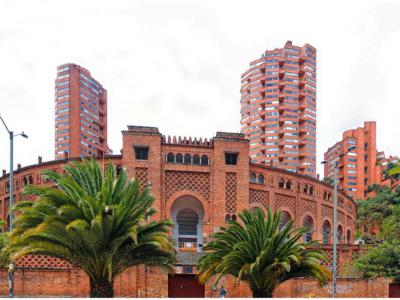
Towers Park (Las Torres del Parque) is a striking residential complex in Bogota's La Macarena neighborhood, designed by the renowned Colombian architect Rogelio Salmona between 1965 and 1970. Nestled in the eastern area of Santa Fe, this trio of brick towers forms a dramatic architectural embrace around the Santamaria Bullring, echoing its circular shape while subtly mirroring the undulating silhouette of the city's eastern hills.
The tallest of the three, Tower A, soars to 37 floors, standing at 117 meters-one of the highest structures in Bogota, further amplified by its elevated position near Monserrate. The towers house 294 apartments of varying sizes, all positioned to reinforce the complex’s radial composition centered around the Bullring. Unlike traditional residential high-rises, the lateral towers are carefully staggered, enhancing both visual fluidity and integration with the surrounding topography.
Towers Park masterfully balances built and open space, with three-quarters of its land dedicated to gardens, plazas, and terraces. Cascading vegetation merges seamlessly with Independence Park, making it an organic extension of Bogota’s landscape. The Stairs Street (Calle de las Escalinatas) connects the Towers, the park, the Bullring, and the Planetarium, anchored by a statue of Copernicus at its base.
Salmona’s signature use of brick-a material deeply embedded in Bogota’s architectural identity-plays both an aesthetic and social role. His commitment to this material, combined with a totalizing vision that merges architecture, landscape, and public space, earned him the prestigious Alvar Aalto Prize in 2003.
More than just an architectural landmark, Towers Park represents a radical rethinking of urban living in 20th-century Latin America. It is a place where private residences and public spaces coexist in harmony, where nature and geometry intertwine, and where the idea of home extends beyond walls into the fabric of the city itself.
The tallest of the three, Tower A, soars to 37 floors, standing at 117 meters-one of the highest structures in Bogota, further amplified by its elevated position near Monserrate. The towers house 294 apartments of varying sizes, all positioned to reinforce the complex’s radial composition centered around the Bullring. Unlike traditional residential high-rises, the lateral towers are carefully staggered, enhancing both visual fluidity and integration with the surrounding topography.
Towers Park masterfully balances built and open space, with three-quarters of its land dedicated to gardens, plazas, and terraces. Cascading vegetation merges seamlessly with Independence Park, making it an organic extension of Bogota’s landscape. The Stairs Street (Calle de las Escalinatas) connects the Towers, the park, the Bullring, and the Planetarium, anchored by a statue of Copernicus at its base.
Salmona’s signature use of brick-a material deeply embedded in Bogota’s architectural identity-plays both an aesthetic and social role. His commitment to this material, combined with a totalizing vision that merges architecture, landscape, and public space, earned him the prestigious Alvar Aalto Prize in 2003.
More than just an architectural landmark, Towers Park represents a radical rethinking of urban living in 20th-century Latin America. It is a place where private residences and public spaces coexist in harmony, where nature and geometry intertwine, and where the idea of home extends beyond walls into the fabric of the city itself.
3) Parque de la Independencia (Independence Park)
One of the oldest parks in Bogota, Independence Park was inaugurated in 1910 to commemorate the first centenary of Colombia’s independence. Nestled in the foothills of the Eastern hills, this green space lies on the eastern edge of the International Center, between Carrera 7 and Carrera 5 on 26th Street, surrounded by key landmarks such as the National Library, Museum of Modern Art, Santamaria Bullring, and the District Planetarium.
In its early years, the park boasted an array of ornate kiosks inspired by global architectural styles, including an Egyptian-style pavilion, an Art Nouveau structure, and a pagoda, alongside a pond that evoked the grandeur of European gardens. At its opening, the contemporary press raved about it, likening it to Versailles and the Crystal Palace. The La Luz pavilion, designed by Italian architect Pietro Cantini, remains one of the last surviving remnants of this bygone era.
Over the decades, Independence Park saw major changes. The 1957 construction of Avenida El Dorado erased its southern section and Centenario Park, while many buildings and wax palms were lost. A 1969 renovation by Rogelio Salmona aimed to revive it, but urban decay followed. A 1990s revitalization ultimately restored its role as a key Bogota green space.
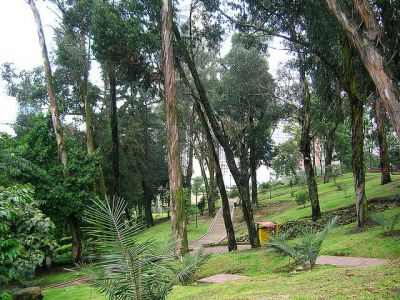
Today, Independence Park is a vital natural sanctuary in the city, featuring a wide variety of trees-from towering eucalyptus and acacias to recently planted tropical species like chicalas and sanggados. Its wax palms, among the most iconic in Bogota, continue to be a focal point of conservation efforts. The park’s rich flora attracts diverse birdlife, making it an urban biodiversity hotspot. With scenic Colpatria Tower views and deep historical roots, Independence Park remains a Bogotá landmark.
In its early years, the park boasted an array of ornate kiosks inspired by global architectural styles, including an Egyptian-style pavilion, an Art Nouveau structure, and a pagoda, alongside a pond that evoked the grandeur of European gardens. At its opening, the contemporary press raved about it, likening it to Versailles and the Crystal Palace. The La Luz pavilion, designed by Italian architect Pietro Cantini, remains one of the last surviving remnants of this bygone era.
Over the decades, Independence Park saw major changes. The 1957 construction of Avenida El Dorado erased its southern section and Centenario Park, while many buildings and wax palms were lost. A 1969 renovation by Rogelio Salmona aimed to revive it, but urban decay followed. A 1990s revitalization ultimately restored its role as a key Bogota green space.
Today, Independence Park is a vital natural sanctuary in the city, featuring a wide variety of trees-from towering eucalyptus and acacias to recently planted tropical species like chicalas and sanggados. Its wax palms, among the most iconic in Bogota, continue to be a focal point of conservation efforts. The park’s rich flora attracts diverse birdlife, making it an urban biodiversity hotspot. With scenic Colpatria Tower views and deep historical roots, Independence Park remains a Bogotá landmark.
4) Torre Colpatria (Colpatria Tower)
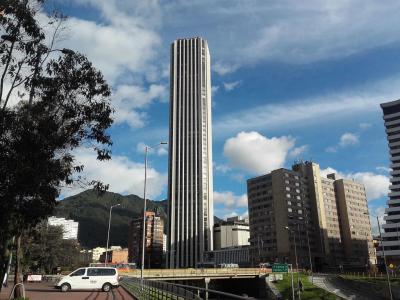
The Colpatria Tower (Torre Colpatria) is a 50-story skyscraper located in the heart of Bogota. Standing at 196 meters (643 feet) tall, it was constructed between 1973 and 1978 and officially opened in 1979. For nearly 40 years, it held the title of the tallest building in Colombia until 2016, when the BD Bacata South Tower surpassed it. Today, it is the fourth tallest building in the country.
As a hub for financial activities, the Colpatria Tower houses the main headquarters of the Colpatria Bank, along with offices of other banks and financial corporations. Its strategic downtown location underscores its importance to Bogotá's business landscape.
The tower's design features a square base and a facade characterized by concrete pilasters and vertical glazing bars. These elements stretch unbroken from the ground level to the roof, providing natural light and ventilation to the interior offices. The surrounding complex includes a separate ten-story building, designed to contrast with the tower's imposing height. The area also includes commercial banking offices and ample parking facilities.
Since 1998, the Colpatria Tower has been illuminated every night, initially with 36 Xenon lights. In 2012, Philips upgraded the lighting system to a 120-meter (390-foot) high LED setup, capable of projecting high-definition images. This modern illumination has enhanced its visibility and iconic status in Bogotá's skyline, where it stands alongside other landmarks such as the BD Bacatá, the World Trade Center, and the FONADE and Colseguros buildings.
One of the tower's most popular features is its observation deck on the 49th floor, which is open to visitors on weekends and holidays. Offering panoramic views of Bogotá, it has become one of the city's most renowned observatories, attracting locals and tourists alike.
Since 2005, a tower running race has been held annually on December 8, challenging participants to climb the 980 steps to the top. Competitors start in groups of ten, with each group setting off at 30-second intervals. The current record stands at an impressive 5 minutes and 11 seconds.
As a hub for financial activities, the Colpatria Tower houses the main headquarters of the Colpatria Bank, along with offices of other banks and financial corporations. Its strategic downtown location underscores its importance to Bogotá's business landscape.
The tower's design features a square base and a facade characterized by concrete pilasters and vertical glazing bars. These elements stretch unbroken from the ground level to the roof, providing natural light and ventilation to the interior offices. The surrounding complex includes a separate ten-story building, designed to contrast with the tower's imposing height. The area also includes commercial banking offices and ample parking facilities.
Since 1998, the Colpatria Tower has been illuminated every night, initially with 36 Xenon lights. In 2012, Philips upgraded the lighting system to a 120-meter (390-foot) high LED setup, capable of projecting high-definition images. This modern illumination has enhanced its visibility and iconic status in Bogotá's skyline, where it stands alongside other landmarks such as the BD Bacatá, the World Trade Center, and the FONADE and Colseguros buildings.
One of the tower's most popular features is its observation deck on the 49th floor, which is open to visitors on weekends and holidays. Offering panoramic views of Bogotá, it has become one of the city's most renowned observatories, attracting locals and tourists alike.
Since 2005, a tower running race has been held annually on December 8, challenging participants to climb the 980 steps to the top. Competitors start in groups of ten, with each group setting off at 30-second intervals. The current record stands at an impressive 5 minutes and 11 seconds.
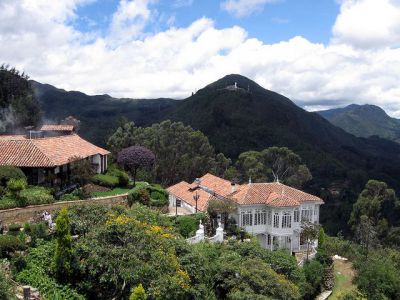
5) Restaurante Santa Clara
Perched atop Monserrate Hill, Restaurante Santa Clara is more than just a dining spot-it's a journey through Colombian history, culture, and gastronomy. Located just south of the church, the restaurant sits in a picturesque colonial house that was originally built in 1924 in the village of Usaquen and later relocated to Monserrate in 1979. Over the years, it has become one of the city's most iconic eateries, offering guests not only a meal but also an unforgettable view across Bogota and its surroundings.
Santa Clara is a showcase of traditional Colombian cuisine, bringing together flavors from across the country. The menu is a culinary tour spanning the Caribbean, the Pacific Coast, the Andean region, the Amazon, and even the Archipelago of San Andres, Providencia, and Santa Catalina. Diners can savor tamales tolimenses, bandeja paisa, grilled chops, and steaks, but one dish stands out-the local specialty, Ajiaco, a comforting and flavorful Bogota favorite.
Beyond the food, Santa Clara impresses with its warm atmosphere and exceptional service. Situated right on the edge of a cliff, the restaurant provides breathtaking panoramic views of Bogota, making every visit a unique and memorable experience. Whether you're here for the rich history, the fine cuisine, or the unbeatable vistas, Restaurante Santa Clara is an essential stop for anyone exploring Monserrate Hill.
Santa Clara is a showcase of traditional Colombian cuisine, bringing together flavors from across the country. The menu is a culinary tour spanning the Caribbean, the Pacific Coast, the Andean region, the Amazon, and even the Archipelago of San Andres, Providencia, and Santa Catalina. Diners can savor tamales tolimenses, bandeja paisa, grilled chops, and steaks, but one dish stands out-the local specialty, Ajiaco, a comforting and flavorful Bogota favorite.
Beyond the food, Santa Clara impresses with its warm atmosphere and exceptional service. Situated right on the edge of a cliff, the restaurant provides breathtaking panoramic views of Bogota, making every visit a unique and memorable experience. Whether you're here for the rich history, the fine cuisine, or the unbeatable vistas, Restaurante Santa Clara is an essential stop for anyone exploring Monserrate Hill.
