Custom Walk in Milan, Italy by depor970_5597a created on 2025-05-21
Guide Location: Italy » Milan
Guide Type: Custom Walk
# of Sights: 5
Tour Duration: 2 Hour(s)
Travel Distance: 4.8 Km or 3 Miles
Share Key: E9STH
Guide Type: Custom Walk
# of Sights: 5
Tour Duration: 2 Hour(s)
Travel Distance: 4.8 Km or 3 Miles
Share Key: E9STH
How It Works
Please retrieve this walk in the GPSmyCity app. Once done, the app will guide you from one tour stop to the next as if you had a personal tour guide. If you created the walk on this website or come to the page via a link, please follow the instructions below to retrieve the walk in the app.
Retrieve This Walk in App
Step 1. Download the app "GPSmyCity: Walks in 1K+ Cities" on Apple App Store or Google Play Store.



Step 2. In the GPSmyCity app, download(or launch) the guide "Milan Map and Walking Tours".
Step 3. Tap the menu button located at upper right corner of the "Walks" screen and select "Retrieve custom walk". Enter the share key: E9STH
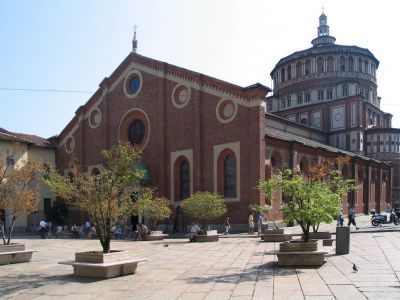
1) Chiesa di Santa Maria delle Grazie (Church of Holy Mary of Grace); "The Last Supper" fresco (must see)
Santa Maria delle Grazie (the Church of Holy Mary of Grace) is a world-famous church and Dominican convent in Milan, included in the UNESCO World Heritage sites list. The Duke of Milan, Francesco I Sforza, ordered the building of Santa Maria delle Grazie in the 15th century. The design of its apse has been attributed to Donato Bramante, who at that time was in the service of the Duchy. While adhering to the overall Gothic style of the convent, he added some Romanesque touches as well.
The church is primarily famous for the mural of The Last Supper (Il Cenacolo Vinciano) found in the refectory of the convent. Created by Leonardo da Vinci for his patron Duke Ludovico Sforza and the Duchess, this 15th-century wall painting was made on a dry wall rather than on wet plaster, and, thus, is not truly a fresco. A fresco cannot be altered as the artist works; therefore, Leonardo decided to paint on the stone wall and then cover it with a sealing layer. The work began to deteriorate a few years after he had finished it. Two early copies of "The Last Supper", thought to be the work of Leonardo's assistant, still exist.
During World War II, on the night of 15 August 1943, an allied aerial bombardment hit the church and the convent. Much of the refectory was destroyed, but some walls survived, including the one holding "The Last Supper", which had been sand-bagged for protection. The preservation works continuously done ever since, and hopefully in the future, are believed to maintain this painting intact for many centuries to come.
Why You Should Visit:
Viewing "The Last Supper" in its own setting will make you feel more appreciative of the single point linear perspective and the 3D effect so cleverly used by Da Vinci.
Tip:
To view "The Last Supper", make sure to book your tickets well in advance on the official website, as they are usually sold out within at least two weeks prior to the sought date.
The church is primarily famous for the mural of The Last Supper (Il Cenacolo Vinciano) found in the refectory of the convent. Created by Leonardo da Vinci for his patron Duke Ludovico Sforza and the Duchess, this 15th-century wall painting was made on a dry wall rather than on wet plaster, and, thus, is not truly a fresco. A fresco cannot be altered as the artist works; therefore, Leonardo decided to paint on the stone wall and then cover it with a sealing layer. The work began to deteriorate a few years after he had finished it. Two early copies of "The Last Supper", thought to be the work of Leonardo's assistant, still exist.
During World War II, on the night of 15 August 1943, an allied aerial bombardment hit the church and the convent. Much of the refectory was destroyed, but some walls survived, including the one holding "The Last Supper", which had been sand-bagged for protection. The preservation works continuously done ever since, and hopefully in the future, are believed to maintain this painting intact for many centuries to come.
Why You Should Visit:
Viewing "The Last Supper" in its own setting will make you feel more appreciative of the single point linear perspective and the 3D effect so cleverly used by Da Vinci.
Tip:
To view "The Last Supper", make sure to book your tickets well in advance on the official website, as they are usually sold out within at least two weeks prior to the sought date.
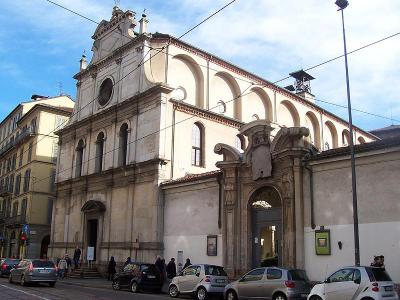
2) Chiesa di San Maurizio al Monastero Maggiore (Church of St. Maurice) (must see)
The Church of Saint Maurice is a stunning church in Milan's city center, located where the most important convent for women once stood. With its beautiful murals, it is considered by many to be the most beautiful church in Milan, surpassing even the famous Duomo. Inside, every inch is covered with color, whether through paintings or mosaics, and gold is everywhere. The pillars, ceilings, and walls are adorned with decorations and prints, earning the church its nickname, "The Sistine Chapel" of Milan.
Construction of the church took about fifteen years in the 16th century. It was originally divided into two parts, one for the nuns and one for the faithful, with the strict division having only disappeared at the end of the 18th century.
Many frescoes on the walls date back to the 16th century and include works by Luini (both father and son), Campi, and Peterzano. They depict various religious images, including saints, angels, Jesus carrying the cross, and Jesus when he died. Another noteworthy object is the organ in the part where the nuns used to sit, dating back to 1554 and designed by Antegnati.
The use of colors in the church is powerful, and the colored stained glass windows are also worth seeing.
Tip:
Museo Civico Archeologico, a small but lovely archaeological museum, is located in the adjacent monastery. Here, you can admire two ancient Roman watchtowers up close, as well as numerous sculptures and a beautiful maquette spread over three floors.
Construction of the church took about fifteen years in the 16th century. It was originally divided into two parts, one for the nuns and one for the faithful, with the strict division having only disappeared at the end of the 18th century.
Many frescoes on the walls date back to the 16th century and include works by Luini (both father and son), Campi, and Peterzano. They depict various religious images, including saints, angels, Jesus carrying the cross, and Jesus when he died. Another noteworthy object is the organ in the part where the nuns used to sit, dating back to 1554 and designed by Antegnati.
The use of colors in the church is powerful, and the colored stained glass windows are also worth seeing.
Tip:
Museo Civico Archeologico, a small but lovely archaeological museum, is located in the adjacent monastery. Here, you can admire two ancient Roman watchtowers up close, as well as numerous sculptures and a beautiful maquette spread over three floors.
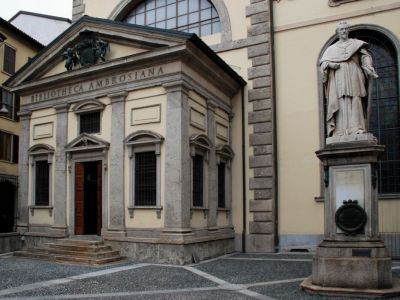
3) Biblioteca Ambrosiana (Ambrosian Library & Art Gallery) (must see)
In the bustling city of Milan, amidst its grandeur and energy, lies a place of quiet contemplation, the Ambrosiana Library and Art Gallery. Its origins date back to 1603 when local Cardinal Federico Borromeo, who had just returned from Rome's artistic circles, founded this sanctuary of knowledge and beauty. With over 36,000 manuscripts and more than 750,000 prints, the library is a true treasure trove of intellectual inquiry and spiritual reflection. Named after the patron saint of Milan, Ambrose, it is a testament to the intersection of religion, intellectualism, and aesthetics that defined the Renaissance period.
One of the main attractions here is the Codex Atlanticus, a collection of twelve volumes of drawings and manuscripts created by Leonardo da Vinci between 1478 and 1519. Containing the artist's drawings, sketches and fables, it is undoubtedly the largest collection of Leonardo's writings on practically every area of human knowledge: mechanics, mathematics, astronomy, botany, geography, physics, chemistry, architecture and philosophy.
Part of the library is the famous Pinacoteca Ambrosiana, the art gallery, featuring da Vinci's "Portrait of a Musician", Caravaggio's "Basket of Fruit", as well as Raffaello's life-size, pencil and carbon sketch of the "The School of Athens", a full-color final version of which is displayed in the Vatican.
Among other major acquisitions here are Islamic manuscripts, 11th-century diwan of poets and the oldest copy of the 'Kitab Sibawahaihi', plus a complete set of manuscripts from the Benedictine monastery of Bobbio (1606) and those from Vincenzo Pinelli of Padua, comprising more than 800 pieces, including the famous Ilias Picta (Ambrosian Iliad).
Why You Should Visit:
A chance to immerse yourself in the world of academic tomes and works of art, experience the tranquil ambiance that has enchanted scholars and art lovers for centuries, see art restorers at work on peculiar Renaissance masterpieces -- and in a brilliant building, too.
Tip:
On a weekday, you can practically have the entire place to yourself. The provided map/guide is quite clear, with all the main highlights identified, but if you're pressed for time, taking a guided tour is advisable.
One of the main attractions here is the Codex Atlanticus, a collection of twelve volumes of drawings and manuscripts created by Leonardo da Vinci between 1478 and 1519. Containing the artist's drawings, sketches and fables, it is undoubtedly the largest collection of Leonardo's writings on practically every area of human knowledge: mechanics, mathematics, astronomy, botany, geography, physics, chemistry, architecture and philosophy.
Part of the library is the famous Pinacoteca Ambrosiana, the art gallery, featuring da Vinci's "Portrait of a Musician", Caravaggio's "Basket of Fruit", as well as Raffaello's life-size, pencil and carbon sketch of the "The School of Athens", a full-color final version of which is displayed in the Vatican.
Among other major acquisitions here are Islamic manuscripts, 11th-century diwan of poets and the oldest copy of the 'Kitab Sibawahaihi', plus a complete set of manuscripts from the Benedictine monastery of Bobbio (1606) and those from Vincenzo Pinelli of Padua, comprising more than 800 pieces, including the famous Ilias Picta (Ambrosian Iliad).
Why You Should Visit:
A chance to immerse yourself in the world of academic tomes and works of art, experience the tranquil ambiance that has enchanted scholars and art lovers for centuries, see art restorers at work on peculiar Renaissance masterpieces -- and in a brilliant building, too.
Tip:
On a weekday, you can practically have the entire place to yourself. The provided map/guide is quite clear, with all the main highlights identified, but if you're pressed for time, taking a guided tour is advisable.
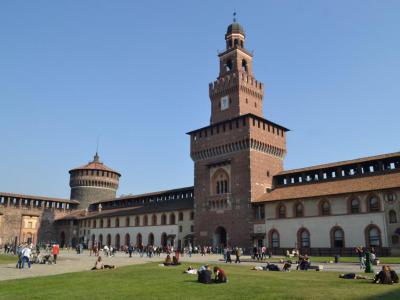
4) Castello Sforzesco (Sforzesco Castle) (must see)
Castello Sforzesco, one of the largest fortresses in Europe, was originally built in the 14th century to house the Duchy of Milan. Despite its long history of battles, invasions, sacking and destruction, the castle has endured and been restored many times. One of its towers, the Filarete tower, once used to store ammunition, famously exploded in 1521 after being struck by lightning, causing many casualties and significant damage to the fortress.
During the Napoleonic era, the castle was severely damaged and used as quarters for troops, including stables in the frescoed rooms on the ground floor of the Corte Ducale. However, following Italy's Unification in the late 19th century, the castle was reconstructed by architect Luca Beltrami and returned to the city of Milan in 1905. Today, it is a prominent hub of art and culture, boasting seven museums accessible to the public.
The interior of is adorned with exquisitely detailed works of art, notably the intricate ceiling fresco in the magnificent Sala delle Asse, painted by Leonardo da Vinci, who was commissioned by his patrons, the Sforza family. The fresco depicts a pergola in a garden with 16 mulberry trees held together by a golden rope.
Why You Should Visit:
Each room herein is a treasure, not only for the exhibited items, but also for the ceiling frescoes which are wonders in their own right.
Entrance to the castle is free, so if you're on a budget, just walk through and admire the courtyards and architecture. As for the "all museums" fee, it is quite reasonable.
Tip:
Exploring the entire Castello Sforzesco, complete with its gardens, may take a few days.
Try to go on Tuesday around 2pm to get free entry (entry on the 1st and 3rd Tuesday of every month is free for all public museums).
There's no way to access the battlements or the "inside" (aside from the museums) except by a guided tour, so consider booking one in advance.
During the Napoleonic era, the castle was severely damaged and used as quarters for troops, including stables in the frescoed rooms on the ground floor of the Corte Ducale. However, following Italy's Unification in the late 19th century, the castle was reconstructed by architect Luca Beltrami and returned to the city of Milan in 1905. Today, it is a prominent hub of art and culture, boasting seven museums accessible to the public.
The interior of is adorned with exquisitely detailed works of art, notably the intricate ceiling fresco in the magnificent Sala delle Asse, painted by Leonardo da Vinci, who was commissioned by his patrons, the Sforza family. The fresco depicts a pergola in a garden with 16 mulberry trees held together by a golden rope.
Why You Should Visit:
Each room herein is a treasure, not only for the exhibited items, but also for the ceiling frescoes which are wonders in their own right.
Entrance to the castle is free, so if you're on a budget, just walk through and admire the courtyards and architecture. As for the "all museums" fee, it is quite reasonable.
Tip:
Exploring the entire Castello Sforzesco, complete with its gardens, may take a few days.
Try to go on Tuesday around 2pm to get free entry (entry on the 1st and 3rd Tuesday of every month is free for all public museums).
There's no way to access the battlements or the "inside" (aside from the museums) except by a guided tour, so consider booking one in advance.
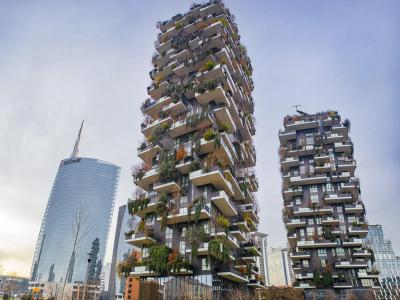
5) Bosco Verticale (Vertical Forest) (must see)
Bosco Verticale, which means "Vertical Forest" in English, is a pair of residential towers located in Milan's Porta Nuova district. Designed by architect Stefano Boeri, the towers were completed in 2014 and have since become one of the city's most iconic landmarks. They stand at heights of 110 and 76 meters and are home to over 900 trees, 5,000 shrubs, and 11,000 plants, creating a green oasis in the heart of the city.
The design of Bosco Verticale was based on the concept of urban reforestation, with the aim of improving the quality of urban life by providing natural spaces for residents. The towers are also equipped with sustainable technologies, including solar panels and a rainwater harvesting system, making them energy-efficient and eco-friendly.
In addition to their ecological features, the towers offer luxurious living spaces, with a range of apartments, penthouses, and duplexes available. The towers also feature a range of amenities, including a fitness center, a spa, and a rooftop swimming pool. Bosco Verticale has won numerous awards for its innovative design and sustainable features, including the International Highrise Award in 2014 and the "Best Tall Building Worldwide" award in 2015.
The design of Bosco Verticale was based on the concept of urban reforestation, with the aim of improving the quality of urban life by providing natural spaces for residents. The towers are also equipped with sustainable technologies, including solar panels and a rainwater harvesting system, making them energy-efficient and eco-friendly.
In addition to their ecological features, the towers offer luxurious living spaces, with a range of apartments, penthouses, and duplexes available. The towers also feature a range of amenities, including a fitness center, a spa, and a rooftop swimming pool. Bosco Verticale has won numerous awards for its innovative design and sustainable features, including the International Highrise Award in 2014 and the "Best Tall Building Worldwide" award in 2015.
