Custom Walk in Brussels, Belgium by katidando_7228c created on 2025-05-22
Guide Location: Belgium » Brussels
Guide Type: Custom Walk
# of Sights: 13
Tour Duration: 2 Hour(s)
Travel Distance: 3.4 Km or 2.1 Miles
Share Key: QC6K4
Guide Type: Custom Walk
# of Sights: 13
Tour Duration: 2 Hour(s)
Travel Distance: 3.4 Km or 2.1 Miles
Share Key: QC6K4
How It Works
Please retrieve this walk in the GPSmyCity app. Once done, the app will guide you from one tour stop to the next as if you had a personal tour guide. If you created the walk on this website or come to the page via a link, please follow the instructions below to retrieve the walk in the app.
Retrieve This Walk in App
Step 1. Download the app "GPSmyCity: Walks in 1K+ Cities" on Apple App Store or Google Play Store.



Step 2. In the GPSmyCity app, download(or launch) the guide "Brussels Map and Walking Tours".
Step 3. Tap the menu button located at upper right corner of the "Walks" screen and select "Retrieve custom walk". Enter the share key: QC6K4
1) Grand Place (Grand Square) (must see)
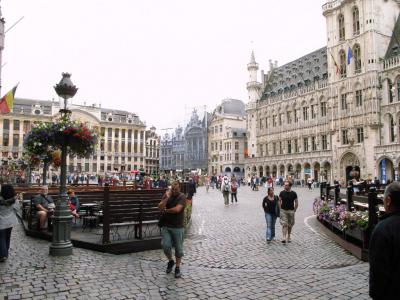
Grand Square-Brussels’ pride and joy-is the biggest show-off move of the Belgian capital. Some say it's the most beautiful square in Europe. Others say the world. Either way, it’s hard to argue when you’re standing there, dwarfed by a 15th-century Gothic Town Hall that looks like it got dressed for the Met Gala... and the neo-Gothic King's House-also charmingly called the Bread House (because apparently even royal buildings get carb cravings).
This cobblestoned stunner has been in the spotlight since the 11th century. Back then, it was a humble marketplace. A few hundred years later, it had a front-row seat to history-picture Inquisition bonfires and a couple of unfortunate noble executions (some sort of “light afternoon entertainment” for the medieval crowd)...
As Brussels bloomed, so did the square’s bling. Surrounding it are guildhalls that practically scream, “We have money and good taste!” Each one was built by a different trade-from haberdashers to bakers to brewers-and while the jobs have changed, the beauty hasn’t. Take Number 10, for example-once a brewers’ headquarters, now home to the Brewers Museum, so yes, beer still lives there. Circle of life.
Now, not everything has been smooth sailing here. In 1695, the French decided Brussels needed a “makeover.” So they bombarded the square for 36 hours straight. Miraculously, several buildings were rebuilt after that even better. Like Number 3, once run by tallow merchants, and Number 5, home of the archers’ guild, proudly rocking a phoenix on its façade-a little "burn me once" statement piece.
Today, in addition to being a history lesson with a stunning backdrop, the Grand Square is a vibe. Alleyways nearby are filled with centuries-old bars serving the holy trinity: Belgian beer, chocolate, and gossip. Butchers Street is your go-to for mussels and souvenirs and maybe some stretchy pants.
And if you time it right, you’ll catch the square in full party mode. There’s the biennial Flower Carpet-a psychedelic begonia explosion, the medieval cosplay of Ommegang, Christmas lights that would make the North Pole jealous, and concerts that echo through time.
Tip:
Visit in daylight to admire every gold-leafed flourish, and come back after dark for the light show. Around 10:20 PM, this square doesn’t just sparkle-it sings.
This cobblestoned stunner has been in the spotlight since the 11th century. Back then, it was a humble marketplace. A few hundred years later, it had a front-row seat to history-picture Inquisition bonfires and a couple of unfortunate noble executions (some sort of “light afternoon entertainment” for the medieval crowd)...
As Brussels bloomed, so did the square’s bling. Surrounding it are guildhalls that practically scream, “We have money and good taste!” Each one was built by a different trade-from haberdashers to bakers to brewers-and while the jobs have changed, the beauty hasn’t. Take Number 10, for example-once a brewers’ headquarters, now home to the Brewers Museum, so yes, beer still lives there. Circle of life.
Now, not everything has been smooth sailing here. In 1695, the French decided Brussels needed a “makeover.” So they bombarded the square for 36 hours straight. Miraculously, several buildings were rebuilt after that even better. Like Number 3, once run by tallow merchants, and Number 5, home of the archers’ guild, proudly rocking a phoenix on its façade-a little "burn me once" statement piece.
Today, in addition to being a history lesson with a stunning backdrop, the Grand Square is a vibe. Alleyways nearby are filled with centuries-old bars serving the holy trinity: Belgian beer, chocolate, and gossip. Butchers Street is your go-to for mussels and souvenirs and maybe some stretchy pants.
And if you time it right, you’ll catch the square in full party mode. There’s the biennial Flower Carpet-a psychedelic begonia explosion, the medieval cosplay of Ommegang, Christmas lights that would make the North Pole jealous, and concerts that echo through time.
Tip:
Visit in daylight to admire every gold-leafed flourish, and come back after dark for the light show. Around 10:20 PM, this square doesn’t just sparkle-it sings.
2) Le Pigeon (The Pigeon) / La Chaloupe d'Or (The Golden Boat)
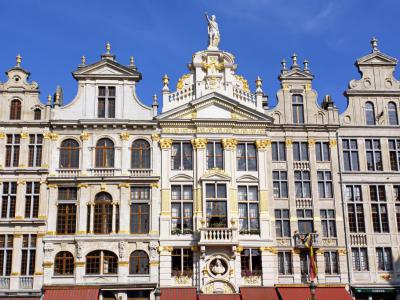
The Pigeon-one of the many fancy guild houses overlooking Brussels’ star-studded main square- might not be the flashiest of the bunch. It's got no gold-drenched unicorns or ships for balconies, but it’s got charm. And brains. And a bit of literary spice.
Originally the clubhouse for the city’s painters, the building took its name from a modest little sign featuring-you guessed it-a pigeon. But don’t let the bird fool you. This place once hosted none other than Victor Hugo himself. Yes, that very same Victor Hugo who wrote Les Misérables and probably made a lot of French teenagers cry in literature class.
In 1852, while exiled from France for not exactly being besties with Napoleon III, Hugo moved in upstairs here. From that very perch, he admired the Grand Square and called it “the most beautiful square in the world.” Honestly, hard to disagree-especially with that kind of view and no rent to pay.
But Hugo wasn’t just swooning over Baroque rooftops. Between gazing lovingly at the architecture, he found time to absolutely roast Belgian politics-calling the monarchy a “farce” and the government “absurd.” All this while sipping coffee and writing from a room above a bird sign. Exile’s never looked so cozy...
Today, you can’t go inside The Pigeon-it’s not a museum-but you can ogle its elegant Baroque façade, sculpted details, and glittering touches, all rebuilt after the French bombed Brussels in 1695. (Awkward, considering Hugo’s later residence.)
Standing outside, keep your eyes peeled for the sculpted pigeon perched above the door-an architectural Easter egg if there ever was one-and a plaque honoring Hugo’s poetic crash pad.
Now glide on over to The Golden Boat-which, despite the name, is more baroque than buoyant. Once the headquarters of the tailors’ guild, this post-bombardment rebuild from 1697 was stitched back together and topped with Saint Homobonus, the patron saint of tailors, looking very pleased with the real estate.
And the best part? You can pop in for a beer and a bite downstairs-because this golden ship now sails as a Belgian café-restaurant. Saintly skyline, savory snacks. It's like eating history, with extra sauce...
Tip:
Swing by after dark. The whole square lights up like a scene from a romantic period drama, and these two are worth a lingering look as a gilded footnote in a very stylish chapter of European history.
Originally the clubhouse for the city’s painters, the building took its name from a modest little sign featuring-you guessed it-a pigeon. But don’t let the bird fool you. This place once hosted none other than Victor Hugo himself. Yes, that very same Victor Hugo who wrote Les Misérables and probably made a lot of French teenagers cry in literature class.
In 1852, while exiled from France for not exactly being besties with Napoleon III, Hugo moved in upstairs here. From that very perch, he admired the Grand Square and called it “the most beautiful square in the world.” Honestly, hard to disagree-especially with that kind of view and no rent to pay.
But Hugo wasn’t just swooning over Baroque rooftops. Between gazing lovingly at the architecture, he found time to absolutely roast Belgian politics-calling the monarchy a “farce” and the government “absurd.” All this while sipping coffee and writing from a room above a bird sign. Exile’s never looked so cozy...
Today, you can’t go inside The Pigeon-it’s not a museum-but you can ogle its elegant Baroque façade, sculpted details, and glittering touches, all rebuilt after the French bombed Brussels in 1695. (Awkward, considering Hugo’s later residence.)
Standing outside, keep your eyes peeled for the sculpted pigeon perched above the door-an architectural Easter egg if there ever was one-and a plaque honoring Hugo’s poetic crash pad.
Now glide on over to The Golden Boat-which, despite the name, is more baroque than buoyant. Once the headquarters of the tailors’ guild, this post-bombardment rebuild from 1697 was stitched back together and topped with Saint Homobonus, the patron saint of tailors, looking very pleased with the real estate.
And the best part? You can pop in for a beer and a bite downstairs-because this golden ship now sails as a Belgian café-restaurant. Saintly skyline, savory snacks. It's like eating history, with extra sauce...
Tip:
Swing by after dark. The whole square lights up like a scene from a romantic period drama, and these two are worth a lingering look as a gilded footnote in a very stylish chapter of European history.
3) Galeries Royales Saint-Hubert (Royal Saint-Hubert Galleries) (must see)
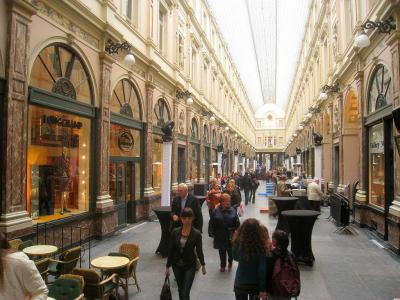
Often credited as Europe's first "mall", the stately Royal Saint-Hubert Galleries in Brussels is a remarkable example of a 19th-century covered shopping arcade. The concept of a shopping gallery originated in Paris during the 1780s when King Louis XIV leased parts of his garden to shopkeepers. Their outlets turned the space into a social and commercial hub that later developed into covered galleries for the affluent.
Brussels saw the creation of seven such galleries during the 1820s and 1830s, yet the Saint-Hubert Galleries – designed by architect Jean-Pierre Cluysenaar – is among the fortunate three that have endured the test of time. Officially inaugurated in 1847 by King Leopold I, the galleries quickly became a beloved haunt of the rich, offering a luxurious shopping and café experience regardless of weather. As such, they were precursors to other 19th-century European shopping venues like Milan's Galleria Vittorio Emanuele II and the Passage in Saint Petersburg, Russia.
Characterized by their Italianate Cinquecento style, the galleries feature glazed-arched shopfronts separated by pilasters beneath a glass-paneled roof with cast-iron framework. A deliberate bend in the galleries adds visual interest to the otherwise long, repetitive perspective. The covered structure is made up of two main sections, known as the King's Gallery and the Queen's Gallery, each measuring 8 meters (or 26 feet) in width and 213 meters (or 700 feet) in length, and a smaller side segment dubbed the Prince's Gallery.
In the past, the site hosted significant cultural developments like the first public showing of the Lumière brothers' moving pictures in 1896, and today houses among other attractions the Museum of Letters and Manuscripts and the Royal Theatre of the Galleries (inside The King's Gallery). The Queen's Gallery is best known for shops like Delvaux, specializing in leather goods, and Neuhaus, the pharmacy-turned-chocolatier renowned for creating the praline, which first opened its doors in 1857. It also houses the popular Passage Tavern restaurant. The Prince's Gallery, in turn, is home to the exquisite Tropismes bookstore.
The Galleries were designated a historic monument in 1986 while also being considered for World Heritage status by UNESCO.
Tip:
Climb to the top floor of the Le Pain Quotidien restaurant (whose name translates to 'The Daily Bread') for an elevated perspective and a unique view from the upper part of the galleries.
Brussels saw the creation of seven such galleries during the 1820s and 1830s, yet the Saint-Hubert Galleries – designed by architect Jean-Pierre Cluysenaar – is among the fortunate three that have endured the test of time. Officially inaugurated in 1847 by King Leopold I, the galleries quickly became a beloved haunt of the rich, offering a luxurious shopping and café experience regardless of weather. As such, they were precursors to other 19th-century European shopping venues like Milan's Galleria Vittorio Emanuele II and the Passage in Saint Petersburg, Russia.
Characterized by their Italianate Cinquecento style, the galleries feature glazed-arched shopfronts separated by pilasters beneath a glass-paneled roof with cast-iron framework. A deliberate bend in the galleries adds visual interest to the otherwise long, repetitive perspective. The covered structure is made up of two main sections, known as the King's Gallery and the Queen's Gallery, each measuring 8 meters (or 26 feet) in width and 213 meters (or 700 feet) in length, and a smaller side segment dubbed the Prince's Gallery.
In the past, the site hosted significant cultural developments like the first public showing of the Lumière brothers' moving pictures in 1896, and today houses among other attractions the Museum of Letters and Manuscripts and the Royal Theatre of the Galleries (inside The King's Gallery). The Queen's Gallery is best known for shops like Delvaux, specializing in leather goods, and Neuhaus, the pharmacy-turned-chocolatier renowned for creating the praline, which first opened its doors in 1857. It also houses the popular Passage Tavern restaurant. The Prince's Gallery, in turn, is home to the exquisite Tropismes bookstore.
The Galleries were designated a historic monument in 1986 while also being considered for World Heritage status by UNESCO.
Tip:
Climb to the top floor of the Le Pain Quotidien restaurant (whose name translates to 'The Daily Bread') for an elevated perspective and a unique view from the upper part of the galleries.
4) L'Arbre d'Or (The Golden Tree), Le Cygne (The Swan), and L'Étoile (The Star)
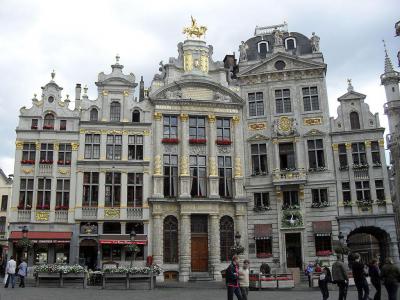
Now, let's zoom in on three other show-stealing guild houses in Grand Square: The Golden Tree, The Swan, and The Star-each with its own backstory, flair, and photo op.
First up: The Golden Tree, at Number 10. Once the proud headquarters of the Brewers' Guild, this place practically oozes hops and heritage. Rebuilt after the French “cannon fireworks” in 1695, its Baroque façade is dripping with gold, grain motifs, and a dramatic statue of Prince Charles of Lorraine (the former governor of the Austrian Netherlands) on horseback. Today, it’s home to the Belgian Brewers Museum-a small but mighty exhibit where you can geek out over brewing tools and end with (what else) a beer tasting. Bonus fact: It's still owned by a professional guild, which makes it the overachiever of the square.
Next door, at Number 9, we’ve got The Swan-elegant, mysterious, and with a touch of revolutionary gossip. Built in 1698 and once tied to the butchers' guild (yes, those are ox heads and cleavers on the facade), The Swan pivoted hard in the 1840s to become a political hangout. Karl Marx and Friedrich Engels met here, likely arguing over pints, and Brussels is where they penned The Communist Manifesto. The building later gave rise to the Belgian Workers' Party. Today, it’s a swanky restaurant with chandeliers, foie gras, and just a pinch of proletarian past.
And now, rounding things off with charm and compactness: The Star. Tucked into the corner where Charles Buls Street kisses the Grand Square, this petite beauty stands where a medieval gate once stood. Its most famous feature is the statue of Everard 't Serclaes, a local hero celebrated for liberating Brussels in the 14th century. Reclining under an arcade like a Belgian version of a chill Greek god, he's your go-to for good luck. Rub his golden arm or leg, and you might just find love-or at least an excuse to come back.
So whether you're sipping history, dining with revolution, or rubbing bronze for romance, these three iconic guild houses prove the Grand Square isn’t just a square-it’s a stage.
First up: The Golden Tree, at Number 10. Once the proud headquarters of the Brewers' Guild, this place practically oozes hops and heritage. Rebuilt after the French “cannon fireworks” in 1695, its Baroque façade is dripping with gold, grain motifs, and a dramatic statue of Prince Charles of Lorraine (the former governor of the Austrian Netherlands) on horseback. Today, it’s home to the Belgian Brewers Museum-a small but mighty exhibit where you can geek out over brewing tools and end with (what else) a beer tasting. Bonus fact: It's still owned by a professional guild, which makes it the overachiever of the square.
Next door, at Number 9, we’ve got The Swan-elegant, mysterious, and with a touch of revolutionary gossip. Built in 1698 and once tied to the butchers' guild (yes, those are ox heads and cleavers on the facade), The Swan pivoted hard in the 1840s to become a political hangout. Karl Marx and Friedrich Engels met here, likely arguing over pints, and Brussels is where they penned The Communist Manifesto. The building later gave rise to the Belgian Workers' Party. Today, it’s a swanky restaurant with chandeliers, foie gras, and just a pinch of proletarian past.
And now, rounding things off with charm and compactness: The Star. Tucked into the corner where Charles Buls Street kisses the Grand Square, this petite beauty stands where a medieval gate once stood. Its most famous feature is the statue of Everard 't Serclaes, a local hero celebrated for liberating Brussels in the 14th century. Reclining under an arcade like a Belgian version of a chill Greek god, he's your go-to for good luck. Rub his golden arm or leg, and you might just find love-or at least an excuse to come back.
So whether you're sipping history, dining with revolution, or rubbing bronze for romance, these three iconic guild houses prove the Grand Square isn’t just a square-it’s a stage.
5) Hotel de Ville (Town Hall) (must see)
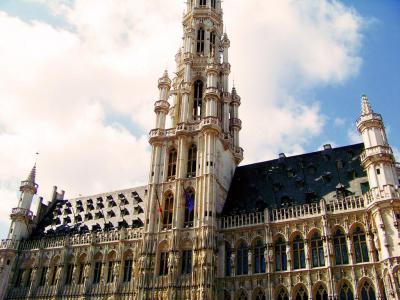
The Brussels Town Hall-part municipal headquarters, part medieval masterpiece, and all-around showoff of the Grand Square. Built between 1401 and 1455, this beauty is the only medieval building still standing in the square. Rich in Brabantine Gothic flair, it was declared a protected monument in 1936 and added to UNESCO’s World Heritage Site list in 1998.
Despite its regal look, the building’s had its fair share of drama. In 1695, during the Nine Years' War, the French heavily bombarded the city. The Town Hall took a hit: fire gutted the interior, torched the archives, and turned priceless artworks into ashes. And yet, like a true diva, it survived.
Its present-day form-a tidy quadrilateral wrapped around a central courtyard-dates from the 18th century, when two extra wings were slapped on the back. Then came the 19th century, when restorers went full "Gothic revival" mode and added nearly 300 statues, gargoyles, and fancy flourishes-because subtlety is not the style for this kind of property. Each ornament nods to Brussels’ proud guild traditions and colorful past.
Speaking of drama, notice that the tower isn’t centered? Legend says that the architect, Jan van Ruysbroek, was so distraught over the lopsided design that he threw himself off the tower. Dark... But let’s be real-it was probably just a classic case of medieval planning chaos.
Crowning the 96-meter tower is a golden spire topped with Saint Michael giving a devil the boot. The current statue is a 1990s replica, but the original goes back to 1455. Inside, it’s all chandeliers, frescoes, and enough historic rooms to make your head spin. Check out the Gothic Room, the Prince’s Gallery, the Mayor’s Cabinet, and the crown jewel-the States of Brabant Room, with a ceiling that deserves its own fan club.
Tip:
You can visit the inside, but only with a guided tour-around 45 minutes long and available in French, English, Dutch, or Spanish. Spots are limited and sell out fast, so grab your ticket early in the day. Tours run on Mondays, Wednesdays, Fridays, Saturdays, and Sundays. Just don’t show up on January 1, May 1, November 1 or 11, or December 25-because even grand old Town Halls need a day off.
Despite its regal look, the building’s had its fair share of drama. In 1695, during the Nine Years' War, the French heavily bombarded the city. The Town Hall took a hit: fire gutted the interior, torched the archives, and turned priceless artworks into ashes. And yet, like a true diva, it survived.
Its present-day form-a tidy quadrilateral wrapped around a central courtyard-dates from the 18th century, when two extra wings were slapped on the back. Then came the 19th century, when restorers went full "Gothic revival" mode and added nearly 300 statues, gargoyles, and fancy flourishes-because subtlety is not the style for this kind of property. Each ornament nods to Brussels’ proud guild traditions and colorful past.
Speaking of drama, notice that the tower isn’t centered? Legend says that the architect, Jan van Ruysbroek, was so distraught over the lopsided design that he threw himself off the tower. Dark... But let’s be real-it was probably just a classic case of medieval planning chaos.
Crowning the 96-meter tower is a golden spire topped with Saint Michael giving a devil the boot. The current statue is a 1990s replica, but the original goes back to 1455. Inside, it’s all chandeliers, frescoes, and enough historic rooms to make your head spin. Check out the Gothic Room, the Prince’s Gallery, the Mayor’s Cabinet, and the crown jewel-the States of Brabant Room, with a ceiling that deserves its own fan club.
Tip:
You can visit the inside, but only with a guided tour-around 45 minutes long and available in French, English, Dutch, or Spanish. Spots are limited and sell out fast, so grab your ticket early in the day. Tours run on Mondays, Wednesdays, Fridays, Saturdays, and Sundays. Just don’t show up on January 1, May 1, November 1 or 11, or December 25-because even grand old Town Halls need a day off.
6) Le Renard (The Fox)/Le Cornet (The Cornet)
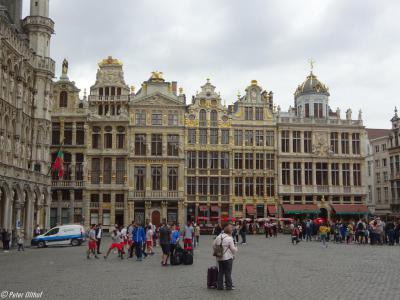
Now check out another two show-offs on the Grand Place stage-The Fox and The Cornet. By far not just average buildings, these are 17th-century drama queens carved in stone, telling tales of trades, triumphs, and, yes, a bit of tasteful self-promotion.
First up: The Fox. This was the stylish headquarters of Brussels’ haberdashers-dealers in sewing trinkets and accessories. Think of them as the 15th-century fashion influencers, minus the ring light. Rebuilt in 1699 after the French sort of “redecorated” Brussels with cannonballs, its façade is now a masterclass in symbolism. Above the doorway is a slender fox-because branding matters. Below that: Bas-reliefs showing the haberdashers doing their thing, plus four allegorical figures representing Africa, America, Asia, and Europe. Right in the middle is a statue of Lady Justice, because even sewing supplies deserve ethical trading practices. And topping it all off, Saint Nicholas, the patron saint of merchants, watching over it all like a spiritual CEO.
Next door: The Cornet. Built for the boatmen’s guild, this one ditched subtlety and went full-on ship mode. Its gable looks like the back end of a fancy vessel-anchors, oars, ropes, and even sculpted winds doing their best Beyoncé hair-blowing impressions. Originally constructed between 1641 and 1645 and rebuilt in 1697, it is basically a ship frozen mid-sail, cruising through the cobblestones of Brussels. Medallions of Charles II of Spain and rugged sailor figures complete the look. If buildings could wear cologne, The Cornet would smell like salt air and bravado.
Together, The Fox and The Cornet are more than just fancy façades but Brussels' own stone-carved profiles: all about hustle, heritage, and a touch of theatrical flair.
Tip:
You can’t go inside these beauties, but believe it-the outside is doing all the heavy lifting. Come by day to admire the detailed carving work, or swing by at night for that moody, shadow-drenched lighting that turns stone into sculpture.
First up: The Fox. This was the stylish headquarters of Brussels’ haberdashers-dealers in sewing trinkets and accessories. Think of them as the 15th-century fashion influencers, minus the ring light. Rebuilt in 1699 after the French sort of “redecorated” Brussels with cannonballs, its façade is now a masterclass in symbolism. Above the doorway is a slender fox-because branding matters. Below that: Bas-reliefs showing the haberdashers doing their thing, plus four allegorical figures representing Africa, America, Asia, and Europe. Right in the middle is a statue of Lady Justice, because even sewing supplies deserve ethical trading practices. And topping it all off, Saint Nicholas, the patron saint of merchants, watching over it all like a spiritual CEO.
Next door: The Cornet. Built for the boatmen’s guild, this one ditched subtlety and went full-on ship mode. Its gable looks like the back end of a fancy vessel-anchors, oars, ropes, and even sculpted winds doing their best Beyoncé hair-blowing impressions. Originally constructed between 1641 and 1645 and rebuilt in 1697, it is basically a ship frozen mid-sail, cruising through the cobblestones of Brussels. Medallions of Charles II of Spain and rugged sailor figures complete the look. If buildings could wear cologne, The Cornet would smell like salt air and bravado.
Together, The Fox and The Cornet are more than just fancy façades but Brussels' own stone-carved profiles: all about hustle, heritage, and a touch of theatrical flair.
Tip:
You can’t go inside these beauties, but believe it-the outside is doing all the heavy lifting. Come by day to admire the detailed carving work, or swing by at night for that moody, shadow-drenched lighting that turns stone into sculpture.
7) La Louve (The She-Wolf) / Le Sac (The Bag) / La Brouette (The Wheelbarrow)
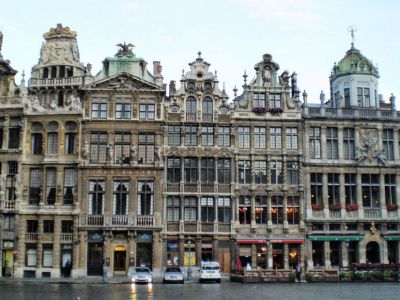
Every building in Brussels' Grand Square has enough flair for a soap opera. Among this theatrical cast of ornate façades, three characters steal the spotlight, namely: The She-Wolf, The Bag, and The Wheelbarrow. So, buckle up-it's guild drama, 17th-century style...
Coming in hot at Number 5, The She-Wolf building once belonged to the Oath of Archers-think medieval neighborhood watch, but with better aim. Rebuilt after Brussels got a not-so-friendly visit from the French in 1695, its new look features a phoenix rising from the ashes (very on-brand for post-bombardment Brussels). Peek up, and you’ll see Apollo mid-drama slaying Python, and four statues below repping Team Truth, Team Lies, Peace, and Discord. It’s basically a mythological group chat carved in stone.
Next door at Number 4 is The Bag, the house that carpenters built-literally. Originally crafted in 1644 and given a Baroque restyle in 1697, the façade flexes with chisels, saws, and all the trade bling. Above the door is a guy pulling something from a bag-very meta. Today, it’s a café where you can sip your coffee under a roof built by the OG toolbox crew.
And now for a double bill at Numbers 2 and 3: The Wheelbarrow, the headquarters of the greasers. No, not the leather-jacket kind-these folks sold butter, eggs, poultry, the whole brunch kit. The golden wheelbarrows above the door say it all. Reborn in 1697 and crowned in 1912 with a statue of Saint Giles (patron saint of greasy things), this place now houses a café where you can chow down like a butter baron.
In essence, these three buildings are true characters, survivors, and storytellers. So, whether you're an architecture nerd, a history buff, or just here for a waffle with a view, the Grand Square’s guild houses are ready for their close-up. Go ahead, wander in. The past has excellent curb appeal.
Coming in hot at Number 5, The She-Wolf building once belonged to the Oath of Archers-think medieval neighborhood watch, but with better aim. Rebuilt after Brussels got a not-so-friendly visit from the French in 1695, its new look features a phoenix rising from the ashes (very on-brand for post-bombardment Brussels). Peek up, and you’ll see Apollo mid-drama slaying Python, and four statues below repping Team Truth, Team Lies, Peace, and Discord. It’s basically a mythological group chat carved in stone.
Next door at Number 4 is The Bag, the house that carpenters built-literally. Originally crafted in 1644 and given a Baroque restyle in 1697, the façade flexes with chisels, saws, and all the trade bling. Above the door is a guy pulling something from a bag-very meta. Today, it’s a café where you can sip your coffee under a roof built by the OG toolbox crew.
And now for a double bill at Numbers 2 and 3: The Wheelbarrow, the headquarters of the greasers. No, not the leather-jacket kind-these folks sold butter, eggs, poultry, the whole brunch kit. The golden wheelbarrows above the door say it all. Reborn in 1697 and crowned in 1912 with a statue of Saint Giles (patron saint of greasy things), this place now houses a café where you can chow down like a butter baron.
In essence, these three buildings are true characters, survivors, and storytellers. So, whether you're an architecture nerd, a history buff, or just here for a waffle with a view, the Grand Square’s guild houses are ready for their close-up. Go ahead, wander in. The past has excellent curb appeal.
8) Le Roy d'Espagne (The King of Spain)
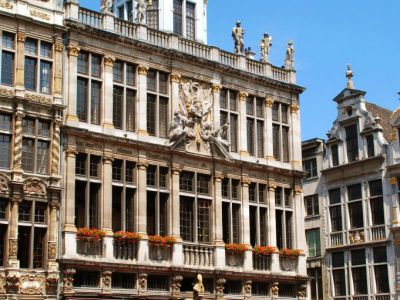
Now, The King of Spain... a historic brasserie parked proudly at Number 1 Grand Square in Brussels. Here, Belgian beer meets Baroque drama, and croissants come with a side of centuries-old gossip.
Built in 1697 as the official hangout of the bakers’ guild, this building replaced the former residence of the noble Serhuyghs family. And if you’re wondering why the royal name, just look up-King Charles II of Spain is keeping watch from the second floor, a nod to the days when Brussels was under Spanish rule and wigs were bigger than your head.
Checking out the façade, you can't help noticing Roman emperors like Marcus Aurelius and Trajan chilling in medallion form, rooftop statues that turn baking into a Marvel movie (with symbols like wind, fire, and foresight), and a golden weathervane shaped like Fame herself. Also, don’t miss the bust of Saint Aubert-the patron saint of bakers-glinting above the entrance in bronze and gold, keeping an eye on your baguette choices.
And, of course, no grand European building can escape drama. The King of Spain took a beating during the French Revolution but got a facelift in 1902 thanks to the then city mayor and his "Make Grand Square Gorgeous Again" campaign. It briefly dabbled in being a hardware store-because why not-but thankfully, in 1952, it embraced its destiny as a brasserie once again.
Today, the building is back in full culinary glory, serving up classic Belgian fare with local ingredients and a beer list that reads like a novel-over 43 brews, 10 of them on tap. Whether you're inside soaking up the 19th-century street vibe or lounging outside on the terrace with front-row views of the Grand Square, you’re in for a treat.
Open daily from 8 a.m. to 1 a.m., this place is where you start your day, end your night, or accidentally stay for both. If you're a history buff, foodie, beer hunter, or just people-watching champion, congratulations!-You’ve found your royal seat.
Built in 1697 as the official hangout of the bakers’ guild, this building replaced the former residence of the noble Serhuyghs family. And if you’re wondering why the royal name, just look up-King Charles II of Spain is keeping watch from the second floor, a nod to the days when Brussels was under Spanish rule and wigs were bigger than your head.
Checking out the façade, you can't help noticing Roman emperors like Marcus Aurelius and Trajan chilling in medallion form, rooftop statues that turn baking into a Marvel movie (with symbols like wind, fire, and foresight), and a golden weathervane shaped like Fame herself. Also, don’t miss the bust of Saint Aubert-the patron saint of bakers-glinting above the entrance in bronze and gold, keeping an eye on your baguette choices.
And, of course, no grand European building can escape drama. The King of Spain took a beating during the French Revolution but got a facelift in 1902 thanks to the then city mayor and his "Make Grand Square Gorgeous Again" campaign. It briefly dabbled in being a hardware store-because why not-but thankfully, in 1952, it embraced its destiny as a brasserie once again.
Today, the building is back in full culinary glory, serving up classic Belgian fare with local ingredients and a beer list that reads like a novel-over 43 brews, 10 of them on tap. Whether you're inside soaking up the 19th-century street vibe or lounging outside on the terrace with front-row views of the Grand Square, you’re in for a treat.
Open daily from 8 a.m. to 1 a.m., this place is where you start your day, end your night, or accidentally stay for both. If you're a history buff, foodie, beer hunter, or just people-watching champion, congratulations!-You’ve found your royal seat.
9) Jeanneke Pis (Little Girl Peeing)
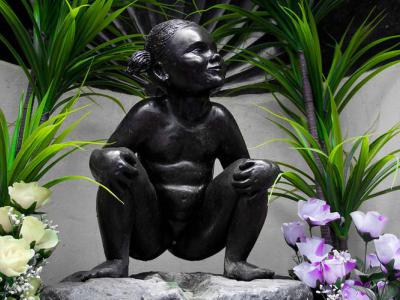
Venturing down a narrow alley that branches off from Rue des Bouchers, you'll stumble upon the whimsical fountain-sculpture known as "Little Girl Peeing". In a cheeky nod to the more famous Little Boy Peeing, this creation completes Brussels' unique trifecta of statues featuring a young boy, a girl, and a canine answering nature's call. While Little Boy Peeing claims the title of the eldest among the trio, dating back to 1619, his female counterpart decided to make her entrance "fashionably late" by several hundred years, debuting in the 1980s with a sassy flair.
Carved from blue-grey limestone by artist Denis-Adrien Debouvrie, who lived in the area and was mysteriously murdered in 2008, the statue of the pigtailed girl stands at half a meter in height. She wears the same expression of serene contentment as the Little Boy Peeing, although she hasn't been welcomed just as warmly as her male predecessor. Some might even say that her presence is more tolerated than embraced. Nevertheless, it is believed that tossing a coin into her fountain may lead to the fulfillment of one's deepest wish.
Carved from blue-grey limestone by artist Denis-Adrien Debouvrie, who lived in the area and was mysteriously murdered in 2008, the statue of the pigtailed girl stands at half a meter in height. She wears the same expression of serene contentment as the Little Boy Peeing, although she hasn't been welcomed just as warmly as her male predecessor. Some might even say that her presence is more tolerated than embraced. Nevertheless, it is believed that tossing a coin into her fountain may lead to the fulfillment of one's deepest wish.
10) Cathedrale des Saints Michel et Gudule (St. Michael and St. Gudula Cathedral) (must see)
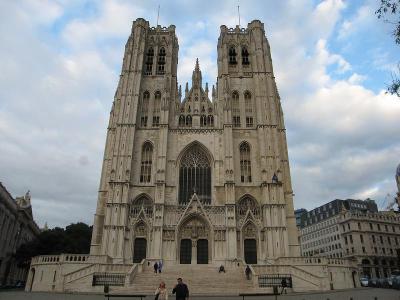
The Cathedral of Saint Michael and Saint Gudula on Treurenberg Hill, Brussels, traces its origins to a 9th-century chapel dedicated to Saint Michael. In 1047, Lambert II, the Duke of Brabant, brought the relics of Saint Gudula to this location, for which purpose a Romanesque-style church was built. Over the course of 300+ years, it had transformed into the striking Brabantine Gothic edifice seen today.
Recognized as Belgium's national church, this cathedral plays a pivotal role in the country's ceremonial life, hosting royal weddings and state funerals, as well as the Te Deum celebration during Belgian National Day. A historic monument since 1936, it underwent multiple restorations, including, most recently, in December 1999, just in time for the wedding of Belgian Crown Prince Philippe to Princess Mathilda. These efforts not only preserved but also uncovered parts of the original 11th-century church which are now visible through strategically placed viewing glass spots on the floor.
Architecturally, the cathedral showcases a French Gothic façade with distinctive twin towers standing 64 meters tall. Unlike traditional designs that feature a rose window, this cathedral’s façade is marked by a large ogival window, enhancing its Brabantine Gothic distinction. The robust structure is supported by double-span flying buttresses adorned with pinnacles and gargoyles.
Approaching the cathedral through a grand staircase, visitors are welcomed into the interior dominated by twelve cylindrical pillars and an array of statues crafted by renowned 17th-century sculptors. The Baroque pulpit, featuring 'Adam and Eve Banished from Paradise' by Flemish sculptor Hendrik Frans Verbruggen, dates back to 1699. The cathedral also contains intricate stained glass windows that chronicle biblical and royal narratives from the 16th to the 19th centuries. In the evening, the window at the nave's base, depicting The Last Judgment, is illuminated from within, creating a captivating spectacle.
Adding to its historic ambiance, the cathedral is also a hub for music, housing two significant pipe organs and a 49-bell carillon in the south tower, along with the bourdon bell named Salvator in the north tower. In recent years, it has also become a conservation site for peregrine falcons which made their nests in its towers. This was further highlighted by the "Falcons for everyone" project featuring live-streaming for public viewing, thus marrying natural history with cultural heritage.
Tips:
Upon entering, be sure to pick up a leaflet providing information about the cathedral's history and details. Access is free, but a small fee is charged if you want to see the archaeological site beneath the existing floors inside the building.
Recognized as Belgium's national church, this cathedral plays a pivotal role in the country's ceremonial life, hosting royal weddings and state funerals, as well as the Te Deum celebration during Belgian National Day. A historic monument since 1936, it underwent multiple restorations, including, most recently, in December 1999, just in time for the wedding of Belgian Crown Prince Philippe to Princess Mathilda. These efforts not only preserved but also uncovered parts of the original 11th-century church which are now visible through strategically placed viewing glass spots on the floor.
Architecturally, the cathedral showcases a French Gothic façade with distinctive twin towers standing 64 meters tall. Unlike traditional designs that feature a rose window, this cathedral’s façade is marked by a large ogival window, enhancing its Brabantine Gothic distinction. The robust structure is supported by double-span flying buttresses adorned with pinnacles and gargoyles.
Approaching the cathedral through a grand staircase, visitors are welcomed into the interior dominated by twelve cylindrical pillars and an array of statues crafted by renowned 17th-century sculptors. The Baroque pulpit, featuring 'Adam and Eve Banished from Paradise' by Flemish sculptor Hendrik Frans Verbruggen, dates back to 1699. The cathedral also contains intricate stained glass windows that chronicle biblical and royal narratives from the 16th to the 19th centuries. In the evening, the window at the nave's base, depicting The Last Judgment, is illuminated from within, creating a captivating spectacle.
Adding to its historic ambiance, the cathedral is also a hub for music, housing two significant pipe organs and a 49-bell carillon in the south tower, along with the bourdon bell named Salvator in the north tower. In recent years, it has also become a conservation site for peregrine falcons which made their nests in its towers. This was further highlighted by the "Falcons for everyone" project featuring live-streaming for public viewing, thus marrying natural history with cultural heritage.
Tips:
Upon entering, be sure to pick up a leaflet providing information about the cathedral's history and details. Access is free, but a small fee is charged if you want to see the archaeological site beneath the existing floors inside the building.
11) Palais Royal (Royal Palace) (must see)
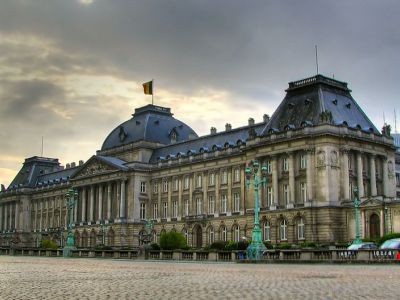
Just around the corner from the Royal Square stands the grand and somewhat unwieldy Royal Palace, a rather solemn conversion of late 18th-century townhouses from the 19th century. The extensive project was initiated by King William I, who ruled both Belgium and the Netherlands from 1815 to 1830. However, the Belgian rebellion of 1830 marked the end of the joint kingdom, and since then, the kings of independent Belgium have spent little time in this palace. In fact, while it remains their official residence, the royal family resides at the Royal Castle of Laeken, just outside Brussels.
Each year, during the summer months (usually from late July to early September), the Royal Palace opens its doors to the public. Visitors can tour several of the palace's rooms and learn about the history of the Belgian monarchy.
A visit here can be worthwhile for a few reasons: the tapestries designed by Goya; the magnificent chandeliers in the Throne Room; and the captivating "Heaven of Delight" ceiling fresco, in the Mirror Room, composed of over a million jewel scarab beetles in radiating green and blue colors.
An even more intriguing option is to explore one of the mansions within the Royal Palace complex, the Hôtel Bellevue, at the corner of Palace Square and Royal Street. This mansion has been transformed into the BELvue Museum, which delves into the brief history of independent Belgium, with corridor displays focusing on the country's kings and rooms dedicated to Belgium as a whole.
The building's location is historically significant, as it was from here that rebellious Belgians fired upon the Dutch army as it attempted to cross Brussels Park in 1830. Original artifacts such as photographs, documents, and letters are on display.
Each year, during the summer months (usually from late July to early September), the Royal Palace opens its doors to the public. Visitors can tour several of the palace's rooms and learn about the history of the Belgian monarchy.
A visit here can be worthwhile for a few reasons: the tapestries designed by Goya; the magnificent chandeliers in the Throne Room; and the captivating "Heaven of Delight" ceiling fresco, in the Mirror Room, composed of over a million jewel scarab beetles in radiating green and blue colors.
An even more intriguing option is to explore one of the mansions within the Royal Palace complex, the Hôtel Bellevue, at the corner of Palace Square and Royal Street. This mansion has been transformed into the BELvue Museum, which delves into the brief history of independent Belgium, with corridor displays focusing on the country's kings and rooms dedicated to Belgium as a whole.
The building's location is historically significant, as it was from here that rebellious Belgians fired upon the Dutch army as it attempted to cross Brussels Park in 1830. Original artifacts such as photographs, documents, and letters are on display.
12) Eglise Notre-Dame du Sablon (Church of Our Lady of the Sablon) (must see)
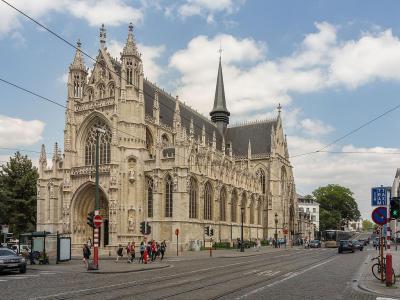
The name "Sablon" originates from the sandy marshland that once occupied the area until the 17th century. The Place du Grand Sablon serves as a hub for antiques and houses leading chocolate makers such as Wittamer and Pierre Marcolini; it's also a great spot for a satisfying lunch. In contrast, the Place du Petit Sablon park is adorned with statues representing the medieval guilds of Brussels. Between the two areas stands this 15th-century church of the Guild of Crossbowmen (or archers), a splendid example of Brabantine Gothic architecture, complete with a lofty nave and chapels embellished with sculptures by some of the most celebrated 17th-century artists.
The structure initially served as a place of worship for the guild members in the 1300s; however, a century later, it had to undergo significant enlargement to accommodate the influx of pilgrims drawn by the purported healing powers of its Madonna statue. The statue was acquired in 1348 through a daring theft from a church in Antwerp, reportedly carried out by a husband-and-wife team motivated by a vision, using a rowing boat. Although it's no longer present, a boat behind the pulpit commemorates this curious event.
Traditionally frequented by Brussels' elite, the church also served as a burial ground for affluent community members until the late 1700s.
Why You Should Visit:
To be awed by the grandeur, yet simultaneously feel the intimacy that sets this church apart from more conventional ones. The structure is exceptionally well-lit thanks to its numerous and striking stained-glass windows – some of the most memorable you'll ever encounter!
Tip:
Visit early on a Sunday to explore the antique market outside the church, adding to the overall experience.
The structure initially served as a place of worship for the guild members in the 1300s; however, a century later, it had to undergo significant enlargement to accommodate the influx of pilgrims drawn by the purported healing powers of its Madonna statue. The statue was acquired in 1348 through a daring theft from a church in Antwerp, reportedly carried out by a husband-and-wife team motivated by a vision, using a rowing boat. Although it's no longer present, a boat behind the pulpit commemorates this curious event.
Traditionally frequented by Brussels' elite, the church also served as a burial ground for affluent community members until the late 1700s.
Why You Should Visit:
To be awed by the grandeur, yet simultaneously feel the intimacy that sets this church apart from more conventional ones. The structure is exceptionally well-lit thanks to its numerous and striking stained-glass windows – some of the most memorable you'll ever encounter!
Tip:
Visit early on a Sunday to explore the antique market outside the church, adding to the overall experience.
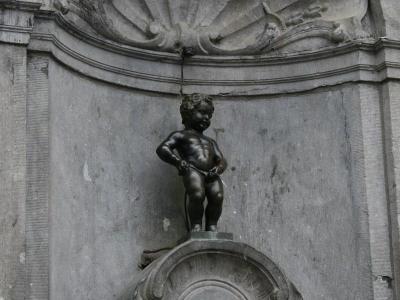
13) Manneken Pis (Little Boy Peeing) (must see)
The small bronze statue of a little boy faithfully relieving himself atop a fountain has paradoxically emerged as an unexpected symbol of Brussels.
The site has been a water fountain since the 13th century, but the statue in its current baroque form was crafted in 1619 to replace an earlier version. Throughout history, the Little Boy Peeing has been stolen and thrown into the canal multiple times. What we see today is a copy made in 1965. The original statue is safeguarded in the Brussels City Museum to protect it from any further mishaps.
This enduring sculpture exemplifies the typical Brussels sense of humor and its capacity to poke fun at its own image. Apart from its humor, however, the statue is renowned for various legends associated with it.
One story claims that it commemorates a brave young boy who urinated on a burning fuse, preventing an explosive charge from detonating and potentially destroying the city's fortification walls. In another account, a wealthy merchant, after an extensive citywide search for his missing son, who was eventually found joyfully urinating in a garden, presented the statue, as a token of his appreciation, to the townspeople who aided in the search. Yet another version of the tale suggests that a young boy woke up to find a fire in the king's castle and promptly used his urine to douse the flames, thus preventing it from burning to the ground.
For about one-third of the year, the statue is dressed up in various costumes by an official dresser who has been appointed by the city since 1755. The current dresser, Nicolas Edelman, is the 13th since the 18th century. In 2014, he volunteered for the job which implies dressing up the statue for about 130 events annually. The role demands flexibility, requiring early mornings or late evenings, regardless of weather or day.
The costumes, donated by various entities, must meet quality standards and not serve political, commercial, or religious agendas. To date, the peeing boy has donned over 500 different outfits, ranging from the earliest-known attire, a Louis XV-provided ensemble portraying him as an elegant 17th-century gentleman, to a samurai robe celebrating the friendship between Belgium and Japan.
Little Boy Peeing has two companion statues: Little Girl Peeing (depicting a urinating girl, installed in 1987 in an alleyway near the Grand Square) and Little Dog Peeing (portraying a urinating dog, erected in 1998 in Dansaert, modeled after a real dog owned by the sculptor). Both of them are located approximately 550 meters away from the Little Boy Peeing but in different directions.
The site has been a water fountain since the 13th century, but the statue in its current baroque form was crafted in 1619 to replace an earlier version. Throughout history, the Little Boy Peeing has been stolen and thrown into the canal multiple times. What we see today is a copy made in 1965. The original statue is safeguarded in the Brussels City Museum to protect it from any further mishaps.
This enduring sculpture exemplifies the typical Brussels sense of humor and its capacity to poke fun at its own image. Apart from its humor, however, the statue is renowned for various legends associated with it.
One story claims that it commemorates a brave young boy who urinated on a burning fuse, preventing an explosive charge from detonating and potentially destroying the city's fortification walls. In another account, a wealthy merchant, after an extensive citywide search for his missing son, who was eventually found joyfully urinating in a garden, presented the statue, as a token of his appreciation, to the townspeople who aided in the search. Yet another version of the tale suggests that a young boy woke up to find a fire in the king's castle and promptly used his urine to douse the flames, thus preventing it from burning to the ground.
For about one-third of the year, the statue is dressed up in various costumes by an official dresser who has been appointed by the city since 1755. The current dresser, Nicolas Edelman, is the 13th since the 18th century. In 2014, he volunteered for the job which implies dressing up the statue for about 130 events annually. The role demands flexibility, requiring early mornings or late evenings, regardless of weather or day.
The costumes, donated by various entities, must meet quality standards and not serve political, commercial, or religious agendas. To date, the peeing boy has donned over 500 different outfits, ranging from the earliest-known attire, a Louis XV-provided ensemble portraying him as an elegant 17th-century gentleman, to a samurai robe celebrating the friendship between Belgium and Japan.
Little Boy Peeing has two companion statues: Little Girl Peeing (depicting a urinating girl, installed in 1987 in an alleyway near the Grand Square) and Little Dog Peeing (portraying a urinating dog, erected in 1998 in Dansaert, modeled after a real dog owned by the sculptor). Both of them are located approximately 550 meters away from the Little Boy Peeing but in different directions.
