Custom Walk in Salzburg, Austria by diana_khasanova_3f33c created on 2025-05-23
Guide Location: Austria » Salzburg
Guide Type: Custom Walk
# of Sights: 10
Tour Duration: 2 Hour(s)
Travel Distance: 2.1 Km or 1.3 Miles
Share Key: ZQ7PH
Guide Type: Custom Walk
# of Sights: 10
Tour Duration: 2 Hour(s)
Travel Distance: 2.1 Km or 1.3 Miles
Share Key: ZQ7PH
How It Works
Please retrieve this walk in the GPSmyCity app. Once done, the app will guide you from one tour stop to the next as if you had a personal tour guide. If you created the walk on this website or come to the page via a link, please follow the instructions below to retrieve the walk in the app.
Retrieve This Walk in App
Step 1. Download the app "GPSmyCity: Walks in 1K+ Cities" on Apple App Store or Google Play Store.



Step 2. In the GPSmyCity app, download(or launch) the guide "Salzburg Map and Walking Tours".
Step 3. Tap the menu button located at upper right corner of the "Walks" screen and select "Retrieve custom walk". Enter the share key: ZQ7PH
1) Mozart Residence (Mozart Wohnhaus) (must see)
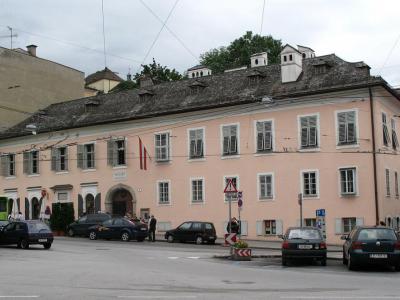
The Dance Master's House (Tanzmeisterhaus), more popularly known as the Mozart Residence (Mozart-Wohnhaus), was once the home of Leopold Mozart and his family, from 1773 to 1787. Here, Wolfgang Amadeus Mozart lived from ages 17 to 25. Located at Makart Square (Makartplatz) Number 8, this building, first documented in 1617, is now a museum.
Originally used by the court dancing master, this house was a venue for dance lessons for nobles. It came to be known as the Dance Master's House by 1713. After several ownership changes, it became the residence of the Mozart family in 1773, who moved here as their place in Grain Lane was no longer adequate for their needs. It was here, in the spacious apartment on the first floor, that the Mozart family would host social gatherings appropriately and where Wolfgang himself stayed until he moved to Vienna in 1781. Leopold Mozart continued to live here until his death in 1787.
The building was partially destroyed by bombs in 1944, but the consequent restoration in the 1950s preserved its late 18th-century stucco decoration. The on-site museum, opened in 1996, showcases musical instruments, documents, and the relocated Magic Flute House (Zauberflötenhäuschen), where Mozart reportedly composed his "The Magic Flute" opera.
A large painting of the family shows the prodigy with his father on the violin and his sister at the piano, while the mother – who had sadly died two years earlier in Paris – is portrayed separately above the threesome. Elsewhere, you'll see three circular targets high on the wall and the air rifle that the Mozarts used to shoot at them in the glass case nearby. These are just some of the marvelous artifacts displayed in the rooms.
Highlights include a screen presentation of Mozart's extensive travels throughout Europe initiated by his father, who was convinced they were essential to enlighten and humanize his prodigy son. In another room, you might be interested in the audio guide's explanation of how Leopold helped to immerse Wolfgang in playing music and later promoted his talented son. The last room has extensive information about how the "Mozart" name has been used for profit, and the one before it shows fraudulent portraits of Mozart throughout the years.
The museum is open daily: from 9 am to 5:30 pm (September through June); and from 8:30 am to 7 pm (July through August). The last admission is 30 minutes before closing.
Originally used by the court dancing master, this house was a venue for dance lessons for nobles. It came to be known as the Dance Master's House by 1713. After several ownership changes, it became the residence of the Mozart family in 1773, who moved here as their place in Grain Lane was no longer adequate for their needs. It was here, in the spacious apartment on the first floor, that the Mozart family would host social gatherings appropriately and where Wolfgang himself stayed until he moved to Vienna in 1781. Leopold Mozart continued to live here until his death in 1787.
The building was partially destroyed by bombs in 1944, but the consequent restoration in the 1950s preserved its late 18th-century stucco decoration. The on-site museum, opened in 1996, showcases musical instruments, documents, and the relocated Magic Flute House (Zauberflötenhäuschen), where Mozart reportedly composed his "The Magic Flute" opera.
A large painting of the family shows the prodigy with his father on the violin and his sister at the piano, while the mother – who had sadly died two years earlier in Paris – is portrayed separately above the threesome. Elsewhere, you'll see three circular targets high on the wall and the air rifle that the Mozarts used to shoot at them in the glass case nearby. These are just some of the marvelous artifacts displayed in the rooms.
Highlights include a screen presentation of Mozart's extensive travels throughout Europe initiated by his father, who was convinced they were essential to enlighten and humanize his prodigy son. In another room, you might be interested in the audio guide's explanation of how Leopold helped to immerse Wolfgang in playing music and later promoted his talented son. The last room has extensive information about how the "Mozart" name has been used for profit, and the one before it shows fraudulent portraits of Mozart throughout the years.
The museum is open daily: from 9 am to 5:30 pm (September through June); and from 8:30 am to 7 pm (July through August). The last admission is 30 minutes before closing.
2) Makartplatz
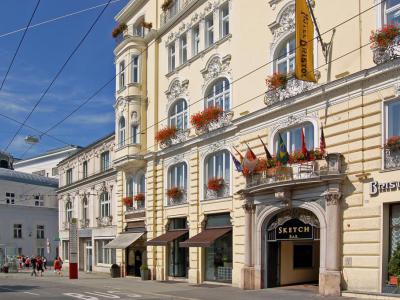
Makartplatz or Markart Square is a busy part of the city of Salzburg surrounded by some of its important buildings. The main attraction in the square today is a museum dedicated to Mozart and his works.
Makartplatz was developed by Archbishop Paris Lodron and architect Bernhard Fischer von Erlach. At the time it was called Hannibalplatz after Hannibal von Raitenau, the brother of the Prince Archbishop Wolf Dietrich. Later, it was named after Hans Makart, a celebrated 19th century Salzburg born artist and son of a chamberlain at the Mirabell Palace.
The most visited part of Makartplatz is the Tanzmeisterhaus where Mozart’s family lived when he was a young boy. The former residence was rebuilt after having been destroyed by bombs in World War II. It is located at No: 8 Makartplatz and houses the museum dedicated to the great composer. The next house to the museum is the Doppler House where eminent physicist, Christian Doppler who founded the Doppler effect of sound was born in 1803. The façade of the Church of the Holy Trinity faces the square and the Landestheater, built by Archbishop Colloredo is located here. The main entrance to the Mirabell Gardens is also located in Makartplatz.
Makartplatz was developed by Archbishop Paris Lodron and architect Bernhard Fischer von Erlach. At the time it was called Hannibalplatz after Hannibal von Raitenau, the brother of the Prince Archbishop Wolf Dietrich. Later, it was named after Hans Makart, a celebrated 19th century Salzburg born artist and son of a chamberlain at the Mirabell Palace.
The most visited part of Makartplatz is the Tanzmeisterhaus where Mozart’s family lived when he was a young boy. The former residence was rebuilt after having been destroyed by bombs in World War II. It is located at No: 8 Makartplatz and houses the museum dedicated to the great composer. The next house to the museum is the Doppler House where eminent physicist, Christian Doppler who founded the Doppler effect of sound was born in 1803. The façade of the Church of the Holy Trinity faces the square and the Landestheater, built by Archbishop Colloredo is located here. The main entrance to the Mirabell Gardens is also located in Makartplatz.
3) Mirabell Palace and Gardens (must see)
Mirabell Palace: part love story, part symphony, part surreal garden party. Here, Baroque drama meets soap opera realness and UNESCO-approved elegance. Originally constructed in 1606 by Prince-Archbishop Wolf Dietrich von Raitenau - who wasn’t just building a palace, but also a very fancy love nest for himself and his mistress - this place has always known how to turn heads.
After Wolf got the boot in 1612 (through palace intrigue), his successor renamed it Mirabell - meaning “wonderful” in Italian, which, come to think of it, is a bit more subtle than “Archbishop’s Love Shack.” The whole palace got a glitzy Baroque makeover between 1721 and 1727, and later a Neoclassical facelift - because palaces, of all properties, do need to keep up appearances...
Step inside and brace yourself for the grand staircase - or the 'staircase of thunder' if you like: with sweeping curves, angelic sculptures, and a shine so dramatic it practically sings. At the top of it is the Marble Hall. Mozart played here. You won’t. But you could get married here - if you book a few years ahead and maybe win a small lottery...
Fun fact: Hitler’s sister-in-law tied the knot here in 1944, with some disturbingly famous guests in attendance. But don’t let that kill the vibe - today, it’s more Mozart concerts and Instagram moments than fascist footnotes.
Venture further and you'll find a chapel dressed in Baroque finery, with statues so saintly they might just bless your photo.
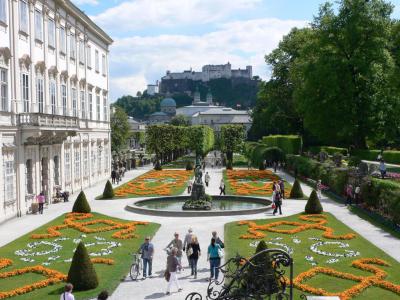
Outside, the gardens are a mythological fever dream. Statues of Hercules, Aeneas, and Pluto look on, while the flower beds explode in geometric perfection - a riot of color that makes your eyeballs do pirouettes. At the center of it is the Pegasus Fountain, a scene-stealer from The Sound of Music’s “Do Re Mi.” Yes, that very one...
Climb the steps like a Von Trapp child chasing high notes, peek into the vine tunnel and hedge maze, and finish at Dwarf Park - where a regiment of lumpy marble gnomes stares you down with all the charm of a slightly haunted chess set.
And beyond it all, the High Salzburg Fortress, sitting smugly on its hilltop, watches centuries go by.
After Wolf got the boot in 1612 (through palace intrigue), his successor renamed it Mirabell - meaning “wonderful” in Italian, which, come to think of it, is a bit more subtle than “Archbishop’s Love Shack.” The whole palace got a glitzy Baroque makeover between 1721 and 1727, and later a Neoclassical facelift - because palaces, of all properties, do need to keep up appearances...
Step inside and brace yourself for the grand staircase - or the 'staircase of thunder' if you like: with sweeping curves, angelic sculptures, and a shine so dramatic it practically sings. At the top of it is the Marble Hall. Mozart played here. You won’t. But you could get married here - if you book a few years ahead and maybe win a small lottery...
Fun fact: Hitler’s sister-in-law tied the knot here in 1944, with some disturbingly famous guests in attendance. But don’t let that kill the vibe - today, it’s more Mozart concerts and Instagram moments than fascist footnotes.
Venture further and you'll find a chapel dressed in Baroque finery, with statues so saintly they might just bless your photo.
Outside, the gardens are a mythological fever dream. Statues of Hercules, Aeneas, and Pluto look on, while the flower beds explode in geometric perfection - a riot of color that makes your eyeballs do pirouettes. At the center of it is the Pegasus Fountain, a scene-stealer from The Sound of Music’s “Do Re Mi.” Yes, that very one...
Climb the steps like a Von Trapp child chasing high notes, peek into the vine tunnel and hedge maze, and finish at Dwarf Park - where a regiment of lumpy marble gnomes stares you down with all the charm of a slightly haunted chess set.
And beyond it all, the High Salzburg Fortress, sitting smugly on its hilltop, watches centuries go by.
4) Getreidegasse (Grain Lane) (must see)
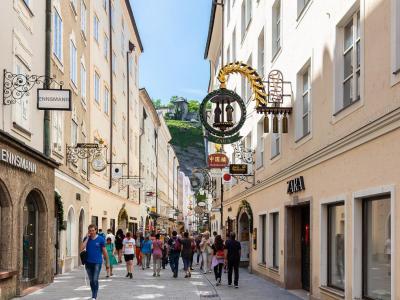
Old Salzburg's colorful main drag, Grain Lane (Getreidegasse) has been a center of trade since Roman times. Now a UNESCO World Heritage Site since 1996, this historic street is famous for being the birthplace of Wolfgang Amadeus Mozart, at No. 9, where he lived until the age of 17. The narrow lane is lined with high townhouses and is distinguished by its traditional wrought-iron guild signs advertising what is (or used to be) sold inside.
The street, originally named Trot Lane (Trabegasse), traces its beginnings to around 1150 when it served as a pathway from Salzburg's trade center to the suburb of Mülln. Over the centuries, its name evolved several times, reflecting its changing role in the city's economy. By the 14th century, the prince-archbishops granted the citizens staple rights, transforming the area into a vibrant trading zone and attracting Salzburg's patricians and officials who established their residences here.
Dating mainly from the 15th century, the buildings are tall and narrow because this was prime real estate, and there was nowhere to build but up. Space was always tight, as the town was squeezed between the river and the mountain, with lots of land set aside for the church. The architecture still looks much as it did in Mozart's day, though many of the buildings themselves are now inhabited by Austrian clothiers and international chain outlets. At Number 37 you will find the glamorous Goldener Hirsch hotel, a hotspot for stylish gatherings – so, if you're appropriately attired, you may wish to view the lobby and enjoy an aperitif in its gorgeous bar, the watering hole of chic Salzburg.
What was once the Salzburg quarter of prosperous medieval burghers (merchants) now bustles with the tourist trade. Today, Grain Lane forms part of a pedestrian zone and continues to be one of Salzburg's prime tourist attractions. Efforts have been made to preserve its authentic character amidst the conversion of historic residential houses into commercial premises.
Visitors can also encounter the "puppet woman" (Marionettenfrau), a local figure selling puppets since 1987, adding a unique cultural touch to the street.
Tip:
If planning some shopping for gifts, take a look in a couple of stores because they often carry similar products for different prices. Small alleys lead off the main street – do wander down these as lots of smaller shops and nice cafés can be found there.
The street, originally named Trot Lane (Trabegasse), traces its beginnings to around 1150 when it served as a pathway from Salzburg's trade center to the suburb of Mülln. Over the centuries, its name evolved several times, reflecting its changing role in the city's economy. By the 14th century, the prince-archbishops granted the citizens staple rights, transforming the area into a vibrant trading zone and attracting Salzburg's patricians and officials who established their residences here.
Dating mainly from the 15th century, the buildings are tall and narrow because this was prime real estate, and there was nowhere to build but up. Space was always tight, as the town was squeezed between the river and the mountain, with lots of land set aside for the church. The architecture still looks much as it did in Mozart's day, though many of the buildings themselves are now inhabited by Austrian clothiers and international chain outlets. At Number 37 you will find the glamorous Goldener Hirsch hotel, a hotspot for stylish gatherings – so, if you're appropriately attired, you may wish to view the lobby and enjoy an aperitif in its gorgeous bar, the watering hole of chic Salzburg.
What was once the Salzburg quarter of prosperous medieval burghers (merchants) now bustles with the tourist trade. Today, Grain Lane forms part of a pedestrian zone and continues to be one of Salzburg's prime tourist attractions. Efforts have been made to preserve its authentic character amidst the conversion of historic residential houses into commercial premises.
Visitors can also encounter the "puppet woman" (Marionettenfrau), a local figure selling puppets since 1987, adding a unique cultural touch to the street.
Tip:
If planning some shopping for gifts, take a look in a couple of stores because they often carry similar products for different prices. Small alleys lead off the main street – do wander down these as lots of smaller shops and nice cafés can be found there.
5) Collegiate Church
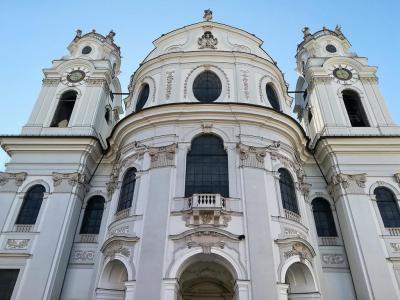
The Collegiate Church was built as the place of worship for the adjacent Benedictine University. It is the finest example of Baroque architecture in Salzburg and became the model for other churches in Austria and Southern Germany.
Prince Archbishop Paris London established the Benedictine University in 1623 and made plans to build a church for the university. Renowned architect Johann Bernhard Fischer von Erlach was commissioned to design the building, and the result was one of his finest works. The church was constructed between 1694 and 1707. It was used as a hay store when Napoleon’s army invaded Salzburg and was disbanded in 1810 when the city came under the Bavarian rule. During the Austro-Hungarian rule, it was a secondary school and military church. It was the venue of the Great World Theater in 1922, and in 1964 it regained its original purpose after the University of Salzburg was re-established.
The interior has a modified Greek cross plan with a convex façade. In 1740 a high altar created by Alton Pfaffinger was added with classical columns representing the seven pillars of wisdom. The altar paintings were by celebrated religious artist Johann Michael Rottmayr. The chapels inside are dedicated to the patron saints of the four university disciplines, Saint Thomas Aquinas of theology, Saint Ivo of jurisprudence, Saint Luke of medicine, and Saint Catherine of philosophy.
Prince Archbishop Paris London established the Benedictine University in 1623 and made plans to build a church for the university. Renowned architect Johann Bernhard Fischer von Erlach was commissioned to design the building, and the result was one of his finest works. The church was constructed between 1694 and 1707. It was used as a hay store when Napoleon’s army invaded Salzburg and was disbanded in 1810 when the city came under the Bavarian rule. During the Austro-Hungarian rule, it was a secondary school and military church. It was the venue of the Great World Theater in 1922, and in 1964 it regained its original purpose after the University of Salzburg was re-established.
The interior has a modified Greek cross plan with a convex façade. In 1740 a high altar created by Alton Pfaffinger was added with classical columns representing the seven pillars of wisdom. The altar paintings were by celebrated religious artist Johann Michael Rottmayr. The chapels inside are dedicated to the patron saints of the four university disciplines, Saint Thomas Aquinas of theology, Saint Ivo of jurisprudence, Saint Luke of medicine, and Saint Catherine of philosophy.
6) Mozartplatz (Mozart Square) (must see)
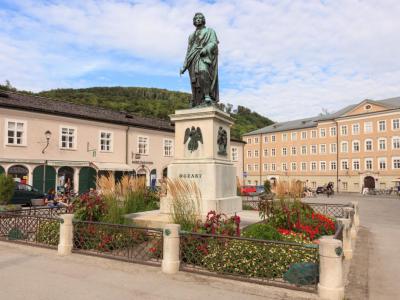
Mozart Square (Mozartplatz), in the historic Old Town of Salzburg, is named after the famous composer Wolfgang Amadeus Mozart, who was born in the city (just a few blocks away from this place, in fact) and spent most of his first 25 years here (from 1756 to 1781).
This area was redeveloped in the early 17th century by Prince-Archbishop Wolf Dietrich von Raitenau and was originally known as Michael's Square (Michaelsplatz), featuring a baroque fountain with a statue of Saint Michael. The latter was eventually replaced by the Mozart Monument (Mozartdenkmal) in 1842 to mark the 50th anniversary of the composer's death.
The monument was unveiled in the presence of Mozart's two surviving sons. The Roman mosaic found on the site during the construction is seen at the base of the statue, bearing an inscription about happiness and protection from evil. The marble pedestal of the statue was a gift from King Ludwig I of Bavaria. This monument was the first sign of public recognition the great composer had received from his hometown since his untimely passing. The music festival held that year sowed the seed for what would later become the world-renowned annual Salzburg Festival.
The square is bordered by several notable buildings. On the north side (adjacent to part of the old city wall dating back to the first half of the 1600s) is the Imhofstöckl edifice housing the city's tourist information office. The New Residence (Neue Residenz) at Number 1, which hosts the Salzburg Museum, together with several 17th-century houses with uniform facades, line the other sides of the square. Notably, one of these houses was the residence of Mozart's widow, Constanze Mozart-Nissen. The square also features the Salzburg Christmas Museum and Café Glockenspiel, sharing space at Number 2.
The on-site Resistance Memorial commemorates the transnational resistance against Bavaria's Wackersdorf reprocessing plant in the late 1980s. Inaugurated in 2000, it features a section of the original fence and a green radiation sign and honors over 420,000 objectors who influenced Austria's anti-nuclear policy.
Tip:
Those looking to buy tacky souvenirs should check out the Zum Mozart shop located at one of the corners of the square.
This area was redeveloped in the early 17th century by Prince-Archbishop Wolf Dietrich von Raitenau and was originally known as Michael's Square (Michaelsplatz), featuring a baroque fountain with a statue of Saint Michael. The latter was eventually replaced by the Mozart Monument (Mozartdenkmal) in 1842 to mark the 50th anniversary of the composer's death.
The monument was unveiled in the presence of Mozart's two surviving sons. The Roman mosaic found on the site during the construction is seen at the base of the statue, bearing an inscription about happiness and protection from evil. The marble pedestal of the statue was a gift from King Ludwig I of Bavaria. This monument was the first sign of public recognition the great composer had received from his hometown since his untimely passing. The music festival held that year sowed the seed for what would later become the world-renowned annual Salzburg Festival.
The square is bordered by several notable buildings. On the north side (adjacent to part of the old city wall dating back to the first half of the 1600s) is the Imhofstöckl edifice housing the city's tourist information office. The New Residence (Neue Residenz) at Number 1, which hosts the Salzburg Museum, together with several 17th-century houses with uniform facades, line the other sides of the square. Notably, one of these houses was the residence of Mozart's widow, Constanze Mozart-Nissen. The square also features the Salzburg Christmas Museum and Café Glockenspiel, sharing space at Number 2.
The on-site Resistance Memorial commemorates the transnational resistance against Bavaria's Wackersdorf reprocessing plant in the late 1980s. Inaugurated in 2000, it features a section of the original fence and a green radiation sign and honors over 420,000 objectors who influenced Austria's anti-nuclear policy.
Tip:
Those looking to buy tacky souvenirs should check out the Zum Mozart shop located at one of the corners of the square.
7) Residenzplatz (Residence Square) (must see)
As Salzburg's center of government, the historic Residence Square (Residenzplatz) has long been at the heart of the city, set on the site of a former Roman Forum. Originally known as Main Square (Hauptplatz), it was renamed after the Old Residence (Alte Residenz) Palace, the former dwelling of the city's rulers – prince-archbishops – located to the west.
Flanking the square on the sides are several important buildings, such as the Salzburg Cathedral (to the south), and the New Residence (Neue Residenz) to the east, with its bell tower now housing the Salzburg Museum (to the west).
The square's construction began in 1587, as part of the grand project by Prince-Archbishop Wolf Dietrich von Raitenau to make Salzburg the new "Rome of the North." For that purpose, some of the surrounding medieval homes, as well as the cemetery (above the ancient Roman Forum) had to be leveled.
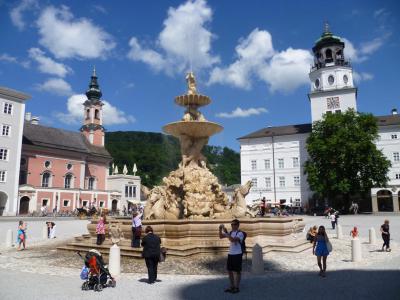
The square's focal point is the massive central 45-foot-tall Residence Fountain (Residenzbrunnen). Completed between 1656 and 1661 by Tommaso di Garona, it is as Italian as it can be (reportedly the largest and most beautiful Baroque fountain outside of Italy). Made from Untersberg limestone, its design features a Triton statue that propels water upwards – an over-the-top version of Bernini's famous Triton Fountain in Rome.
Notably, in the movie “The Sound Of Music”, the lead character Maria sings "I Have Confidence in Me" while crossing the square by bus on her way to the Trapp villa. She's also seen playfully splashing the fountain's spouting horses.
In the more recent past, Residence Square served as a venue for major rock concerts by the likes of Joe Cocker and Tina Turner. Presently, apart from being a historical site, it is also a vibrant cultural venue hosting various events, including an open-air cinema during summer, a fair in September, and a Christmas market during Advent.
In the 2010s, the square underwent a refurbishment which included the erection of a monument to mark the 80th anniversary of the Nazi book burning that took place here in 1938.
Tip:
Grab some lunch from the nearby bakeries or shops and sit on one of the benches near the fountain, enjoying the view.
Flanking the square on the sides are several important buildings, such as the Salzburg Cathedral (to the south), and the New Residence (Neue Residenz) to the east, with its bell tower now housing the Salzburg Museum (to the west).
The square's construction began in 1587, as part of the grand project by Prince-Archbishop Wolf Dietrich von Raitenau to make Salzburg the new "Rome of the North." For that purpose, some of the surrounding medieval homes, as well as the cemetery (above the ancient Roman Forum) had to be leveled.
The square's focal point is the massive central 45-foot-tall Residence Fountain (Residenzbrunnen). Completed between 1656 and 1661 by Tommaso di Garona, it is as Italian as it can be (reportedly the largest and most beautiful Baroque fountain outside of Italy). Made from Untersberg limestone, its design features a Triton statue that propels water upwards – an over-the-top version of Bernini's famous Triton Fountain in Rome.
Notably, in the movie “The Sound Of Music”, the lead character Maria sings "I Have Confidence in Me" while crossing the square by bus on her way to the Trapp villa. She's also seen playfully splashing the fountain's spouting horses.
In the more recent past, Residence Square served as a venue for major rock concerts by the likes of Joe Cocker and Tina Turner. Presently, apart from being a historical site, it is also a vibrant cultural venue hosting various events, including an open-air cinema during summer, a fair in September, and a Christmas market during Advent.
In the 2010s, the square underwent a refurbishment which included the erection of a monument to mark the 80th anniversary of the Nazi book burning that took place here in 1938.
Tip:
Grab some lunch from the nearby bakeries or shops and sit on one of the benches near the fountain, enjoying the view.
8) Salzburger Dom (Salzburg Cathedral) (must see)
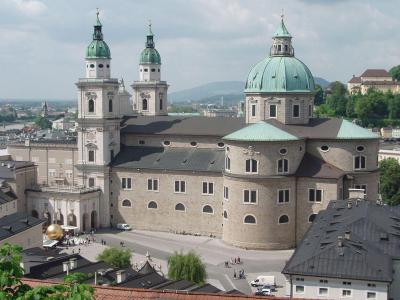
Absolutely massive, incredibly ornate, and very welcoming towards visitors of all stripes, Salzburg Cathedral (Salzburger Dom) is the 17th-century Baroque church of the Roman Catholic denomination. It is dedicated to Saint Rupert and Saint Vergilius. The former founded the church in 774 on the remnants of a Roman town, and in 1181 the cathedral was rebuilt after a fire. In the 17th century, it was completely remodeled in the Baroque style under Prince-Bishop Wolf Dietrich von Raitenau to its present appearance.
In 1756, Wolfgang Amadeus Mozart was baptized here; the cathedral still contains the 14th-century Gothic baptismal font in which the composer was baptized (just see to the left upon entering). Famously, the grand bronze baptismal font was also used for the baptism of yet another artistic celebrity, Joseph Mohr, the Austrian writer, who wrote the words to the Christmas carol "Silent Night."
During World War II, the cathedral was damaged when a single bomb crashed through its central dome but was completely restored by 1959.
Salzburg Cathedral is framed by three arches linking it to the Residence Palace and Saint Peter's Abbey, creating an enclosed square. The cathedral's façade, made from dark grey stone with bright Untersberg marble, includes three portals leading to bronze doors, surrounded by statues of saints and topped with figures of the four evangelists and a scene of the Transfiguration of Jesus. The cathedral also houses historic bronze gates inside these portals, representing Faith, Hope, and Love, created by renowned sculptors in the mid-20th century.
The oldest bells in the cathedral are the Marien and the Virgil, both cast in 1628. The Salvator bell of the cathedral is the second largest bell in Austria, after the Pummerin bell in Vienna Cathedral.
Once inside, a number of organs are to be admired: one on each side of the high altar and a magnificent one in the rear traditional placing. Make sure to take a minute to sit in a pew and absorb everything around – you won't be disappointed. Cameras are allowed and there are some excellent photo opportunities to be had.
Tip:
Take a downward trip to the crypt – there is as much underground as above.
It is also worth attending a Sunday mass at 10 am, as you get a full orchestra and chorus.
In 1756, Wolfgang Amadeus Mozart was baptized here; the cathedral still contains the 14th-century Gothic baptismal font in which the composer was baptized (just see to the left upon entering). Famously, the grand bronze baptismal font was also used for the baptism of yet another artistic celebrity, Joseph Mohr, the Austrian writer, who wrote the words to the Christmas carol "Silent Night."
During World War II, the cathedral was damaged when a single bomb crashed through its central dome but was completely restored by 1959.
Salzburg Cathedral is framed by three arches linking it to the Residence Palace and Saint Peter's Abbey, creating an enclosed square. The cathedral's façade, made from dark grey stone with bright Untersberg marble, includes three portals leading to bronze doors, surrounded by statues of saints and topped with figures of the four evangelists and a scene of the Transfiguration of Jesus. The cathedral also houses historic bronze gates inside these portals, representing Faith, Hope, and Love, created by renowned sculptors in the mid-20th century.
The oldest bells in the cathedral are the Marien and the Virgil, both cast in 1628. The Salvator bell of the cathedral is the second largest bell in Austria, after the Pummerin bell in Vienna Cathedral.
Once inside, a number of organs are to be admired: one on each side of the high altar and a magnificent one in the rear traditional placing. Make sure to take a minute to sit in a pew and absorb everything around – you won't be disappointed. Cameras are allowed and there are some excellent photo opportunities to be had.
Tip:
Take a downward trip to the crypt – there is as much underground as above.
It is also worth attending a Sunday mass at 10 am, as you get a full orchestra and chorus.
9) St. Peter's Abbey and Cemetery (must see)
Saint Peter's Abbey (Stift Sankt Peter) is a Benedictine monastery and former cathedral. Considered one of the oldest monasteries in the German-speaking world, the abbey was founded in 696 by Saint Rupert. Despite challenges during the Nazi regime in 1938, the abbey maintained operation and remains active to this very day.
A marvelous steeple crowned with an onion dome gives an admirable facade to the Abbey Church. Since its dedication in 1147, this Romanesque church underwent multiple renovations, acquiring its Rococo style in 1782. The church houses significant graves, including that of Martin Luther's superior.
Saint Peter's Abbey is home to Austria's oldest library, comprising nearly 100,000 volumes. The Rococo-style library is particularly noted for its extensive collection of manuscripts, incunabula, and local history volumes, along with special collections of graphics and maps. It also contains a notable collection of music manuscripts from composers like Mozart and Haydn. Additionally, the abbey houses diverse collections of paintings and other artifacts, although some are not accessible to the public. Access to the library requires a special permit.
During his early years in Salzburg, Wolfgang Amadeus Mozart composed the Dominikus Mass for Saint Peter's Abbot Dominikus Hagenauer, in 1769. Hagenauer wrote in his diary: "Music for the Mass composed by Wolfgang Mozart, 14 years of age, was in every one's opinion most elegant. Wolfgang Mozart played on the great organ for half an hour to the astonishment of all." The composer returned to Saint Peter's in 1783 to conduct his "Mass in C minor," which is now performed at the Salzburg Festival each summer.
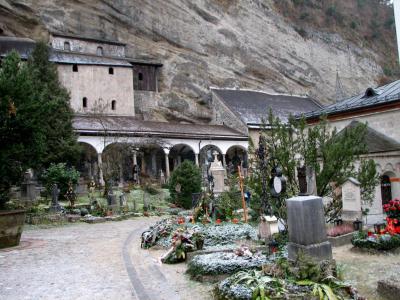
The abbey complex also contains a very old (established circa 700 AD) cemetery. The oldest graves in Saint Peter's Cemetery (Petersfriedhof) date back to the late 13th century. Distinguished individuals including Mozart's sister Nannerl (an accomplished musician in her own right), Joseph Haydn's brother Michael, and sculptor Josef Thorak are buried here.
The cemetery grounds are also known for the catacombs carved into rocks, which served as early Christian assembly places and hermitages. Wonderful to visit, they are filled with early altars, faded murals, and inscriptions.
In "The Sound of Music" movie, the Von Trapp family goes into hiding from the Nazis at a local cemetery. The actual scene was filmed on a Hollywood set meticulously recreating the setting inspired by Saint Peter's cemetery.
Why You Should Visit:
Everything here is free to visit except for the catacombs which cost a modest fee.
A marvelous steeple crowned with an onion dome gives an admirable facade to the Abbey Church. Since its dedication in 1147, this Romanesque church underwent multiple renovations, acquiring its Rococo style in 1782. The church houses significant graves, including that of Martin Luther's superior.
Saint Peter's Abbey is home to Austria's oldest library, comprising nearly 100,000 volumes. The Rococo-style library is particularly noted for its extensive collection of manuscripts, incunabula, and local history volumes, along with special collections of graphics and maps. It also contains a notable collection of music manuscripts from composers like Mozart and Haydn. Additionally, the abbey houses diverse collections of paintings and other artifacts, although some are not accessible to the public. Access to the library requires a special permit.
During his early years in Salzburg, Wolfgang Amadeus Mozart composed the Dominikus Mass for Saint Peter's Abbot Dominikus Hagenauer, in 1769. Hagenauer wrote in his diary: "Music for the Mass composed by Wolfgang Mozart, 14 years of age, was in every one's opinion most elegant. Wolfgang Mozart played on the great organ for half an hour to the astonishment of all." The composer returned to Saint Peter's in 1783 to conduct his "Mass in C minor," which is now performed at the Salzburg Festival each summer.
The abbey complex also contains a very old (established circa 700 AD) cemetery. The oldest graves in Saint Peter's Cemetery (Petersfriedhof) date back to the late 13th century. Distinguished individuals including Mozart's sister Nannerl (an accomplished musician in her own right), Joseph Haydn's brother Michael, and sculptor Josef Thorak are buried here.
The cemetery grounds are also known for the catacombs carved into rocks, which served as early Christian assembly places and hermitages. Wonderful to visit, they are filled with early altars, faded murals, and inscriptions.
In "The Sound of Music" movie, the Von Trapp family goes into hiding from the Nazis at a local cemetery. The actual scene was filmed on a Hollywood set meticulously recreating the setting inspired by Saint Peter's cemetery.
Why You Should Visit:
Everything here is free to visit except for the catacombs which cost a modest fee.
10) Kapitelplatz (Chapter Square)
Chapter Square (Kapitelplatz), in the heart of Salzburg’s Old Town, is a spacious, diamond-shaped square surrounded by historical buildings. Bordering it on the north side is the Salzburg Cathedral. The Cathedral Provost's Office and the Archbishop's Palace are on the east side, while to its west are the novice's wing of Saint Peter's Monastery and the Cathedral Chapter's mills. The religious sites around the square serve as reminders of the powerful archdiocese that once ruled the city.
The square and the adjacent Chapter Lane (Kapitelgasse) are named after the Salzburg cathedral chapter, a set of canons that regulated worship services at the cathedral and in the city of Salzburg.
The Waldstein Canon House at Number 2, first mentioned in 1547, has served various purposes through the centuries, from housing the cathedral chapter's administration to serving as military and tax offices. It is now used by the Archdiocese of Salzburg. Nearby, the Number 4 Chapter House was rebuilt in its present form after a catastrophic fire in 1598. Today, this building houses the University of Salzburg’s rectorate and administrative offices.
The Salm-Firmian Canonical House at Numbers 5-7, initially designed as a hospital and later transformed into canon housing, is now a part of the university, hosting law libraries. Also noteworthy is the Cathedral Deanery at Number 6.
Significant too is the Cardinal Schwarzenberg House, which has transitioned from a granary to a "storehouse of knowledge," presently housing the cathedral archive and music rooms.
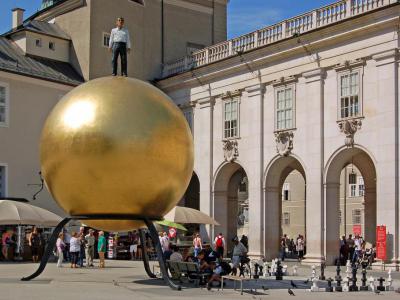
Aside from the beautiful view of High Salzburg Fortress (perfect for taking pictures), three things stand out on the square itself. These include the giant chessboard that often draws a crowd; the playful modern sculpture of the 'emotionless man' on the golden ball (called 'Sphaera') installed in 2007; and a spectacular Neptune's Fountain, built in 1732 on the site of one of the old horse ponds. Forming part of the so-called Chapter Flood (Kapitelschwemme) ensemble, the fountain shows the God of the Sea holding a trident and crown while being mounted on a seahorse spurting water. It looks a bit like a mini-version of the Fontana di Trevi in Rome, which is probably why many tourists throw coins into the shallow well.
The square and the adjacent Chapter Lane (Kapitelgasse) are named after the Salzburg cathedral chapter, a set of canons that regulated worship services at the cathedral and in the city of Salzburg.
The Waldstein Canon House at Number 2, first mentioned in 1547, has served various purposes through the centuries, from housing the cathedral chapter's administration to serving as military and tax offices. It is now used by the Archdiocese of Salzburg. Nearby, the Number 4 Chapter House was rebuilt in its present form after a catastrophic fire in 1598. Today, this building houses the University of Salzburg’s rectorate and administrative offices.
The Salm-Firmian Canonical House at Numbers 5-7, initially designed as a hospital and later transformed into canon housing, is now a part of the university, hosting law libraries. Also noteworthy is the Cathedral Deanery at Number 6.
Significant too is the Cardinal Schwarzenberg House, which has transitioned from a granary to a "storehouse of knowledge," presently housing the cathedral archive and music rooms.
Aside from the beautiful view of High Salzburg Fortress (perfect for taking pictures), three things stand out on the square itself. These include the giant chessboard that often draws a crowd; the playful modern sculpture of the 'emotionless man' on the golden ball (called 'Sphaera') installed in 2007; and a spectacular Neptune's Fountain, built in 1732 on the site of one of the old horse ponds. Forming part of the so-called Chapter Flood (Kapitelschwemme) ensemble, the fountain shows the God of the Sea holding a trident and crown while being mounted on a seahorse spurting water. It looks a bit like a mini-version of the Fontana di Trevi in Rome, which is probably why many tourists throw coins into the shallow well.
