Custom Walk in Cologne, Germany by gabriela_rmo_9837d created on 2025-05-28
Guide Location: Germany » Cologne
Guide Type: Custom Walk
# of Sights: 11
Tour Duration: 2 Hour(s)
Travel Distance: 3.2 Km or 2 Miles
Share Key: XYPC9
Guide Type: Custom Walk
# of Sights: 11
Tour Duration: 2 Hour(s)
Travel Distance: 3.2 Km or 2 Miles
Share Key: XYPC9
How It Works
Please retrieve this walk in the GPSmyCity app. Once done, the app will guide you from one tour stop to the next as if you had a personal tour guide. If you created the walk on this website or come to the page via a link, please follow the instructions below to retrieve the walk in the app.
Retrieve This Walk in App
Step 1. Download the app "GPSmyCity: Walks in 1K+ Cities" on Apple App Store or Google Play Store.



Step 2. In the GPSmyCity app, download(or launch) the guide "Cologne Map and Walking Tours".
Step 3. Tap the menu button located at upper right corner of the "Walks" screen and select "Retrieve custom walk". Enter the share key: XYPC9
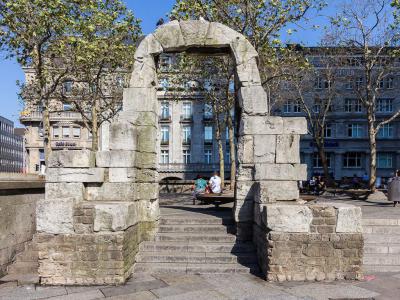
1) Roman Gate
On the side of Domplatz [Cathedral Square] there is an ancient structure vaguely reminiscent of what was once a Roman wall. Built in the days of the Roman Empire, a symbolic gate now stands in its place.
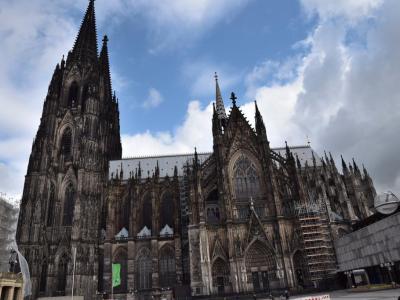
2) Kölner Dom (Cologne Cathedral) (must see)
The Cologne Cathedral - a place where Gothic ambition met a 600-year-long construction delay and still came out looking fabulous... Indeed, the magnitude of this building dwarfs your expectations and your camera’s field of view.
This towering masterpiece is Germany’s most visited landmark, with 20,000 people dropping by daily - not bad for a church that took over six centuries to finish. At 157 meters (that’s 515 feet for those who still think in feet), it’s the tallest twin-spired church on Earth, the second-tallest church in Europe, and the third tallest in the world. Clearly, Cologne doesn’t do things halfway...
Construction began in 1248, then took a casual break around 1560. The west tower wasn't completed until 1880, when 19th-century officials unearthed the original blueprints and reasoned, “Why not finish it?”
But the site’s sacred history runs much deeper than that. Since the 4th century, Christians have been building here. The "Old Cathedral" stood from 818 to 1248, and even earlier, a baptistery once graced the eastern end.
So, what kicked off this giant Gothic project? A golden box. Specifically, the Shrine of the Three Kings, believed to hold relics of the Three Wise Men (also known as the Magi - the ones who visited baby Jesus and offered him gifts). Its construction started at the eastern arm to house the shrine, then the west front followed - until everything just kind of stopped in 1473. The work-in-progress look lasted for centuries, complete with a giant crane stuck on top for 400 years. Talk about an eternal fixer-upper...
The cathedral's highlights include the 1322 black marble High Altar and that aforementioned blingy shrine, which began in 1190 and shines brighter than a royal wedding. There's also the 10th-century Gero Crucifix, the 1290 Milan Madonna, and a legal twist - a 13th-century stone tablet that once granted rights to Cologne’s Jewish residents.
And, of course, there are bells - eleven in total. The Saint Peter Bell, cast in 1922, was once the biggest free-swinging bell in the world. You’ll feel it before you hear it...
Insider Tip:
Don’t skip the rear mosaics - they're stunning. Brave the climb for sky-high views, or sneak into the underground parking to see the cathedral’s ancient roots... literally.
This towering masterpiece is Germany’s most visited landmark, with 20,000 people dropping by daily - not bad for a church that took over six centuries to finish. At 157 meters (that’s 515 feet for those who still think in feet), it’s the tallest twin-spired church on Earth, the second-tallest church in Europe, and the third tallest in the world. Clearly, Cologne doesn’t do things halfway...
Construction began in 1248, then took a casual break around 1560. The west tower wasn't completed until 1880, when 19th-century officials unearthed the original blueprints and reasoned, “Why not finish it?”
But the site’s sacred history runs much deeper than that. Since the 4th century, Christians have been building here. The "Old Cathedral" stood from 818 to 1248, and even earlier, a baptistery once graced the eastern end.
So, what kicked off this giant Gothic project? A golden box. Specifically, the Shrine of the Three Kings, believed to hold relics of the Three Wise Men (also known as the Magi - the ones who visited baby Jesus and offered him gifts). Its construction started at the eastern arm to house the shrine, then the west front followed - until everything just kind of stopped in 1473. The work-in-progress look lasted for centuries, complete with a giant crane stuck on top for 400 years. Talk about an eternal fixer-upper...
The cathedral's highlights include the 1322 black marble High Altar and that aforementioned blingy shrine, which began in 1190 and shines brighter than a royal wedding. There's also the 10th-century Gero Crucifix, the 1290 Milan Madonna, and a legal twist - a 13th-century stone tablet that once granted rights to Cologne’s Jewish residents.
And, of course, there are bells - eleven in total. The Saint Peter Bell, cast in 1922, was once the biggest free-swinging bell in the world. You’ll feel it before you hear it...
Insider Tip:
Don’t skip the rear mosaics - they're stunning. Brave the climb for sky-high views, or sneak into the underground parking to see the cathedral’s ancient roots... literally.
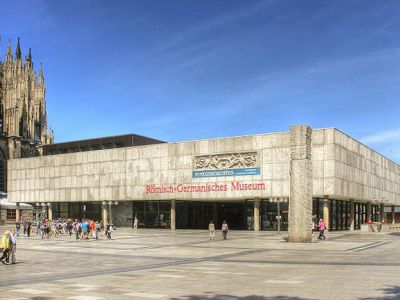
3) Roman-German Museum
If you have been to Cologne, you would certainly have visited the Roman-German Museum, an important archaeological museum that has a large collection of Roman artifacts from the Roman settlement of Colonia Claudia Ara Agrippinensium, on which modern Cologne is built.
The Römisch-Germanisches Museum, which opened in 1974, is near the Cologne Cathedral on the site of a 3rd-century villa. The villa was discovered in 1941 during the construction of an air-raid shelter. On the floor of the main room of the villa is the renowned Dionysus mosaic. Since the mosaic could not be moved easily, the architects Klaus Renner and Heinz Röcke designed the museum around the mosaic.
The inner courtyards of the museum mimic the layout of the ancient villa. The mosaic covers an area of 70 square meters and is made of millions of ceramic, limestone and glass pieces. This exquisite mosaic skillfully depicts the Greek God of wine Dionysus surrounded by dancers, Pan, Cupid, satyrs at a delightful table scene. The mosaic is in a good condition preserved by the remains of the building that fell on it during the fourth century Germanic raids.
Do not miss out the reconstructed Tomb of Poblicius, a veteran who served in the Fifth Legion. This tomb stands above the mosaic and is a major attraction here. It is 15 meters high and dates back to 40 AD. Another attraction you must not miss here is the Practorium. Ruins of this palace were found recently located close to the cathedral. This palace belonged to the Lower Germania Roman governors. All other exhibits are skillfully arranged based on themes and categories. Rhine valley Roman antiquities can be found on the second floor of the museum.
Why You Should Visit:
Really worth stopping by for an hour or two if you're into Roman artifacts, as there are three floors full of things to see and entry is very affordable.
Tip:
Check out the fine mosaics dotted throughout, as well as some highly interesting decorative pieces in the cabinets.
The Römisch-Germanisches Museum, which opened in 1974, is near the Cologne Cathedral on the site of a 3rd-century villa. The villa was discovered in 1941 during the construction of an air-raid shelter. On the floor of the main room of the villa is the renowned Dionysus mosaic. Since the mosaic could not be moved easily, the architects Klaus Renner and Heinz Röcke designed the museum around the mosaic.
The inner courtyards of the museum mimic the layout of the ancient villa. The mosaic covers an area of 70 square meters and is made of millions of ceramic, limestone and glass pieces. This exquisite mosaic skillfully depicts the Greek God of wine Dionysus surrounded by dancers, Pan, Cupid, satyrs at a delightful table scene. The mosaic is in a good condition preserved by the remains of the building that fell on it during the fourth century Germanic raids.
Do not miss out the reconstructed Tomb of Poblicius, a veteran who served in the Fifth Legion. This tomb stands above the mosaic and is a major attraction here. It is 15 meters high and dates back to 40 AD. Another attraction you must not miss here is the Practorium. Ruins of this palace were found recently located close to the cathedral. This palace belonged to the Lower Germania Roman governors. All other exhibits are skillfully arranged based on themes and categories. Rhine valley Roman antiquities can be found on the second floor of the museum.
Why You Should Visit:
Really worth stopping by for an hour or two if you're into Roman artifacts, as there are three floors full of things to see and entry is very affordable.
Tip:
Check out the fine mosaics dotted throughout, as well as some highly interesting decorative pieces in the cabinets.
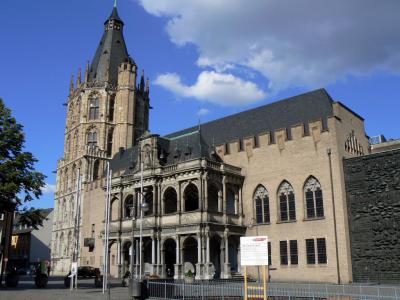
4) Historic Town Hall
Cologne’s Historic Town Hall - where ancient Rome meets medieval ambition and Renaissance flair, all crammed into one delightfully stubborn complex. This city hall is the oldest in Germany, proudly perched atop the ruins of the Roman Praetorium, once the power seat of the Roman governor of the Lower Germania province. That is, until an 8th-century earthquake gave it a rather abrupt renovation.
A few centuries later, precisely in the 11th, Cologne’s citizens got organized and formed a commune. By 1114, the city's coat of arms had already made its debut-because every self-respecting city needs a good logo... The oldest part of the complex is a roofed hall from 1330, decorated with stone figures who represent the Emperor, Privileges, and the Nine Worthies - think of them as the medieval version of a motivational poster.
Then came the Gothic tower: built between 1407 and 1414, it was Cologne’s first secular skyscraper (five whole stories tall!), reaching an impressive 61 meters. It’s adorned with 130 stone statues, some of which appear to be judging you. Bombed in WWII but restored since, the tower also plays a carillon tune four times a day - because even stone buildings like to show off a little...
Swing around to the Renaissance-style loggia - the Town Hall Arbor - completed in 1573. This two-story arcade served both as an elegant entryway and a stage for balcony speeches. Look up and you’ll find a sculpted lion doing battle with Mayor Gryn. Who won? Depends on who’s telling the story.
And let’s not forget the so-called Spanish Structure, finished in 1615, featuring Dutch Renaissance architecture with a Spanish twist, thanks to some rather well-travelled delegates from the Thirty Years’ War. The Piazzetta (or “Little Square”), a post-WWII addition, ties it all together.
Tip:
Catch a postcard-perfect view from across the Rhine. Bonus points if you frame it with the Hohenzollern Bridge and Cologne Cathedral in the background. Now that’s a skyline...
A few centuries later, precisely in the 11th, Cologne’s citizens got organized and formed a commune. By 1114, the city's coat of arms had already made its debut-because every self-respecting city needs a good logo... The oldest part of the complex is a roofed hall from 1330, decorated with stone figures who represent the Emperor, Privileges, and the Nine Worthies - think of them as the medieval version of a motivational poster.
Then came the Gothic tower: built between 1407 and 1414, it was Cologne’s first secular skyscraper (five whole stories tall!), reaching an impressive 61 meters. It’s adorned with 130 stone statues, some of which appear to be judging you. Bombed in WWII but restored since, the tower also plays a carillon tune four times a day - because even stone buildings like to show off a little...
Swing around to the Renaissance-style loggia - the Town Hall Arbor - completed in 1573. This two-story arcade served both as an elegant entryway and a stage for balcony speeches. Look up and you’ll find a sculpted lion doing battle with Mayor Gryn. Who won? Depends on who’s telling the story.
And let’s not forget the so-called Spanish Structure, finished in 1615, featuring Dutch Renaissance architecture with a Spanish twist, thanks to some rather well-travelled delegates from the Thirty Years’ War. The Piazzetta (or “Little Square”), a post-WWII addition, ties it all together.
Tip:
Catch a postcard-perfect view from across the Rhine. Bonus points if you frame it with the Hohenzollern Bridge and Cologne Cathedral in the background. Now that’s a skyline...
5) Alter Markt (Old Market)
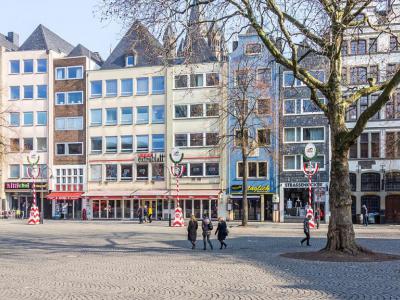
In the Old Market Square of Cologne, cobblestones carry gossip older than most European countries.
Once connected to the Hay Market, this lively square has seen everything from Renaissance flair to full-blown weaver revolts. Today, it's home to beautiful façades, a dramatic fountain, and, come winter, one of Cologne’s coziest Christmas Markets. But don’t let the mulled wine distract you from the centuries of drama baked into these stones.
Markets and homes have stood here since at least the year 922-that’s not a typo... The oldest surviving building dates back to 1580, though many historic structures were wiped out during WWII bombings. Still, Cologne rebuilt with style, as it always does.
One particularly spicy chapter unfolded here in 1371: the Cologne Weaver Uprising. Picture disgruntled guild members facing off with the city council. The weavers lost-badly-and were either arrested or politely escorted out of town with pitchforks (not the musical kind).
At the heart of the square stands the Jan von Werth fountain, completed in 1884. The story it tells is pure soap opera. Young Jan, a lowly farm boy, fell for Griet. But Griet wanted someone with a bit more... coin. Heartbroken, Jan headed off to the Thirty Years’ War, leveled up to war hero status, and returned to find Griet peddling fruit in the square. She gasped, “Jan, who would’ve thought it?” To this, he shrugged and delivered the ultimate verbal mic drop: “Griet, the one who should have” (and with these words, he turned away).
Around the square, you’ll find old-school German architecture, statues of the city’s founders, and-up near house No. 24-a cheeky little sculpture called Kallendresser. It shows a man relieving himself into a gutter. Tasteful? Not exactly. But pointed absolutely-it’s likely a rebellious jab at the city hall conveniently located on the square’s west side.
Today, the Old Market is car-free and people-full. With its bars, restaurants, and ice cream shops, it buzzes well into the night. So, come here for the history, stay for the beer-and maybe watch out for flying weaver spindles...
Once connected to the Hay Market, this lively square has seen everything from Renaissance flair to full-blown weaver revolts. Today, it's home to beautiful façades, a dramatic fountain, and, come winter, one of Cologne’s coziest Christmas Markets. But don’t let the mulled wine distract you from the centuries of drama baked into these stones.
Markets and homes have stood here since at least the year 922-that’s not a typo... The oldest surviving building dates back to 1580, though many historic structures were wiped out during WWII bombings. Still, Cologne rebuilt with style, as it always does.
One particularly spicy chapter unfolded here in 1371: the Cologne Weaver Uprising. Picture disgruntled guild members facing off with the city council. The weavers lost-badly-and were either arrested or politely escorted out of town with pitchforks (not the musical kind).
At the heart of the square stands the Jan von Werth fountain, completed in 1884. The story it tells is pure soap opera. Young Jan, a lowly farm boy, fell for Griet. But Griet wanted someone with a bit more... coin. Heartbroken, Jan headed off to the Thirty Years’ War, leveled up to war hero status, and returned to find Griet peddling fruit in the square. She gasped, “Jan, who would’ve thought it?” To this, he shrugged and delivered the ultimate verbal mic drop: “Griet, the one who should have” (and with these words, he turned away).
Around the square, you’ll find old-school German architecture, statues of the city’s founders, and-up near house No. 24-a cheeky little sculpture called Kallendresser. It shows a man relieving himself into a gutter. Tasteful? Not exactly. But pointed absolutely-it’s likely a rebellious jab at the city hall conveniently located on the square’s west side.
Today, the Old Market is car-free and people-full. With its bars, restaurants, and ice cream shops, it buzzes well into the night. So, come here for the history, stay for the beer-and maybe watch out for flying weaver spindles...
6) Heumarkt (Hay Market) (must see)
Welcome to Cologne’s Hay Market-where the past smells faintly of hay, spice, and maybe a little too much fish.
Dating all the way back to Roman times, this square is one of Central Europe’s oldest markets. In the Middle Ages, it bloomed into a buzzing trade hub. Originally, Hay Market and Old Market were one big commercial jumble simply called the Old Market. But as the centuries marched on and city life got more complex, the two parted ways-amicably, we assume...
By the 13th century, Cologne was booming, with a population of over 40,000-massive by medieval standards. Hay Market, thanks to its prime location, became the go-to spot for everything from cheese to chickpeas. Traders hawked vegetables, fish, grain, spices, and yes, actual hay. In 1492, while Columbus was off looking for India, a grain scale was added here to keep the deals honest.
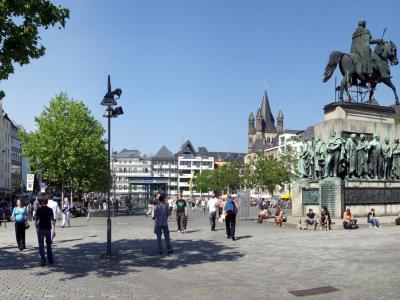
But this wasn’t just your average muddy medieval market. During the Renaissance, Hay Market leveled up in beauty, drawing comparisons to Venice’s St. Mark’s Square. Today, it’s still charming, paved in brick, framed by neatly trimmed trees, and peppered with restaurants that definitely know how to plate a schnitzel.
In 1580, the Cologne stock exchange took root here, too-proof that not just onions were traded. Closer to our days, in 1878, the square got a serious upgrade in the form of a dramatic equestrian statue of Prussia’s King Friedrich Wilhelm III. The Market Hall was added in 1904, and historic flair has been going strong here ever since.
Though nobody comes here for hay anymore, Hay Market is far from quiet. These days, it’s one of the city’s liveliest squares-packed with pubs, breweries, and cafés perfect for watching the world go by. And in winter, it transforms into a holiday wonderland with a cheerful Christmas market and a festive ice-skating rink.
Hay Market may have traded its wagons and wheat for lattes and selfies-but its spirit is very much alive and thriving.
Dating all the way back to Roman times, this square is one of Central Europe’s oldest markets. In the Middle Ages, it bloomed into a buzzing trade hub. Originally, Hay Market and Old Market were one big commercial jumble simply called the Old Market. But as the centuries marched on and city life got more complex, the two parted ways-amicably, we assume...
By the 13th century, Cologne was booming, with a population of over 40,000-massive by medieval standards. Hay Market, thanks to its prime location, became the go-to spot for everything from cheese to chickpeas. Traders hawked vegetables, fish, grain, spices, and yes, actual hay. In 1492, while Columbus was off looking for India, a grain scale was added here to keep the deals honest.
But this wasn’t just your average muddy medieval market. During the Renaissance, Hay Market leveled up in beauty, drawing comparisons to Venice’s St. Mark’s Square. Today, it’s still charming, paved in brick, framed by neatly trimmed trees, and peppered with restaurants that definitely know how to plate a schnitzel.
In 1580, the Cologne stock exchange took root here, too-proof that not just onions were traded. Closer to our days, in 1878, the square got a serious upgrade in the form of a dramatic equestrian statue of Prussia’s King Friedrich Wilhelm III. The Market Hall was added in 1904, and historic flair has been going strong here ever since.
Though nobody comes here for hay anymore, Hay Market is far from quiet. These days, it’s one of the city’s liveliest squares-packed with pubs, breweries, and cafés perfect for watching the world go by. And in winter, it transforms into a holiday wonderland with a cheerful Christmas market and a festive ice-skating rink.
Hay Market may have traded its wagons and wheat for lattes and selfies-but its spirit is very much alive and thriving.
7) Chocolat Shop
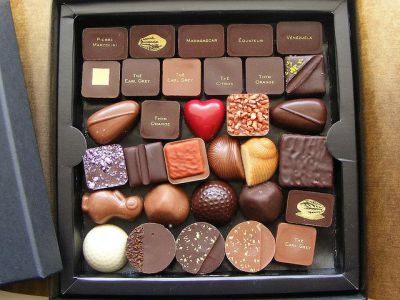
At the recently revamped Chocolat Shop, you'll be greeted with not only a brand-new store design but also a wide range of handmade chocolate creations from the Chocolate Museum! This chocolate haven offers not only a completely new store design, but also a wide range of handmade chocolate creations from the Chocolate Museum.
As soon as you step into the Chocolat Shop, you'll be greeted by a large selection of high-quality and delicious chocolate treats. From freshly made chocolate bars to homemade chocolates with a variety of fillings, hand-poured chocolate figurines, and colorful thalers, there's something for everyone.
What sets Chocolat Shop apart is the use of high-quality ingredients and exquisite recipes for all their products. The shop also keeps up with the latest trends, offering a variety of fine chocolates, exclusive truffles & pralines, and delicious pastries, complemented by traditional nibbles and a large selection of the latest confectionery gifts.
You can taste the products before purchasing them, ensuring you're getting the chocolate that's just right for you. So, whether you're looking to indulge yourself or surprise someone special, the Chocolat Shop in Cologne is definitely worth a visit.
As soon as you step into the Chocolat Shop, you'll be greeted by a large selection of high-quality and delicious chocolate treats. From freshly made chocolate bars to homemade chocolates with a variety of fillings, hand-poured chocolate figurines, and colorful thalers, there's something for everyone.
What sets Chocolat Shop apart is the use of high-quality ingredients and exquisite recipes for all their products. The shop also keeps up with the latest trends, offering a variety of fine chocolates, exclusive truffles & pralines, and delicious pastries, complemented by traditional nibbles and a large selection of the latest confectionery gifts.
You can taste the products before purchasing them, ensuring you're getting the chocolate that's just right for you. So, whether you're looking to indulge yourself or surprise someone special, the Chocolat Shop in Cologne is definitely worth a visit.
8) Chocolate Museum (must see)
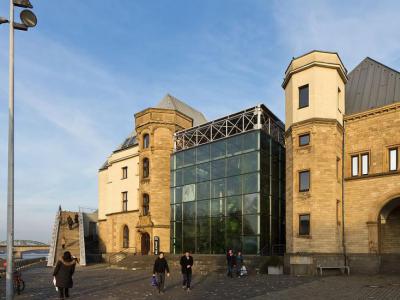
The Imhoff-Schokoladenmuseum was opened by Hans Imhoff on 31 October 1993. It is situated in the Cologne quarter Altstadt-Süd on the Rheinauhafen-peninsula. The exhibition shows the whole history of chocolate, from the beginning at the Olmecs, Maya and Aztecs until the contemporary products and their production methods. The museum belongs to the Top Ten of German museums with 5,000 guidances and 600,000 visitors a year.
A special attraction is the three-meter-high chocolate fountain, at which a woman dips wafers in the liquid chocolate and distributes them to visitors. Another interesting thing for visitors is the small tropiarium consisting of a glass cube with 10-meter edge length showing cacao trees of the species Theobroma cacao and Theobroma grandiflorum. Several production machineries were built as miniatures so that you can have a look at the production process of the small chocolate bars, which are given to the visitors at the entrance of the museum.
Why You Should Visit:
Gives a brief history of chocolate as well as more esoteric things like the religion & culture related to it. Great spot to view the Rhine river, too.
Tip:
Lots of free samples during visits and you can have your own personalized chocolate made.
A special attraction is the three-meter-high chocolate fountain, at which a woman dips wafers in the liquid chocolate and distributes them to visitors. Another interesting thing for visitors is the small tropiarium consisting of a glass cube with 10-meter edge length showing cacao trees of the species Theobroma cacao and Theobroma grandiflorum. Several production machineries were built as miniatures so that you can have a look at the production process of the small chocolate bars, which are given to the visitors at the entrance of the museum.
Why You Should Visit:
Gives a brief history of chocolate as well as more esoteric things like the religion & culture related to it. Great spot to view the Rhine river, too.
Tip:
Lots of free samples during visits and you can have your own personalized chocolate made.
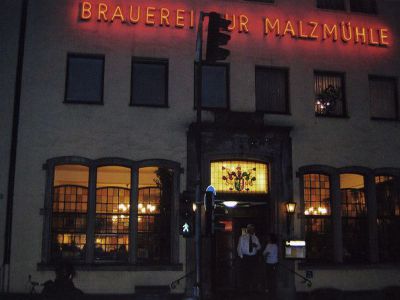
9) Brauerei zur Malzmuehle
The Brauerei zur Malzmühle ("Brewery at the Malt Mill") is a traditional Kölsch brewery and restaurant at Heumarkt No. 6. The brewhouse was founded by Hubert Koch in 1858, which makes it one of the oldest in the city, and was originally known as the "Bier und Malzextrakt Dampfbrauerei Koch, Cöln" ("Beer and Malt Extract Steam Brewery, Cologne").
In 1901 Hubert's son Jakob Koch took over the brewery and turned it into a popular meeting place for locals, especially the well-off traders in the neighboring wholesale market hall. In 1912 Koch sold the business to his nephew Gottfried Joseph Schwartz, ancestor of the current owner family, who gave it the current name.
The malt mill was destroyed by bombing in 1945 and then rebuilt after World War II. In 1948, brewing operations resumed, although guests still had to be served outdoors.
Nowadays, the imposing historical property from 1744 is still in place. Here Malzmühle's main product – "Mühlen Kölsch", a unique traditional top-fermented beer, part of Cologne's Kölsch Convention – has been produced according to the original handmade brewing recipe ever since it was patented. Also within the building is a shop, where you can buy Mühlen Kölsch in bottles, crates or kegs.
In 1999, US President Bill Clinton visited the brewery whilst attending the G8 summit. Another prominent guest of the Malzmühle, in earlier times, was Konrad Adenauer.
In 1901 Hubert's son Jakob Koch took over the brewery and turned it into a popular meeting place for locals, especially the well-off traders in the neighboring wholesale market hall. In 1912 Koch sold the business to his nephew Gottfried Joseph Schwartz, ancestor of the current owner family, who gave it the current name.
The malt mill was destroyed by bombing in 1945 and then rebuilt after World War II. In 1948, brewing operations resumed, although guests still had to be served outdoors.
Nowadays, the imposing historical property from 1744 is still in place. Here Malzmühle's main product – "Mühlen Kölsch", a unique traditional top-fermented beer, part of Cologne's Kölsch Convention – has been produced according to the original handmade brewing recipe ever since it was patented. Also within the building is a shop, where you can buy Mühlen Kölsch in bottles, crates or kegs.
In 1999, US President Bill Clinton visited the brewery whilst attending the G8 summit. Another prominent guest of the Malzmühle, in earlier times, was Konrad Adenauer.
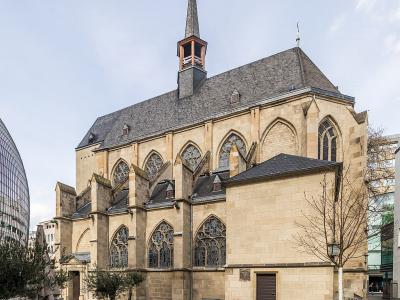
10) Antoniterkirche (St. Anthony Church)
Cologne is a city that every avid tourist must visit at least once. This city has a unique charm and warm atmosphere that entices tourists to come back repeatedly. Cologne is known for its Gothic and Romanesque churches. Among the Gothic churches, the Antoniterkirche holds a special place. Located close to the main shopping street of the city, this Protestant church is frequented by those who wish to pray in absolute peace and quiet.
Antoniterkirche is a very peaceful church built around 1350 to 1380. It boasts a simple, yet elegant architecture. Step inside the church and you cannot miss the Barlach’s Memorial Angel. This cast also known as the Angel of Death is made from the original cast. As the original was destroyed during WWII by the Nazis, this is the only remaining cast today preserved in this church.
You will also be struck by the oasis of peace inside the church in spite of the bustling, noisy Schildergasse outside. Schildergasse is incidentally one of Cologne’s busiest, main shopping streets. Antoniterkirche has three wings even though the church seems more of a chapel due to its small size. On your trip to Cologne, pay a visit to this charming church to enjoy its unique architecture and period art.
Antoniterkirche is a very peaceful church built around 1350 to 1380. It boasts a simple, yet elegant architecture. Step inside the church and you cannot miss the Barlach’s Memorial Angel. This cast also known as the Angel of Death is made from the original cast. As the original was destroyed during WWII by the Nazis, this is the only remaining cast today preserved in this church.
You will also be struck by the oasis of peace inside the church in spite of the bustling, noisy Schildergasse outside. Schildergasse is incidentally one of Cologne’s busiest, main shopping streets. Antoniterkirche has three wings even though the church seems more of a chapel due to its small size. On your trip to Cologne, pay a visit to this charming church to enjoy its unique architecture and period art.
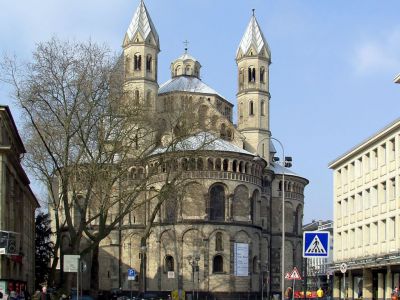
11) Basilika St. Aposteln (Basilica of the Holy Apostles)
Basilika Saint Aposteln (Basilica of the Holy Apostles) is a magnificent Romanesque church. It was constructed during the 11th century and is one of the twelve Romanesque churches built in Cologne during that time. The church has a basilical plan of nave and aisles, and like Groß Saint Martin and Saint Maria im Kapitol, has three apses at the east end making a trefoil plan.
One of the main features of the church is the domed clover leaf chancel, which was built around 1200 and is a true gem of Romanesque architecture. The chancel is located at the east end of the church, and its shape is reminiscent of a clover leaf, with three semicircular apses arranged in a trefoil plan. The chancel is covered by a stunning dome that gives the church a monumental and almost Byzantine appearance.
The church was significantly enlarged in the 13th century, and an octagonal dome was added above the crossing. This new addition further enhanced the grandeur of the church, and it is now one of the most remarkable examples of Romanesque architecture in Germany. Despite the building modifications, the old structures were retained and copied, and integrated into the new construction project.
One of the main features of the church is the domed clover leaf chancel, which was built around 1200 and is a true gem of Romanesque architecture. The chancel is located at the east end of the church, and its shape is reminiscent of a clover leaf, with three semicircular apses arranged in a trefoil plan. The chancel is covered by a stunning dome that gives the church a monumental and almost Byzantine appearance.
The church was significantly enlarged in the 13th century, and an octagonal dome was added above the crossing. This new addition further enhanced the grandeur of the church, and it is now one of the most remarkable examples of Romanesque architecture in Germany. Despite the building modifications, the old structures were retained and copied, and integrated into the new construction project.
