Custom Walk in Sorrento, Italy by theduerrings_b7f8b created on 2025-05-29
Guide Location: Italy » Sorrento
Guide Type: Custom Walk
# of Sights: 13
Tour Duration: 2 Hour(s)
Travel Distance: 2.5 Km or 1.6 Miles
Share Key: TGHUJ
Guide Type: Custom Walk
# of Sights: 13
Tour Duration: 2 Hour(s)
Travel Distance: 2.5 Km or 1.6 Miles
Share Key: TGHUJ
How It Works
Please retrieve this walk in the GPSmyCity app. Once done, the app will guide you from one tour stop to the next as if you had a personal tour guide. If you created the walk on this website or come to the page via a link, please follow the instructions below to retrieve the walk in the app.
Retrieve This Walk in App
Step 1. Download the app "GPSmyCity: Walks in 1K+ Cities" on Apple App Store or Google Play Store.



Step 2. In the GPSmyCity app, download(or launch) the guide "Sorrento Map and Walking Tours".
Step 3. Tap the menu button located at upper right corner of the "Walks" screen and select "Retrieve custom walk". Enter the share key: TGHUJ
1) House of Cornelia Tasso
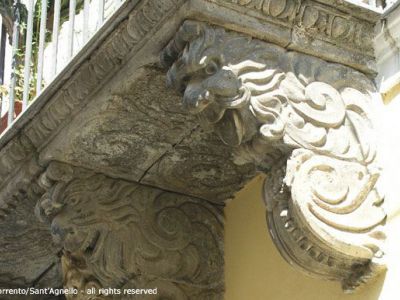
The House of Cornelia Tasso in Sorrento offers a unique glimpse into the Renaissance era and the life of one of its most eminent literary figures. Situated in the historic core of Sorrento, this ancient dwelling, sometimes referred to as the Sersale house, was once the abode of Cornelia, the sister of the celebrated poet Torquato Tasso.
Cornelia married Marzio Sersale in 1558 and continued to reside in this house with her sons, Antonino and Alessandro, even after becoming a widow. The residence is distinguishable by its charming balcony adorned with decorative stonework, a feature that marks its historical significance.
Torquato Tasso, born in Sorrento in 1544, is renowned for his epic poem "Gerusalemme Liberata" ("Jerusalem Delivered"), a creative rendition of the Christian-Muslim conflicts during the first Crusade's siege of Jerusalem. Tasso emerged as the preeminent Italian poet of the Renaissance, captivating readers across Europe until the 19th century. His literary achievements inspired subsequent luminaries, including Spencer and Byron.
Despite his nomadic lifestyle, Tasso harbored a strong bond with his sister, Cornelia. Returning to Sorrento amid growing paranoia and persecution fears, he sought refuge in a Franciscan convent, then tested Cornelia's loyalty by posing as a peasant reporting his death. Despite brief solace in Sorrento, he yearned for the familiar Ferrara court and eventually returned, only to be later confined to a madhouse due to erratic behavior. Despite regaining freedom, his health declined, leading to his death in Rome at 51 in April 1595.
The House of Cornelia Tasso stands as a tribute to the Tasso family's legacy and Torquato Tasso's lasting influence on European literature, reflecting his intricate personal history.
Cornelia married Marzio Sersale in 1558 and continued to reside in this house with her sons, Antonino and Alessandro, even after becoming a widow. The residence is distinguishable by its charming balcony adorned with decorative stonework, a feature that marks its historical significance.
Torquato Tasso, born in Sorrento in 1544, is renowned for his epic poem "Gerusalemme Liberata" ("Jerusalem Delivered"), a creative rendition of the Christian-Muslim conflicts during the first Crusade's siege of Jerusalem. Tasso emerged as the preeminent Italian poet of the Renaissance, captivating readers across Europe until the 19th century. His literary achievements inspired subsequent luminaries, including Spencer and Byron.
Despite his nomadic lifestyle, Tasso harbored a strong bond with his sister, Cornelia. Returning to Sorrento amid growing paranoia and persecution fears, he sought refuge in a Franciscan convent, then tested Cornelia's loyalty by posing as a peasant reporting his death. Despite brief solace in Sorrento, he yearned for the familiar Ferrara court and eventually returned, only to be later confined to a madhouse due to erratic behavior. Despite regaining freedom, his health declined, leading to his death in Rome at 51 in April 1595.
The House of Cornelia Tasso stands as a tribute to the Tasso family's legacy and Torquato Tasso's lasting influence on European literature, reflecting his intricate personal history.
2) Marina Grande (Big Marina) (must see)
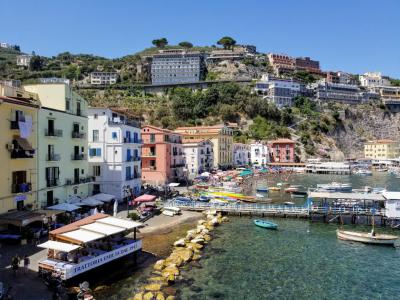
It's not a great idea to take the names of the two Marinas literally. Big Marina (Marina Grande) is the smaller of the two. It is a fishing village, and it has restaurants. Small Marina (Marina Piccola) is a large marina, but it is a ferry terminal and transport hub. One is a destination. The other is but a link to a destination.
Big Marina is a community in itself. It has restaurants and bars, hotels, and a church. It is also a pretty place to walk in. The Marina nestles in a nook of the Amalfi Coast. It is like a world waiting to be discovered but much better than Rockaway Beach in the old days. It has kept its rustic insouciance.
The Marina port is secluded from the rest of busy Sorrento by a rocky promontory which is said to be the site of a Roman villa of Emperor Augustus's nephew, Marcellus. Marina village still clings, in some ways, to its pre-industrial life. See a bit of that life at sunset, when the fishermen clean up their nets and boats for another day.
Big Marina is a community in itself. It has restaurants and bars, hotels, and a church. It is also a pretty place to walk in. The Marina nestles in a nook of the Amalfi Coast. It is like a world waiting to be discovered but much better than Rockaway Beach in the old days. It has kept its rustic insouciance.
The Marina port is secluded from the rest of busy Sorrento by a rocky promontory which is said to be the site of a Roman villa of Emperor Augustus's nephew, Marcellus. Marina village still clings, in some ways, to its pre-industrial life. See a bit of that life at sunset, when the fishermen clean up their nets and boats for another day.
3) Piazza della Vittoria (Victory Square)
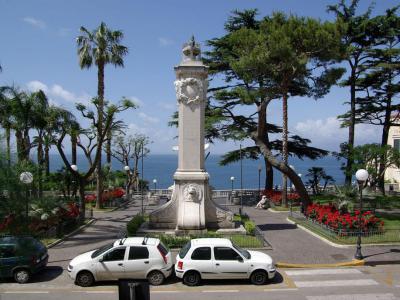
The Victory Square snuggles between two Marinas of Sorrento, the Big Marina (Marina Grande) and the Small Marina (Marina Piccola). In the middle of the square is a garden with plenty of shade under the palms. People often stop there to take in the incomparable views of the bay and the Gulf of Naples.
On one side of the area, the Imperial Hotel Tromontano overlooks the harbor. The famous Norwegian playwright Henrik Ibsen stayed in the Imperial Hotel Tromontano for six months in 1881, where he wrote his masterpiece play "Ghosts." Disenchanted with his native home in Norway, Ibsen took his family into self-imposed exile and settled in Sorrento for four years.
On the corner of Victory Square and Vittoria Veneto Street, just next to the Imperial Hotel Tromontano's elegant bridge across Vittorio Veneto Street, one can find a plague commemorating Ibsen's stay.
Part of the building that forms today's Imperial Hotel Tromontano was known as Villa Laurito Mastrogiudice. It was here Sorrento's favorite son, poet Torquato Tasso was born on March 11, 1544.
On one side of the area, the Imperial Hotel Tromontano overlooks the harbor. The famous Norwegian playwright Henrik Ibsen stayed in the Imperial Hotel Tromontano for six months in 1881, where he wrote his masterpiece play "Ghosts." Disenchanted with his native home in Norway, Ibsen took his family into self-imposed exile and settled in Sorrento for four years.
On the corner of Victory Square and Vittoria Veneto Street, just next to the Imperial Hotel Tromontano's elegant bridge across Vittorio Veneto Street, one can find a plague commemorating Ibsen's stay.
Part of the building that forms today's Imperial Hotel Tromontano was known as Villa Laurito Mastrogiudice. It was here Sorrento's favorite son, poet Torquato Tasso was born on March 11, 1544.
4) Villa Comunale Park (must see)
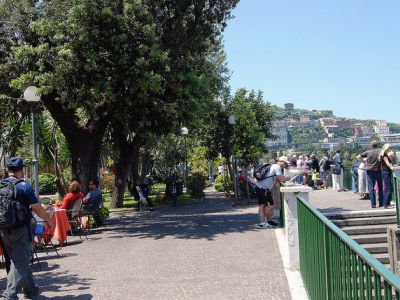
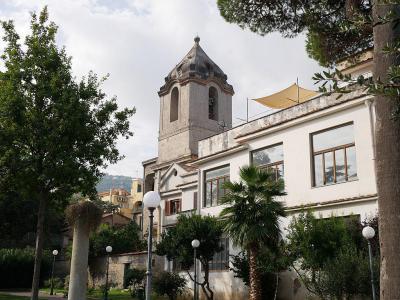
Villa Comunale Park in Sorrento is a beautiful and historically significant location that attracts visitors with its natural charm. Positioned near the Saint Francis Church and Cloister, this small park is a lush haven filled with palm trees, oaks, holm oaks, and ancient pines. Perched on the cliffs of Sorrento, it offers stunning views of Marina Grande and the coastline, making it more famous for its panoramic vistas than its greenery.
One distinctive feature of the park is its elevators, which provide access to Marina Piccola ferry and the San Francisco swim towers, offering a convenient route to the sea. Elevated above the bay and Mount Vesuvius, the park boasts well-maintained flower beds, manicured lawns, and tall palm trees. A cozy café within the park serves espresso, pastries, and ice cream, with sunset being the ideal time to enjoy its tranquil atmosphere.
Located a short walk from Tasso Square in the city center, the path to Villa Comunale Park passes by the historic 11th-century Church of Saint Antonino, adding a touch of history to the journey. Established between 1877 and 1879 on the former gardens of Franciscan friars, the park reflects the region's cultural heritage. Visitors can relax in the shade, stroll through well-kept gardens, and admire centuries-old olive trees.
The park also features two notable busts from the early twentieth century, honoring historian Bartolomeo Capasso and magistrate Francesco Saverio Gargiulo, contributing to its cultural ambiance. Additionally, it houses a museum displaying archaeological discoveries from Sorrento and a precious mosaic depicting a nymphaeum, adding to the historical appeal.
Villa Comunale Park serves not only as a natural oasis but also as a cultural center. Its terrace often hosts musical and theatrical performances, and during the Christmas season, it is adorned with festive lights. For those interested in exploring the beach below, the park offers access to the sea and an elevator for convenience, ensuring that all visitors can enjoy Sorrento's beauty and the majestic Gulf of Naples, with Vesuvius in the background.
One distinctive feature of the park is its elevators, which provide access to Marina Piccola ferry and the San Francisco swim towers, offering a convenient route to the sea. Elevated above the bay and Mount Vesuvius, the park boasts well-maintained flower beds, manicured lawns, and tall palm trees. A cozy café within the park serves espresso, pastries, and ice cream, with sunset being the ideal time to enjoy its tranquil atmosphere.
Located a short walk from Tasso Square in the city center, the path to Villa Comunale Park passes by the historic 11th-century Church of Saint Antonino, adding a touch of history to the journey. Established between 1877 and 1879 on the former gardens of Franciscan friars, the park reflects the region's cultural heritage. Visitors can relax in the shade, stroll through well-kept gardens, and admire centuries-old olive trees.
The park also features two notable busts from the early twentieth century, honoring historian Bartolomeo Capasso and magistrate Francesco Saverio Gargiulo, contributing to its cultural ambiance. Additionally, it houses a museum displaying archaeological discoveries from Sorrento and a precious mosaic depicting a nymphaeum, adding to the historical appeal.
Villa Comunale Park serves not only as a natural oasis but also as a cultural center. Its terrace often hosts musical and theatrical performances, and during the Christmas season, it is adorned with festive lights. For those interested in exploring the beach below, the park offers access to the sea and an elevator for convenience, ensuring that all visitors can enjoy Sorrento's beauty and the majestic Gulf of Naples, with Vesuvius in the background.
5) Chiostro di San Francesco (Church and Cloister of Saint Francis) (must see)
The Church and Cloister of Saint Francis are near the public gardens of Sorrento, with stunning views of the fabled Gulf of Naples. The church was built in the 8th century. Originally it was an oratory founded by Saint Antonino, dedicated to Saint Martin of Tours, and reconstructed in the Baroque style by the Franciscans in the 14th century.
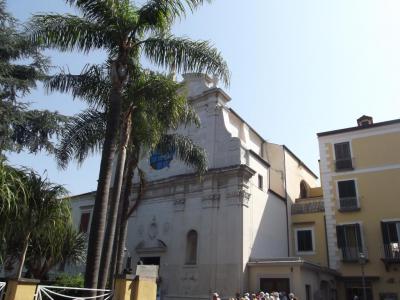
The church has a simple white facade divided into two parts. The well-preserved 14th-century portal is flanked by five pilasters, on each side, on the lower part. There are two arched blind windows on either side of the portal. In the left window is a painting of Saint Francis. A similar portrait of Saint Antonino appears on the right.
The upper part of the facade has a mullioned rose window flanked by two pilasters on each side. A scalloped roof front surmounts the crenelated edges of the upper side.
The church has one nave and six chapels. On the right facing the altar, in the first two chapels, are the statues of Saint Francis and Saint Antonino. On the left, we find the statues of Saint Rita of Cascia and the Immaculate Madonna. Above the altar is a 1735 painting Saint Francis Receiving the Stigmata.
In the sacristy are several marble artifacts from different eras. In the reception hall, it is a 16-century painting of Madonna and Infant with Saint Michael and John the Baptist.
Next to the church is the monastery cloister of Saint Francis. The cloister was founded in the 7th century but ceded to the Franciscans in the 14th century. It presents a mixture of architectural styles. Two sides of the porch have crossed 14th-century tuff arches. Two other sides have rounded arches on octagonal columns.
Architectural artifacts extracted from ancient temples and buildings have been integrated into the construction of the cloister. The cloister is often used for art exhibitions and musical events. It is also a popular venue for weddings.
The church has a simple white facade divided into two parts. The well-preserved 14th-century portal is flanked by five pilasters, on each side, on the lower part. There are two arched blind windows on either side of the portal. In the left window is a painting of Saint Francis. A similar portrait of Saint Antonino appears on the right.
The upper part of the facade has a mullioned rose window flanked by two pilasters on each side. A scalloped roof front surmounts the crenelated edges of the upper side.
The church has one nave and six chapels. On the right facing the altar, in the first two chapels, are the statues of Saint Francis and Saint Antonino. On the left, we find the statues of Saint Rita of Cascia and the Immaculate Madonna. Above the altar is a 1735 painting Saint Francis Receiving the Stigmata.
In the sacristy are several marble artifacts from different eras. In the reception hall, it is a 16-century painting of Madonna and Infant with Saint Michael and John the Baptist.
Next to the church is the monastery cloister of Saint Francis. The cloister was founded in the 7th century but ceded to the Franciscans in the 14th century. It presents a mixture of architectural styles. Two sides of the porch have crossed 14th-century tuff arches. Two other sides have rounded arches on octagonal columns.
Architectural artifacts extracted from ancient temples and buildings have been integrated into the construction of the cloister. The cloister is often used for art exhibitions and musical events. It is also a popular venue for weddings.
6) Piazza Francesco Saverio Gargiulo (Francesco Saverio Gargiulo Square)
Francesco Saverio Gargiulo Square in Sorrento is a tranquil spot away from the busy city life. Named after Francesco Saverio Gargiulo, an esteemed Italian magistrate and public figure, this square embodies Sorrento's rich cultural and historical heritage. Situated in the heart of the town's historic center, it is bordered by the impressive Church and Cloister of San Francesco, near Villa Comunale Park. Dating back to the 14th century, this church features distinctive cloisters with Arabic influences, characterized by arches adorned with plants and flowers, creating a charming atmosphere complemented by the delightful birdsong, especially in springtime.
The Church and Cloister of San Francesco are part of the larger Convent Complex of San Francesco d’Assisi, which includes a monastery. Built in 1623 by affluent families of the town, this complex showcases a fusion of Baroque and Arabic architectural styles, evoking a fairy tale-like ambiance that continues to enchant visitors.
Beyond its tranquility, Francesco Saverio Gargiulo square serves as a cultural center, hosting concerts and exhibitions that attract locals and tourists alike. Its close proximity to significant historical and architectural landmarks, coupled with its cultural events, makes it a must-see destination for those interested in Sorrento's beauty and history. Visitors have the chance to immerse themselves in the past, admire architectural wonders, and savor the serene atmosphere of this remarkable place.
The Church and Cloister of San Francesco are part of the larger Convent Complex of San Francesco d’Assisi, which includes a monastery. Built in 1623 by affluent families of the town, this complex showcases a fusion of Baroque and Arabic architectural styles, evoking a fairy tale-like ambiance that continues to enchant visitors.
Beyond its tranquility, Francesco Saverio Gargiulo square serves as a cultural center, hosting concerts and exhibitions that attract locals and tourists alike. Its close proximity to significant historical and architectural landmarks, coupled with its cultural events, makes it a must-see destination for those interested in Sorrento's beauty and history. Visitors have the chance to immerse themselves in the past, admire architectural wonders, and savor the serene atmosphere of this remarkable place.
7) Piazza Sant'Antonino (Sant'Antonino Square)
In the heart of Sorrento, lies Sant'Antonino Square, a tranquil spot amidst the lively city center, where visitors can delve into the area's rich history and culture. Named after the city's patron saint, Saint Antonino, the square is home to the Basilica of Saint Antonino, which holds his tomb and stands as a significant landmark. Surrounded by lush greenery and the sweet scent of flowers, palm, and orange trees, it's a perfect spot for a peaceful retreat.
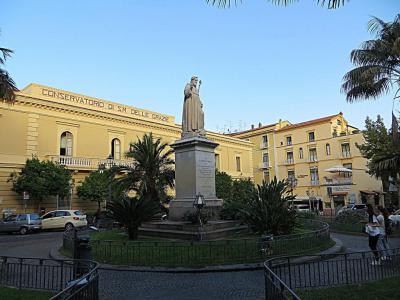
The square is lined with charming bars and restaurants, offering a chance to enjoy local cuisine while taking in the beautiful views. With the town hall and the ancient 11th-century basilica nearby, there's plenty of history to explore. A statue of Saint Antonino Abate greets visitors, symbolizing the saint's acts of heroism and kindness towards the city's people.
The basilica itself is a treasure trove of art and history, being the oldest church in Sorrento. Inside, visitors can admire a collection of artworks, including a painting depicting the 1648 siege of Sorrento. The crypt beneath the basilica provides an opportunity for a spiritual encounter with the saint's tomb and relics of other saints.
Across the square, the Santa Maria delle Grazie Conservatory School (Conservatorio Scuola Santa Maria delle Grazie) adds another layer to Sorrento's cultural heritage. This 16th-century building, part of a larger church complex, houses religious art, statues, and a remarkable majolica floor, enriching visitors' experience with its historical and artistic significance.
Sant'Antonino Square, near Tasso Square in Sorrento, is a tranquil haven rich in natural beauty, history, and spiritual significance, ideal for those wanting to experience Sorrento's essence.
The square is lined with charming bars and restaurants, offering a chance to enjoy local cuisine while taking in the beautiful views. With the town hall and the ancient 11th-century basilica nearby, there's plenty of history to explore. A statue of Saint Antonino Abate greets visitors, symbolizing the saint's acts of heroism and kindness towards the city's people.
The basilica itself is a treasure trove of art and history, being the oldest church in Sorrento. Inside, visitors can admire a collection of artworks, including a painting depicting the 1648 siege of Sorrento. The crypt beneath the basilica provides an opportunity for a spiritual encounter with the saint's tomb and relics of other saints.
Across the square, the Santa Maria delle Grazie Conservatory School (Conservatorio Scuola Santa Maria delle Grazie) adds another layer to Sorrento's cultural heritage. This 16th-century building, part of a larger church complex, houses religious art, statues, and a remarkable majolica floor, enriching visitors' experience with its historical and artistic significance.
Sant'Antonino Square, near Tasso Square in Sorrento, is a tranquil haven rich in natural beauty, history, and spiritual significance, ideal for those wanting to experience Sorrento's essence.
8) Valley of the Mills
Some 35,000 years ago, in today's Sorrento, a volcano erupted. It cut a deep gorge through the limestone on the spot where the city's center is currently located. Waters, moving through the canyon, sculpted out fast-running channels to the sea. Over the centuries, settlements arose, leaving historical evidence of their passing in the area's caves.
There are mysteries and legends about the caves. Many people of Sorrento believed the gorge was patrolled at night by a huge medieval figure, armed head to foot. It was the mission of the ghost to kill anyone who did not know the magic words to unlock the treasure of the caves.
While there may not have been a ghost, there was "treasure." In 1885, Leonardo Lorenzoni, director of the Technical School of Vigiano, discovered several rare and precious artifacts of early settlers. He donated his find to professor Justinian Nicolucci of the University of Naples. He called the artifact cave "Nicolucci's Cave."
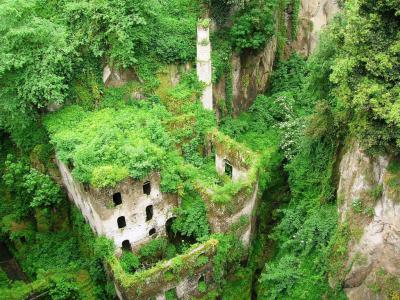
A good view of the mills is from behind Tasso Square. There are two streams, the Casariano-Cesarano, and Saint Antonino. Where the two streams meet is where the mills were built. Mills of one sort or another have been in the gorge since the 10th century. A grain mill, a sawmill, and an old washhouse are among the ruins.
The mills were isolated from the sea when Tasso Square was built in 1866. They were later abandoned. The gorge was taken over by exotic vegetation and rare ferns.
There are mysteries and legends about the caves. Many people of Sorrento believed the gorge was patrolled at night by a huge medieval figure, armed head to foot. It was the mission of the ghost to kill anyone who did not know the magic words to unlock the treasure of the caves.
While there may not have been a ghost, there was "treasure." In 1885, Leonardo Lorenzoni, director of the Technical School of Vigiano, discovered several rare and precious artifacts of early settlers. He donated his find to professor Justinian Nicolucci of the University of Naples. He called the artifact cave "Nicolucci's Cave."
A good view of the mills is from behind Tasso Square. There are two streams, the Casariano-Cesarano, and Saint Antonino. Where the two streams meet is where the mills were built. Mills of one sort or another have been in the gorge since the 10th century. A grain mill, a sawmill, and an old washhouse are among the ruins.
The mills were isolated from the sea when Tasso Square was built in 1866. They were later abandoned. The gorge was taken over by exotic vegetation and rare ferns.
9) Piazza Tasso (Tasso Square) (must see)
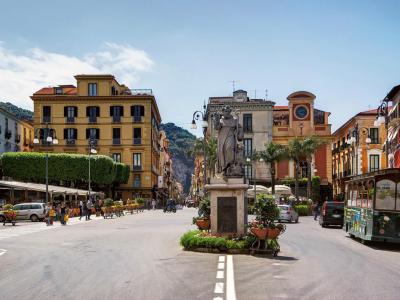
Torquato Tasso, born in 1544, stands on a granite pedestal in the square named for him. Tasso was the greatest poet of his era. He died in 1595, days before being crowned King of Poets by Pope Clement VIII. His statue shares the square with that of Saint Antonino, who sought asylum in Sorrento during the Lombard invasions of the 6th century.
The square was initially called Big Castle (Largo del Castello). Where the statue of Saint Antonino stands today was once the location of the 15th-century castle of Ferdinand of Aragon, demolished in 1843. The monument of Torquato Tasso was dedicated in 1870. The square sits astride the deep gorge that divides the center of Sorrento.
Surrounding the square are grand historical edifices. The Correale Palace, with its tiled courtyard, was rebuilt in 1768. The Church of Santa Maria del Carmine is in the square's northern part. Inside is a 1710 ceiling painting by Onofrio Avellino of the Virgin with Saint Simon. It also has 16th-century gilded reliquaries of saints' bones.
Tasso Square is the main square, regarded as the entry point to the historic old Sorrento. There are shops, restaurants, and bars all around. The Fauno Bar is a popular spot for cappuccino and pastry; Italy Avenue (Corso Italia), the shopping street branches off Tasso Square. There are many smaller shopping side streets.
Cross over the forbidding gorge to find access to Sorrento Big Marina. It is where one may catch the water bus (vaporetto) to the Isla of Capri, Tiberius's exotic playground. There are tour trolleys and hop-on, hop-off open-top sight-seeing busses from the square. Did we mention horse carriages as well? Yes, we did, just now.
Tasso Square is a busy place. Be wary of motor traffic, especially scooters.
The square was initially called Big Castle (Largo del Castello). Where the statue of Saint Antonino stands today was once the location of the 15th-century castle of Ferdinand of Aragon, demolished in 1843. The monument of Torquato Tasso was dedicated in 1870. The square sits astride the deep gorge that divides the center of Sorrento.
Surrounding the square are grand historical edifices. The Correale Palace, with its tiled courtyard, was rebuilt in 1768. The Church of Santa Maria del Carmine is in the square's northern part. Inside is a 1710 ceiling painting by Onofrio Avellino of the Virgin with Saint Simon. It also has 16th-century gilded reliquaries of saints' bones.
Tasso Square is the main square, regarded as the entry point to the historic old Sorrento. There are shops, restaurants, and bars all around. The Fauno Bar is a popular spot for cappuccino and pastry; Italy Avenue (Corso Italia), the shopping street branches off Tasso Square. There are many smaller shopping side streets.
Cross over the forbidding gorge to find access to Sorrento Big Marina. It is where one may catch the water bus (vaporetto) to the Isla of Capri, Tiberius's exotic playground. There are tour trolleys and hop-on, hop-off open-top sight-seeing busses from the square. Did we mention horse carriages as well? Yes, we did, just now.
Tasso Square is a busy place. Be wary of motor traffic, especially scooters.
10) The Cathedral’s Bell Tower
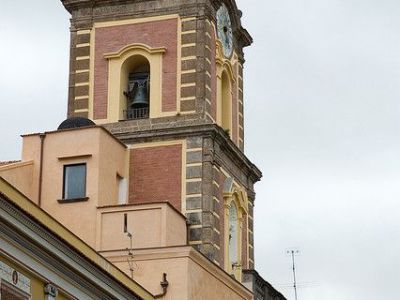
The Bell Tower of the Cathedral in Sorrento is a prominent landmark that rises three stories above the surrounding buildings. Its unique red and yellow stone facade makes it easily recognizable from various points in the town's historic center.
The lower two stories of the tower date back to the 11th century, coinciding with the initial construction of the Cathedral. This period marked the beginning of Sorrento's ecclesiastical architectural development. However, the tower's current appearance is largely the result of renovations in the 15th century, when the Cathedral was reconstructed in a Romanesque style, dedicated to San Filippo and San Giacomo. During this renovation, three additional stories were added to the bell tower, significantly changing its appearance within the town.
A notable decorative feature of the tower is its blue majolica clock, which adds to its visual appeal. This clock not only enhances the tower's aesthetic but also serves a practical purpose, providing timekeeping for both residents and visitors of Sorrento.
Throughout Sorrento's history, the bell tower has been more than just a piece of architecture; it has been an integral part of community life. The ground floor, located under an archway from Pietà Street (Via Pietà), served as a central gathering place during medieval times. Even after the construction of a castle in what is now Tasso Square (Piazza Tasso)-another gathering place that has since been demolished-the bell tower remained a focal point for communal activities. The columns supporting the tower at ground level believed to be of ancient Roman or early Byzantine origin, attest to the tower's enduring presence and significance in Sorrento's urban landscape.
The lower two stories of the tower date back to the 11th century, coinciding with the initial construction of the Cathedral. This period marked the beginning of Sorrento's ecclesiastical architectural development. However, the tower's current appearance is largely the result of renovations in the 15th century, when the Cathedral was reconstructed in a Romanesque style, dedicated to San Filippo and San Giacomo. During this renovation, three additional stories were added to the bell tower, significantly changing its appearance within the town.
A notable decorative feature of the tower is its blue majolica clock, which adds to its visual appeal. This clock not only enhances the tower's aesthetic but also serves a practical purpose, providing timekeeping for both residents and visitors of Sorrento.
Throughout Sorrento's history, the bell tower has been more than just a piece of architecture; it has been an integral part of community life. The ground floor, located under an archway from Pietà Street (Via Pietà), served as a central gathering place during medieval times. Even after the construction of a castle in what is now Tasso Square (Piazza Tasso)-another gathering place that has since been demolished-the bell tower remained a focal point for communal activities. The columns supporting the tower at ground level believed to be of ancient Roman or early Byzantine origin, attest to the tower's enduring presence and significance in Sorrento's urban landscape.
11) Sedile Dominova (Dominova Seat)
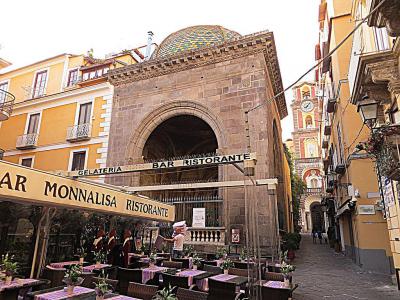
Dominova Seat (Sedile Dominova) is a historic architectural gem in the heart of Sorrento. Originally a gathering place for political discussions among nobles, this building has witnessed centuries of administrative affairs and political debates. Its location near the Sorrento coast adds to its charm, making it an attractive destination right from its elaborately decorated entrance.
Upon entering this 14th-century structure, visitors are welcomed by a meticulously painted depiction of the town, recounting its illustrious past. Moving further inside, the 16th-century atrium unfolds, supported by imposing pillars and arches, each adorned with majestic designs that narrate tales of the past.
One of the most notable features of the building is its dome, decorated with Majolica tiles in vibrant shades of yellow and green. These tiles not only enhance its visual appeal but also bear the heraldic symbols of the noble families who once frequented Sedile Dominova for political gatherings. Although the passage of time has led to the deterioration of some original decorations, the 18th-century frescoes remain a testament to the artistic prowess of the era, preserved in their original splendor.
Today, Dominova Seat serves as a bustling tourist hub, attracting visitors from around the world with its historical significance and architectural beauty. While the influx of tourists can be overwhelming, nearby dining establishments such as La Pizza del Poeta, Le Colline di Sorrento, and Pub America offer delightful culinary experiences. The surrounding area buzzes with activities, promising a dynamic experience for visitors.
Upon entering this 14th-century structure, visitors are welcomed by a meticulously painted depiction of the town, recounting its illustrious past. Moving further inside, the 16th-century atrium unfolds, supported by imposing pillars and arches, each adorned with majestic designs that narrate tales of the past.
One of the most notable features of the building is its dome, decorated with Majolica tiles in vibrant shades of yellow and green. These tiles not only enhance its visual appeal but also bear the heraldic symbols of the noble families who once frequented Sedile Dominova for political gatherings. Although the passage of time has led to the deterioration of some original decorations, the 18th-century frescoes remain a testament to the artistic prowess of the era, preserved in their original splendor.
Today, Dominova Seat serves as a bustling tourist hub, attracting visitors from around the world with its historical significance and architectural beauty. While the influx of tourists can be overwhelming, nearby dining establishments such as La Pizza del Poeta, Le Colline di Sorrento, and Pub America offer delightful culinary experiences. The surrounding area buzzes with activities, promising a dynamic experience for visitors.
12) Via San Cesareo (San Cesareo Street)
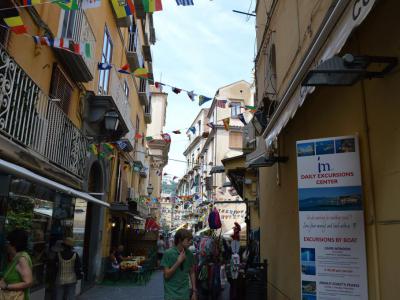
San Cesareo Street has always been a "main" street. In Roman times it was the central cross street of ancient Sorrento. It is a bit shorter than Italy Avenue. On Italy Avenue, the shops are sizeable and the street roomier. San Cesarea Street is often cramped with people and merchandise together.
Maybe it is the crowding or the lemon liqueur, but San Cesareo Street seems to be more entertaining than Italy Avenue. Ultimately San Cesareo Street merges into Fuoro Street, essentially a continuation of the same street.
San Cesareo Street is a short walk from Tasso Square. Find the Bar Ercolano on the square. To the right of the bar is the beginning of San Cesareo Street. Close by the street is the Inlaid Wood Work Museum (Museo Bottega della Tarsia Lignea), dedicated to the art of inlaid wood.
The Dominova Seat (Sedile Dominova), built in 1319, is an ancient meeting place where nobles would meet for discussions. Now it is a venue for card players. To the left of the Dominova Seat is the Addolorata Church, a Baroque-style church built in 1739. Sorrento Cathedral is on Italy Avenue, only a short distance away.
Since the old days of the Roman Empire, the street has remained essentially the same. It has always been a go-to street for shopping. Here one can stuff shopping bags with souvenirs, merchandise, novelties, curios, arts and crafts, and whatever else.
Maybe it is the crowding or the lemon liqueur, but San Cesareo Street seems to be more entertaining than Italy Avenue. Ultimately San Cesareo Street merges into Fuoro Street, essentially a continuation of the same street.
San Cesareo Street is a short walk from Tasso Square. Find the Bar Ercolano on the square. To the right of the bar is the beginning of San Cesareo Street. Close by the street is the Inlaid Wood Work Museum (Museo Bottega della Tarsia Lignea), dedicated to the art of inlaid wood.
The Dominova Seat (Sedile Dominova), built in 1319, is an ancient meeting place where nobles would meet for discussions. Now it is a venue for card players. To the left of the Dominova Seat is the Addolorata Church, a Baroque-style church built in 1739. Sorrento Cathedral is on Italy Avenue, only a short distance away.
Since the old days of the Roman Empire, the street has remained essentially the same. It has always been a go-to street for shopping. Here one can stuff shopping bags with souvenirs, merchandise, novelties, curios, arts and crafts, and whatever else.
13) Corso Italia (Italy Avenue) (must see)
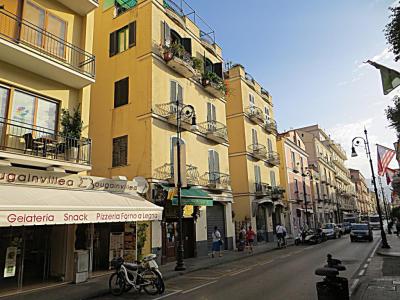
Italy Avenue is the main shopping street. It is busy with bars, restaurants, and shops. Most of the road is pedestrianized, and shoppers may enjoy their strolls without fear. The Tasso Square also is a Controlled Traffic Zone where the rights of motorists may suffer some abridgment.
Prices on the street are more moderate than those on the connecting side streets. Products include leather goods, hand-sewn tablecloths, olive oil, wines, groceries, novelties, and souvenirs. There is a wide variety of lemony things like candy, soaps, and Limoncello, a local liquor made from lemons.
The street is also known for its carved and inlaid wood products, like tables, music boxes, and boxes for jewelry. The shop, Primavera Gelateria Sorrento, should not be overlooked. They have dozens of flavors. Italy Avenue will lead to a view of the Big Marina, a colorful fishing village.
Prices on the street are more moderate than those on the connecting side streets. Products include leather goods, hand-sewn tablecloths, olive oil, wines, groceries, novelties, and souvenirs. There is a wide variety of lemony things like candy, soaps, and Limoncello, a local liquor made from lemons.
The street is also known for its carved and inlaid wood products, like tables, music boxes, and boxes for jewelry. The shop, Primavera Gelateria Sorrento, should not be overlooked. They have dozens of flavors. Italy Avenue will lead to a view of the Big Marina, a colorful fishing village.
