Custom Walk in Matera, Italy by xongas_447bb created on 2025-06-01
Guide Location: Italy » Matera
Guide Type: Custom Walk
# of Sights: 10
Tour Duration: 2 Hour(s)
Travel Distance: 3 Km or 1.9 Miles
Share Key: RGUHS
Guide Type: Custom Walk
# of Sights: 10
Tour Duration: 2 Hour(s)
Travel Distance: 3 Km or 1.9 Miles
Share Key: RGUHS
How It Works
Please retrieve this walk in the GPSmyCity app. Once done, the app will guide you from one tour stop to the next as if you had a personal tour guide. If you created the walk on this website or come to the page via a link, please follow the instructions below to retrieve the walk in the app.
Retrieve This Walk in App
Step 1. Download the app "GPSmyCity: Walks in 1K+ Cities" on Apple App Store or Google Play Store.



Step 2. In the GPSmyCity app, download(or launch) the guide "Matera Map and Walking Tours".
Step 3. Tap the menu button located at upper right corner of the "Walks" screen and select "Retrieve custom walk". Enter the share key: RGUHS
1) Convento di Sant'Agostino (Convent of Saint Augustine)
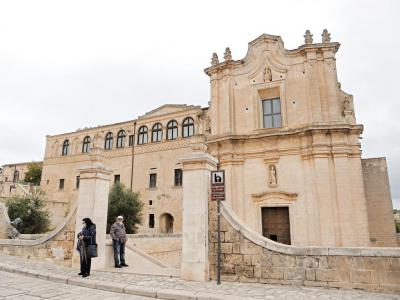
The Convent of Saint Augustine in Matera is a striking complex that combines religious devotion with architectural grandeur. Founded in the late 16th century by the Order of the Augustinian monks, it was built on the remains of an earlier medieval church dedicated to Saint Augustine. Its elevated position on the edge of the Sassi of Matera offers sweeping views over the ravine of the Gravina, making it both a spiritual retreat and a visual landmark in the city’s unique landscape. The convent and church together reflect the growing influence of religious orders in Matera during the Counter-Reformation, when monumental constructions were often used to inspire faith through art and architecture.
The church, completed in 1595, is notable for its Late Renaissance and early Baroque design, with a façade marked by pilasters, niches, and an elegant central portal. Inside, visitors will find a single nave adorned with altars, frescoes, and sculptures that highlight both local craftsmanship and broader Italian artistic traditions of the time. A particular treasure is the wooden statue of Saint Augustine, which continues to play a role in religious celebrations. Despite periods of decline, restorations in the 20th century have helped preserve the site, allowing today’s visitors to appreciate its historic character.
Exploring the convent and its church gives tourists a chance to connect with Matera’s religious heritage while enjoying one of the city’s most panoramic vantage points. From the terrace, the dramatic view across the canyon underscores why Matera is recognized as a UNESCO World Heritage Site. For travelers interested in history, architecture, and breathtaking scenery, the Convent of Saint Augustine is a rewarding stop that embodies both spiritual and cultural layers of the city.
The church, completed in 1595, is notable for its Late Renaissance and early Baroque design, with a façade marked by pilasters, niches, and an elegant central portal. Inside, visitors will find a single nave adorned with altars, frescoes, and sculptures that highlight both local craftsmanship and broader Italian artistic traditions of the time. A particular treasure is the wooden statue of Saint Augustine, which continues to play a role in religious celebrations. Despite periods of decline, restorations in the 20th century have helped preserve the site, allowing today’s visitors to appreciate its historic character.
Exploring the convent and its church gives tourists a chance to connect with Matera’s religious heritage while enjoying one of the city’s most panoramic vantage points. From the terrace, the dramatic view across the canyon underscores why Matera is recognized as a UNESCO World Heritage Site. For travelers interested in history, architecture, and breathtaking scenery, the Convent of Saint Augustine is a rewarding stop that embodies both spiritual and cultural layers of the city.

2) Rock Complex of Madonna of the Virtues and Saint Nicholas of the Greeks
The rupestrian churches of Matera are buildings carved into limestone rock. These structures were created in the early Middle Ages. The rock church Madonna of the Virtues (Madonna delle Virtu) was built circa 1000 AD. The adjoining monastery was the home of refugee nuns from Acre or Accon in the Middle East.
The church has a basilica plan of three naves divided by large columns. The columns support "donkey-back" vaults. The women's gallery has arches and columns in relief. The nave apses are semicircular. The vault forms a dome inscribed with a Greek cross in relief. The entrance is from a side nave; road construction in 1934 cut it in half.
The central apse has an 18th-century fresco of the Virgin and Saint John at the crucifixion. The right aisle holds a Gothic, 14th, or 15th-century crucifixion. There is a tuff quarry chamber in the middle of the right nave.
The penitent nuns of Saint Maria di Accon were brought to Matera's Madonna of the Virtues in 1198. They moved in the 13th century to the monastery of Santa Maria Foggiali, the San Giovanni Battista of today.
Above the church is the 10th-century monastery of Saint Nicholas of the Greeks (San Nicola Dei Greci). It is probably the oldest crypt in Matera. It has two naves and apses. The apsidal basin houses a 14th-century fresco of the crucifixion. In the left aisle is a 13th-century triptych of saints. Today, the church and the crypt of Saint Nicholas of the Greeks are used as art exhibition spaces.
The church has a basilica plan of three naves divided by large columns. The columns support "donkey-back" vaults. The women's gallery has arches and columns in relief. The nave apses are semicircular. The vault forms a dome inscribed with a Greek cross in relief. The entrance is from a side nave; road construction in 1934 cut it in half.
The central apse has an 18th-century fresco of the Virgin and Saint John at the crucifixion. The right aisle holds a Gothic, 14th, or 15th-century crucifixion. There is a tuff quarry chamber in the middle of the right nave.
The penitent nuns of Saint Maria di Accon were brought to Matera's Madonna of the Virtues in 1198. They moved in the 13th century to the monastery of Santa Maria Foggiali, the San Giovanni Battista of today.
Above the church is the 10th-century monastery of Saint Nicholas of the Greeks (San Nicola Dei Greci). It is probably the oldest crypt in Matera. It has two naves and apses. The apsidal basin houses a 14th-century fresco of the crucifixion. In the left aisle is a 13th-century triptych of saints. Today, the church and the crypt of Saint Nicholas of the Greeks are used as art exhibition spaces.
3) Sassi in Miniatura (Sassi in Miniature)
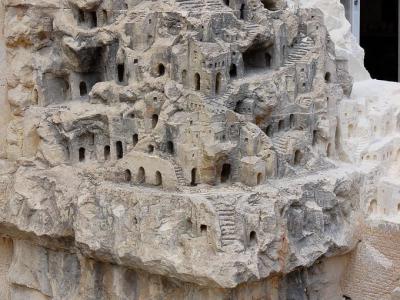
The Sassi in Miniatura in Matera feels like a city within a city-only this one fits inside a single room. On Fiorentini Street in the Sasso Barisano, not far from the Cathedral and Tramontano Castle, artisan Eustachio Rizzi set himself a challenge back in 1996: to carve Matera’s entire cave district into the very stone it was built from. Three years later, out came a 129-square-foot model, weighing 3,500 pounds, and packed with enough detail to make your eyes linger for minutes on a single corner.
Look closely, and the city shrinks before you: staircases zigzagging up hillsides, courtyards tucked between homes, mule paths winding their way past farmhouses, and even little churches glowing with lights. The sheer density of the real Sassi can overwhelm first-time visitors, but Rizzi’s miniature distills centuries of growth into one comprehensible view-a kind of stone-made map that shows how people, animals, and faith all shared the same carved landscape.
The workshop doubles as a gallery of smaller stone carvings and souvenirs, tying Matera’s geology to its cultural identity. But the big model is more than just orientation-it’s commentary. The Sassi, once abandoned and condemned as the “shame of Italy,” now stand as a UNESCO World Heritage Site, and Rizzi’s creation mirrors that turnaround. By chiseling the story of Matera into miniature, he gave visitors a way to understand not only the city’s structure but also its resilience.
Walking through the real Sassi after seeing the model feels different. You already carry in your head a compressed version of the maze, which makes each alley and staircase less confusing and more alive-like you’ve already walked the city once before, only in miniature.
Look closely, and the city shrinks before you: staircases zigzagging up hillsides, courtyards tucked between homes, mule paths winding their way past farmhouses, and even little churches glowing with lights. The sheer density of the real Sassi can overwhelm first-time visitors, but Rizzi’s miniature distills centuries of growth into one comprehensible view-a kind of stone-made map that shows how people, animals, and faith all shared the same carved landscape.
The workshop doubles as a gallery of smaller stone carvings and souvenirs, tying Matera’s geology to its cultural identity. But the big model is more than just orientation-it’s commentary. The Sassi, once abandoned and condemned as the “shame of Italy,” now stand as a UNESCO World Heritage Site, and Rizzi’s creation mirrors that turnaround. By chiseling the story of Matera into miniature, he gave visitors a way to understand not only the city’s structure but also its resilience.
Walking through the real Sassi after seeing the model feels different. You already carry in your head a compressed version of the maze, which makes each alley and staircase less confusing and more alive-like you’ve already walked the city once before, only in miniature.
4) Cattedrale di Matera (Matera Cathedral) (must see)
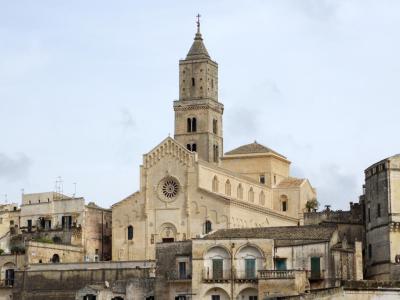
The Matera Cathedral crowns the city from the highest ridge between the Sassi districts, a position that has made it both a landmark and a watchful presence for nearly eight centuries. Work began around 1230, on the ruins of a Benedictine monastery, and by 1270 the new cathedral was ready-first dedicated to Saint Eustace, then later to the Dark-skinned Madonna, who became Matera’s most beloved protector. From the outside, the building still carries the clean lines of the 13th century, while the interior reveals a far more layered history of alteration and embellishment.
Look closely at the façade: a rose window with sixteen rays bursts out from the stone, framed above by Archangel Michael trampling a dragon. Below, an Atlas figure strains under the weight of the design, while a row of lemons-twelve in all-quietly symbolize the apostles. Lions, saints, and prophets guard the portal, while a 170-foot bell tower rises beside it, visible from every corner of the Sassi.
Step inside and the mood shifts. A Byzantine fresco of the Dark-skinned Madonna survives from the 13th century, while later centuries gilded the space with painted ceilings, elaborate plasterwork, and golden altars. The wooden choir stalls, Persio’s Nativity, and Santoro’s paintings all speak to Matera’s artistic lineage. The Chapel of the Annunciation, with its coffered ceiling and sculpted Virgin, completes the ensemble.
Neglect, earthquakes, and restorations have all left their trace, but since reopening in 2016 the cathedral has returned to its role as both parish church and symbol of civic pride. From its terrace, the view sweeps down over the Sassi, making the cathedral as much a vantage point on Matera’s history as it is a place of worship.
Look closely at the façade: a rose window with sixteen rays bursts out from the stone, framed above by Archangel Michael trampling a dragon. Below, an Atlas figure strains under the weight of the design, while a row of lemons-twelve in all-quietly symbolize the apostles. Lions, saints, and prophets guard the portal, while a 170-foot bell tower rises beside it, visible from every corner of the Sassi.
Step inside and the mood shifts. A Byzantine fresco of the Dark-skinned Madonna survives from the 13th century, while later centuries gilded the space with painted ceilings, elaborate plasterwork, and golden altars. The wooden choir stalls, Persio’s Nativity, and Santoro’s paintings all speak to Matera’s artistic lineage. The Chapel of the Annunciation, with its coffered ceiling and sculpted Virgin, completes the ensemble.
Neglect, earthquakes, and restorations have all left their trace, but since reopening in 2016 the cathedral has returned to its role as both parish church and symbol of civic pride. From its terrace, the view sweeps down over the Sassi, making the cathedral as much a vantage point on Matera’s history as it is a place of worship.
5) Casa Noha (Noha House) (must see)
Noha House doesn’t just stand quietly in Matera’s Civita district-it speaks. Built in the 15th century as the residence of the noble Noha family, it once anchored a patchwork of gardens and estates that even included their own bridge, linking their property to the Saint Paolo quarter. Unlike their peers, who chose more stable terrain, the Nohas built their home directly over an erosion channel. To shore it up, they recycled ruins as foundations, unintentionally unearthing traces of Bronze and Iron Age life, along with Greek, Roman, and medieval layers. In short, Noha House was perched above a cross-section of Matera’s entire past.
Architecturally, it mirrors the Sassi themselves-half-carved into the rock, half-built above ground. A courtyard framed by service rooms, an external staircase climbing toward the living quarters, and stone details give the house its distinctive form. For centuries it remained a private residence, until it was donated to the Italian Environmental Fund, an organization dedicated to preserving Italy’s heritage. Acquired in 2004, it was carefully restored and transformed from a family home into a cultural threshold for the city.
Step inside and you won’t find display cases or shelves of artifacts. Instead, the house itself becomes the stage for The Invisible Stones, a thirty-minute immersive presentation. Film, archival images, and narration flood the walls, guiding visitors through Matera’s story-from its earliest cave settlements to its medieval faith, from the abandonment and stigma of the 20th century to the UNESCO recognition and cultural revival that redefined its future.
Noha House now acts as both a preserved piece of Matera’s fabric and a lens through which the city is understood. By sitting in its cool stone rooms, visitors gain not only orientation but perspective: the journey of a city once dismissed as a national embarrassment, reborn as a European Capital of Culture, carved permanently into the rock of memory.
Architecturally, it mirrors the Sassi themselves-half-carved into the rock, half-built above ground. A courtyard framed by service rooms, an external staircase climbing toward the living quarters, and stone details give the house its distinctive form. For centuries it remained a private residence, until it was donated to the Italian Environmental Fund, an organization dedicated to preserving Italy’s heritage. Acquired in 2004, it was carefully restored and transformed from a family home into a cultural threshold for the city.
Step inside and you won’t find display cases or shelves of artifacts. Instead, the house itself becomes the stage for The Invisible Stones, a thirty-minute immersive presentation. Film, archival images, and narration flood the walls, guiding visitors through Matera’s story-from its earliest cave settlements to its medieval faith, from the abandonment and stigma of the 20th century to the UNESCO recognition and cultural revival that redefined its future.
Noha House now acts as both a preserved piece of Matera’s fabric and a lens through which the city is understood. By sitting in its cool stone rooms, visitors gain not only orientation but perspective: the journey of a city once dismissed as a national embarrassment, reborn as a European Capital of Culture, carved permanently into the rock of memory.

6) Chiesa di Santa Maria di Idris (Church of Saint Maria of Idris) (must see)
The Church of Saint Maria of Idris is a rupestrian church in Matera. It is carved into a limestone rock of Monterrone that dominates the Sasso Caveoso. The beautiful location offers a unique view of the city. The church can be reached via stairs to the rock Church of Santa Lucia alle Malve. "Idris" is derived from the Greek "Odigitria," "who shows the way."
A facade of masonry is next to a small bell tower. The interior nave is uneven. Some frescoes have been removed for restoration. Once restored, they are kept at the Superintendency for Historical and Artistic Heritage of Matera. On the altar is a 17th-century tempera rendering of the Madonna and Child.
Santa Maria de Idris is connected to the rock crypt of San Giovanni in Monterrone via a tunnel. The tomb holds several precious frescoes from the 12th to the 17th century. A fresco of John the Baptist is in the tunnel. In a lunette above the crypt is a 12th-century Christ Pantocrator. The title is Greek, meaning "All-Powerful."
After the corridor is a large hall, a nave of San Giovanni in Monterrone. On the wall of the presbytery is a 12th-century Madonna and Child, Glykophilousa style (Virgin of the Sweet Kiss). Other saints stand in decorated niches.
A facade of masonry is next to a small bell tower. The interior nave is uneven. Some frescoes have been removed for restoration. Once restored, they are kept at the Superintendency for Historical and Artistic Heritage of Matera. On the altar is a 17th-century tempera rendering of the Madonna and Child.
Santa Maria de Idris is connected to the rock crypt of San Giovanni in Monterrone via a tunnel. The tomb holds several precious frescoes from the 12th to the 17th century. A fresco of John the Baptist is in the tunnel. In a lunette above the crypt is a 12th-century Christ Pantocrator. The title is Greek, meaning "All-Powerful."
After the corridor is a large hall, a nave of San Giovanni in Monterrone. On the wall of the presbytery is a 12th-century Madonna and Child, Glykophilousa style (Virgin of the Sweet Kiss). Other saints stand in decorated niches.
7) Casa Grotta di Vico Solitario (Cave House of Lonely Alley) (must see)
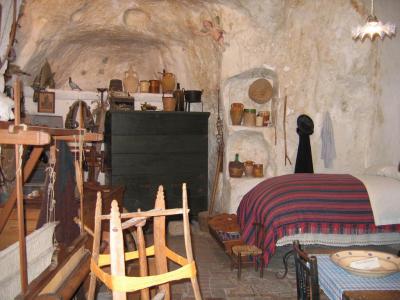
The Cave House of Lonely Alley pulls you straight into Matera’s past, before 1952, when the government declared the Sassi unfit for living and moved families out. While many of the old cave homes have since been polished into hotels and guesthouses, this one was left as it was-complete with tools, furniture, and the everyday traces of life carved into stone. It’s less a reconstruction than a freeze-frame, showing exactly how generations managed to live inside the rock.
The house itself is set in a natural hollow in the limestone, with additions made over the 18th century. Step through its wide archway and you enter a single chamber, where spaces were divided not by walls but by necessity. Light fell on the front rooms, so that’s where cooking, eating, and sleeping took place. A single table fed the family, a brazier provided heat, and a raised bed with a corn-stuffed mattress kept dampness at bay.
Move further in and the cave becomes more practical: a manger for the mule, a manure pit, and rough stables. Tools, pottery, and a loom remind us that work and domestic life were inseparable, while channels cut into the rock fed a cistern that captured every drop of precious rainwater.
When the Sassi were abandoned, the house-like many others-stood empty, part of what Italians called the “shame of Italy.” Today, it survives as a reminder of that era, complemented by nearby sites like the rock church of Saint Pietro Monterrone and a snow cave now showing old documentary footage.
The Cave House of Lonely Alley doesn’t romanticize the past-it lets you walk into it, stone walls and all, and see how people endured by turning bare rock into a home.
The house itself is set in a natural hollow in the limestone, with additions made over the 18th century. Step through its wide archway and you enter a single chamber, where spaces were divided not by walls but by necessity. Light fell on the front rooms, so that’s where cooking, eating, and sleeping took place. A single table fed the family, a brazier provided heat, and a raised bed with a corn-stuffed mattress kept dampness at bay.
Move further in and the cave becomes more practical: a manger for the mule, a manure pit, and rough stables. Tools, pottery, and a loom remind us that work and domestic life were inseparable, while channels cut into the rock fed a cistern that captured every drop of precious rainwater.
When the Sassi were abandoned, the house-like many others-stood empty, part of what Italians called the “shame of Italy.” Today, it survives as a reminder of that era, complemented by nearby sites like the rock church of Saint Pietro Monterrone and a snow cave now showing old documentary footage.
The Cave House of Lonely Alley doesn’t romanticize the past-it lets you walk into it, stone walls and all, and see how people endured by turning bare rock into a home.
8) Chiesa di Santa Lucia alle Malve (Church of Saint Lucia at Malve)
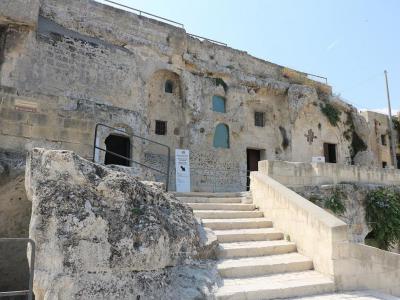
The Church of Santa Lucia alle Malve is a rock church near the Sasso Caveoso, annexed to a women's Benedictine monastery of the 11th century. The church was first dedicated to Saint Agatha and then to Saint Lucia between 1217 and 1267. The nuns moved in 1525 to the monastery of Santa Lucia alla Civita and later to Santa Lucia al Piano. The church became a residence.
Three sculptures of chalices, each from a different era, adorn the facade. They refer to the martyrdom of Saint Lucia. Frescoes, discovered in 1977, decorate the inner walls. The 12th-century pictures show Gabriel crushing a dragon, the Nursing Madonna, San Nicola, San Benedetto, Giovanna Battista, and others.
The church is easy to see compared to the monastic houses. In 1283 the community of nuns moved to the Civita, and the structures became private homes. The church is in two parts. The right aisle, restored and renovated, is open to the public. Mass is celebrated here on December 13, Saint Lucia's Day.
The second part encompasses the other aisles as private residences. The three naves are not symmetrical; they are formed more by stones shaped by nature than craft, similar to a lithotome. The crypt of the church has rich, vivid frescoes. Above the church is a necropolis of rock tombs.
Three sculptures of chalices, each from a different era, adorn the facade. They refer to the martyrdom of Saint Lucia. Frescoes, discovered in 1977, decorate the inner walls. The 12th-century pictures show Gabriel crushing a dragon, the Nursing Madonna, San Nicola, San Benedetto, Giovanna Battista, and others.
The church is easy to see compared to the monastic houses. In 1283 the community of nuns moved to the Civita, and the structures became private homes. The church is in two parts. The right aisle, restored and renovated, is open to the public. Mass is celebrated here on December 13, Saint Lucia's Day.
The second part encompasses the other aisles as private residences. The three naves are not symmetrical; they are formed more by stones shaped by nature than craft, similar to a lithotome. The crypt of the church has rich, vivid frescoes. Above the church is a necropolis of rock tombs.

9) Convicinio di Sant'Antonio (St. Anthony Conviction Church Complex)
Saint Anthony Conviction is a complex of four rock churches and a courtyard. It is located in the Casalnuovo district, an old working area of Matera. It is possible to find more than a few 17th-century cellars showing signs of activity. There are caves adapted to wine storage, millstones, and work surfaces.
The four churches are from the 12th and 13th centuries. An ogival arch opens to the courtyard overlooked by the rock churches of San Primo, Sant Eligo, San Donato, and Sant Antonio Abate. Around the end of the 18th century, they lost their status as churches and were adapted to the work systems of the area.
The first church after going through the arch is San Primo. It consists of two small chapels. There is a passage to the crypt of Sant Eligo. Here is a hall and a presbytery for the worshippers and celebrants. Three apses at the rear of the hall have walls with traces of frescoes dating from the 14th century.
The crypt of San Donato has a square plan layout. The vaults, adorned with fading decorations, add to the liturgical spaces of the faithful and the presbytery. Next to the entrance is a cistern used to collect rainwater. The face of San Donato in a miter can be seen in the remains of a fresco. Also discernible is a Madonna and Child.
The last church is a chapel room dedicated to Sant Antonio Abate. The space is divided into three apsidal naves. The apse caps have sculpted lily crosses.
Editor's Note: The sight is under renovations and temporarily closed.
The four churches are from the 12th and 13th centuries. An ogival arch opens to the courtyard overlooked by the rock churches of San Primo, Sant Eligo, San Donato, and Sant Antonio Abate. Around the end of the 18th century, they lost their status as churches and were adapted to the work systems of the area.
The first church after going through the arch is San Primo. It consists of two small chapels. There is a passage to the crypt of Sant Eligo. Here is a hall and a presbytery for the worshippers and celebrants. Three apses at the rear of the hall have walls with traces of frescoes dating from the 14th century.
The crypt of San Donato has a square plan layout. The vaults, adorned with fading decorations, add to the liturgical spaces of the faithful and the presbytery. Next to the entrance is a cistern used to collect rainwater. The face of San Donato in a miter can be seen in the remains of a fresco. Also discernible is a Madonna and Child.
The last church is a chapel room dedicated to Sant Antonio Abate. The space is divided into three apsidal naves. The apse caps have sculpted lily crosses.
Editor's Note: The sight is under renovations and temporarily closed.
10) Palombaro Lungo (Palombaro Lungo Cistern) (must see)
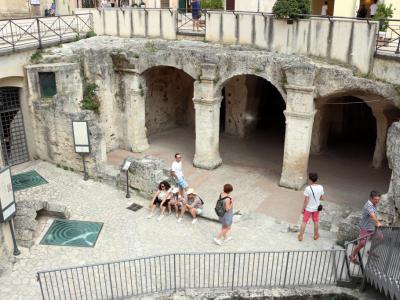
Beneath Matera’s Vittorio Veneto Square lies the Palombaro Lungo, a cistern of such scale and ambition that locals began calling it a water cathedral. The project began in the 16th century, when natural caves were stitched together to form part of the city’s water network, though the final push to complete it only came in 1832. By then, the underground chamber stretched long and deep, able to hold nearly five million liters of water collected from rainfall and nearby springs-an immense reservoir for a town where rivers were scarce and every drop mattered. Expansion continued into the 1880s, ensuring that Matera’s residents had a steady supply long before modern pipelines arrived.
The very name tells its story. Some link Palombaro to the Latin for a bird of prey diving toward its target, others to plumbarius, a term for water collectors, while Lungo simply nods to its enormous size. Step inside and the atmosphere justifies the reputation: arches and stone columns rise like the supports of a great basilica, their reflections dancing in the still water below. For generations, this hidden structure fed the square’s fountain above and supplied Matera’s households, until the Apulian Aqueduct, completed in 1920, finally made it redundant.
For decades, the cistern sat sealed and forgotten until 1991, when students climbed in with a dinghy and revealed what lay below. Their discovery, followed by careful restoration, offered the city not just a reclaimed monument but proof of its historic ingenuity-evidence that helped Matera secure its UNESCO World Heritage designation.
Today, raised walkways guide visitors across this immense chamber. With dim lighting, mirrored waters, and soaring vaults, the Palombaro Lungo feels both monumental and intimate-a reminder that Matera’s survival was literally carved out of stone.
The very name tells its story. Some link Palombaro to the Latin for a bird of prey diving toward its target, others to plumbarius, a term for water collectors, while Lungo simply nods to its enormous size. Step inside and the atmosphere justifies the reputation: arches and stone columns rise like the supports of a great basilica, their reflections dancing in the still water below. For generations, this hidden structure fed the square’s fountain above and supplied Matera’s households, until the Apulian Aqueduct, completed in 1920, finally made it redundant.
For decades, the cistern sat sealed and forgotten until 1991, when students climbed in with a dinghy and revealed what lay below. Their discovery, followed by careful restoration, offered the city not just a reclaimed monument but proof of its historic ingenuity-evidence that helped Matera secure its UNESCO World Heritage designation.
Today, raised walkways guide visitors across this immense chamber. With dim lighting, mirrored waters, and soaring vaults, the Palombaro Lungo feels both monumental and intimate-a reminder that Matera’s survival was literally carved out of stone.
