Custom Walk in Willemstad, Curacao by cmwygant_a7389 created on 2025-06-03
Guide Location: Curacao » Willemstad
Guide Type: Custom Walk
# of Sights: 6
Tour Duration: 1 Hour(s)
Travel Distance: 2.7 Km or 1.7 Miles
Share Key: 5662H
Guide Type: Custom Walk
# of Sights: 6
Tour Duration: 1 Hour(s)
Travel Distance: 2.7 Km or 1.7 Miles
Share Key: 5662H
How It Works
Please retrieve this walk in the GPSmyCity app. Once done, the app will guide you from one tour stop to the next as if you had a personal tour guide. If you created the walk on this website or come to the page via a link, please follow the instructions below to retrieve the walk in the app.
Retrieve This Walk in App
Step 1. Download the app "GPSmyCity: Walks in 1K+ Cities" on Apple App Store or Google Play Store.



Step 2. In the GPSmyCity app, download(or launch) the guide "Willemstad Map and Walking Tours".
Step 3. Tap the menu button located at upper right corner of the "Walks" screen and select "Retrieve custom walk". Enter the share key: 5662H
1) Curaçao Cruise Port
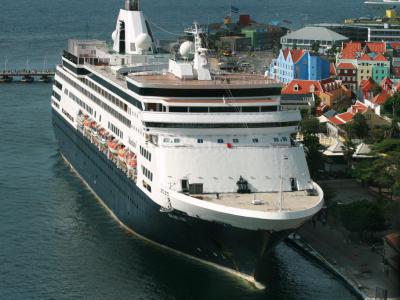
The Willemstad Cruise Port stands as a pivotal gateway to the captivating island of Curaçao. Serving as the primary and largest port on the island, the Port of Willemstad boasts a comprehensive array of maritime facilities catering to vessels of various types and sizes.
At the heart of this maritime hub is the entrance channel, Saint Anna Bay. Cruise ships and diverse vessels gracefully navigate through this channel, finding their docking points at the Megapier Cruise Terminal, situated at the entrance of the bay. Additionally, cruise terminals on the Otrobanda side of the bay provide additional berthing options for visiting vessels.
The Curaçao Cruise Port offers state-of-the-art facilities and services designed to accommodate cruise ships of varying sizes. Beyond its maritime functions, the port area is equipped with a modern shopping center, enticing restaurants, and entertainment options that cater to the diverse needs and preferences of cruise passengers.
One of the distinctive features of the Curaçao Cruise Port is its accessibility to the island's treasures. Passengers can easily explore Curaçao's pristine beaches, iconic sights, and landmarks. To enhance their experience, visitors have the option to book shore excursions, take a taxi, or rent a car, allowing them to traverse the island at their own pace.
Downtown Willemstad, a UNESCO World Heritage Site known for its colorful architecture and rich history, is conveniently within walking distance from the various piers.
At the heart of this maritime hub is the entrance channel, Saint Anna Bay. Cruise ships and diverse vessels gracefully navigate through this channel, finding their docking points at the Megapier Cruise Terminal, situated at the entrance of the bay. Additionally, cruise terminals on the Otrobanda side of the bay provide additional berthing options for visiting vessels.
The Curaçao Cruise Port offers state-of-the-art facilities and services designed to accommodate cruise ships of varying sizes. Beyond its maritime functions, the port area is equipped with a modern shopping center, enticing restaurants, and entertainment options that cater to the diverse needs and preferences of cruise passengers.
One of the distinctive features of the Curaçao Cruise Port is its accessibility to the island's treasures. Passengers can easily explore Curaçao's pristine beaches, iconic sights, and landmarks. To enhance their experience, visitors have the option to book shore excursions, take a taxi, or rent a car, allowing them to traverse the island at their own pace.
Downtown Willemstad, a UNESCO World Heritage Site known for its colorful architecture and rich history, is conveniently within walking distance from the various piers.
2) Fort Amsterdam
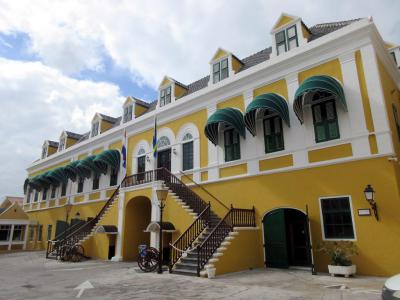
Fort Amsterdam, affectionately known as "Forti," stands proudly as the seat of government for the country of Curacao, gracing the Punda district with its historical significance and commanding presence. Positioned strategically on a headland southeast of Sint Anna Bay, at the entrance to the harbor, this imposing fort holds the distinction of being the largest among the eight forts scattered across the island.
Constructed between 1635 and 1636 by the Dutch West India Company under the leadership of Admiral Johan van Walbeek, Fort Amsterdam was a formidable defense against potential threats, particularly from Spanish troops. Its robust walls, made of coral stone and boasting thicknesses of up to three meters in certain sections, were a testament to the strategic importance of the fortress in safeguarding the island.
The fort's historical narrative extends beyond its military role. Before October 2010, Fort Amsterdam served as the seat of the government of the Netherlands Antilles. Today, it continues to be the focal point for the government of Curacao. Within the walls of this UNESCO World Heritage-listed structure, visitors can explore the oldest church in Curacao, dating back to 1769, and the governor's residence.
Featuring four bastions that contribute to its distinctive shape, Fort Amsterdam stands as a living testament to the island's past. As you traverse the fort's grounds, you'll encounter memorial stones, including one adorned with the image of Prince William of Orange, symbolizing Curacao's affiliation with the Netherlands for three centuries.
Constructed between 1635 and 1636 by the Dutch West India Company under the leadership of Admiral Johan van Walbeek, Fort Amsterdam was a formidable defense against potential threats, particularly from Spanish troops. Its robust walls, made of coral stone and boasting thicknesses of up to three meters in certain sections, were a testament to the strategic importance of the fortress in safeguarding the island.
The fort's historical narrative extends beyond its military role. Before October 2010, Fort Amsterdam served as the seat of the government of the Netherlands Antilles. Today, it continues to be the focal point for the government of Curacao. Within the walls of this UNESCO World Heritage-listed structure, visitors can explore the oldest church in Curacao, dating back to 1769, and the governor's residence.
Featuring four bastions that contribute to its distinctive shape, Fort Amsterdam stands as a living testament to the island's past. As you traverse the fort's grounds, you'll encounter memorial stones, including one adorned with the image of Prince William of Orange, symbolizing Curacao's affiliation with the Netherlands for three centuries.
3) Queen Wilhelmina Park
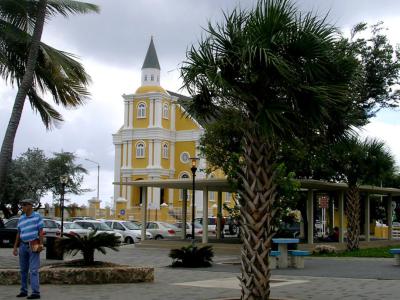
Queen Wilhelmina Park honors Queen Wilhelmina Helena Pauline Marie, the longest-reigning Dutch monarch, who ruled from 1890 to 1948. Located in a central part of the city, the park provides a peaceful and well-maintained space for both locals and visitors. Its terraced bandstand and central fountain create a relaxed atmosphere, while the nearby Fort Amsterdam church clock tower adds a touch of historical context to the surroundings.
The park’s main feature is a ‘W’-shaped memorial dedicated to Queen Wilhelmina. This monument recognizes her influence and long reign, marking her as an important figure in Dutch history and a symbol of the island’s connection to the Netherlands. The park’s design and layout encourage visitors to stroll, sit, and enjoy the surroundings while learning about its historical significance.
During the summer months, Queen Wilhelmina Park comes alive with cultural activities. Concerts, music performances, and street acts are common, offering entertainment for all ages. The park also hosts food events and tasting fairs, giving visitors a chance to explore local cuisine in an outdoor setting. These seasonal events create a lively atmosphere, making the park a popular spot for social gatherings and community engagement.
Queen Wilhelmina Park combines history, culture, and leisure in one accessible location. It offers a place to relax, appreciate the city’s heritage, and enjoy seasonal events, making it a pleasant stop for those exploring the area.
The park’s main feature is a ‘W’-shaped memorial dedicated to Queen Wilhelmina. This monument recognizes her influence and long reign, marking her as an important figure in Dutch history and a symbol of the island’s connection to the Netherlands. The park’s design and layout encourage visitors to stroll, sit, and enjoy the surroundings while learning about its historical significance.
During the summer months, Queen Wilhelmina Park comes alive with cultural activities. Concerts, music performances, and street acts are common, offering entertainment for all ages. The park also hosts food events and tasting fairs, giving visitors a chance to explore local cuisine in an outdoor setting. These seasonal events create a lively atmosphere, making the park a popular spot for social gatherings and community engagement.
Queen Wilhelmina Park combines history, culture, and leisure in one accessible location. It offers a place to relax, appreciate the city’s heritage, and enjoy seasonal events, making it a pleasant stop for those exploring the area.
4) Mikve Israel-Emanuel Synagogue
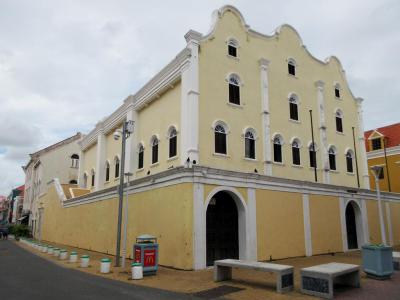
The Mikvé Israel-Emanuel Synagogue highlights the long and influential history of the Jewish community in Curaçao, which traces its roots back to Spanish and Portuguese Jews who settled in the region in the 1500s. Consecrated in 1732, it is recognized as the oldest synagogue in continuous use in the Americas, reflecting centuries of tradition and community life.
Its design pays tribute to the congregation’s Portuguese heritage. The interior was modeled after the well-known Portuguese Synagogue in Amsterdam, featuring classic architectural elements that help visitors understand the cultural connections between the Caribbean and Europe.
Next to the synagogue, the Jewish Cultural Historical Museum offers a deeper look into the island’s Jewish history. At the entrance, a timeline links key moments in Curaçao’s Jewish community with major world events, giving visitors helpful context about how this community developed and adapted over time.
Inside, the museum displays a wide collection of artifacts, photographs, and documents that illustrate everyday life, religious traditions, and the community’s role in Curaçao’s history. Many of the items—more than 1,000 in total—are centuries old, and some are still used in the synagogue today. Together, the synagogue and the museum provide a meaningful look at a community that has played an important part in shaping the island’s identity.
Its design pays tribute to the congregation’s Portuguese heritage. The interior was modeled after the well-known Portuguese Synagogue in Amsterdam, featuring classic architectural elements that help visitors understand the cultural connections between the Caribbean and Europe.
Next to the synagogue, the Jewish Cultural Historical Museum offers a deeper look into the island’s Jewish history. At the entrance, a timeline links key moments in Curaçao’s Jewish community with major world events, giving visitors helpful context about how this community developed and adapted over time.
Inside, the museum displays a wide collection of artifacts, photographs, and documents that illustrate everyday life, religious traditions, and the community’s role in Curaçao’s history. Many of the items—more than 1,000 in total—are centuries old, and some are still used in the synagogue today. Together, the synagogue and the museum provide a meaningful look at a community that has played an important part in shaping the island’s identity.
5) Handelskade (Merchant's Quay) (must see)
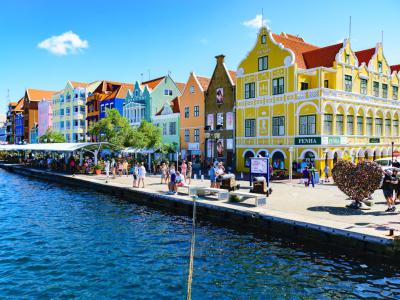
The Merchant’s Quay is a notable waterfront strip in Punda, positioned along the edge of Saint Anna Bay. This historic area is recognized for its row of well-preserved 18th-century buildings, which reflect Curaçao’s Dutch architectural heritage. The layout is often compared to Dutch canal districts, but Merchant’s Quay carries its own character thanks to the brightly colored facades that have become a defining feature of the waterfront.
The use of bold exterior colors has roots in Curaçao’s colonial past. According to local accounts, one of the island’s early Dutch governors instructed residents to avoid painting buildings white. At the time, it was believed that the strong reflection of the sun off white walls caused discomfort for the eyes. This practical decision gradually shaped the visual identity of the quay and contributed to the range of blues, yellows, pinks, and greens that now distinguish the area. Today, this tradition continues and remains an important part of the island’s cultural expression.
Visitors can experience the setting by sitting at one of the outdoor cafés positioned along the water. From these spots, guests have a clear view of daily activity on the bay, including the movement of the Queen Emma Bridge as it opens to allow ships to pass. The quay is also home to several small shops and businesses, giving visitors plenty of opportunities to explore local products and enjoy the steady pace of the harbor.
As evening approaches, the colors of the quay become more pronounced in the shifting light, creating a calm and appealing atmosphere along the waterfront. The combination of heritage architecture, active harbor life, and accessible public spaces makes Merchant’s Quay a meaningful part of the Punda district and a place where both residents and visitors spend time enjoying the surroundings.
The use of bold exterior colors has roots in Curaçao’s colonial past. According to local accounts, one of the island’s early Dutch governors instructed residents to avoid painting buildings white. At the time, it was believed that the strong reflection of the sun off white walls caused discomfort for the eyes. This practical decision gradually shaped the visual identity of the quay and contributed to the range of blues, yellows, pinks, and greens that now distinguish the area. Today, this tradition continues and remains an important part of the island’s cultural expression.
Visitors can experience the setting by sitting at one of the outdoor cafés positioned along the water. From these spots, guests have a clear view of daily activity on the bay, including the movement of the Queen Emma Bridge as it opens to allow ships to pass. The quay is also home to several small shops and businesses, giving visitors plenty of opportunities to explore local products and enjoy the steady pace of the harbor.
As evening approaches, the colors of the quay become more pronounced in the shifting light, creating a calm and appealing atmosphere along the waterfront. The combination of heritage architecture, active harbor life, and accessible public spaces makes Merchant’s Quay a meaningful part of the Punda district and a place where both residents and visitors spend time enjoying the surroundings.
6) Queen Emma Bridge (must see)
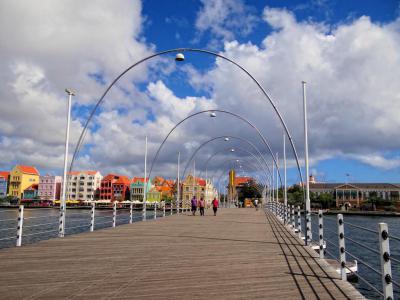
The Queen Emma Bridge is one of Curaçao’s most distinctive structures, spanning Saint Anna Bay and linking the districts of Punda and Otrobanda. This floating pontoon bridge serves both as an important pedestrian route and as a historical engineering feature that reflects the island’s development over more than a century.
Completed in 1888, the bridge was named in honor of Queen Emma of Waldeck and Pyrmont, who was queen consort of the Netherlands at the time. Since its construction, it has undergone multiple renovations to maintain reliable operation and respond to the changing needs of the harbor.
The design of the Queen Emma Bridge sets it apart from conventional bridges. Supported by a series of pontoons, it is able to swing open to make room for oceangoing vessels entering or leaving the harbor. A hinge on the Punda side allows the bridge to pivot horizontally, while an operator stationed at the opposite end manages the movement. Two diesel engines power propellers positioned perpendicular to the bridge’s length, guiding the structure as it swings parallel to the shoreline. This opening process typically takes only a few minutes and has become a routine and practical aspect of daily life in the city.
An important upgrade took place in 1955 with the installation of lighting arches, added to mark the visit of Queen Juliana and Prince Bernhard. These lights enhanced visibility and gave the bridge a stronger presence during evening hours, reinforcing its status as both a transportation link and a cultural landmark for residents and visitors.
Completed in 1888, the bridge was named in honor of Queen Emma of Waldeck and Pyrmont, who was queen consort of the Netherlands at the time. Since its construction, it has undergone multiple renovations to maintain reliable operation and respond to the changing needs of the harbor.
The design of the Queen Emma Bridge sets it apart from conventional bridges. Supported by a series of pontoons, it is able to swing open to make room for oceangoing vessels entering or leaving the harbor. A hinge on the Punda side allows the bridge to pivot horizontally, while an operator stationed at the opposite end manages the movement. Two diesel engines power propellers positioned perpendicular to the bridge’s length, guiding the structure as it swings parallel to the shoreline. This opening process typically takes only a few minutes and has become a routine and practical aspect of daily life in the city.
An important upgrade took place in 1955 with the installation of lighting arches, added to mark the visit of Queen Juliana and Prince Bernhard. These lights enhanced visibility and gave the bridge a stronger presence during evening hours, reinforcing its status as both a transportation link and a cultural landmark for residents and visitors.
